Don’t ever tell anybody anything

Jd-salinger_51909385

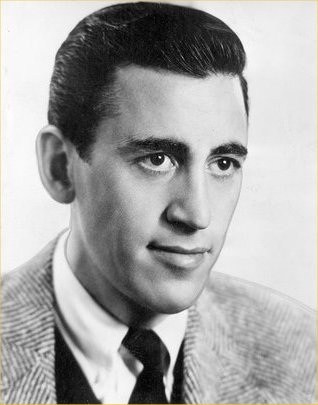
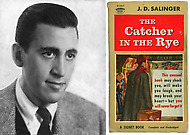
“Don’t ever tell anybody anything,” J.D. Salinger wrote in the closing lines of “The Catcher in the Rye.” “If you do, you start missing everybody.” For more than two decades now, I’ve thought about that ending as a piece of code. Not that Salinger, who died Wednesday at age 91 in Cornish, N.H., was an oracle, despite what his most dedicated followers — those who hung around his driveway, hoping for a glimpse of the reclusive author, or parsed his sentences on a million websites — might believe. But Salinger was a writer who refracted his perspective into language, producing work that was personal and profound. Between 1951 and 1965, he produced four uncommonly sensitive books of fiction — “Catcher,” “Nine Stories,” “Franny and Zooey” and “Raise High the Roof Beam, Carpenters” — before retreating to his home in Cornish and refusing to publish any more.

more from David L. Ulin at the LA Times here.

the way we learn

ArticleInline

In the four rigorously reasonable essays in “The Marketplace of Ideas,” Louis Menand takes up four questions about American higher education: “Why is it so hard to institute a general education curriculum? Why did the humanities disciplines undergo a crisis of legitimation? Why has ‘interdisciplinarity’ become a magic word? And why do professors all tend to have the same politics?” Menand, a professor of English at Harvard and a staff writer for The New Yorker, offers answers notable in part for what they don’t contain: namely, the complaint that it’s all been downhill since 1970 because of feminism, multiculturalism, postmodernism, deconstruction and queer theory. Yes, humanities enrollments have declined since 1970, as have enrollments in the social and natural sciences. But as Menand points out, that’s partly because departments of business administration and computer science have drawn students away from all fields in the liberal arts and sciences and partly because the decades following World War II were anomalous in the history of American higher education — a “Golden Age” of tremendous expansion, when the number of undergraduates increased fivefold and the number of graduate students ninefold. To assess the American university by starting from 1970 is to take the high-­water mark as if it were the mean.

more from Michael Bérubé at the NYT here.

Saturday Poem

Ae Fond Kiss

Ae fond kiss, and then we sever;

Ae fareweel, and then forever!

Deep in heart-wrung tears I'll pledge thee,

Warring sighs and groans I'll wage thee.

Who shall say that Fortune grieves him,

While the star of hope she leaves him?

Me, nae cheerfu' twinkle lights me;

Dark despair around benights me.

I'll ne'er blame my partial fancy,

Naething could resist my Nancy;

But to see her was to love her;

Love but her, and love forever.

Had we never lov'd sae kindly,

Had we never lov'd sae blindly,

Never met—or never parted—

We had ne'er been broken-hearted.

Fare thee weel, thou first and fairest!

Fare thee weel, thou best and dearest!

Thine be ilka joy and treasure,

Peace. enjoyment, love, and pleasure!

Ae fond kiss, and then we sever;

Ae fareweel, alas, forever!

Deep in heart-wrung tears I'll pledge thee,

Warring sighs and groans I'll wage thee!

by Robert Burns

Don’t Objectify Him: Tino Sehgal at the Guggenheim

From Culture.wnyc.org

Tino Walk into the Guggenheim between now and March 10th and you will find it empty. There are no paintings on the walls, no sculptures in the rotunda or multimedia installations that require dim lights and headphones. What you will find instead are people – several dozen of them scattered along the bare, spiraling ramp of the museum – ready to engage in chatty, cerebral dialogue about what we, the viewer, consider progress – among myriad other topics. Welcome to “This is Progress,” a work by Tino Sehgal, a London-born conceptual artist who produces only ephemeral performances that he refers to as “situations.” Insert Jersey Shore joke here. Sehgal allows no documentation of his work (no photos, video, or audio), nor does he allow the creation of any objects related to it. There is no wall text, no certificates, no hernia-inducing catalogues loaded with artspeak. In fact, when I showed up for the press preview, there was no speechifying by curators and no press releases (all museum shows should be this awesome) – just the experience of walking into an empty museum wondering what exactly I was in for.

Accompanying me was Susanna Heller, a Brooklyn-based painter – and, coincidentally, a Guggenheim Fellow – who responded to a call by WNYC to be part of this highly unusual experience. (Since the only existing record of Sehgal’s work are the people who experience it, we thought it’d be prudent to take back-up.) So what did we see and do? As we ascended the ramp, we were greeted by a young girl (about 8, missing front teeth, seriously cute), who asked us to follow her. Soon, she was peppering us with all manner of grown-up questions: What is progress? What does progress mean to us? Could we provide examples to support our answers? As we spoke, we strolled slowly up the ramp and were deposited in the hands of a young man in his late teens, where we continued the discussion on somewhat more adult terms. As we continued up the ramp, we were relayed to another performer and another. On some occasions, the questions we were asked were in keeping with the theme of progress; in others, they came completely out of left field. We discussed painting, man's relationship to nature and tried to understand why humans venerate the objects they do. Trying to recount all the details here is like trying to reconstruct a particularly intense dinner party conversation: It was fascinating while it happened, but on the retelling can seem trite and pretentious.

By the time we reached the top of the museum’s ramp, we’d had some pretty intense dialogues – with complete strangers – about ideas, society and ourselves. I didn’t want it to end. Neither did Susanna. In fact, as soon as we finished, we went right back down and did it again and had a completely different set of equally intriguing discussions.

More here. (Note: Thanks to Asad Raza, Producer of the show)

The Night Belongs to Us

From The New York Times:

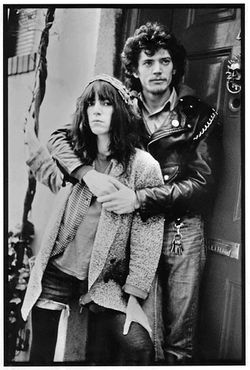
The downtown rocker Patti Smith’s memoir of her early career and her relationship with Robert Mapplethorpe is a spellbinding, diverting portrait of funky-but-chic New York in the late ’60s and early ’70s.Patti

Apart from a certain shared apprehension of immortality — complacent in one case, but endearingly gingerly in the other — the skinny 28-year-old on the cover of Patti Smith’s seismic 1975 album, “Horses,” doesn’t look much at all like Picasso’s portrait of Gertrude Stein. But because the shutterbug was Robert Mapplethorpe, who was soon to become fairly legendary himself, that exquisite photograph of Smith on the brink of fame is as close as New York’s 1970s avant-garde ever came to a comparable twofer. The mythmaking bonus is that the latter-day duo were much more genuinely kindred spirits.

Born weeks apart in 1946, Smith and Mapple­thorpe played Mutt and Jeff from their first meeting in 1967 through his death from AIDS more than 20 years later. They were lovers as well until he came out of the closet with more anguish than anyone familiar with his bold later career as gay sexuality’s answer to Mathew Brady (and Jesse Helms’s N.E.A. nemesis) is likely to find credible. Yet his Catholic upbringing had been conservative enough that he and Smith had to fake being married for his parents’ sake during their liaison.

More here.

A Short History of Hydrogen Sulfide: From the sewers of Paris to physiological messenger

Roger P. Smith in American Scientist:

ScreenHunter_04 Jan. 30 11.39 Early last year, reports began to emerge in the Southeastern United States of a strange illness. Homeowners reported nosebleeds, sinus irritation and respiratory problems that appeared to be associated with corrosion of copper pipes and air conditioner coils in their houses.

The culprit seems to be drywall imported from China and possibly contaminated with strontium sulfide, an unstable salt that releases hydrogen sulfide on exposure to moisture. It was used widely in the housing boom of 2004–2007, and in the rebuilding efforts after Hurricane Katrina in 2005, when domestic suppliers could not keep up with the demand. The Consumer Products Safety Commission is now investigating whether sulfide gases given off by the drywall, including hydrogen sulfide, are to blame. The Florida Department of Health maintains a Web site with information for consumers. Lawsuits abound, and many who are able to do so have moved out of their homes. Several estimates place the number of affected houses at 100,000.

To those experiencing or investigating this phenomenon early on, it seemed bizarre. But in fact, this is just the latest chapter in the history of a chemical whose effects were first noted in the 16th century. And there is still more to learn about its role in the human body. Recent research offers insights into its biochemical actions as well as some intriguing suggestions for medical uses.

In 1713, a remarkable Italian physician named Bernardino Ramazzini published De Morbis Artificum, or Diseases of Workers. In Chapter 14, titled “Diseases of Cleaners of Privies and Cesspits,” he describes a painful inflammation of the eyes which was common among such workers. The inflammation often led to secondary bacterial invasion, and sometimes to total blindness. Displaying amazing insight, Ramazzini hypothesized that when the cleaners disturbed the excrement in the course of their work, an unknown volatile acid was produced, which was irritating to the eyes. It was also at least partially responsible for the odor of excrement, and it is now known to be generated wherever organic matter undergoes putrefaction.

Ramazzini further postulated that that same acid was causing copper and silver coins which the workers had in their pockets to turn black on their surfaces—an eerie resonance with the phenomena recently observed by U.S. homeowners.

More here.

The Froth of Khan

Nadeem F. Paracha in Dawn:

Imran Khan What can one say about Imran Khan? A great former cricketer, a compassionate philanthropist … a sorry excuse for a politician. But his continuing forays into bad politics and tactical blunders can be excused, for he is yet to understand that politics is not a game of cricket, and that the democratic election process does not follow the selection policy he enforced as the captain of the Pakistan cricket squad.

The truth is, Khan’s penchant for picking up talented players seemed to have gone haywire when he decided to pick his early political mentors.

Coming from a highly educated, cultivated, and somewhat liberal background, Khan had slipped into reverse gear by the time he decided to enter politics in the early 1990s. In other words, instead of looking forward to becoming an integral part of a new, democratic, and General Zia-less Pakistan, Khan struck an ideological partnership with shadowy characters who were hell-bent on keeping the country stuck in the 1980s – a decade when Pakistan pulled and damaged all of its important political, economic and social muscles under the stressful weight of a myopic dictatorship and the damaging jihad that a dictatorship sponsored in Afghanistan.

By the time Khan officially entered politics sometime in late 1995, it wasn’t his pristine education at Oxford University, or a more insightful understanding of Pakistan’s political history, that was informing his political make-up. On the contrary, his ideology was weaved from the usual reactionary claptrap one expects from former ISI men, especially those who got emotionally involved in Pakistan’s counterproductive Afghan jihad project.

More here.

Mencken, Islam, and Political Correctness

Edward Cline in Capitalism Magazine:

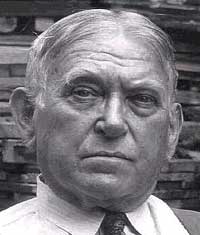
HLMencken Two months after the John Scopes monkey trial of July 1925, H.L. Mencken, writing for the Baltimore Evening Sun, took to task two prominent publications, the New York World and the New Republic, for castigating Clarence Darrow, chief defense counsel of Scopes, over his conduct during the trial. The World was infuriated by Darrows brutal cross-examination of William Jennings Bryan, the states star counsel against Scopes, an experience which humiliated Bryan and is thought to have contributed to his death later that same month. The New Republic objected to Darrow having made the issue of evolution vs. the Bible a national, rather than merely a local one, even though the trial was broadcast on radio.

What drew Mencken's ire was the Worlds position that one's religious beliefs, should be respected and not subjected to criticism or satire.

Once more I find myself unable to follow the best Liberal thought. What the Worlds contention amounts to, at bottom, is simply the doctrine that a man engaged in combat with superstition should be very polite to superstition. This, I fear, is nonsense. The way to deal with superstition is not to be polite to it, but to tackle it with all arms, and so rout it, cripple it, and make it forever infamous and ridiculous. Is it, perchance, cherished by persons who should know better? Then their folly should be brought out into the light of day, and exhibited there in all its hideousness until they flee from it, hiding their heads in shame.True enough, even a superstitious man has certain inalienable rights. He has a right to harbor and indulge his imbecilities as long as he pleases, provided only he does not try to inflict them upon other men by force.

More here. [Thanks to Markella Hatziano.]

Friday, January 29, 2010

In Memory of Howard Zinn, an American and a Jew

Rsz_howardzinnMichael Furman in Jewcy:

A close friend called me today and notified me of Howard Zinn's death. After a half hour of the requisite investigatory quest through the digital abyss, the news seemed to coalesce in my mind with the myriad headlines of the day. The modern information onslaught indeed seems malleable to me, over time becoming little more than a monstrosity of factoids. How the whole has become less than the sum of its parts.

Over tea and thought, however, my knowledge of the good professor's passing became quite real, substantive, and sobering. After all, Zinn remains among my biggest inspirations.

As a student of history, he shattered the myth of objectivity with a forceful blow, displaying in a massive tome the hollow nature of facts; it is instead our perspectives, our manipulations, and our conclusions that smack of bias and are deeply flawed. While we all know the adage that ‘history books are written by the winners,' Zinn overwhelmed us with the sheer tragedy of this mantra, and exposed the ugly underbelly of our collective memory.

As an American, he upheld the virtues of the Declaration of Independence, even if he admonished its author.

The Emergence of the Indian Public Sphere

IndianPubSphereNalini Rajan in The Hindu:

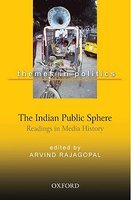
As citizens of a nation in the making, Indian scholars have been deeply interested in the writings of Benedict Anderson and Jurgen Habermas. Anderson has discussed the ways in which print capitalism allows a literate monolingual population to imagine the nation through the newspaper and the novel. Habermas, for his part, has delineated his notion of the public sphere as a realm of free debate and rational argument.

In a country where, even today, one in every three does not have signature literacy, it is hard to straitjacket the complex idea of nation-building into the phenomenon of print capitalism. Some of the essays in this book pertain to pre-colonial India when barely six per cent of the population was literate. What is exciting about the descriptions of the colonial era is that they uncannily mirror the post-colonial state’s obsession with a strong law and order paradigm (see Rajeev Dhavan’s essay). If nationalist struggles and an emerging free press were seen as an infectious disease (because it spreads quickly) by the British colonialists, revolutionary movements and the free media are viewed with suspicion by the Indian state even today, as Ranajit Guha points out.

Undoubtedly, the Indian public sphere has rarely been based on the force of better argument. It has often assumed symbolic, non-constitutional forms of politics (see Francesca Orsini’s essay), like salt-making, drum-beating, horn-blowing, and bazaar gossip. Arvind Rajagopal dubs this dual nature of the public sphere as a ‘split public’ — a term that calls to mind Partha Chatterjee’s distinction between the ‘us’ of civil society and the ‘them’ of political society. C.A. Bayly calls the indigenous public sphere as the “Indian ecumene,” or the form of cultural and political debate that was typical of north India, before the emergence of the print media.

God Was on Everybody’s Side: An Interview with Jean Comaroff

Comaroff_jean_print In the Immanent Frame:

[David Kyuman Kim]: Jean Comaroff, tell us about the role of religion in your work.

JC: For me, as a scholar, religion has always been an exercise for a left hand. I started out working on these issues because I was interested in the relationship between politics and religion and the uneasy ways in which anthropologists at the time separated them. I was interested not least because, if you went to Africa in the 1960s to study religion, religion was assumed to be a matter of “tradition.” Already I felt that this term, in its then unproblematic usage, was less than helpful.

When I got to my field site, in rural northwest South Africa, the religious lingua franca was Christianity, African Christianity, which was inseparable from anything else you might call spiritual, religious, or moral life. I was Jewish in my upbringing, but the kind of Christianity I encountered was profoundly unlike the Christianity I had known about growing up in white South Africa, or when I subsequently lived in England.

There was concern among my advisors at the London School of Economics [LSE] because Christianity was regarded as a topic for comparative religion or sociology, not for anthropology. There was no anthropology of Christianity at that time, so it was really quite a struggle at that point to find relevant interlocutors.

At the same time, it was obvious that Christianity had long been a key dimension of local history. In South Africa, Christianity was inseparable from the whole logic of the way colonialism had been made and was then being unmade.

JD Salinger: reclusive, eccentric author of an undying masterpiece

From The Telegraph:

Salinger_1568328c Was JD Salinger best known, in later years, for being the most celebrated literary recluse in the world? After 1965, he withdrew from engagement with the literary world, emerging only at the hands of the occasional journalistic tale of stalking, in a furious-looking snatched photograph, or some unsubstantiated rumours. He made no distinction between a respectful inquiring scholar like Ian Hamilton and any number of scandalous muckrakers.

That wasn’t his real fame, however. The four books he published before that withdrawal have gone on selling in steady, substantial numbers. Catcher in the Rye in particular has never stopped being loved by a huge audience since it was taken up by the first generation of campus near-dropouts. The two stories in Raise High The Roof-Beam, Carpenters are the celebrated New Yorker oblique tender style at its pinnacle and summit. Some people thought that with Franny and Zooey, Salinger demonstrated a love for his fictional family, the Glasses, which no reader could be expected to match. For others, it stopped, exquisitely, on the verge of the sentimental.

More here.

The Ape That Never Grows Up

From Science:

Bonobo Chimpanzees have an aggressive reputation and often fight rather than share. Bonobos, on the other hand, are famously playful and friendly. A new study hints at a difference in how the two apes develop, suggesting that bonobos retain a youthful lack of social inhibition longer than chimpanzees do. Understanding how and why these two apes–the closest living relatives to humans–differ from each other could yield clues about how our own species evolved to be so social. Anatomical studies of ape skulls have suggested that bonobos' brains mature more slowly than those of chimps, says the lead author of the new study, Victoria Wobber, a graduate student in the lab of Harvard University primatologist Richard Wrangham. But no one had looked for corresponding differences in the development of social behaviors in the two apes, Wobber says.

So she and colleagues conducted experiments on about 60 apes of various ages at the Tchimpounga Sanctuary in the Republic of the Congo and the Lola ya Bonobo sanctuary in the Democratic Republic of the Congo. In the first experiment, the researchers put a bowl of fruit in an enclosure and allowed pairs of age-matched chimps or bonobos to enter. The apes scored high marks for social tolerance if they shared the food, particularly if they came close together and ate from the bowl at the same time. Young animals of both species were good at sharing, the researchers found. Although older bonobos appeared to maintain their youthful tolerance, chimps tended to be less tolerant with age. In pairs of older chimps, the more dominant one often hogged all the food. And even when sharing occurred, two individuals rarely ate from the bowl at the same time.

More here.

Friday Poem

Jake Addresses the World from the Garden
…………………..

……………Rocks without ch'i [spirit] are dead rocks.

……………..—Mai-Mai Sze, The Way of Chinese Painting
………………………………

It's spring and Jake toddles to the garden

as the sun wobbles up clean and iridescent.
………………………………
He points to the stones asleep and says, “M'mba,”

I guess for the sound they make, takes another step
………………………………
and says, “M'mba,” for the small red berries crying

in the holly. “M'mba” for the first sweet sadness
………………………………
of the purplish-black berries in the drooping monkey grass,

and “M'mba” for the little witches' faces bursting into blossom.
………………………………
That's what it's like being shorter than the primary colors,

being deafened by humming stones while the whole world billows
………………………………
behind the curtain, “M'mba,” the one word. Meanwhile I go on

troweling, slavering the world with language as Jake squeals
………………………………
like a held bird and begins lallating to me in tongues.

I follow him around as he tries to thread the shine off a stone
………………………………
through the eye of a watchful bird. After a year of banging

his head, all the crying, the awful falling down, now he's trying
………………………………
to explain the vast brightening in his brain by saying “M'mba”

to me again and again. And though I follow with the sadness
………………………………
above which a stone cannot lift itself, I wink and say

“M'mba” back to him. But I don't mean it.
………………………………
by Jack Myers
………………………………
from New American Poets of the ‘90s;
publisher: David R. Godine, 1991

Salinger’s Best Story

Chris Wilson in Slate:

J-d-salinger-term-papers I love J.D. Salinger, who died today, far too much to write about him with any perspective. Perhaps this qualifies me to eulogize his last anthologized workthe story of a man who loves and admires his deceased brother too much to write about him with any perspective.

“Seymour: An Introduction” was originally published in The New Yorker in 1959 and was printed in book form, alongside “Raise High the Roof Beams, Carpenters,” four years later. It runs about 120 pages and has no appreciable form, reading like an unedited, freewheeling character description. I know several avowed Salinger fanatics who have never made it through the thing, and I don't blame them: The story is dense, tiresome, and irritating. Its charm is difficult to diagnose. But I submit that it's the best story the guy ever wrote.

Narrated by Buddy Glass—the second eldest brother of the prodigious family that occupies the majority of Salinger's post-Catcher fiction—it takes place years after Seymour Glass committed suicide. There is very little plot. Buddy, like Salinger, has retreated to a bucolic existence in New England, where he is preparing a volume of his dead brother's poetry for publication. The story is a jumble of anecdotes, musings, and epic descriptions, punctuated by Buddy's still-raw anger and confusion over his brother's suicide.

More here.

In the Next Industrial Revolution, Atoms Are the New Bits

Chris Anderson in Wired:

ScreenHunter_02 Jan. 29 09.36 Here’s the history of two decades in one sentence: If the past 10 years have been about discovering post-institutional social models on the Web, then the next 10 years will be about applying them to the real world.

This story is about the next 10 years.

Transformative change happens when industries democratize, when they’re ripped from the sole domain of companies, governments, and other institutions and handed over to regular folks. The Internet democratized publishing, broadcasting, and communications, and the consequence was a massive increase in the range of both participation and participants in everything digital — the long tail of bits.

Now the same is happening to manufacturing — the long tail of things.

The tools of factory production, from electronics assembly to 3-D printing, are now available to individuals, in batches as small as a single unit. Anybody with an idea and a little expertise can set assembly lines in China into motion with nothing more than some keystrokes on their laptop. A few days later, a prototype will be at their door, and once it all checks out, they can push a few more buttons and be in full production, making hundreds, thousands, or more. They can become a virtual micro-factory, able to design and sell goods without any infrastructure or even inventory; products can be assembled and drop-shipped by contractors who serve hundreds of such customers simultaneously.

Today, micro-factories make everything from cars to bike components to bespoke furniture in any design you can imagine. The collective potential of a million garage tinkerers is about to be unleashed on the global markets, as ideas go straight into production, no financing or tooling required. “Three guys with laptops” used to describe a Web startup. Now it describes a hardware company, too.

More here. [Thanks to Kris Kotarski.]

The greatest athlete for his age the world has ever seen

James Zug in Squash Magazine [July 2004]:

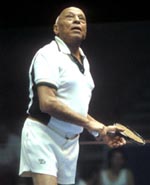
Khan Hashim 04 Hashim Khan, who I think can fairly be described as the greatest squash-racquets player of all time, made his American debut in the winter of 1954.

Hashim Khan, may his tribe increase, completely changed the course of events in the game of squash racquets.

The more I think about it, the more firmly convinced I am that the greatest athlete for his age the world has ever seen may well be Hashim Khan, the Pakistani squash player.

That was how Herbert Warren Wind led off his three epic articles on squash in the New Yorker, in 1973, 1978 and in 1985. Being the New Yorker, the articles were rigorously fact-checked, and all hyperbole was stricken with a red pen. These three sentences were true then and are true today.

Yet, Wind and the New Yorker got his birth date wrong. There is no birth certificate for Hashim Khan. Ned Bigelow, the founder of the United States Open and the man responsible for bringing Hashim to the US and thus revolutionizing our game, made a trip to Pakistan in the 1960s solely to dig up the elusive piece of paper. But the Northwest Frontier Province of the Raj four decades before independence did not focus on record-keeping, and after days of searching Bigelow declared that there was no extant proof of Hashim’s arrival in this world (most of Hashim’s children don’t know their birth date either). Hashim grew up thinking he was born in 1914. When he was first approached, in 1951, about coming to England to play in the British Open, he thought they would not let him play in the tournament if they knew he was 37. So he made himself 35, with 1916 as a birth date. A few years ago he changed it back to 1914. Many people believed he was born even earlier, in 1910 or 1912. Regardless, Hashim is now sticking to 1914, which makes the first of July 2004 his 90th birthday.

Many happy returns, indeed, for whenever he was born, Hashim can look back on a legacy greater than anyone else in the history of squash.

More here. Hashim Khan won the British Open seven times between 1951 and 1958, and is widely considered to be one of the greatest squash players of all time. He also won five British Professional Championship titles, three US Open titles, and three Canadian Open titles. Hashim Khan's son Sharif Khan later won the American Open between 1969 and 1981 an unbelievable 12 times, losing only once in 1975! It is good to note that in 2010 Hashim Khan is still healthy, and at age 96, still playing squash. Watch this video, Aps, and others:

Haiti and the hypocrisy of Christian theology

Richard Dawkins in the Washington Post:

ScreenHunter_01 Jan. 29 08.54 You nice, middle-of-the-road theologians and clergymen, be-frocked and bleating in your pulpits, you disclaim Pat Robertson's suggestion that the Haitians are paying for a pact with the devil. But you worship a god-man who – as you tell your congregations even if you don't believe it yourself – 'cast out devils'. You even believe (or you don't disabuse your flock when they believe) that Jesus cured a madman by causing the 'devils' in him to fly into a herd of pigs and stampede them over a cliff. Charming story, well calculated to uplift and inspire the Sunday School and the Infant Bible Class. Pat Robertson may spout evil nonsense, but he is a mere amateur at that game. Just read your own Bible. Pat Robertson is true to it. But you?

Educated apologist, how dare you weep Christian tears, when your entire theology is one long celebration of suffering: suffering as payback for 'sin' – or suffering as 'atonement' for it? You may weep for Haiti where Pat Robertson does not, but at least, in his hick, sub-Palinesque ignorance, he holds up an honest mirror to the ugliness of Christian theology. You are nothing but a whited sepulchre.

More here.

Thursday, January 28, 2010

J. D. Salinger, 1919-2010

SalingerCharles McGrath in the NYT:

J. D. Salinger, who was thought at one time to be the most important American writer to emerge since World War II but who then turned his back on success and adulation, becoming the Garbo of letters, famous for not wanting to be famous, died Wednesday at his home in Cornish, N.H., where he had lived in seclusion for more than 50 years. He was 91.

Mr. Salinger’s literary representative, Harold Ober Associates, announced the death, saying it was of natural causes. “Despite having broken his hip in May,” the agency said, “his health had been excellent until a rather sudden decline after the new year. He was not in any pain before or at the time of his death.”

Mr. Salinger’s literary reputation rests on a slender but enormously influential body of published work: the novel “The Catcher in the Rye,” the collection “Nine Stories” and two compilations, each with two long stories about the fictional Glass family: “Franny and Zooey” and “Raise High the Roof Beam, Carpenters and Seymour: An Introduction.”

“Catcher” was published in 1951, and its very first sentence, distantly echoing Mark Twain, struck a brash new note in American literature: “If you really want to hear about it, the first thing you’ll probably want to know is where I was born and what my lousy childhood was like, and how my parents were occupied and all before they had me, and all that David Copperfield kind of crap, but I don’t feel like going into it, if you want to know the truth.”

Though not everyone, teachers and librarians especially, was sure what to make of it, “Catcher” became an almost immediate best seller, and its narrator and main character, Holden Caulfield, a teenager newly expelled from prep school, became America’s best-known literary truant since Huckleberry Finn.