The Forgotten Radicalism of the European Enlightenment

From The Economist:

ScreenHunter_05 Nov. 05 11.48 Atheism is a hot topic. In recent years writers from Richard Dawkins and Daniel Dennett to Christopher Hitchens and Sam Harris have penned popular tracts advancing the cause of godlessness. But, as the Bible reminds us, there is nothing new under the sun. Philipp Blom’s latest book tells the story of a set of remarkable individuals on the radical fringes of the 18th-century European Enlightenment, whose determinedly atheistic and materialist philosophies denied the existence of God or the soul. Echoing ancient thinkers such as Democritus and Lucretius, they held ideas that were to prove too revolutionary even for a revolutionary age.

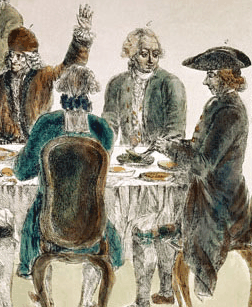
It is the story of the scandalous Paris salon run by Baron Paul Thierry d’Holbach, a philosophical playground for many of the greatest thinkers of the age. Its members included Denis Diderot (most famous as the editor of the original encyclopedia, but, Mr Blom argues, an important thinker in his own right), Jean-Jacques Rousseau, the father of romanticism, and the baron himself; even David Hume, a famous Scottish empiricist, paid the occasional visit.

A philosophy grew up around the baron’s generously stocked table that denied religious revelation and shunned Christian morality, embracing instead the primal passions (the fundamental motives, said the philosophes, for human behaviour) and cool reason (which could direct the passions, but never stand against them). They dreamt of a Utopia built on pleasure-seeking, rationality and empathy. Their ideal nation would leave no room for what they saw as the twisted ethical code of Christianity, which they argued prized suffering and destructive self-repression.

More here.
Thursday, November 4, 2010

Ants and Us

Ant manART2 J.M. Ledgard discusses ants with E.O. Wilson, in More Intelligent Life:

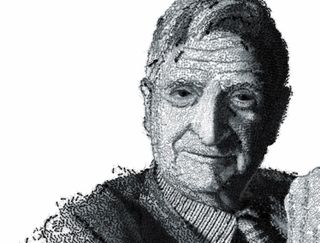
Wilson arrived at Harvard from the University of Alabama in 1953 and proved his mettle by traversing the tropics in search of undiscovered ant species. He helped uncover the diversity of ants in Amazonia and in the Orinoco basin. He was one of the first outsiders to climb the remote mountain ranges in Papua New Guinea, gathering ants and frogs in the chill mists. His studies were so thorough they laid the groundwork for the new field of biogeography. Every summer he set out, and every autumn he returned to Boston, studying the ants under the microscope into the winter, mapping all the features down to the talons on the claws of each of the six legs, and the milky sacs in the body of a queen which she would draw on for ten years or more.

None of this would have amounted to much in the eyes of the outside world had Wilson not got into the behaviour of ants and from there into comparisons with human nature. He has written 24 books and 400 scientific papers. Two of his books—“On Human Nature” (1978) and “The Ants” (1990, with Bert Hölldobler)—have won the Pulitzer prize. Tom Wolfe, the American journalist, described him as “Darwin II”. I think what Wolfe meant was that Wilson’s thinking about the biological basis of social and group behaviour would fundamentally alter man’s perception of himself. Wilson contends not just that we are primates, made in nobody’s image, but that the same laws of population biology and evolutionary theory that govern behaviour in ants also govern us.

Good Placebos Gone Bad

Mungebo_HL Dave Munger in Seed:

Placebo-controlled clinical trials are the gold standard of medical research. When doctors and other researchers want to know if a potential new drug is actually effective in treating disease, they design a controlled clinical trial comparing the drug to an ostensibly inert placebo. As I wrote last year, it’s critical to compare the drug to placebo, because otherwise it’s impossible to know whether the patients would have gotten better (or worse) anyways. Patients who believe their illness is being treated will often improve faster than those who are not confident that the treatment (or lack thereof) is actually helping. This is the placebo effect, and it’s a cornerstone of modern medicine. True placebos don’t have any power to treat disease; they just allow us to compare a proposed treatment to a neutral alternative.

But what if the placebo itself isn’t actually neutral? What if, for example, patients were allergic to some ingredient in a placebo? Might researchers be led into believing that the proposed treatment is more effective than it really is, since the placebo they’re comparing it to actually harms some patients?

You might argue that if this was the case, it would be a simple matter to take a look at the contents of placebos in a field of research and assess their potential side effects. Unfortunately, last week, UK medical writer Helen Jaques examined a recently published report suggesting that investigating the composition of placebos would not be a simple matter. A team led by Beatrice Golumb reviewed 176 clinical trials published in four highly-regarded medical journals in 2008 and 2009 and found that surprisingly few reports disclosed the contents of placebos used in the research. Only 23 percent of the trials gave full reports of the makeup of the placebos they used, and even counting partial reports, the number only increased to 32 percent. Studies involving pills (as opposed to shots or other treatments) disclosed even less: Just 9.3 percent of trials of pills gave full descriptions of the placebos used. The investigative report was published in Annals of Internal Medicine.

Making Muslim Democracies

Muller_35.6_maritain Jan-Werner Müller in The Boston Review:

In the summer of 2008, Turkey’s ruling Justice and Development Party (Adalet ve Kalkinma Partisi, or AKP) narrowly escaped being banned by the country’s constitutional court. State prosecutors had alleged that the party which is officially committed to economic modernization, conservative moral values, and Turkey’s admission to the European Union was trying to breach the country’s notoriously strict separation of religion and politics, slowly Islamicize the state, and ultimately introduce theocracy.

Many local supporters of the AKP breathed a sigh of relief after the decision, as did non-Muslims who see the AKP as the prototype of a Muslim Democratic party that can appeal to believers while being fully committed to the rules (and values) of the democratic game.

At the same time, loud voices proclaiming that Islam and democracy are incompatible remain in Turkey, and, of course, are not limited to it. Their pronouncements are reminiscent of what many secular liberals in nineteenth-century Europe had to say about democracy and religion, though with an important and instructive twist: back then, Catholicism was deemed an insurmountable obstacle to liberal democracy. Leading French Republican Léon Gambetta famously exclaimed “Le cléricalisme, voilà l’ennemi!” in 1877. In fact, far into the twentieth century prominent politicians and social scientists asserted that Catholicism explained the persistence of dictatorship in Latin America and on the Iberian Peninsula. Catholicism, in the words of Seymour Martin Lipset, appeared “antithetical to democracy”; Pierre Trudeau claimed that Catholic countries

are authoritarian in spiritual matters; and since the dividing line between the spiritual and the temporal may be very fine or even confused, they are often disinclined to seek solutions in temporal affairs through the mere counting of heads.

And as with Muslims today, Catholic citizens were suspected of maintaining transnational ties and ultimate loyalties to spiritual institutions elsewhere—a suspicion that still mattered in John F. Kennedy’s election campaigns.

Yet during the second half of the twentieth century, Christian—which mainly meant Catholic—Democratic parties emerged and flourished in Western Europe and, to a lesser extent, Latin America. These were—and in some degree remain—moderately religious parties. They advance political programs infused with select doctrinal values while firmly upholding democratic structures and respecting the separation of state and church.

This suggestive analogy between Christian and Muslim Democracy is not lost on Western politicians and intellectuals, but many of them have been at pains to reject it.

mortality and the triumph of life

ID_PI_GOLBE_HOUDI_AP_001

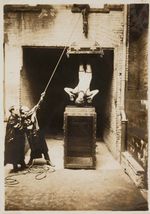
Harry Houdini’s escape trunk stands in the Jewish Museum like a coffin. “Embedded in Houdini’s ventures were competing ambitions,” says the wall text in the museum’s new “Houdini: Art and Magic” exhibition, “he simultaneously courted mortality and the triumph of life.” There’s a lot of metaphor in a trunk: adventure, travel, excitement, secrets. Houdini turned his trunk into a symbol of resurrection. Houdini’s audiences couldn’t know what tricks went on inside that trunk after he had allowed himself to be locked in and the curtain was closed. But some part of them believed that when Harry Houdini burst free, undefeated and smiling, he had shaken hands with the Grim Reaper and spat in his eye. Harry Houdini met death and came back to tell the tale. There are many things to say about Harry Houdini, and one is that he really loved his mother. Her death in 1913 devastated him. As anyone who has ever lost a loved one knows, the hardest thing may be the unbearable, suffocating absence. Houdini wanted little more than to hear just one word from his mother again and, in his grief, started to think it was possible. In Houdini’s day, a Spiritualist movement had taken hold in America and Europe, led by self-appointed mediums who convinced a grieving public they could conjure the dead. The Spiritualists held séance sideshows and passed around double-exposure photographs to show ghostly beings lurking about.

more from Stefany Anne Golberg at The Smart Set here.

shattering taboos, destroying innocence

Larry-rivers

On a late-September evening, an art-world crowd swarms through the high, dark spaces of Manhattan’s Museum of Modern Art for the opening of “Abstract Expressionist New York,” a show drawn entirely, and remarkably, from MoMA’s own basement—for this is the art that the museum, under the aegis of late, great director Alfred Barr, began snatching up in those postwar days when a Jackson Pollock or Willem de Kooning could be had for a pittance. And MoMA had a lot more than that to spend. But what’s this? Here amid the masters of anti-figurative art is Washington Crossing the Delaware, a more or less representational painting by Larry Rivers. And there, in front of it, is most of Rivers’s three-family clan, gazing at his 1953, career-making work with a mix of pride and love—and, for his daughter Gwynne, 46, hurt and anger too. “It’s the first time I’ve seen it,” she says softly, for the sizable canvas sat in storage for 25 years until MoMA curator Ann Temkin came upon it this year and muttered “Wow.” The painting isn’t what’s stirred those darker feelings in Gwynne. It’s another work by her father that’s just come to light, one that’s haunted her since she was a pre-adolescent.

more from Michael Shnayerson at Vanity Fair here.

Ellroy’s Curse

TLS_Showalter_730857a

James Ellroy is the Ancient Mariner of LA Noir. For decades, he has been fixing his audiences with a glittering eye and delivering his staccato rap about his mother’s murder when he was a child, his adolescent delinquencies, obsessions and perversions, his voyeurism and addictions, and his colossal and grandiose literary ambitions. I first heard Ellroy give his spiel in a BBC radio interview in the 1990s; since then he has repeated it internationally at bookstores and literary festivals, in print and on the air; he seems to have confessed it to every interviewer but Oprah. In May 2004, he notes in this new memoir, he delivered the “six thousandth public performance of my dead-mother act” at a gig in Sacramento, with the usual success: “I was boffo. I read from pitch-perfect memory and laid down even eye contact”. The “Hilliker curse” is the name Ellroy gives to the cosmic malediction for his guilt-ridden love–hate feelings towards his mother, Jean Hilliker Ellroy, and his belief that since her death he has been destined to pursue women who resemble her, or his fantasies of her. When his mother was killed, Ellroy began his lifelong quest “to write books and find the Other” – the woman who would be his Shelleyan partner, doppelgänger and soulmate.

more from Elaine Showalter at the TLS here.

History of Anti-vaccination Movements

From The History of Vaccines website (a new project of the College of Physicians of Philadelphia):

ScreenHunter_04 Nov. 04 16.50 Health and medicine scholars have described vaccination as one of the top ten achievements of public health in the 20th century. Yet, opposition to vaccination has existed as long as vaccination itself. Critics of vaccination have taken a variety of positions, including opposition to the smallpox vaccine in England and the United States in the mid to late 1800s, and the resulting anti-vaccination leagues; as well as more recent vaccination controversies such as those surrounding the safety and efficacy of the diphtheria, tetanus, and pertussis (DTP) immunization, the measles, mumps, and rubella (MMR) vaccine, and the use of a mercury-containing preservative called thimerosal.

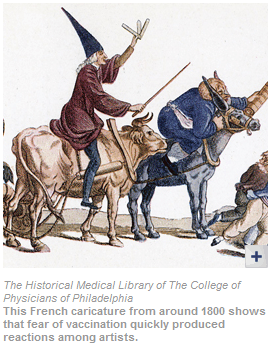
Widespread smallpox vaccination began in the early 1800s, following Edward Jenner’s cowpox experiments, in which he showed that he could protect a child from smallpox if he infected him or her with lymph from a cowpox blister. Jenner’s ideas were novel for his time, however, and they were met with immediate public criticism. The rationale for this criticism varied, and included sanitary, religious, scientific, and political objections.

For some parents, the smallpox vaccination itself induced fear and protest. It included scoring the flesh on a child’s arm, and inserting lymph from the blister of a person who had been vaccinated about a week earlier. Some objectors, including the local clergy, believed that the vaccine was “unchristian” because it came from an animal. For other anti-vaccinators, their discontent with the smallpox vaccine reflected their general distrust in medicine and in Jenner’s ideas about disease spread. Suspicious of the vaccine’s efficacy, some skeptics alleged that smallpox resulted from decaying matter in the atmosphere. Lastly, many people objected to vaccination because they believed it violated their personal liberty, a tension that worsened as the government developed mandatory vaccine policies.

More here.

Dark Worlds: A Journey to a Universe of Unseen Matter

Jonathan Feng and Mark Trodden in Scientific American:

ScreenHunter_03 Nov. 04 16.17 On September 23, 1846, Johann Gottfried Galle, director of the Berlin Observatory, received a letter that would change the course of astronomical history. It came from a Frenchman, Urbain Le Verrier, who had been studying the motion of Uranus and concluded that its path could not be explained by the known gravitational forces acting on it. Le Verrier suggested the existence of a hitherto unobserved object whose gravitational pull was perturbing Uranus’s orbit in precisely the way required to account for the anomalous observations. Following Le Verrier’s directions, Galle went to his telescope that night and discovered the planet Neptune.

A similar drama—in which astronomers observe anomalous cosmic motions, deduce the presence of new matter and go out to hunt for it—is playing out again today in modern cosmology. In the role of Uranus, we see stars and galaxies moving in ways they should not; in the role of Neptune, we deduce the existence of hitherto unobserved substances, provisionally called dark matter and dark energy.

More here.

Mir Ibrahim Rahman Harvard Graduation Speech

Mir Ibrahim Rahman gives a somewhat controversial student speech at the Harvard Kennedy School’s Graduation Ceremony 2010. Also receives the most prestigious award given by Harvard in the field of Government/Public Service –The Robert F Kennedy Award for past and future potential leadership and public service– the only Muslim, and the 2nd South Asian in the Award’s history of over 23 years.

Mir is the CEO and Co Founder of GEO TV NETWORK, and has been on a sabbatical for a year at Harvard to complete his Masters in Public Administration –where he has also researched and written a thesis on Pakistan’s potential, titled: Reason to Believe: Finding A New Public Narrative for Pakistan.

What happened to essential books?

Rick Gekoski in The Guardian:

Man-reading-in-deckchair-006 I'd begun by supposing that we were back in the year 1974, and playing a game of Humiliation (later made popular in David Lodge's Changing Places) in which you earn points by naming books that you haven't read and which you think the other players have. (I used to do well by not having read The Wind in the Willows.) In Lodge's novel, a competitive young lecturer, playing the game with his English Department colleagues, startles them by announcing that he hasn't read Hamlet, gleefully gathers a bushel of points, and is fired a few weeks later. How can you employ a lecturer who is this illiterate? In 1974, you would have won a lot of points if you hadn't read these books:

Simone de Beauvoir, The Second Sex (1953)
JD Salinger, The Catcher in the Rye (1953)
William Golding, The Lord of the Flies (1954)
Herbert Marcuse, Eros and Civilization (1955)
Allen Ginsberg, Howl (1956)
Erich Fromm, The Art of Loving (1956)
Jack Kerouac, On the Road (1957)
Norman O Brown, Life Against Death (1959)
RD Laing, The Divided Self (1960)
Joseph Heller, Catch-22 (1961)
Marshall McLuhan, The Gutenberg Galaxy (1962)
Ken Kesey, One Flew Over the Cuckoo's Nest (1962)
Pauline Reage, The Story of O (1965)
Alex Haley, The Autobiography of Malcolm X (1965)
Desmond Morris, The Naked Ape (1967)
Eldridge Cleaver, Soul on Ice (1967)
Norman Mailer, Miami and the Siege of Chicago (1968)
Carlos Castaneda, The Teachings of Don Juan (1968)
Arthur Janov, The Primal Scream (1970)
Germaine Greer, The Female Eunuch (1971)
Robert M Pirsig, Zen and the Art of Motorcycling Maintenance (1974)

More here.

Star Wars-style holograms: a new hope?

From Nature:

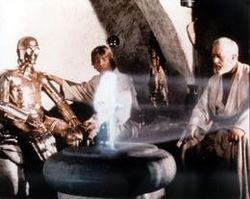
Leah The fuzzy three-dimensional (3D) image of Princess Leia calling for help in the 1977 film Star Wars demonstrates an effect that researchers have long been trying to achieve: holograms that move in real time. Now, a material that can store shifting holographic data moves the fantasy into the realms of reality. The substance could have future applications in medicine and manufacturing, as well as in the entertainment industry.

“From day one, I thought about the hologram of Princess Leia and whether it can be brought out of science fiction,” says Nasser Peyghambarian, an optical scientist at the University of Arizona in Tucson, who has been trying for several years to develop holographic projections that move in real time. The challenge was to find a rewritable material that could store data encoding successive holographic images. Now Peyghambarian and his colleagues have developed a material that can record and display 3D images that refresh every two seconds. The research is published in Nature this week.

More here.

An Investigation of Beautiful Objects

Sean Patrick Cooper in The Rumpus:

Sound logical reasoning would lead a person to conclude that my sustained interest in a document like Nicholas Felton’s Feltron Annual Report is sort of nuts. Overflowing with a nearly endless amount of data detailing the most boring minutia of Nicholas’ day-to-day life, no one besides Felton’s mother or medical health handlers should intentionally request let alone exchange any sum of money for such a thing.

But I do.

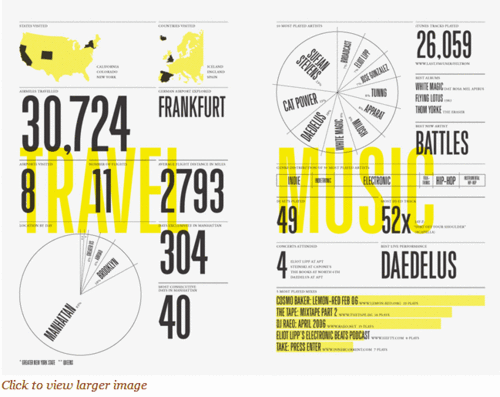
The Reports are mailed to suckers like myself at the beginning of each year. Essentially small booklets, they are dimensionally similar to an LL Bean clothing catalogue. From cover to cover, the reports are filled with what appear to be a bunch of well organized but weirdly shaped and oddly labeled charts and graphs. Here, for instance, are the contents of Page 3 | Report 2006:

ScreenHunter_02 Nov. 04 11.53

A map of the USA highlighting the 3 states Feltron visited that year—California, Colorado, New York. Next to that, a sliced map of Europe showing his visits to Iceland, England, and Spain. Below the maps is a small headline “Airmiles Traveled,” which itself hovers above the number in a very large font, “30,724.” Next to that in also large type is the word “Frankfurt,” which makes sense once you see that it itself is under the small headline of “German Airport Explored.” Then, closer to the center of the page and also in big type: “Airports Visited: 8,” “Number of Flights: 11,” “Average Flight Distance (miles): 2793.” And then there’s the bottom third of the page, a break down of Feltron’s location by day. 304 days were spent exclusively on the island of Manhattan with the longest stretch of consecutive time spent on the island identified as 40 days. A pac man pie chart shows that for the 17% of his time away from the city proper he was mostly in Brooklyn, which was where he was for 10% of the entire calendar year.

More here.

Wednesday, November 3, 2010

Necessary Roughness

During 2009’s post-election protests in Tehran, one man is struck into a commitment to the cause.

Salar Abdoh in Guernica:

Iran_575 And that’s when it happens. A hard blow of a baton right over my right shoulder. The strike is solid enough that my chest hits the gas tank of the motorcycle and I bounce back. Then another hit.

The blows, I confess, are liberating. I had not known how incomplete my day was until now. And as I scan the landscape of the square—broken bricks, burning garbage containers, tear gas, swarming riot-police, windows being smashed, and people bleeding and thrown every which way—I have the feeling we might not make it out of here. I’m out of my body and in pain and I want to laugh. I am surprised by my pain and I want to thank someone for it at the same time, because the immediacy of physical pain is like a purchase; it makes one feel irrevocably committed. Only now do I remember that when the woman got hit a minute ago, which might just as well have been eons ago (as everything is happening around me in slow-motion), someone started crying out that they are hitting women, they are hitting women. As if hitting women mattered to the men who command the baton-wielders.

After the blows, the bike stalls. I kick the handle and it restarts. In front of me is a lead riot-cop on a bike. Our eyes meet—two bike riders situated at the opposite poles of this republic. His gaze and the slight twist of the head tell me to move it. And as much as I don’t want to be here, neither does he; he’s just doing a job: Go that way. Just go, save yourself and that woman. Get out!

More here.

against humanism

Secular_humanism

Does the term “humanism” really stand for a new and better form of religion? If so, what is that religion? Or is it something designed as a cure for religion itself, a way to get rid of it on Christopher Hitchens’s principle that “religion poisons everything”? Many people, no doubt, agree with Hitchens. But Auguste Comte, the founding father of modern humanism, would not have been one of them. For him, “humanism” was a word parallel to “theism”. It just altered the object worshipped, substituting humanity for God. He called it the “religion of humanity” and devised ritual forms for it that were close to traditional Christian ones. He thought – and many others have agreed with him – that the trouble with religion was simply its having an unreal supernatural object, God. Apart from this, the attitudes and institutions characteristic of religion itself seemed to him valuable, indeed essential. And he certainly had no wish to get rid of the habit of worship, only to give it a more suitable object. Surely (he said) worshipping human beings – who are real natural entities – would easily be able to replace the existing idle and artificial practices? So he ruled that, for instance, the enlightened citizen should start his day by worshipping first his mother, then his wife and then his daughter – after, of course, ensuring that they all did exactly what they were told for the rest of the time. And the other occasions of life could be similarly hallowed. This would all be part of his positivistic enterprise of developing the human scientific faculties that would finally enable us to abandon superstition.

more from Mary Midgley at Eurozine here.

A Lost Generation

S-SAD-OBAMA-large

Asked on Monday to assess the significance of the coming Democratic defeat, Tim Kaine, the chairman of the Democratic National Committee, tried to portray this election as fairly typical. “Since Teddy Roosevelt,” Kaine told Gwen Ifill of the PBS NewsHour, “the average midterm is, you lose 28 House seats and lose four Senate seats if you’re the party in the White House.” Does losing over 60 House seats and as many as eight Senate seats simply make this a below average outcome, or did something much more serious and significant happen in yesterday’s election? Republicans might say it’s the re-emergence of a conservative Republican majority, but that’s not really what happened. What this election suggests to me is that the United States may have finally lost its ability to adapt politically to the systemic crises that it has periodically faced. The U.S emerged from the Civil War, the depression of the 1890s, World War I, and the Great Depression and World War II stronger than ever—with a more buoyant economy and greater international standing. A large part of the reason was the political system’s ability to provide the leadership the country needed. But what this election suggests to me is that this may no longer be the case.

more from John B. Judis at TNR here.

here, you drive

Shitty+Car

We are a nation of swingers. In the last 16 years, each party has had a presidential victory and taken control of Congress in what was heralded as a realignment of American politics. Now it’s happened again. House Republicans got the car keys back, to borrow Barack Obama’s overused metaphor. But it wasn’t a victory. The exit polls suggested the country threw them at the GOP in disgust: Here, you drive. Polls don’t show much affection for the new co-leaders of American politics. According to exit polls, 41 percent of voters have an favorable view of the Republican Party, four points less than President Obama. Even Tea Party members said the GOP was on “probation.” Yes, this was an election fueled by a bad economy, but American politics is also in a dizzying cycle. Now the debate changes. With the election over, we will now move on from the argument of how you should vote and start the argument over why you voted the way you did. The post-election debate matters because it will shape the motivations of lawmakers of both parties and the expectations of voters, who want them to do something but have no faith that they can do anything. In exit polls, almost 90 percent of voters said they were worried about the future.

more from John Dickerson at Slate here.

Wednesday Poem

Happy Birthday

So you’ve skied a double-diamond down the side of Fujiyama,
so you’ve taken tea and biscuits with the 14th Dalai Lama,
so you’ve studied metaphysics in the city of Shamballa,
so you’ve played a dazed Ophelia in that famous Shakespeare drama.
[indent]So your world is like a stage and it’s now your time to shine,
[indent]for you were ten plus eight, but now you’re four and six and nine.

So you’ve married a theosophist who worships Jakob Boehm,
so you’ve planned to one-up Caesar when it comes to ruling Rome,
so you’ve got noetic prowess and a spacious mental dome,
so you’ve stocked atomic registries from hydrogen to chrome.
[indent]So you’ve ironed out the ions and your half-life’s just begun,
[indent]for you were ten plus eight but now you’re twenty minus one.

So you’ve parodied Lord Byron and recited all of Yeats,
so you’ve summoned Sir Beelzebub near cemetery gates,
so you’ve cradled Tutankhamen and you’ve fed him salted dates,
so you’ve solved Goldbach’s conjecture using only ones and eights.
[indent]So your life is like a lottery and you’ve been dealt the primes,
[indent]for you were ten plus eight but now you’re one (just nineteen times).

So you’ve pilfered all the knowledge from the mind of Aristotle,
so you’ve chilled with Ernest Hemingway while knocking back a bottle,
so you’ve cured the world’s chrysanthemums of Botrytis and mottle,
so you’ve saddled up a quasar that you like to ride full-throttle.
[indent]So you’ve realized that existence is just a cosmic laugh,
[indent]for you were ten plus eight but now you’re thirty-eight, in half.

by Walter Ancarrow

Gut bacteria change the sexual preferences of fruit flies

Ed Yong in Not Exactly Rocket Science:

ScreenHunter_01 Nov. 03 12.31 Imagine taking a course of antibiotics and suddenly finding that your sexual preferences have changed. Individuals who you once found attractive no longer have that special allure. That may sound far-fetched, but some fruit flies at Tel Aviv University have just gone through that very experience. They’re part of some fascinating experiments by Gil Sharon, who has shown that the bacteria inside the flies’ guts can actually shape their sexual choices.

The guts of all kinds of animals, from flies to humans, are laden with bacteria and other microscopic passengers. This ‘microbiome’ acts as a hidden organ. It includes trillions of genes that outnumber those of their hosts by hundreds of times. They affect our health, influencing the risk of obesity and chronic diseases. They affect our digestion, by breaking down chemicals in our food that we wouldn’t normally be able to process. And, at least in flies, they can alter sexual preferences, perhaps even contributing to the rise of new species.

Sharon was inspired by experiments by Diane Dodd, who raised two strains of fruit flies on different diets, and found that after 25 generations, their menus had affected their sex lives. Those reared on a menu of starch preferred to mate with other ‘starch flies’, while those reared on maltose had a bias towards ‘maltose flies’. These results were odd. Dodd had set up an artificial evolutionary pressure for diet but somehow, the flies’ mating habits had changed as well.

To work out why, Sharon repeated Dodd’s experiment with the fly Drosophila melanogaster, and raised two strains on either molasses or starch. After just two generations, she found the same effect that Dodd did: the flies were more attracted to individuals reared on the same diets. Something in their food was changing their behaviour.

More here.