Scientific Regress: When Science Goes Backward

11-15-AirFranceConcorde John Horgan in Scientific American:

To celebrate the ends of years, decades and other milestones, science publications often churn out “Whither science?” predictions. Just last week, The New York Times Science Times section celebrated its, um, 32nd birthday with a special issue on “What's next in science”. What I found fascinating was the issue's overall tone of caution rather than the traditional boosterish enthusiasm.

Gina Kolata recalled a job interview 25 years ago with U.S. News and World Report, an editor of which asked her, “What will be important medical news next year?” Kolata replied that “next year gene therapy will be shown to work.” Gene therapy, of course, has been a big bust. Kolata goes on to say that the best answer to “Whither science?” is to expect the unexpected. (Fortunately for her, Kolata didn't get the job with what a mean friend of mine liked to call “U.S. Snooze and World Distort,” the print version of which just died after years of terminal illness.)

My favorite answer to the Science Times “What's next?” query was James Gorman's list of things that scientists won't accomplish. They won't find ET or the ivory-billed woodpecker, clone Neandertals, download our psyches into computers, and so on.

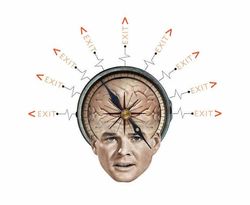
If the Times had asked me to chime in, I would have pointed out areas of science, technology and medicine that are regressing. I don't mean what the philosopher Imre Lakatos referred to as a “degenerating research program,” which produces diminishing returns. That's merely declining progress. I mean fields of research that actually go backward, as measured by some specific benchmark.

A Case of Bogus Science

Pervez Hoodbhoy Pervez Hoodbhoy in Dawn:

Comstech’s magnificent headquarters are located on Constitution Avenue in Islamabad. It has been headed by Dr Atta-ur-Rahman since 1996. Although its performance has been consistently mediocre, the organisation has now descended to an all-time low.

Recently Dr Rahman published an eye-popping article entitled HAARP (Dawn, Oct 17). The article claims that a physics research project, based in Alaska, may have been used by the US to trigger earthquakes globally, and could also have caused the catastrophic floods in Pakistan. Dr Rahman concludes with a chilling question: “Is the HAARP then, a harmless research tool — or a weapon of mass destruction far more lethal than nuclear weapons? We may never know.”

Given Dr Rahman’s prominent place in Pakistani science, and that he is fellow of the Royal Society, one must consider seriously his claim that HAARP can cause earthquakes and floods. But even the briefest examination makes clear his claims make no scientific sense.

HAARP stands for High Frequency Active Auroral Research Programme. Its website states it is a research programme run by the University of Alaska in collaboration with various US colleges and universities. If HAARP is a secret military project conceived by evil and diabolical minds, it is hard to see why visitors, including foreign nationals, are said to be allowed on site. The website says that the last open house was on July 17, 2010.

At least on the face of things, HAARP does not have the trappings of an American secret weapons facility. (Google Earth, which I used, blacks these out.) Readers will see a field of antennas, as well as some cars and two ordinary looking buildings.

No security barriers are visible. This does not appear to be a classified project.

But, of course, appearances can be deceptive. So let us simply use common sense and physics. Assume therefore that the power of the transmitters is many times that declared on the website (3.6MW). This may mean HAARP could potentially disrupt radio communications during war, or blind incoming missiles. But science cannot accept Dr Rahman’s claim that “It (HAARP) may also affect plate tectonics causing earthquakes, floods through torrential rains and trigger tsunamis.”

late night

101122_r20203_p233

Carter gives the last words, or almost the last, of his book on the Leno-O’Brien wars to Jerry Seinfeld. To Seinfeld, O’Brien’s letter to the People of Earth promising never to desecrate the “Tonight” legacy suggested a man who was indeed lost in space. “There is no tradition!” Seinfeld says. “This is what I didn’t get. Conan has been on television for sixteen years. At that point you should get it: There are no shows! It’s all made up!” O’Brien gave up a time slot on network television in the name of a fiction. And what are the stakes, anyway? Seventeen and a half million people, Carson’s nightly average back in the late seventies, is more than twice the number who now watch “The Tonight Show with Jay Leno” and “The Late Show with David Letterman” combined. Measured in constant 1972 persons, “Tonight” is watched by a smaller audience than “The Dick Cavett Show” was when it was cut back to one week a month. The late-night talk-show potatoes have got very small. But today the original networks are like gigantic and benign marine creatures, relics of an earlier time on earth, swimming in a sea filled with more nimble and opportunistic predators, all competing for the chance to alarm, to titillate, and—if such a thing is still possible—to offend.

more from Louis Menand at The New Yorker here.

obama is the new first bush

LeadARt__1289587939_3800

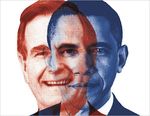
In his inaugural address, in which he studiously eschewed the folksy populism of Carter, Obama pledged that Americans were “ready to lead once more.” Similarly Bush predicted a “new world order” led by America, a phrase that would come to haunt him in the 1992 primaries. “Is George Bush merely an idealist or are there now plans underway to merge the interests of the US and the Soviet Union in the United Nations,” Pat Robertson drooled in his campaign book, “and install a socialist ‘world order’ in place of a free market system?” If that rings a bell, it may be because you’ve been watching clips of Glenn Beck. There is also a rhetorical similarity between the two presidents. Obama is better spoken and more inspiring than was Bush, but, like Obama, Bush’s central rhetorical fault — how he eventually lost the public — was that he was always cool, always rational. He knew what he wanted, and what he’d done, but, like Obama, he was almost bashful about explaining as much to Americans, going so far as to cross many of the I’s out of his addresses. Bush press secretary Marlin Fitzwater lamented that his boss’s approach to message politics was “If I am doing the right thing, I can take any punishment.” Bush himself admitted, “I’m not good at expressing the concerns of a nation — I’m just not very good at it.” Like Obama, Bush had a cerebral, deliberative, occasionally paradoxical way of speaking.

more from James Verini at the Boston Globe here.

Here’s where things get really weird

Clairvoyant_madamepsychosis

Most science papers don’t begin with a description of psi, those “anomalous processes of information or energy transfer” that have no material explanation. (Popular examples of psi include telepathy, clairvoyance and psychokinesis.) It’s even less common for a serious science paper, published in an elite journal, to show that psi is a real phenomenon. But that’s exactly what Daryl Bem of Cornell University has demonstrated in his new paper, “Feeling the Future: Experimental Evidence for Anomalous Retroactive Influences on Cognition and Affect,” which was just published in The Journal of Personality and Social Psychology. Bem’s experimental method was extremely straightforward. He took established psychological protocols, such as affective priming and recall facilitation, and reversed the sequence, so that the cause became the effect. For instance, he might show students a long list of words and ask them to remember as many as possible. Then, the students are told to type a selection of words which had been randomly selected from the same list. Here’s where things get really weird: the students were significantly better at recalling words that they would later type.

more from Jonah Lehrer at Wired here.

Tuesday Poem

Counterman

What'll it be?

Roast beef on rye, with tomato and mayo.

Whudduhyuh want on it?

A swipe of mayo.
Pepper but no salt.

You got it. Roast beef on rye
. . . You want lettuce on that?

No. Just tomato and mayo.

Tomato and mayo. You got it.
. . . Salt and pepper?

No salt. Just a little pepper.

You got it. No salt.
You want tomato.

Yes. Tomato. No lettuce.

No lettuce. You got it.
. . . No salt, right?

Right. No salt.

You got it. — Pickle?

No, no pickle. Just tomato and mayo.
And pepper.

Pepper.

Yes, a little pepper.

Right. A little pepper.
No pickle.

Right. No pickle.

You got it.
Next!

Roast beef on whole wheat, please,
With lettuce, mayonnaise and a center slice
Of beefsteak tomato.
The lettuce splayed, if you will,
In a Beaux Arts derivative of classical acanthus,
And the roast beef, thinly sliced, folded
In a multi-foil arrangement
That eschews Bragdonian pretensions
Or any idea of divine geometric projection
For that matter, but simply provides
A setting for the tomato
To form a medallion with a dab
Of mayonnaise as a fleuron.
And — as eclectic as this may sound —
If the mayonnaise can also be applied
Along the crust in a Vitruvian scroll
And as a festoon below the medallion,
That would be swell.

You mean like in the Cathedral St. Pierre in Geneva?

Yes, but the swag more like the one below the rosette
At the Royal Palace in Amsterdam.

You got it.
Next!

by Paul Violi
Shiny Magazine; Number 13
and The Best American Poetry, 2006

The dramatic decline of the modern man

From Salon:

Man “Manthropology,” a tongue-in-cheek look at the science of maleness, examines what recent discoveries in the fields of archaeology and anthropology can teach us about the state of modern masculinity. Ice Age aboriginal tribesmen, he discovers, were able to run long distances at approximately the same speed as modern-day Olympic sprinters. Classic Grecian rowers could attain speeds of 7.5 miles an hour, which today's rowers can only attain for short bursts of time. Our culture may be obsessed with muscles: He notes that, since 1982, G.I. Joe's Sgt. Savage has gotten three times more muscular and Barbie's Ken now has a chest circumference attainable by only one in 50 men, but the luxuries of our contemporary lifestyle have caused a steady decline in genuine physical power. The book may be a light, breezy work, but it puts our current debate around masculinity into fascinating context. Salon spoke with McAllister on the phone from Australia, about the current state of American manhood, hypermuscular toys and whether the recession is bringing back old-school masculinity.

You make the very intriguing argument that muscularity and aggression are increasingly being weeded out of the gene pool.

I've cited some studies of children of the Viking Berserkers [a group of notorious Norse warriors known for their aggression], and found that these are hyperviolent men and actually did have more children than comparable warriors in that society. In the past when muscular strength was everything, there was a real likelihood that genes would be spread by that kind of behavior. With the society that we live in now, that kind of self-destructive thing gets people out of the gene pool. Young males that have nothing to lose — they're hyperaggressive, they get into gang violence, they're liable to die at a very young age. Aggressive men go to prison and they go for longer periods of time, and they commit more offenses that keep them in there, which impedes their ability to have a family life and reproduce. And thanks to the rise of reproductive control, like the pill, when women have liaisons with muscular males, it doesn't have the reproductive consequences that it did. That's good news for the cuckolded husbands of old, because studies show that they're often stuck raising the children that result from women's liaisons with the beefcakes.

More here.

When the Mind Wanders, Happiness Also Strays

John Tierney in The New York Times:

Brain A quick experiment. Before proceeding to the next paragraph, let your mind wander wherever it wants to go. Close your eyes for a few seconds, starting … now. And now, welcome back for the hypothesis of our experiment: Wherever your mind went — the South Seas, your job, your lunch, your unpaid bills — that daydreaming is not likely to make you as happy as focusing intensely on the rest of this column will.

I’m not sure I believe this prediction, but I can assure you it is based on an enormous amount of daydreaming cataloged in the current issue of Science. Using an iPhone app called trackyourhappiness, psychologists at Harvard contacted people around the world at random intervals to ask how they were feeling, what they were doing and what they were thinking. The least surprising finding, based on a quarter-million responses from more than 2,200 people, was that the happiest people in the world were the ones in the midst of enjoying sex. Or at least they were enjoying it until the iPhone interrupted. The researchers are not sure how many of them stopped to pick up the phone and how many waited until afterward to respond. Nor, unfortunately, is there any way to gauge what thoughts — happy, unhappy, murderous — went through their partners’ minds when they tried to resume. When asked to rate their feelings on a scale of 0 to 100, with 100 being “very good,” the people having sex gave an average rating of 90. That was a good 15 points higher than the next-best activity, exercising, which was followed closely by conversation, listening to music, taking a walk, eating, praying and meditating, cooking, shopping, taking care of one’s children and reading. Near the bottom of the list were personal grooming, commuting and working.

More here.

Monday, November 15, 2010

3 Quarks Daily Welcomes Our New Columnists

Hello Readers (and Writers!),

We received a triple-digit number of submissions of sample essays in our search for new columnists. Most of them were very good as usual (with the normal number of incomprehensible and some even insane pieces thrown in just to test our sanity, I suppose) and it was hard deciding whom to accept and whom not to. So hard, in fact, that we ended up deciding that we will dramatically expand the number of 3QD columns on Mondays. Hence today we welcome to 3QD the top 32 people (in the combined ratings of the editors). Without further ado, here they are, in alphabetical order by last name:

  1. Fountain-pens-530Omar Ali
  2. Robert P. Baird
  3. Kevin S. Baldwin
  4. Simon Boas
  5. Rishidev Chaudhuri
  6. Gabe DiNicola
  7. Melody Dye
  8. Wayne Ferrier
  9. Julia Galef
  10. Jonathan Halvorson
  11. Liam Heneghan
  12. Joy Icayan
  13. Thomas Jacobs
  14. David Maier
  15. James McGirk
  16. Vivek Menezes
  17. Dave Munger
  18. Feisal H. Naqvi
  19. Jen Paton
  20. Alyssa Pelish
  21. Gautam Pemmaraju
  22. Steven Poole
  23. Akim Reinhart
  24. Meghan Rosen
  25. Ryan Sayre
  26. Haider Shahbaz
  27. Hartosh Bal Singh
  28. Robert Basil Talisse & Scott Forrest Aikin
  29. Terrance Tomkow
  30. Jenny White
  31. George Wilkinson
  32. Frederick William Zackel

A few of these people will begin writing at 3QD today (see below). I will be in touch with the rest of you to schedule a start date. The “About Us” page will be updated with short bios and photographs of the new writers no later than the day they start.

Thanks to all of the people who sent samples of writing to us. It was sometimes tiring, but still a pleasure to read them all. If you didn't make it this time, we will keep you in mind for the future. And congratulations to the new columnists!

Best wishes,

Abbas

Sunday, November 14, 2010

Presidential Art

ID_NC_MEIS_BUSH_AP_001 Morgan decides that he admires the new, middlebrow official portrait of George W. Bush at the National Portrait Gallery of the Smithsonian, in The Smart Set:

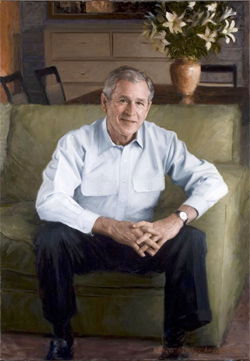
The portrait is by Robert Anderson, a portrait painter more or less by trade and, as it happens, a classmate of Bush's from Yale. George W looked at the work of a number of painters and eventually settled on Anderson as the man to do the official portrait, the one that hangs in the National Portrait Gallery of the Smithsonian along with the other presidential portraits.

That can't be serious, I thought to myself when I turned a corner at the Gallery and saw the portrait. The mundane kitsch of the thing was shocking. There are standards. By God there are standards. Aren't there? A vase of flowers sits on the table of a dining room set behind him. The set is more middlebrow than anything you could find even at a mainstream outfit like IKEA. It is a set you'd find, I suppose, at Jennifer Convertibles. The whole scene is resolutely suburban. Aggressively suburban. The portrait is, essentially, a Sears portrait. Hanging at The National Portrait Gallery, not too far from where Elaine de Kooning's Modernist rendering of JFK can be found, is a Sears portrait of the 43rd President of the United States of America.

Pantless morgan

The more I looked at it, the more my admiration grew. Say what you like about George W. Bush, but that dummy is no dummy. Any other painting, any other style, any other approach would have been ridiculous. But how do you ridicule a Sears portrait that really and truly presents itself as nothing other than a Sears portrait? It should have been more classical, you could protest. It should have been more in line with contemporary trends in the arts. Oh, really?

I like how clean his shirt is, how crisp are the lines running up the right arm that Bush rests with such infinite comfort on his leg.

Bad Chemistry

57807-1 Mary Beth Aberlin in The Scientist:

There's something irresistible about plays that deal with iconic scientific discoveries, especially when controversy surrounds the people who make these finds–just think of Niels Bohr and Werner Heisenberg in Copenhagen. That play, by Michael Frayn, portrayed seminal discoveries about the structure of the atom made in the early 20th century. The second iconic discovery of that century–the molecular structure of DNA–was every bit as earthshaking, and is the subject of a new play, Photograph 51, written by Anna Ziegler.

The drama centers on the story of X-ray crystallographer Rosalind Franklin and her role in elucidating DNA's double-helical structure from 1951 to 1953. James Watson, Francis Crick and Maurice Wilkins shared the 1962 Nobel Prize for this achievement. Franklin died from ovarian cancer in 1958, but had she lived, there is little possibility that she would have been tapped for the prize.

In Photograph 51, Franklin is portrayed as a complex person–attractive, competent, self-confident, but also driven and rather imperious. She arrives at Kings College in 1951 with the understanding that she will have sole charge of a project to determine the crystal structure of DNA, just as the molecule's role in the passage of hereditary information was becoming clearer. Ray Gosling, an affable young PhD candidate, who had formerly worked on DNA with Maurice Wilkins, is to be her assistant. Wilkins returns from vacation eager to work with Franklin, not knowing that the head of the department, J.T. Randall, has assigned his project to her. And Franklin doesn't know that Wilkins doesn't know. This terrible misunderstanding sets the stage for the bitter relationship that develops between the two, where daily life in the lab becomes a sad sort of turf battle.

Lost Your Libido? Let’s Try a Little Neuro-Realism, Madam

MRI-of-the-brain-006 Ben Goldacre in the Guardian:

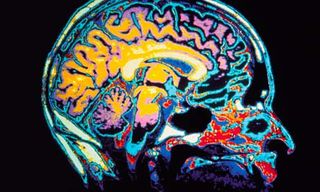
When the BBC tells you, in a headline, that libido problems are in the brain and not in the mind, you might find yourself wondering what the difference between the two is supposed to be, and whether a science article can really be assuming – in 2010 – that its readers buy into a strange Cartesian dualism in which the self is contained by a funny little spirit entity in constant and elaborate pneumatic connection with the corporeal realm. But first let's consider the experiment they're reporting on.

As far as we know (because this experiment has not yet been published, only presented at a conference), some researchers took seven women with a “normal” sex drive, and 19 women diagnosed with “hypoactive sexual desire disorder”. Participants watched a series of erotic films in a scanner while an MRI machine took images of blood flow in their brains: the women with a normal sex drive had an increased flow of blood to some parts of their brain associated with emotion, while those with low libido did not.

Dr Michael Diamond, one of the researchers, tells the Mail: “Being able to identify physiological changes, to me provides significant evidence that it's a true disorder as opposed to a societal construct”. In the Metro, he goes further: “Researcher Dr Michael Diamond said the findings offer 'significant evidence' that persistent low sex drive – known as hypoactive sexual desire disorder (HSDD) – is a genuine physiological disorder and not made up.”

This strikes me as an unusual world view. All mental states have physical correlates, if you believe that the physical activity of the brain is what underlies our sensations, beliefs and experiences. So while different mental states will be associated with different physical states, that doesn't tell you which caused which.

Far stranger is the idea that a subjective experience must be shown to have a measurable physical correlate in the brain before we can agree that the subjective experience is real. If someone is complaining of persistent low sex drive, then they have persistent low sex drive, and even if you could find no physical correlate in the brain whatsoever, that wouldn't matter: they still have low sex drive.

Sunday Poem

Border Song

I water my horse
Crossing an autumn river.
The water is cold,
The wind like a knife.

Away across level sands
The sun is still sinking.
Off in the darkness—
The beginning of the Great Wall.

A former days' battles
By the Great Wall,
Everyone says
Will and spirit ran high.

But yellow earth
Is all that remains,
Then or now.
White bones lie scattered
In the weeds.

by Wang Chang-Lin
Tang Dynasty, about 750 A.D.
from The Heart of Chinese Poetry
editor: Greg Whincup;
Anchor Books, 1987

Christopher Hitchens: ‘You have to choose your future regrets’

Andrew Anthony in The Guardian:

Christopher-Hitchens-006 First, though, there was dinner. We walked to a local restaurant where Hitchens knows the barman and the barman knows what Hitchens drinks, and I asked whether his cancer diagnosis had altered his political outlook at all. He looked mystified at the question, but I explained that he used to say that he woke up angry, full of disgust at the world. Was it still possible to feel so strongly about external enemies when the internal one had taken such malevolent root in his body? “It's the sort of alternative that doesn't present itself to you,” he says. “You don't think, 'Why do I care when I could be thinking about my daunting nemesis?'”

The banality of cancer seems to irk him almost as much as its lethality. Lacking any dialectical substance, it affords few opportunities to escape platitude or avoid cliche. It's a big subject, but it's essentially small talk, and Hitchens's style requires the elevated registers of the epic and the ironic. Anything less is like asking a high-wire artist to perform his act at ground level. Yet his engagement remains unusually engaging, in large part because with him it's never just about politics. His frame of cultural interests is far too large to be squeezed into the straitjacket of dogma and doctrine. He chided me a couple of times for not asking him about his first love, literature. “I wish people would put in a bit more of that because it's also what I think of when I say grand things like defending civilisation.”

More here.

Scientists’ Nightstand: Steven Weinberg

From American Scientist:

Weinberg Steven Weinberg is Josey Regental Professor of Science and a member of the physics and astronomy departments at the University of Texas, Austin. In 1979 he received the Nobel Prize in Physics with Abdus Salam and Sheldon Glashow for their contributions to the theory of the unified weak and electromagnetic interaction between elementary particles. His latest book is Lake Views: This World and the Universe (Harvard University Press, 2010).

Who are your favorite writers (fiction, nonfiction or poetry)? Why?

In English-language fiction, Anthony Trollope, Henry James, E.M. Forster, Edith Wharton, Herman Melville, Jane Austen, W.M. Thackeray. As you can see, I'm more at home in the 19th than the 20th century, let alone the 21st. I've enjoyed the great 19th-century French and Russian novelists, but unfortunately I have to read them in translation. In nonfiction, I read mostly history: Gibbon, Thomas Macaulay, G.M. Trevelyan, Thucydides, Tacitus, Winston Churchill, Allan Nevins, Samuel Eliot Morison. And memoirs: Ulysses S. Grant, the Duke of Saint-Simon, Churchill again, Henry Adams. In poetry, William Shakespeare, Andrew Marvell, John Donne, John Milton, John Keats, Lord Tennyson, Gerard Manley Hopkins, William Butler Yeats, Dylan Thomas, W.H. Auden, T.S. Eliot, Philip Larkin, Robert Frost, John Crowe Ransom.

What are the three best books you've ever read? Explain.

I have to include at least one novel by Trollope. I suppose I'd pick Barchester Towers (1857). It has a great cast of wonderfully drawn characters and is very funny. The language in Moby-Dick (1851) bowled me over when I read it years ago. And The Decline and Fall of the Roman Empire lays out an amazing panorama, spanning 13 centuries, with both sympathy and sarcasm.

More here.

Can Technology End Poverty?

Kentaro Toyama in the Boston Review:

ScreenHunter_24 Nov. 14 12.07 A ten-year-old boy named Dhyaneshwar looked up for approval after carefully typing the word “Alaska” into a PC.

“Bahut acchaa!” I cheered—“very good.”

It was April, 2004, and I was visiting a “telecenter” in the tiny village of Retawadi, three hours from Mumbai. The small, dirt-floored room, lit only by an open aluminum doorway, was bare except for a desk, a chair, a PC, an inverter, and a large tractor battery, which powered the PC when grid electricity was unavailable. Outside, a humped cow chewed on dry stalks, and a goat bleated feebly.

As I encouraged the boy, I wondered about the tradeoff his parents had made in order to pay for a typing tutor. Their son was learning to write words he’d never use, in a language he didn’t speak. According to the telecenter’s owner, Dhyaneshwar’s parents paid a hundred rupees—about $2.20—a month for a couple hours of lessons each week. That may not sound like much, but in Retawadi, it’s twice as much as full-time tuition in a private school.

Such was my introduction to the young field of ICT4D, or Information and Communication Technologies for Development. The goal of ICT4D is to apply the power of recent technologies—particularly the personal computer, the mobile phone, and the Internet—to alleviate the problems of global poverty. ICT4D sprouted from two intersecting trends: the emergence of an international-development community eager for novel solutions to nearly intractable socioeconomic challenges; and the expansion of a brashly successful technology industry into emerging markets and philanthropy.

More here. [This is the lead article of a forum on the role of information and communication technology in global development, with responses from Nicholas Negroponte, Evgeny Morozov and others.]

In Praise of Tea

Lawrence Lessig in The Huffington Post:

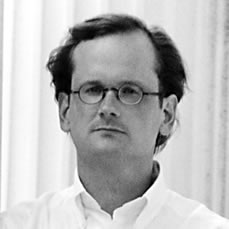
Lessig Many of my friends have been puzzled that I have not been a strong critic of the Tea Party. Indeed, quite the opposite, I stand as a critical admirer. That means that while I don't share most of the substantive ends of many in that movement, and I strongly object to the extremism of some, I am a genuine admirer of the urge to reform that is at the heart of the grassroots part of this, perhaps the most important political movement in the current political context.

My admiration for this movement grew yesterday, as at least the Patriots flavor of the Tea Party movement announced its first fight with (at least some) Republicans. The Tea Party Patriots have called for a GOP moratorium on “earmarks.” Key Republican Leaders (including Senator Jim DeMint and Congressman John Boehner) intend to introduce a resolution to support such a moratorium in their caucus. But many Republicans in both the House and Senate have opposed a moratorium. Earmarks, they insist, are only a small part of the federal budget. Abolishing them would be symbolic at best.

More here.