
Stuart E. Eizenstat in Foreign Affairs:
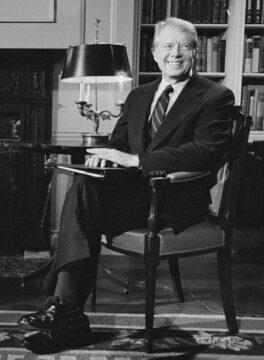 On September 17, 1978, U.S. President Jimmy Carter faced a momentous crisis. For nearly two weeks, he had been holed up at Camp David with Egyptian President Anwar al-Sadat and Israeli Prime Minister Menachem Begin, trying to hammer out a historic peace deal. Although the hard-liner Begin had proven intransigent on many issues, Carter had made enormous progress by going around him and negotiating directly with Israeli Foreign Minister Moshe Dayan, Defense Minister Ezer Weizman, and Legal Adviser Aharon Barak. On the 13th day, however, Begin drew the line. He announced he could compromise no further and was leaving. The talks on which Carter had staked his presidency would all be for naught.
But then, Carter made a personal gesture. Knowing that Begin had eight grandchildren and was exceptionally devoted to them, Carter signed photographs of the three leaders, which he addressed to each grandchild by name, and then personally carried them over to Begin’s cabin, where Begin was preparing to depart. As Begin read the names of his grandchildren, his lips quivered and his eyes watered and he put down his bags. Later that same day, he reached a breakthrough agreement with Sadat on what became the framework for the Egyptian-Israeli peace treaty six months later.
More here.
 Girard’s corpus is not just an erudite self-help manual, however; his intellectual landscape is not intended to be therapeutic, and yet it is. What he came to see was not a comfort, however, but something fierce and intractable. What he learned about the individual also limns the destiny of our species. Our impossible plight: the mechanism of scapegoat violence—whether on the level of the individual, or society, or epoch—is rooted in the very imitation that teaches us to love and learn, in fact, the very tissue that connects us with the rest of humanity.
 Have you ever said “I hate you” to someone? What about using the “h-word” in casual conversation, like “I hate broccoli”? What are you really feeling when you say that you hate something or someone?
 If you’ve ever vented to ChatGPT about troubles in life, the responses can sound empathetic. The chatbot delivers affirming support, and—when prompted—even gives advice like a best friend. Unlike older chatbots, the seemingly “empathic” nature of the latest AI models has already galvanized the psychotherapy community, with
  My own tutee students, whom I met on a regular basis, were reporting poor mental health or asking for extensions because they were unable to meet deadlines that were stressing them out. They were overly obsessed with marks and other performance outcomes, and this impacted not only on them, but also on the teaching and support staff who were increasingly dealing with alleviating student anxiety. Students wanted more support that most felt was lacking and, in an effort to deal with the issue, the university had invested heavily, making more provision for mental health services. The problem with this strategy, however, is that by the time someone seeks out professional services, they are already at a crisis point. I felt compelled to do something.
 For months, OpenAI has been losing employees who care deeply about making sure
 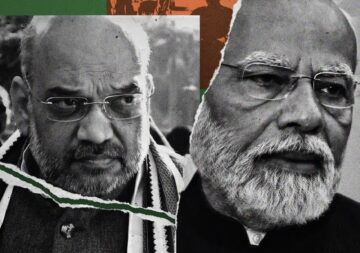 Today, Amit Shah isn’t home minister for Gujarat, but all of India. From the heart of power in Delhi, he is in charge of domestic policy, commands the capital city’s police force, and oversees the Indian state’s intelligence apparatus. He is, simply put, the second-most powerful man in the country. With the BJP poised to win the current general election, he is all but certain to remain so for at least the next five years. For Modi, he is what Dick Cheney and Karl Rove were for George W Bush – the muscle as well as the brain – rolled into one. Over the past decade, he has been the key architect in remaking India according to the BJP’s Hindu nationalist ideology.
 S
S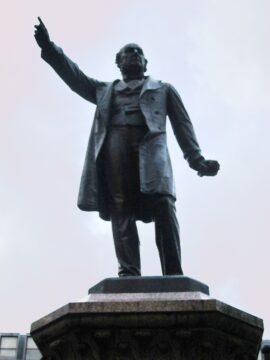 William Ewart Gladstone was Britain’s prime minister four times between 1868 and 1894, a member of Parliament for more than sixty years, a brilliant and passionate orator, an accomplished writer, and an indefatigable social reformer. Lord Kilbracken, his private secretary, estimated that if a figure of 100 could represent the energy of an ordinary man and 200 that of an exceptional one, Gladstone’s energy would be represented by a figure of at least 1,000.
 The day when
 ‘C
‘C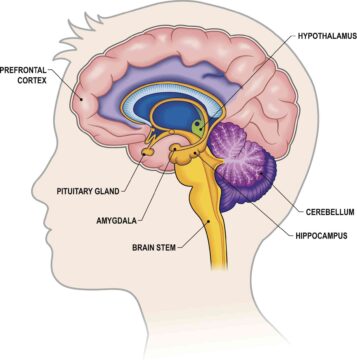 I am a neurobiologist focused on understanding the chemicals and brain regions that
 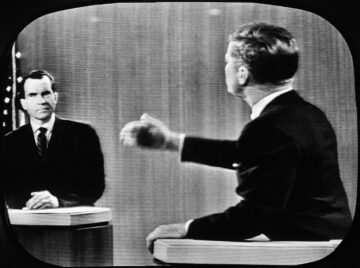 Donald Trump is incapable of meaningful participation in such an event. Only in the sense that “match” can apply to both chess and mud wrestling could the word “debate” apply both to the Kennedy-Nixon event and to Trump’s on-stage behavior. Trump cannot help but distort a debate into a cage-fight. He will, again, shamelessly lie and endlessly interrupt.