Tunisia: What comes next?

From Prospect Magazine:

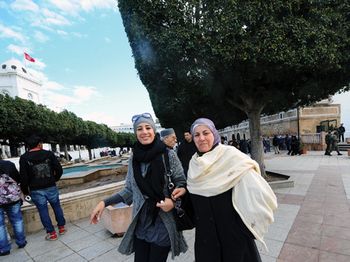
Tunis Tunis is oddly calm and normal for the capital of a country that has just triggered the greatest upheaval in the Arab world since the end of the first world war. Nor would you guess from the current provisional government that the revolution was driven by frustrated young people using the latest networking technologies; the combined ages of the new Tunisian president and prime minister is 161 years. But the two old men are bridging the generation gap and, for now, keeping the show on the road. The attention of the world has of course moved elsewhere since Tunisia, much to its own amazement, lit the torch at the end of December. But on a recent trip to Tunis I discovered that the Tunisians have not been idle since the president of 23 years, Ben Ali, fled the country on 14th January.

They are now on to their third government, having got rid of Ben Ali’s unpopular prime minister, Mohamed Ghannouchi, at the end of February. The new prime minister, 84-year-old Beji Caid Essebsi, a veteran of the 1950s independence movement and largely untainted by the Ben Ali regime, announced elections on 24th July for an assembly to draw up a new constitution. From not having had a proper election, ever, Tunisia is poised to have three in quick succession—culminating with elections for a new president and parliament, perhaps at the end of the year. This modest former French colony could now set the pattern for the next, trickier stage of Arab democratic reform. “We can be the test-bed for the whole Arab world, but we must not rush,” says Raoudha Ben Othman, professor of linguistics at Tunis University.

More here.

Thursday Poem

One Hundred White-sided Dolphins on a Summer Day

1.

Fat,
black, slick,
galloping in the pitch
of the waves, in the pearly

fields of the sea,
they leap toward us,
they rise, sparkling, and vanish, and rise sparkling,
they breathe little clouds of mist, they lift perpetual smile,

they slap their tails on the waves, grandmothers and grandfathers
enjoying the old jokes,
they circle around us,
they swim with us –

2.

a hundred white-sided dolphins
on a summer day,
each one, as God himself
could not appear more acceptable

a hundred times,
in a body blue and black threading through
the sea foam,
and lifting himself up from the opened

tents of the waves on his fishtail,
to look
with the moon of his eye
into my heart,

3.

and find there
pure, sudden, steep, sharp, painful
gratitude
that falls –

I don't know – either
unbearable tons
or the pale, bearable hand
of salvation

on my neck,
lifting me
from the boat's plain plank seat
into the world's

4.

unspeakable kindness.
It is my sixty-third summer on earth
and, for a moment, I have almost vanished
into the body of the dolphin,

into the moon-eye of God,
into the white fan that lies at the bottom of the sea
with everything
that ever was, or ever will be,

supple, wild, rising on flank or fishtail –
singing or whistling or breathing damply through blowhole
at top of head. Then, in our little boat, the dolphins suddenly gone,
we sailed on through the brisk, cheerful day.


by Mary Oliver
from What Do We Know
© Da Capo Press, 2002

Dying for a long life

From Nature:

Worm A chemical dye that lights up the protein clumps characteristic of Alzheimer's disease also slows ageing in worms. The lifespan-boosting effects of the dye — called Thioflavin T or Basic Yellow 1 — support the idea that the build-up of misshapen proteins underlies ageing. Drugs that recognize such toxic detritus and alert the cell's natural repair and protein-recycling systems could, therefore, be used to treat diseases of old age, says Gordon Lithgow, a molecular geneticist at the Buck Institute in Novato, California, who led the study, published today in Nature1.

Proteins are essential for almost everything a cell does, from communicating with other cells to generating energy. But sometimes proteins form the wrong three-dimensional shapes. Misfolded proteins don't function properly and, worse, tend to accumulate and gum up other cellular systems. To prevent this from happening, cells deploy 'chaperones', whose job it is to refold misshapen proteins. In more extreme cases, cells can degrade these potentially dangerous proteins. “There's a growing appreciation that protein misfolding may be one of the very fundamental events of ageing,” says Richard Morimoto, a molecular biologist at Northwestern University in Evanston, Illinois, who was not involved with the study. Worms genetically engineered to have a revved-up protein-recycling system, for instance, live longer than normal worms23.

More here.

Wednesday, March 30, 2011

India beat Pakistan to reach World Cup final

From Times of India:

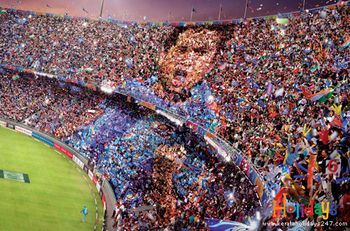
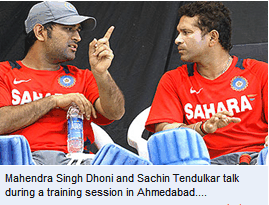
World-Cup-2011 Twenty-eight long years after that magical Indian summer in England, the Men in Blue are one victory away from proving that India is truly cricket’s superpower, not just commercially but also on the field. One victory away from being world No.1 in ODIs, in addition to Tests. One victory away from giving the ultimate thank you gift to the greatest cricketer since Don Bradman, and a fitting farewell to a coach who has contributed so much to their rise. And one victory away from giving millions of young Indians born after 1983 – including several members of the present team – the joy of knowing what it actually feels like to have your squad lift the Cup that counts before your jubilant eyes. Kumar Sangakkara – Sanga to millions of fans – is waiting with his formidable Lankans. But so is the opportunity of a lifetime for Dhoni’s Daredevils.

More here.

Wednesday Poem

The Wish to be Generous

All that I serve will die, all my delights,
the flesh kindled from my flesh, garden and field,
the silent lilies standing in the woods,
the woods, the hill, the whole earth, all
will burn in man's evil, or dwindle
in its own age. Let the world bring on me
the sleep of darkness without stars, so I may know
my little light taken from me into the seed
of the beginning and the end, so I may bow
to mystery, and take my stand on the earth
like a tree in a field, passing without haste
or regret toward what will be, my life
a patient willing descent into the grass.

by Wendell Berry
from The Collected Poems, 1957-1982

worrying about the singularity

Intelligencedeficit

If you’ve got any spare change, the Lifeboat Foundation of Minden, Nevada, has a worthy cause for your consideration. Sometime this century, probably sooner than you think, scientists will likely succeed in creating an artificial intelligence, or AI, greater than our own. What happens after that is anyone’s guess — we’re simply not smart enough to understand, let alone predict, what a superhuman intelligence will choose to do. But there’s a reasonable chance that the AI will eradicate humanity, either out of malevolence or through a clumsily misguided attempt to be helpful. The Lifeboat Foundation’s AIShield Fund seeks to head off this calamity by developing “Friendly AI,” and thus, as its website points out, “will benefit an almost uncountable number of intelligent entities.” As of February 9, the fund has raised a grand total of $2,010; donations are fully tax deductible in the United States. The date of this coming “Technological Singularity,” as mathematician and computer scientist Vernor Vinge dubbed the moment of machine ascendance in a seminal 1983 article, remains uncertain. He initially predicted that the Singularity (sometimes referred to, in less reverential tones, as the “Rapture of the nerds”) would arrive before 2030. Inventor and futurist Ray Kurzweil, whose book The Singularity Is Near was turned into a movie last year, places it in 2045. Those predictions are too conservative for Canadian science fiction juggernaut Robert J. Sawyer: in his WWW trilogy, whose third volume, Wonder, appears in April, the Singularity arrives in the autumn of 2012.

more from Alex Hutchinson at The Walrus here.

night and day

GrahamGreene

Night and Day, a literary magazine founded and run by Graham Greene in the early 20th century, survived for six months. The fact that it is remembered at all is testament to the extraordinary hold that small magazines are capable of exerting on the memories of publishers and writers alike. It’s odd, after all, that a publication that wobbled into existence so briefly should prompt two 21st-century publishers to declare that they intend to re-launch it “to celebrate our imprints’ rich and illustrious history”; to “bring forth… the vagaries of publishing life and an enviable slice of literary heritage”. But what is this history, and why is it worth celebrating?

more from Aime Williams at The New Statesman here.

one of history’s most unsuccessful utopias ever

Showalter_03_11

In June 1843, Bronson Alcott, his small family, and three of his Transcendental disciples from Alcott House in England – Charles Lane, who financed the project, his eleven-year-old son William, and their friend Henry Gardiner Wright – went to live in a utopian commune in Massachusetts called Fruitlands. Their six-month effort at being a ‘Consociate Family’ was traumatic and almost tragic. The philosophers knew nothing about agriculture, disapproved of the use of ‘noxious’ manure, and did not wish to oppress animals by ploughing the fields. They were extreme vegetarians (what we would call vegans), and by the winter were half-starving on a diet of apples, water and rough bread. For some of the thirteen members, Fruitlands was too fanatical; for others it was not fanatical enough. Gradually some decamped to more sociable environments, while the Lanes went off to a stricter Shaker community nearby, who later did not want to release William: as a celibate community, they needed every child they could get. The Alcotts soldiered on alone – father, mother Abigail (‘Abba’), and the four daughters Louisa, Anna, Elizabeth and May – until Bronson had a severe, almost suicidal breakdown. The entire enterprise was a disaster, what Richard Francis calls ‘one of history’s most unsuccessful utopias ever’.

more from Elaine Showalter at Literary Review here.

Why We Read ‘Don Quixote’

From The Paris Review:

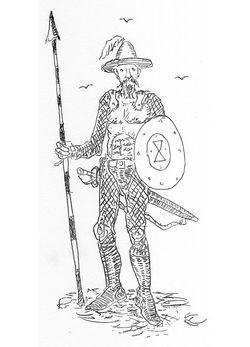
Quixote_wiley_BLOG2 What does it mean to be “quixotic” today? Are street-corner preachers quixotic? Is Bono? What about film directors who dementedly pursue the unlikely grail of adapting a difficult book for the screen? The word endures because its source endures. Don Quixote de la Mancha is the first modern novel, and two weeks ago I found myself on the Upper East Side, at the Queen Sofía Spanish Institute, tracing the word part of the way toward its origin. In the inevitable absence of Miguel de Cervantes, it was left to the book’s most recent English translator, Edith Grossman, the publisher, Andrew Hoyem, and the artist, William T. Wiley to explain the book’s riverine significance. The Quixote Delta has proved fertile ground for world literature, branching off into numerous tributaries, irrigating any number of national traditions and, finally, trickling down into the work of some of the most singular figures in world literature, from Nabokov to Borges, Fielding to Garcia Marquez.

But doesn’t quixotic threaten to swamp Quixote? Aren’t these words, which get coined in tribute to an author or a book, almost always treacherous? Can all the possibilities and implications of a character, or even—more ambitiously—a life’s work, be contained within the semantic boundaries of just one word? We think of Orwellian as adjectival shorthand for a state apparatus of terror and surveillance, but what if we also took it to mean window-pane clarity of expression or even a marked aversion to the poetry of Stephen Spender? In the same way, Don Quixote is not only a cautionary tale about the perils of idealism: among other things, it is also the first great book about books, a visionary parable about the responsibilities of reading and writing fiction that arrived early on in the age of printing. The river feeds into an ocean.

More here.

Khan Academy aims to reinvent education through video

From PhysOrg:

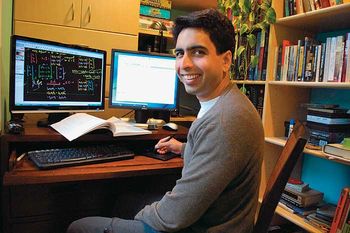
Salman_khan The problems with basic education, both in the US and other countries, are complex, but one website may have the ability to improve education on a global scale. The Khan Academy, whose mission is to “provide a free world-class education to anyone, anywhere,” currently has 2,200 video tutorials on subjects ranging from math to science to history. Not only could the free educational videos help individual students learn better, but the concept could also reform schools by redefining the teacher’s role and laying the foundations for a global classroom.

Since the site was launched in 2006, the videos have been viewed millions of times. The videos have received positive reviews from viewers due to their clear, conversation-style approach and simple drawings, which are made in SmoothDraw. But, as founder Salman Khan explained at a TED conference earlier this month, he thinks the Khan Academy could do a lot more. Khan wants to increase the academy’s video library to tens of thousands of video tutorials – each about 10 minutes long – that students would watch in the evening as “homework.” Then the next day in class, the students would work on homework-like assignments, where they could ask the teacher questions and work with their peers. In essence, by “flipping the classroom,” students could watch a video lecture as many times as they like, at their own pace, and then have time in class to ask specific questions.

More here.

Leonardo da Vinci’s Mathematical Slip-Up

Dirk Huylebrouk in Scientific American:

Davinci-mathematical-slip-up_1 Artist, inventor and philosopher Leonardo da Vinci (1452–1519) was without a doubt a genius. Yet, there is some criticism. In his book 1434: The Year a Magnificent Chinese Fleet Sailed to Italy and Ignited the Renaissance (William Morrow, 2008) British author and retired submarine commander Gavin Menzies claims that da Vinci swiped most of his ideas from the Chinese. Menzies's theory was poorly received by the world of science. Besides, isn't da Vinci's brilliance beyond question? Definitely, but the Dutch mathematician and artist Rinus Roelofs did find an error in one of the Renaissance man's drawings (at right).

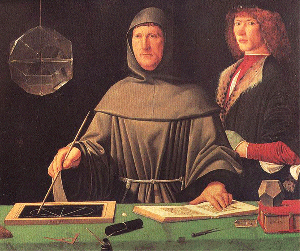
3-29-DaVinci-Picolli-300 A clue can be found in a portrait (below) of Luca Pacioli, a mathematician who, like his contemporary da Vinci, worked at the court of the Duke of Milan. The polyhedron in the left upper corner, hanging from a string, is called a rhombicuboctahedron: a polyhedron with an equilateral triangle that is always surrounded by squares. Leonardo illustrated it separately in Pacioli's book.

The rhombicuboctahedron can also be found in the star-shaped figures, at least if we put a pointed protrusion on each side surface—that is, a pyramid with a triangular or quadrangular base.

More here.

Why a Battle with Bat and Ball Is Exactly What India and Pakistan Need

Omar Waraich in Time:

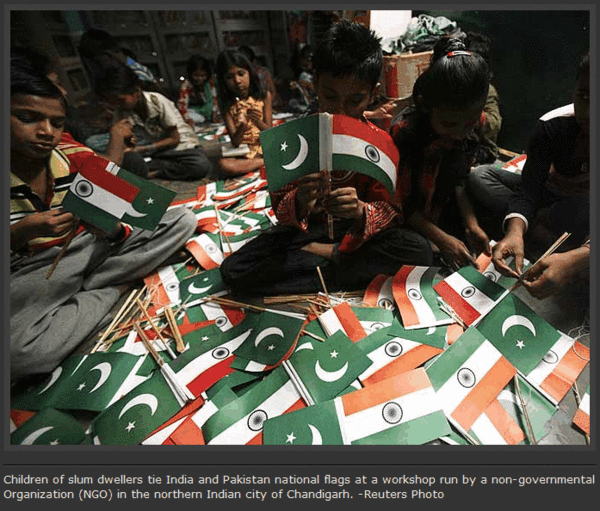
ScreenHunter_04 Mar. 30 08.11 It is difficult to exaggerate the excitement built up on both sides of the border, with anticipation of the match having dominated the news cycle for days now on a subcontinent obsessed with the sport. Hundreds of millions of viewers are expected to watch the match on television, with absenteeism at work likely to reach record highs. Pakistan's Prime Minister Yousuf Raza Gilani, who will be at the match, has announced that government offices will close two hours before the opening ball is bowled.

Cricket is a rare source of cohesion in an increasingly fractured Pakistani society in which passion for the game is as widespread and embedded in the national identity as the embrace of Islam is. But whereas religion has proved to be a violent source of division in recent years, cricket unites Pakistanis across the dangerous fissures of ethnicity, sect and social class. But the violent fanaticism that cloaks itself in religion impinged on the sanctity of cricket when, in March 2009, the visiting Sri Lankan team was attacked by terrorists. No foreign team has toured there since. Were it not for the terror threat, Pakistan would be co-hosting the World Cup. Some say it is better that Pakistan was spared the embarrassment of hosting matches at Lahore's Gaddafi Stadium, named in honor of the Libyan dictator for his support of Pakistan's clandestine nuclear weapons pursuit.

More here.

Tuesday, March 29, 2011

Jeremy Harding on Hitchens

In the LRB:

Hitchens’s strong, almost gamey opinions produce a whiff of well-hung grouse in the reactions he provokes, and it tends to linger in the house. Stefan Collini, for the opposition, imagines Hitchens ‘as twilight gathers and the fields fall silent, lying face down in his own bullshit’ (LRB, 23 January 2003). Colin MacCabe, for the friends, tells us that passages of the memoir, Hitch-22, are ‘among the most affecting writing that I know in English’ (New Statesman, 17 November 2010). That’s a pungent claim and it bears repeating, or MacCabe must have thought so. Last month in the Pittsburgh Post-Gazette, he recalled telling Hitchens that the first two chapters of the memoir were ‘among the most affecting prose that I had ever read in English’. Hitchens, it seems, seldom meets with moderation and when he does, it’s apt to give way to exasperation. And so John Barrell, reviewing his book on Tom Paine (LRB, 30 November 2006):

Rights of Man (not The Rights of Man, as Hitchens persistently calls it) was written as an answer to Burke’s Reflections on the Revolution in France, and Hitchens tells us that among others who wrote replies to Burke … was William Godwin, which he wasn’t. He says that, unlike Paine, Wollstonecraft advocated votes for women, which she didn’t. Paine himself, Hitchens says, was not discouraged from writing Part One of Rights of Man by the rough treatment he received at the hands of a Parisian crowd following Louis XVI’s flight to Varennes. Nor should he have been, for Part One was published several months before the king fled and Paine was manhandled. According to Hitchens, Part Two was produced partly to explain to Dr Johnson the need for a written constitution, and partly to endorse Ricardo’s views on commerce and free trade, but when it was written Johnson had been dead for seven years and Ricardo, not yet 20, had published no views that required endorsing.

Hitchens’s fans are prepared to overlook the odd slip in favour of the flow (or the ‘words’, as Chris Corner goes on to say in his lugubrious ode):

Your words will live in us
Timelessly insane
Explosive, fresh and wise

But which words? ‘Wise’ he’s never done. And ‘fresh’? His flirtatious, boom-boody-boom examination of Tony Blair at close quarters is the best contender. Dr Hitchens says of the appealing patient who followed him into the deserts of Mesopotamia: ‘There is a moral pulse to be detected here and it’s quite a strong one’ (Vanity Fair, February). Hitchens in ‘explosive’ mode is hard to monitor: he is a one-man North Korea. For timeless insanity – and ‘timeless’, I guess, means anything either side of the long happy hour – one goes to the vexed sentence in the book on Paine that amused Barrell after a morning’s irritation: ‘Just as Paine’s joke about dress and lost innocence was intended to remind his audience of a mythical Eden, so his appeal to a lost but golden and innocent past was a trope that Milton and Blake knew very well.’

Blind Spot: Why We Fail to Do What’s Right and What to Do about It

From Harvard Magazine:

Cover Could the financial crisis have been solved by giving all individuals involved more ethics training? If the training resembled that which has historically and is currently being used, the answer to that question is no. Ethics interventions have failed and will continue to fail because they are predicated on a false assumption: that individuals recognize an ethical dilemma when it is presented to them. Ethics training presumes that emphasizing the moral components of decisions will inspire executives to choose the moral path. But the common assumption this training is based on—that executives make explicit trade-offs between behaving ethically and earning profits for their organizations—is incomplete. This paradigm fails to acknowledge our innate psychological responses when faced with an ethical dilemma.Findings from the emerging field of behavioral ethics—a field that seeks to understand how people actually behave when confronted with ethical dilemmas—offer insights that can round out our understanding of why we often behave contrary to our best ethical intentions. Our ethical behavior is often inconsistent, at times even hypocritical. Consider that people have the innate ability to maintain a belief while acting contrary to it. Moral hypocrisy occurs when individuals’ evaluations of their own moral transgressions differ substantially from their evaluations of the same transgressions committed by others.

More here.

Top six India-Pakistan thrillers

From the Hindustan Times:

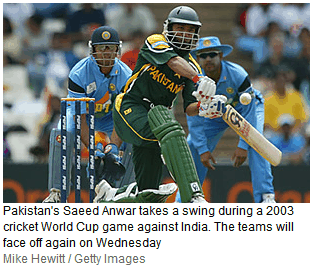
ScreenHunter_03 Mar. 29 13.46 India and Pakistan have played 119 one-day internationals in more than three decades. Here's a look at six memorable matches ahead of Wednesday's World Cup semi-final in Mohali:

March 22, 1985 | Sharjah India won by 38 runs – Pakistani paceman Imran Khan had virtually put his team in a winning position when he grabbed 6-14 off 10 overs to bowl India out for a paltry 125 in a Four-Nations Cup match. But India, led by fast bowler Kapil Dev (3-17), dismissed Pakistan for 87 to clinch a low-scoring thriller.

April 18, 1986 | Sharjah Pakistan won by one wicket – The match will always be remembered for Pakistani batsman Javed Miandad's last-ball match-winning six off Indian seamer Chetan Sharma. Pakistan needed four runs to win off the last delivery before Miandad (116 not out) broke Indian hearts with one memorable blow.

More here.

Tuesday Poem

The Boat

Maybe the eyes of a dragon or goddess
glare from its prow.

More likely it leaks, loses an oar,
and reeks of rainbows awash on a sheen
of gutted salmon and gasoline.

If it’s a liner, we lash ourselves
to whatever will float or sell.

No matter which. We choose. We’re aboard,
icebergs or no, as we plow
through the songs of the siren stars—

one boat, black water, dark whispering below.

…………………..
by Paul Fisher

All roads lead to Mohali for “mother of all contests”

ScreenHunter_02 Mar. 29 13.20

From Dawn:

NEW DELHI: A tiny north Indian city has overnight become a hottest tourist destination, drawing Prime Ministers, corporate czars, showbiz celebrities and passionate fans for what is touted as the “mother of all cricket contests”.

Nothing gets bigger in this part of the globe than a cricket match featuring India and Pakistan, who fought three wars since their independence from Britain in 1947.

The rivalry would be renewed in Wednesday’s World Cup semi-final in Mohali in the state of Punjab and the city administration is already bracing for a logistical nightmare. Many government and cricket officials fear the match could be a potential tinderbox given the emotions involved and some have urged the fans and the media not to hype what is essentially a cricket contest.

“It’s like any other match. The media hype around the match, I think, is totally unnecessary,” Pakistan team manager Intikhab Alam told CNN-IBN channel.

“We have come here to play cricket. This is not war field or anything. I’m sure you will see a great game of cricket,” said the former Pakistan captain, who has coached the Punjab team in Ranji trophy.

Even South African all-rounder Jacques Kallis hoped the high-profile match would pass without anything untoward.

More here.