Tuesday Poem

Disappearing Act

No, soul doesn't leave the body.

My body is leaving my soul.
Tired of turning fried chicken and
coffee to muscle and excrement,
tried of secreting tears, wiping them,
tired of opening eyes on another day,
tired especially of that fleshy heart,
pumping, pumping. More,
that brain spinning nightmares.
Body prepares:
disconnect, unplug, erase.

But here, I think, a smallish altercation
arises.
Soul seems to shake its fist.
Wants brain? Claims dreams and nightmares?
Maintains a codicil bequeathes it shares?

There'll be a fight. A deadly struggle.
We know, of course, who'll win. . . .

But who's this, watching?

by Eleanor Ross Taylor
from Blackbird, Spring 2002

How quickly are you aging?

From Scientific American:

My-what-long-telomeres-you-have_1 Doctors routinely urge their patients to quit smoking and exercise regularly. But what if there were a blood test that could show smokers and couch potatoes the damage their lifestyle was actually wreak­ing on their chromosomes?

Two groups of prominent researchers have started companies to provide just such a test, which would measure the length of one’s telomeres. Telomeres are caps on the ends of chromosomes, protecting them much as plastic tips on the ends of shoelaces keep the laces from fraying. Whenever chromosomes—the store­houses of our genes—are replicated in preparation for cell division, their telomeres shorten. That shrinking has led many scientists to view telomere length as a marker of biological aging, a “molecular” clock ticking off the cell’s life span, as well as an indicator of overall health. Studies comparing the telomere length of white blood cells among groups of volunteers show distinct correlations between telomere length and lifestyle. Those who exercise regularly have longer telomeres than those who do not. Folks who perceive themselves as the most stressed have shorter telomeres than those who see themselves as the least. Certain diseases, too, correlate with shorter telomeres, including cardiovascular, obesity and Alzheimer’s.

More here.

Multitude of Species Face Climate Threat

Carl Zimmer in The New York Times:

Zimmer Over the past 540 million years, life on Earth has passed through five great mass extinctions. In each of those catastrophes, an estimated 75 percent or more of all species disappeared in a few million years or less. For decades, scientists have warned that humans may be ushering in a sixth mass extinction, and recently a group of scientists at the University of California, Berkeley, tested the hypothesis. They applied new statistical methods to a new generation of fossil databases. As they reported last month in the journal Nature, the current rate of extinctions is far above normal. If endangered species continue to disappear, we will indeed experience a sixth extinction, over just the next few centuries or millennia.

The Berkeley scientists warn that their new study may actually grossly underestimate how many species could disappear. So far, humans have pushed species toward extinctions through means like hunting, overfishing and deforestation. Global warming, on the other hand, is only starting to make itself felt in the natural world. Many scientists expect that as the planet’s temperature rises, global warming could add even more devastation. “The current rate and magnitude of climate change are faster and more severe than many species have experienced in their evolutionary history,” said Anthony Barnosky, the lead author of the Nature study.

More here.

Monday, April 4, 2011

Sunday, April 3, 2011

Five Ways of Looking at the Legend of Derek Jeter

Mag-03Riff-t_CA0-articleLargeSam Anderson in the New York Times Sunday Magazine:

1. The Book of Jeter

The time has come, once again, for everyone to think about Derek Jeter. Don’t try to fight it: it is time. Here in the spring of Jeter’s 17th season, as he begins to play out what should be the last of his giant contracts, as he prepares to become the first career-long Yankee to amass 3,000 hits, as he melts the snow across the Northeast with the warmth of his intangible clutchness and coaxes the fresh blades of grass (which he spent his entire off-season individually planting across America) out of the dark and loamy soil — it is only right that our thoughts should turn back to the Captain.

But how do we even begin to think about someone who has been so thoroughly thought about? Jeter has been, since the middle of the Clinton administration, the signature player on the signature franchise in America’s signature sport — a sport that doubles as national mythology. He is the meta-Yankee: his legendary glories help us to experience, firsthand, the legendary glories of previous generations of Yankees. He’s like a wormhole to the world of our grandparents. His entire career might as well have been broadcast in sepia.

Jeter’s mythology is, at this point, basically impenetrable. His public image is almost scandalously banal — as Buster Olney once put it, he is “Jimmy Stewart in pinstripes.” He’s like an after-school special about the Protestant work ethic. His every motion expresses the quiet dignity of champion champion dignity champion dignity champion. (Sorry: my word-processing software figured out that I was writing about Derek Jeter and started automatically filling in the text.)

Imperialism Reclaimed

Pa3729c_thumb3 Robert Skidelsky on Niall Ferguson's new book Civilization: The West and the Rest:

Ferguson snazzily summarizes the reasons for this reversal in six “killer apps”: competition, science, property rights, medicine, the consumer society, and the work ethic. Against such tools – unique products of Western civilization – the rest had no chance. From such a perspective, imperialism, old and new, has been a beneficent influence, because it has been the means of spreading these “apps” to the rest of the world, thereby enabling them to enjoy the fruits of progress hitherto confined to a few Western countries.

Understandably, this thesis has not met with universal approbation. The historian Alex von Tunzelmann accused Ferguson of leaving out all of imperialism’s nasty bits: the Black War in Australia, the German genocide in Namibia, the Belgian exterminations in the Congo, the Amritsar Massacre, the Bengal Famine, the Irish potato famine, and much else.

But that is the weakest line of attack. Edward Gibbon once described history as being little better than a record of the “crimes, follies, and misfortunes of mankind.” Imperialism certainly added its quota to these. But the question is whether it also provided, through Hegel’s “cunning of reason,” the means to escape from them. Even Marx justified British rule in India on these grounds. Ferguson, too, can make a sound argument for such a proposition.

Foreign Aid for a Frugal Age

Mmw_povertyaction_0311 John Mecklin in Miller-McCune:

[Dean Karlan and Jacob Appel's] More Than Good Intentions builds off the behavioral economics ideas widely publicized in Nudge, the Richard Thaler/Cass Sunstein book that explains how people can be encouraged to make better decisions by a society that makes good decisions easier to reach than bad ones. (Prototypical example: Students eat more fresh fruit and vegetable sticks when they are put in an appealing display next to the cafeteria cash register.) But Karlan’s book combines a keen sense of the quirks of behavioral economics with an insistence on the rigorous scientific testing of international development programs, using random, controlled trials to see whether the programs improve people’s lives.

The first sections of the book are fascinating, if less cheerful than the rest, as they take the shine off a category of aid that has been a darling of the development sector: micro-credit. In 2006, the Nobel Peace Prize went to Bangladeshi economist Muhammad Yunus and the Grameen Bank, which Yunus created, for their work over three decades to, as the Norwegian Nobel Committee put it, “create economic and social development from below.”

“Lasting peace cannot be achieved,” the committee opined, “unless large population groups find ways in which to break out of poverty. Micro-credit is one such means.”

Micro-credit programs — which offer small-scale loans to people (often women) in developing countries who then start or expand small-scale businesses — have spread to reach some 155 million people. More Than Good Intentions does not conclude that the micro-credit movement is a failure, but through a series of studies Karlan does show that, as he put it in a recent phone conversation with me, micro-credit “is the poster child for programs that are oversold.” In random, controlled trials aimed at testing the efficacy of several micro-lending programs, he finds that there are, indeed, amazing success stories, people who have taken small loans and, through entrepreneurial skill and hard work, lifted themselves out of poverty. But the studies show that this result isn’t the most common, that — as anyone with much experience in the for-profit world might guess — a poor population in a developing nation with a rudimentary educational system is unlikely to contain a far higher percentage of brilliant entrepreneurs than the general population of a richer, better-educated country.

But More Than Good Intentions doesn’t debunk international development mythology just for the sake of debunking. It tries, instead, to find a middle way between continuing to invest billions of dollars in aid programs with long, sad histories of accomplishing little and giving up on development aid as inherently ineffective.

Sunday Poem

Sean Pen Anti-ode

Must Sean Penn always look like he’s squeezing
the last drops out of a sponge and the sponge
is his face? Even the back of his head grimaces.
Just the pressure in his little finger alone
could kill a gorilla. Remember that kid
whose whole trick was forcing blood into his head
until he looked like the universe’s own cherry bomb
so he’d get the first whack at the piñata?
He’s grown up to straighten us all out
about weapons of mass destruction
but whatever you do, don’t ding his car door with yours.
Don’t ask about his girlfriend’s cat.
Somewhere a garbage truck beeps backing up
and in these circumstances counts as a triumph of sanity.
Sleet in the face, no toilet paper,
regrets over an argument, not investing wisely,
internment of the crazy mother, mistreatment
of laboratory animals.
Life, my friends, is ordinary crap.
Pineapple slices on tutu-wearing toothpicks.
Those puke bags in the seatback you might need.
The second DVD only the witlessly bored watch.
Some architectural details about Batman’s cape.
Music videos about hairdos, tattoos, implants and bling.
The crew cracking up over some actor’s flub.

by Dean Young
from Poetry, Vol. 188, No. 4, July/August
Publisher: Poetry, Chicago, © 2006

Natural history of the soul

From New Humanist:

Nick[1] In his new book Soul Dust: The Magic of Consciousness, Nicholas Humphrey, a distinguished evolutionary psychologist and philosopher, claims to have solved two fairly large intellectual conundrums. One is something of a technical matter, about which you may have thought little or not at all, unless you happen to be a philosopher. This is the so-called “hard problem” of consciousness. The problem is how an entity which is apparently immaterial like the human consciousness – it exists, but you can’t locate it, much less measure it – can have arisen from something purely physical, like the arrangement of cells that make up the human body. The second problem Humphrey claims he has solved is a rather more everyday one, about which you may well have puzzled yourself. This is the problem of the soul. Does it exist? What sort of a thing might it be? Does everyone have one, even atheists?

His solution to both these problems is the same, because for him the strange properties of consciousness, the fact that for those of us that have it the world of dull matter is suffused with meaning, beauty, relevance and awe – means that it makes sense to think that we are permanent inhabitants of a “soul-niche” or “soul-world”. As the jacket blurb of his book has it, “consciousness paves the way for spirituality”, by creating a “self-made show” that “lights up the world for us, making us feel special and transcendent.” Consciousness and the soul are one and the same.

More here.

I’ve Seen Every Woody Allen Movie: Here’s what I’ve learned

From Slate:

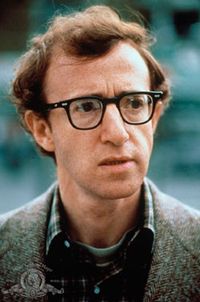
Allen In this little-seen comedy, the recently divorced Allan Felix (Woody Allen) tries to get the hang of dating. Trouble is, he's romantically self-destructive: Felix (I'll use his surname to avoid confusion) says he's attracted to “emotionally disturbed women,” and that's not an exaggeration. The depth of his perverse inclination becomes clear when he approaches a woman looking at a Jackson Pollock drip-painting, and asks what it means to her. She answers: “It restates the negativeness of the universe. The hideous, lonely, emptiness of existence. Nothingness. The predicament of man forced to live in a barren, godless eternity like a tiny flame flickering in an immense void with nothing but waste, horror, and degradation forming a useless bleak straightjacket in a black absurd cosmos.” She's just the kind of woman Felix has been looking for, and he asks her what's she's doing Saturday night. “Committing suicide,” she responds. Unfazed, he counters: “What about Friday night?”

This nameless woman seems to articulate Allen's world view exactly. (After the 2009 release of Whatever Works, he told NPR that filmmaking “distracts me from the uncertainty of life, the inevitability of aging and death and death of loved ones; mass killings and starvation, from holocausts—not just man-made carnage, but the existential position you're in.” Inspiring!) But in Play It Again, Sam, we're clearly meant to find her approach ridiculous. The depressive despairs: Because there is “nothing,” she longs to return to that state. Felix, by contrast, moves forward blithely: If existence is lonely and hideous, why not go out on Saturday? Or Friday, whatever, he's not busy. By letting Felix win the volley, Allen also endorses his protagonist's resigned epicurean sensibility.

More here.

Dhoni leads India to World Cup glory

From CNN:

ScreenHunter_01 Apr. 03 13.25 Captain Mahendra Singh Dhoni guided India to a second Cricket World Cup title on Saturday as his team beat tournament co-hosts Sri Lanka by six wickets in the final in Mumbai.

Dhoni, the world's highest-paid player, produced his best performance of the six-week-long event when it mattered most as India passed Sri Lanka's total of 274-6 with 10 balls of the allotted 50 overs to spare.

The 29-year-old smashed the winning runs with a huge six over the boundary ropes to finish the innings unbeaten on 91 off only 79 balls faced.

He set up victory with his fourth-wicket partnership of 109 with Gautam Gambhir, who top-scored with an invaluable 97, after coming to the batting crease at 114-3 in the 22nd over.

Sri Lanka, winners of the tournament in 1996 and runners-up in the last staging four years ago, set a potentially testing target for India thanks to an unbeaten 103 from captain Mahela Jayawardene.

With the victory, India — the top-ranked team in cricket's five-day Test format — assumed the No. 1 position in the limited-overs game ahead of previous champions Australia.

More here. [Photo shows Sachin Tendulkar.]

Reconsidering the Goldstone Report on Israel and war crimes

Richard Goldstone in the Washington Post:

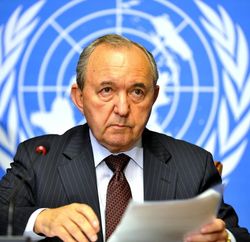
RichardGoldstone We know a lot more today about what happened in the Gaza war of 2008-09 than we did when I chaired the fact-finding mission appointed by the U.N. Human Rights Council that produced what has come to be known as the Goldstone Report. If I had known then what I know now, the Goldstone Report would have been a different document.

The final report by the U.N. committee of independent experts — chaired by former New York judge Mary McGowan Davis — that followed up on the recommendations of the Goldstone Report has found that “Israel has dedicated significant resources to investigate over 400 allegations of operational misconduct in Gaza” while “the de facto authorities (i.e., Hamas) have not conducted any investigations into the launching of rocket and mortar attacks against Israel.”

Our report found evidence of potential war crimes and “possibly crimes against humanity” by both Israel and Hamas. That the crimes allegedly committed by Hamas were intentional goes without saying — its rockets were purposefully and indiscriminately aimed at civilian targets.

More here.

Saturday, April 2, 2011

all that is left to them is the essay

Ed38f2f2-5c01-11e0-bb56-00144feab49a

“Why, since life holds only so many hours, waste one of them on being lectured?” asked Virginia Woolf in her amusing 1934 essay “Why?”. The question could equally well be applied to the essay form itself: why? Why do novelists write essays? Why do we read them? Next month, a new imprint called Notting Hill Editions will be launched to publish great essays, past and present. Lucasta Miller, its editorial director, says: “In the 19th century, essayists such as Charles Lamb, William Hazlitt and Thomas De Quincey found a huge readership, as did George Orwell in the 20th. Now is the perfect time to reinvigorate the essay.” It’s already happening. In the past month, Hanif Kureishi’s Collected Essays, the sixth and final volume of The Essays of Virginia Woolf and The Inevitable, a collection of pieces on death edited by David Shields and Bradford Morrow, have all been published. Alongside these, Egyptian novelist Alaa Al Aswany has assembled a collection of essays, On The State of Egypt, which is available now as an e-book and will be published in the UK in May. The essay in its modern, playful, discursive form dates back to Michel de Montaigne, who published his ground-breaking Essais (“attempts”) in 1580.

more from Carl Wilkinson at the FT here.

mildred pierce

6a00d8341c630a53ef014e86f5ed99970d-800wi

“I make no conscious effort to be tough, or hard-boiled, or grim,” Cain once noted of his own writing, “or any of the things I am usually called. I merely try to write as the character would write, and I never forget that the average man, from the fields, the streets, the bars, the offices, and even the gutters of his country, has acquired a vividness of speech that goes beyond anything I could invent, and that if I stick to this heritage, this logos of the American countryside, I shall attain a maximum of effectiveness with very little effort.” In 1941, Cain published his fourth novel, “Mildred Pierce,” a book that has such an aesthetic at its heart. The story of a divorcee in Depression-era Glendale, it was filmed in 1945 with Joan Crawford; this weekend, HBO debuts a new five-part adaptation with Kate Winslet in the title role. To read “Mildred Pierce” now is to experience a double vision, in which we confront both how much and how little things have changed.

more from David L. Ulin at the LAT here.

quantum man

Johnson-articleInline

In the heyday of the physicist Richard P. Feynman, which ensued after his death in 1988, a publishing entrepreneur might have been tempted to start a book club of works by and about him. Offered as main selections would be Feynman’s autobiographical rambles (as told to Ralph Leighton), “ ‘Surely You’re Joking, Mr. Feynman!’ ” and “ ‘What Do You Care What Other People Think?’ ” For alternate selections, readers could choose from his more serious works, like “QED: The Strange Theory of Light and Matter” — a spirited account of the counterintuitive behavior of the quantum world — and the legendary “Feynman Lectures on Physics.” Whatever the man said had swagger. For those who would rather listen, there are recordings of the lectures and of Feynman playing his bongos. He was an irresistible subject for biographers and, as he called himself in two of his subtitles, a curious character indeed. The best biography, James Gleick’s “Gen­ius,” captured the ebullience — sometimes winning, sometimes exasperating — and gave lucid explanations of some hard physics. Those seeking a more mathematical treatment could turn to Jagdish Mehra’s thick book “The Beat of a Different Drum,” while for a lighter touch there was Christopher Sykes’s “No Ordinary Gen­ius: The Illustrated Richard Feynman.”

more from George Johnson at the NYT here.

Saturday Poem


Now I Become Myself

Now I become myself. It's taken
Time, many years and places,
I have been dissolved and shaken,
Worn other people's faces,
Run madly, as if Time were there,
Terribly old, crying a warning,
“hurry, you will be dead before —–“
(What? Before you reach the morning?
or the end of the poem, is clear?
Or love safe in the walled city?)
Now to stand still, to be here,
Feel my own weight and density!…..
Now there is time and Time is young.
O, in this single hour I live
All of myself and do not move
I, the pursued, who madly ran,
Stand still, stand still, and stop the Sun!

by May Sarton
from Collected Poems 1930-1993

Pakistan: a Hard Country

From The Telegraph:

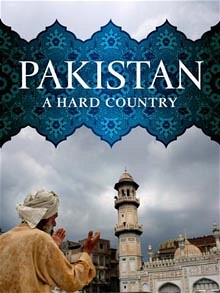
Pakistan_summary_1861193f The crisis in North Africa and the Middle East has driven Pakistan out of the headlines, but this is surely only a temporary lull. Cursed by nuclear weapons, home to al-Qaeda, victim of several raging insurgencies and notorious for a chronically unstable political structure – most Western experts continue to view Pakistan as the most dangerous country in the world. So this book by Anatol Lieven could hardly be more timely. Lucid and well informed, he deals carefully with all Pakistan’s well-known problems. And one of the joys of this nicely written volume is that it avoids the hysteria and partial judgment that disfigure much contemporary writing on the subject.

Above all, it emanates a deep affection bordering on love for unfortunate, beleaguered, magical Pakistan. Lieven’s research takes him to an army cantonment in Quetta, boar-hunting in the Punjab and to a stay in Taliban-dominated Mohmand Agency on the North West Frontier. Lieven, a former foreign correspondent who is now professor of terrorism studies at King's College, London, talks to just about everybody who counts: farmers, intelligence officers, judges, clerics, politicians, doctors, soldiers, jihadis. In the course of this journey he demolishes the neo-conservative narrative that Pakistan is dominated by a mortal struggle between virtuous modernity and rage-filled Islamist conservatism. He insists that Pakistan is not – as Western intelligence agencies, journalists and think tanks believe – a country on the brink. We needn’t worry too much about its nuclear weapons falling into the wrong hands. Pakistan is not about to be taken over by Islamists.

More here.