How Evolution Explains Altruism

From The New York Times:

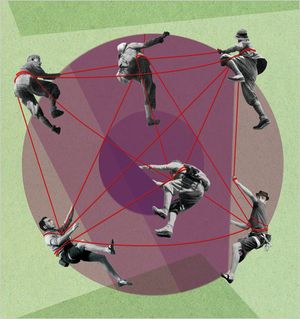
Harman-popup What do colon cancer, ant colonies, language and global warming have in common? This might sound like the front end of a joke, but in fact it’s a serious challenge to the standard view of evolution. Martin A. Nowak, the director of the Program for Evolutionary Dynamics at Harvard, has devoted a brilliant career to showing that Darwin, and particularly his followers, batted only two for three. Random mutation and natural selection have indeed been powerful motors for change in the natural world — the struggle for existence pitting the fit against the fitter in a hullabaloo of rivalry. But most of the great innovations of life on earth, Nowak argues, from genes to cells to societies, have been due to a third motor, and “master architect,” of evolution: cooperation.

“SuperCooperators” (written with Roger Highfield, editor of New Scientist magazine) is an absorbing, accessible book about the power of mathematics. Unlike Darwin with his brine bottles and pigeon coops, Nowak aims to tackle the mysteries of nature with paper, pencil and computer. By looking at phenomena as diverse as H.I.V. infection and English irregular verbs, he has formally defined five distinct mechanisms that have helped give rise to cooperative behavior, from the first molecules that joined to self-replicate, to the first cells that formed multicellular organisms, all the way to human societies, which exhibit a degree of cooperation unmatched in all creation. In Nowak’s view, figuring out how cooperation comes about and breaks down, as well as actively pursuing the “snuggle for existence,” is the key to our survival as a species.

More here.

Saturday Poem

Afterlife

Older people are exiting this life as if it were a movie… “I didn’t get it,”
they are saying.
He says, “It didn’t seem to have any plot.”
“No.” she says, “it seemed like things just kept coming at me. Most of the
time I was confused… and there was way too much sex and violence.”
“Violence anyway,” he says.
“It was not much for character development either; most of the time
people were either shouting or mumbling. Then just when someone started
to make sense and I got interested, they died. Then a whole lot of new
characters came along and I couldn’t tell who was who.”
“The whole thing lacked subtlety.”
“Some of the scenery was nice.”
“Yes.”
They walk on in silence for a while. It is a summer night and they walk
slowly, stopping now and then, as if they had no particular place to go.
They walk past a streetlamp where some insects are hurling themselves at
the light, and then on down the block, fading into the darkness.
She says, “I was never happy with the way I looked.”
“The lighting was bad and I was no good at dialogue,” he says.
“I would have liked to have been a little taller,” she says.

by Louis Jenkins
from North of the Cities
Will o’ the Wisp Books, 2007

© Louis Jenkins.

Friday, April 8, 2011

translating rimbaud

Rimbaud-448

What are the Illuminations? Originally an untitled, unpaginated bunch of manuscript pages that Arthur Rimbaud handed to his former lover Paul Verlaine on the occasion of their last meeting, in Stuttgart in 1875. Verlaine had recently been released from a term in a Belgian prison for wounding the younger poet with a pistol in Brussels two years earlier. Rimbaud wanted his assassin manqué to deliver the pages to a friend, Germain Nouveau, who (he thought) would arrange for their publication. This casual attitude toward what would turn out to be one of the masterpieces of world literature is puzzling, even in someone as unpredictable as its author. Was it just a question of not wanting to splurge on stamps? (Verlaine would later complain in a letter that the package cost him “2 francs 75 in postage!!!”) More likely it was because Rimbaud had decided already to abandon poetry for what would turn out to be a mercantile career in Africa, trafficking in a dizzying variety of commodities (though not, apparently, slaves, as some have thought). He had, after all, seen his previous book, A Season in Hell, through publication, though he had left the bulk of the edition with its printer, whom he wasn’t able to pay. Like Emily Dickinson, he had seen “the horses’ heads were toward eternity.” In the penultimate strophe of “Adieu,” the last poem of A Season in Hell, he had written: “Meanwhile, this is now the eve. Let’s welcome the influx of strength and real tenderness. And at dawn, armed with burning patience, we will enter splendid cities.”

more from John Ashbery at Poetry here.

What is jewelry?

Our own Morgan Meis in The Smart Set:

30011_410206089424_513199424_4185593_2507765_n What is jewelry? We know what it is, of course. Jewelry is the pretty extras with which we adorn ourselves. But what is it really? There is no specific use to jewelry. Yet, humans in every culture on the planet wear jewelry of some kind. It is ubiquitous and pointless at the same time.

Here's something Art Smith said about jewelry:

A piece of jewelry is in a sense an object that is not complete in itself. Jewelry is a 'what is it?' until you relate it to the body. The body is a component in design just as air and space are. Like line, form, and color, the body is a material to work with. It is one of the basic inspirations in creating form.

Art Smith was a Brooklyn man. He died in 1982 after a lifetime spent making jewelry. He had a shop on Cornelia Street in Greenwich Village back in the 1940s. He was influenced quite clearly by the broader trends in Modernism that characterized the era. One of his necklaces was, famously, inspired by the mobiles of Alexander Calder. You can see that piece and others, along with some of Art's tools and drawings, at the Brooklyn Museum of Art right now.

I like Art's statement about jewelry because it offers an interesting “third way” out of the art-versus-craft dilemma. In the last century or so, a dividing line between art and craft was drawn according to whether or not the object in question was “useful.” Crafts — such as weaving or carpentry or glass making — could be artful, but the fact that they were still geared toward the production of useful and usable objects meant that they were not art as such. Fine art distinguished itself by having no other purpose except to be art. A painting, for instance, cannot be used for anything else. Taken out of its context, a painting ceases to function.

More here.

Tevatron accelerator yields hints of new particle

Jason Palmer at the BBC:

ScreenHunter_07 Apr. 08 15.11 A particle accelerator in the US has shown compelling hints of a never-before-seen particle, researchers say.

The find must be more fully confirmed, but researchers at the Tevatron are racing to work through existing data.

If proved, it will be a completely new, unanticipated particle; researchers say it cannot be the much sought-after Higgs boson.

It could also signal a new fundamental force of nature, and the most radical change in physics for decades.

Researchers at the Tevatron formally announced the find on the collaboration's website, after posting an as-yet unreviewed account of the research on the Arxiv repository.

The team was analysing data from collisions between protons and their anti-matter counterparts antiprotons. In these collisions, particles known as W bosons are produced, along with a pair of “jets” of other particles.

It was in these jets that the unexpected “bump” in the team's data came to light, potentially representing a particle that the current understanding of the zoo of subatomic particles – the Standard Model – does not include.

More here.

Friday Poem

The Bridge

I want to stay with you tonight, as light unhusks
and spills slowly from the half-moon,
where I am lying curved beside you in the dark.

I know you by touch, our bodies finding the other,
kiss by kiss, like birds flying in pattern, a tiny shape of God –
breast to breast and legs intertwined.

Your flesh glitters, shadowless, round droplets
rising in dew. I cannot be near enough.
I remember the first night our skins were this close,

after a day of rain, a bridge shining behind you
in the blind wilderness. I heard the crunch
of leaves under my boots, the distant heartbreak

of a bird’s small cry as I moved closer to you,
one half of a creature midwived out of the dark,
trails of goose-pimples along my skin.

Months later I think of it, leaning against you,
as if on the lip of a boat, and the clouds
unloosing their nets until the full rain came again,

moving everything in one direction, tremendous as a cell
and brushing against the whole nerve of my body,
in the dew hours, your lips on my forehead.

© 2006, Leanne O’Sullivan

Dreams and Work: On ‘Light Years’

Porochista Khakpour in The Paris Review:

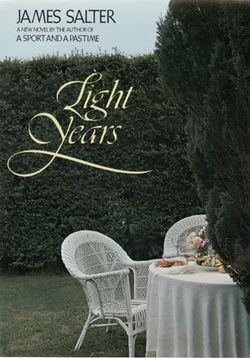
Salter_lightyears_BLOG I discovered James Salter just late enough, in grad school, at the suggestion of a brooding alcoholic, the best writer in the room, with whom I’d become entangled in a very Salter-esque doomed affair. I was the writer who’d gush about the stylists, steer the conversations from plot and story to diction and syntax, the one who’d make over-earnest pleas about art over mechanics, always to the rolled eyes of the Ivy Leaguers who made up most the program. Most everything I wrote failed on a story level as much as it succeeded on a sentence level, and so this writer-fling of mine one day said, “You should read Salter. Because he does that thing you like. But he also tells stories. He can help you.”

I dashed to Light Years—Salter’s fourth novel, published in 1975—as I did to any of his suggestions. Up to that point, stylists meant maximalists, hysterical realists, the breathless and the sprawling: William Faulkner, Thomas Pynchon, John Barth, Stephen Dixon. I had never encountered a minimalist I could live inside of. But as minimal as Light Years was aesthetically, it was maximal emotionally. The sentences were sharp and piercing, alarmingly brief, and yet they contained entire lifetimes rendered in stream of consciousness within three-word observations about the seasons. “I’m a frotteur, someone who likes to rub words in his hand, to turn them around and feel them, to wonder if that really is the best word possible,” Salter said in his Paris Review interview. I lived for that poet’s spirit in my storytellers. That taut and yet tender surface simplicity was applied to amplifying the elemental in this world destroyed me, as if trees and desks and fog and smoke are their own metaphors in a universe that is essentially figurative:

The trees are naked. The eels sleep.

Life is weather. Life is meals.

Dreams and work.

The mornings were white, the trees still bare.

More here.

What will people do for money?

From PhysOrg:

Money_tree FeldmanHall’s study showed that what people say they will do in a given situation and what they really do are two very different things. If given a hypothetical situation of a choice of giving someone an electrical shock for money or walking away, most people answered they would never be able to inflict pain on another person. However, in a real-life scenario, with real money and real electric shocks, the actions were much different. In FeldmanHall’s study, subjects were placed in an MRI scanner and then given the choice to either administer an electrical shock to a person located in another room and make money (one British pound) or not inflict pain and receive no money. They also broke down that one pound into percentages based on the severity of the shock, so they would receive the full pound for administering a severe shock and less for more mild shocks.

The subject in the MRI was shown a video of the person receiving the shock and would either see just the person’s hand jerk or be shown both the hand jerk and the person’s face. Each participant was given the choice to shock another person 20 times, with the opportunity to make 20 pounds. In the hypothetical scenario, 64 percent of participants said they would never administer a shock to someone else for money. However, in the real world that number changed, and in a big way. When faced with real money, 96 percent chose to shock the person in the other room for money.

More here.

Fossil fuels are not about to run out. That’s our biggest problem—and our big opportunity

Dieter Helm in Prospect:

ScreenHunter_06 Apr. 08 09.46 Peak oil—the idea that we have passed or are about to pass the physical peak of oil production—is again in fashion. It has been lent impetus by events in the Middle East and North Africa. Predictions abound of imminent price shocks, $200 dollars-a-barrel oil, and an oil-induced Armageddon. We have been here before: it is all very reminiscent of the reactions to the Iranian revolution and the oil price shock in 1979 when oil prices hit $39 a barrel (about $130 in current money).

Belief in this coming Armageddon naturally underpins the case for going green, and in particular for placing overwhelming emphasis on renewables and energy efficiency measures. Current extremely expensive offshore wind programmes (amounting to over £100bn in Britain before 2020) become economic, advocates of this argument say, because the price of the alternative is going to be so high. Energy efficiency becomes more attractive at high oil prices, the argument goes, and hence the demand for energy will fall (at least for the domestic market) thereby offsetting the costs of renewables. Thus the strategy pays for itself.

From an environmental perspective it all looks too good to be true—and it is. Almost all that could be wrong with this argument is wrong—there is no obvious peak in oil production; what matters for electricity is gas (and coal), not oil; and there are few reasons to think that energy demand is likely to fall. Renewables will increase retail prices a lot. The one thing that remains is that offshore wind is about the most expensive means to achieving limited carbon reductions.

More here.

Thursday, April 7, 2011

China Miéville’s Other Reality

Farrell_36.2_mieville Henry Farrell reviews China Miéville's The City & the City, in The Boston Review:

When Granta compiled its decennial list of the best young British writers ten years ago, it did not include China Miéville, thank to his well-known connections to fantasy and science fiction. Yet it paid him the even greater compliment of including him by name in its salon des refusés. Miéville is unabashedly a writer of the fantastic, but his influences trace back to Bruno Schulz and Mervyn Peake as well as the pulps. Not to mention Marx—Miéville is a committed socialist and has stood for Parliament. And, as Michael Chabon has observed, Miéville’s first instinct toward the conventions of genre is to play with them.

In The City & the City Miéville continues to play, offering a distinctive combination of fantasy’s two familiar flavors. Committed fantasists such as C.S. Lewis embrace the obsessive literalism that the British novelist M. John Harrison has unkindly described as “the great clomping foot of nerdism . . . the attempt to exhaustively survey a place that isn’t there.” They try to make the fantastic seem real in its own right, internally consistent and painfully detailed. By contrast, mainstream novelists who dabble in fantasy—José Saramago in Blindness, Cormac McCarthy in The Road—do not fret about internal consistency or detail. For them, the fantastic provides a device for allegorical comment on some aspect of the real world.

But rather than serving up fantasy as a world in itself or as an allegory subordinate to the real world, Miéville treats the real world (or something like it) as a set of detailed, overlapping fantasies. In The City & the City he takes elements of our own world—the social relationships that organize our lives—directly into his imagined one, and reconfigures them with the machinery of fantasy. Miéville’s task is as complicated as it sounds, but he’s up to it. The result is an innovative way of using fiction to understand ourselves.

3 Quarks Daily App Now Available For Android Phones

Mobile Blog Reader - powered by Notice OrangeHello,

If you have an Android phone, please try the new 3 Quarks Daily app by clicking on the picture at the right.

There is also a permanent icon in the right-hand column (below the ads) where you can click to get the app.

We are still working on getting iPhone and iPad apps approved by the Apple store people, and hope to have something for those devices in a couple of weeks.

Please let us know what you think of the app by either emailing me or leaving a comment here.

Thanks!

Abbas

Spellbound

Jhumpa Lahiri in Paris Review:

Salter1 For over half my life, I have returned repeatedly to Light Years. It was the first of James Salter’s books I discovered; it has since led me to all his others. Light Years is the one I know best. The first copy was borrowed. It belonged to my college roommate and was among the handful of books she’d brought with her from home, having nothing to do with our classes. It was a beautiful paperback published by North Point Press: yellow border, rough edges, thickly woven pages, a Bonnard painting on the cover. It was 1985. The book was ten years old; I was eighteen. I was new to New York, a freshman at Barnard College. I was unsophisticated, unmoored, bewildered by college and by the city. Reading the novel was like opening a window for the first time in spring, after a long winter has passed. Something worn out was set aside, something invigorating ushered in. At the time I had not read much contemporary literature. I had certainly never read sentences so precise, so clean, so fervent and yet so calm. I reacted to the novel as I did to the books of my childhood: it cast a spell in the same way, provoking a reaction that was visceral and dreamlike and whole. But here was a book that was about adulthood, the undiscovered country that lay on the other side of a bridge I was only beginning to cross.

I loved the mood of the book, which was sober and sophisticated, but also casual, playful. I loved its structure, restrained and orderly, while at the same time loose and unspooling. I loved its intimate texture and its images: Nedra’s hands flat on a table, her oat-colored sweater. Pigeons crowding into the R of a furniture store, a martini that is like a change in the weather. I loved the devotional rendering of meals, peoples’ faces, rooms and the objects they contained. Though it felt startlingly modern, I recognized certain ancient forms of literature I was studying in my classes: myth, elegy, ode. The five acts of Shakespeare. Long passages of conversation, as unadorned but as revelatory as dialogue in a classical play.

More here.

Contagious yawning evidence of empathy

From PhysOrg:

Chimp New research at the Yerkes National Primate Research Center, Emory University, may help scientists understand empathy, the mechanism thought to underlie contagious yawning, in both chimpanzees and humans. The research also may help show how social biases strengthen or weaken empathy. Scientists at Yerkes discovered chimpanzees yawn more after watching familiar chimpanzees yawn than after watching strangers yawn. The Public Library of Science One (PLoS ONE) is publishing the study online on Wednesday, April 6, 2011. Yerkes researchers Matthew Campbell, PhD, and Frans de Waal, PhD, propose that when yawning spreads between chimpanzees, it reflects an underlying empathy between them.

“The idea is that yawns are contagious for the same reason that smiles, frowns and other facial expressions are contagious,” they write. “Our results support the idea that contagious yawning can be used as a measure of empathy, because the biases we observed were similar to empathy biases previously seen in humans.” Campbell is a FIRST postdoctoral fellow at Yerkes and Emory (Fellowship in Research and Science Teaching). De Waal is director of the Living Links Center at Yerkes and C.H. Candler Professor of Psychology at Emory. They studied 23 adult chimpanzees that were housed in two separate groups. The chimpanzees viewed several nine-second video clips of other chimpanzees, in both groups, either yawning or doing something else. They yawned 50 percent more frequently in response to seeing members of their group yawn compared to seeing others yawn.

More here.

12 Questions with Michael Sandel

Jonathan Bruno and Jason Swadley in The Art of Theory:

Art of Theory: What features of our political life most puzzle you?

Michael-sandel Sandel: I would say the largely arid terms of political discourse, the thinness of public discourse in the world’s leading democracies. That’s the single most striking and worrisome thing.

It’s partly the tendency, over the past three decades, of economics to crowd out politics. This has been an age of market triumphalism. We’ve come to the assumption that markets are the primary instruments for achieving the public good. I think that is a mistaken notion and people are now beginning to question that.

It also has led to political discourse being preoccupied with technocratic, managerial, economic concerns. The broader public questions and ethical questions have been crowded to the side.

I think that this has been reinforced by a certain idea of toleration, a well-intentioned idea of toleration that says, “Given the disagreements we have on moral and spiritual questions, we should try to conduct our political debate without reference to them.” I think that’s also contributed to an emptying out of substantive moral discourse in politics, an emptiness people are eager to fill.

Such emptiness often provokes a backlash, so that narrow, intolerant and sometimes fundamentalist voices fill that void and have a persuasive force they wouldn’t otherwise have, if public discourse included open and direct engagement with rival moral views and moral conceptions.

More here.

No. 11: to be famous

Matthew Kevin Clair in 365 (a blog devoted to presenting 365-word-or-less stories written daily for 365 days):
Playing-baby-grand In fourth grade when he got the lead in Mozart, the school musical, he promised himself he would do everything in his power to become famous by the age of 18.

This promise lead to little changes, at first. He asked his mom to sign him up for voice lessons in addition to his already twice-weekly piano lessons. He never missed a lesson, and his mother was often overheard at club dinners gushing over her son's many accomplishments: lead pianist in this, lead vocals in that.

But by sixth grade, something changed, his voice wasn’t quite the same, and he didn’t get the lead in Aladdin, that year’s school production.

This forced other changes. After watching the world cup with his father one summer, he asked to start taking soccer lessons. But after a few weeks, he realized the other boys had been playing for years and he was too far behind to be a star. He tried painting and debate and basketball and came to the same realization: it was too late to be exemplary.

By the time high school came around, he started wearing black clothes and eye-liner. He dyed his hair. He didn’t have any friends, but his classmates were always staring at him and he read rumors about himself on bathroom stalls and in the back of math textbooks. This was fame, he thought at first, until he read The Scarlet Letter junior year and understood the meaning of infamy.

And so, on his eighteenth birthday, all other options exhausted, he set up a Youtube account and streamed himself live for the whole internet to see as he opened his college dorm room window, kicked out the screen and let his bare feet dangle over the courtyard fifty feet below as he readied himself to fulfill his promise.

More stories here.