This year’s best illusion reveals a visual quirk

From MSNBC:

Dot A mysterious illusion that illustrates how motion can render color changes invisible won the “Best Illusion of the Year” for 2011, and it also taught researchers something they didn't know. “It is a really beautiful effect, revealing something about how our visual system works that we didn't know before,” said Daniel Simons, a professor at the University of Illinois, Champaign-Urbana. Simons studies visual cognition, and did not work on this illusion. Before its creation, scientists didn't know that motion had this effect on perception, Simons said.

A viewer stares at a speck at the center of a ring of colored dots, which continuously change color. When the ring begins to rotate around the speck, the color changes appear to stop. But this is an illusion. For some reason, the motion causes our visual system to ignore the color changes. (You can, however, see the color changes if you follow the rotating circles with your eyes.) [See video of illusion winner] This illusion is the work of Jordan Suchow, a graduate student in cognitive science at Harvard University, and his adviser George Alvarez. Their illusion took first place at the conclusion of the seventh annual Best Illusion of the Year Contest in Florida. Suchow discovered it when his laptop, which was displaying a similar set of color-changing circles, slipped and the dots appeared to stop changing.

More here.

Tuesday, May 10, 2011

the many unknowns of the arab spring

Arab+Spring2

Yet we know that the spring of revolutions is followed by the passions of summer and the discord of fall. At least since Hegel’s analysis of the follies of the French Revolution in Phenomenology of Spirit, it has become commonplace to think that the Revolution will devour its own children. Such warnings were expressed not only by Hillary Clinton in the first days of the Egyptian uprising; the many commentators who have hidden their distrust in the capacity of the Arab peoples to exercise democracy are now rejoicing that the first signs of contention between religious and secular groups are breaking out in Egypt and Tunisia. The journalists and intellectuals of the European Right, who have spilt a lot of ink on whether or not “Islamophobia” is racist, are now attempting to cover their tracks, while Israel’s “pseudo-friends” among European conservatives are prophesying imminent attacks on Israel by Hizbollah in the north and Egypt cum Hamas in the south.[1] None of this is inevitable. It is not inevitable, or even likely, that fundamentalist Muslim parties will transform Tunisia or Egypt into theocracies; nor is it inevitable that Iran will gain ascendance and that the Arab states will conduct a new war against Israel. What we have witnessed is truly revolutionary, in the sense that a new order of freedom – a novo ordo saeclorum – is emerging transnationally in the Arab world.

more from Seyla Benhabib at Eurozine here.

You don’t resist Picasso … a woman doesn’t resist Picasso

Picasso110509_198b

Picasso and Marie-Thérèse: L’Amour fou,” the rapturous, vagino-­maniacal show of more than 80 Pablo Picasso works at Gagosian, is a love story. It tells a tale of a devouring monster, a goddess and doormat, frenzied sex, and abject cruelty. The woman of the show’s title is Marie-Thérèse Walter, called “the greatest sexual passion of Picasso’s life,” “endlessly submissive and willing,” the sumptuous voluptuary who surrendered to his sadomasochistic demands. He himself once called her “a slice of melon,” and she said of herself, “I always cried with Picasso. I bowed my head in front of him.” “L’Amour fou” was curated by John Richardson and Diana Widmaier Picasso, granddaughter of the artist and Marie-Thérèse. Widmaier Picasso once told a British paper that her grandmother talked of their “secrets,” some of which have been widely reported. Richardson (in his acclaimed three-part Picasso biography) says that Picasso enjoyed “the perverse pleasure of denying [Walter] the release of orgasm.” Yet Walter herself rhapsodized, many years later, that sex with Picasso was “completely fulfilling,” describing him as “very virile.” For decades, no one knew of Walter or that she was Picasso’s mistress from 1927 until around 1937. Not only was she his submissive sexual conquest, artistic muse, psychic victim, and mother of his daughter; she’s the fleshy subject of some of his juiciest paintings. Picasso said she saved his life. And it’s true that from the moment she appears in his work, in early 1927, his art gets plusher and more immediate, catapulting him out of Cubism, paving the way for all his subsequent efforts. Marie-Thérèse is the fertile inspiration that made Picasso Picasso after Cubism.

more from Jerry Saltz at New York Magazine here.

the intimate orwell

Leys_1-052611_jpg_190x868_q85

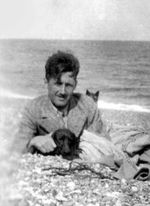
All the diaries of Orwell that are still extant (some were lost, and one was stolen in Barcelona during the Spanish civil war, by the Stalinist secret police—it may still lie today in some Moscow archive) were first published in 1998 by Peter Davison and included in his monumental edition of The Complete Works of George Orwell (twenty volumes; nine thousand pages). They are now conveniently regrouped here in one volume, excellently presented and annotated by Davison. The diaries provide a wealth of information on Orwell’s daily activities, concerns, and interests; they present considerable documentary value for scholars, but they do not exactly live up to their editor’s claim: “These diaries offer a virtual autobiography of his life and opinions for so much of his life.” This assessment would much better characterize the utterly fascinating companion volume (also edited by Peter Davison), George Orwell: A Life in Letters. Orwell’s diaries are not confessional: here he very seldom records his emotions, impressions, moods, or feelings; hardly ever his ideas, judgments, and opinions. What he jots down is strictly and dryly factual: events happening in the outside world—or in his own little vegetable garden; his goat Muriel’s slight diarrhea may have been caused by eating wet grass; Churchill is returning to Cabinet; fighting reported in Manchukuo; rhubarb growing well; Béla Kun reported shot in Moscow; the pansies and red saxifrage are coming into flower; rat population in Britain is estimated at 4–5 million; among the hop-pickers, rhyming slang is not extinct, thus for instance, a dig in the grave means a shave; and at the end of July 1940, as the menace of a German invasion becomes very real, “constantly, as I walk down the street, I find myself looking up at the windows to see which of them would make good machine-gun nests.”

more from Simon Leys at the NYRB here.

Osama bin Laden mission agreed in secret 10 years ago by US and Pakistan

Declan Walsh in The Guardian:

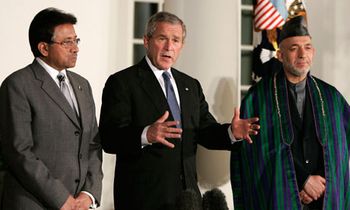
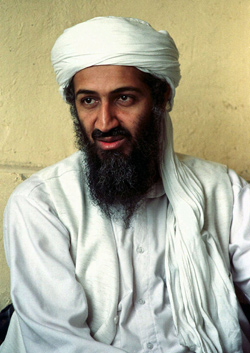
Pervez-Musharraf-and-Geor-007 The US and Pakistan struck a secret deal almost a decade ago permitting a US operation against Osama bin Laden on Pakistani soil similar to last week's raid that killed the al-Qaida leader, the Guardian has learned.

The deal was struck between the military leader General Pervez Musharraf and President George Bush after Bin Laden escaped US forces in the mountains of Tora Bora in late 2001, according to serving and retired Pakistani and US officials.

Under its terms, Pakistan would allow US forces to conduct a unilateral raid inside Pakistan in search of Bin Laden, his deputy, Ayman al-Zawahiri, and the al-Qaida No3. Afterwards, both sides agreed, Pakistan would vociferously protest the incursion.

“There was an agreement between Bush and Musharraf that if we knew where Osama was, we were going to come and get him,” said a former senior US official with knowledge of counterterrorism operations. “The Pakistanis would put up a hue and cry, but they wouldn't stop us.”

The deal puts a new complexion on the political storm triggered by Bin Laden's death in Abbottabad, 35 miles north of Islamabad, where a team of US navy Seals assaulted his safe house in the early hours of 2 May.

Pakistani officials have insisted they knew nothing of the raid, with military and civilian leaders issuing a strong rebuke to the US. If the US conducts another such assault, Prime Minister Yousaf Raza Gilani warned parliament on Monday, “Pakistan reserves the right to retaliate with full force.”

More here.

Unspoken Truths

Until cancer attacked his vocal cords, the author didn’t fully appreciate what was meant by “a writer’s voice,” or the essential link between speech and prose. As a man who loved to talk, he turns to the masters of such conversation, both in history and in his own circle.

Christopher Hitchens in Vanity Fair:

I have seen the moment of my greatness flicker,
And I have seen the eternal Footman hold my coat, and snicker,
And in short, I was afraid.

—T. S. Eliot, “The Love Song of J. Alfred Prufrock.”
L-hitchens Like so many of life’s varieties of experience, the novelty of a diagnosis of malignant cancer has a tendency to wear off. The thing begins to pall, even to become banal. One can become quite used to the specter of the eternal Footman, like some lethal old bore lurking in the hallway at the end of the evening, hoping for the chance to have a word. And I don’t so much object to his holding my coat in that marked manner, as if mutely reminding me that it’s time to be on my way. No, it’s the snickering that gets me down.

On a much-too-regular basis, the disease serves me up with a teasing special of the day, or a flavor of the month. It might be random sores and ulcers, on the tongue or in the mouth. Or why not a touch of peripheral neuropathy, involving numb and chilly feet? Daily existence becomes a babyish thing, measured out not in Prufrock’s coffee spoons but in tiny doses of nourishment, accompanied by heartening noises from onlookers, or solemn discussions of the operations of the digestive system, conducted with motherly strangers. On the less good days, I feel like that wooden-legged piglet belonging to a sadistically sentimental family that could bear to eat him only a chunk at a time. Except that cancer isn’t so … considerate.

Most despond-inducing and alarming of all, so far, was the moment when my voice suddenly rose to a childish (or perhaps piglet-like) piping squeak. It then began to register all over the place, from a gruff and husky whisper to a papery, plaintive bleat. And at times it threatened, and now threatens daily, to disappear altogether. I had just returned from giving a couple of speeches in California, where with the help of morphine and adrenaline I could still successfully “project” my utterances, when I made an attempt to hail a taxi outside my home—and nothing happened. I stood, frozen, like a silly cat that had abruptly lost its meow.

More here.

Uganda Walks to Work

Robert P. Baird in n + 1:

ScreenHunter_05 May. 10 13.33 On the day of the royal wedding in Britain, my wife emailed from the other side of Kampala. “At least if I’m stuck at the hospital, I get to stream the royal wedding! Totally surreal to watch this with periodic bullets and tear-gas canisters in the background.” Needless to say, this was not the kind of thing you want to hear from your spouse: it’s always a shock to discover you’re sleeping with a royalist.

The bullets and tear gas were worrying as well. They were the most visible manifestation of the Ugandan government’s crackdown on a series of “walk to work” protests that have taken place twice a week for three weeks now. The demonstrations began as a complaint against a government quick to spend millions on Russian fighter jets and presidential inaugurations but seemingly unconcerned with a 30 percent annual increase in food prices and a headline inflation rate of 14 percent. Demonstrators have joined the millions of Ugandans for whom walking to work is a matter of economic necessity, abstaining from cars, shared taxis, and the motorcycle taxis known as boda-bodas.

The pattern of protest and crackdown settled into a rhythm early on. On Monday and Thursday mornings, Ugandans—opposition politicians, students, and regular citizens—would walk from their homes, and the police—regular, plainclothes, and military—would do their best to stop them.

More here.

The future of old

From The Boston Globe:

Thefutureofold2__1304707488_3139-1 When these experts look ahead, they see a population of people who are less vulnerable to isolation, less likely to be bored, and more adept at using technologies to stay healthy and compensate for various ways in which life has become more difficult. They also see a population less inclined to leave the workforce — or less able to leave it — for a life of pure leisure: “Retirement” in today’s sense is likely to shrivel and be pushed later into life. We’re looking at people living 30 to 40 years longer than they did 100 years ago,” said Joseph Coughlin, director of the MIT AgeLab. “More of your adult life will be lived after the age of 50 than before age 50. The question is, what’re you going to do with it?”

There are still unknowns, such as how and whether America will keep funding the health care system the old now count on, or whether the prevalence of dementia will continue to grow or be vanquished by medicine. And skeptics warn against fantasies of Peter Pan-style agelessness: There is no escaping that age changes how you move and how you think. But among the most resonant — and least obvious — points that aging experts make is that old age, though a constant throughout human history, does not refer to some static set of habits, joys, and frustrations. Rather, it is an evolving condition that is continuously defined, and redefined, with every generation that experiences it.

More here.

Life and the Cosmos, Word by Painstaking Word

From The New York Times:

Hawkingillo-sfSpan Like Einstein, he is as famous for his story as for his science. At the age of 21, the British physicist Stephen Hawking was found to have amyotrophic lateral sclerosis, Lou Gehrig’s disease. While A.L.S. is usually fatal within five years, Dr. Hawking lived on and flourished, producing some of the most important cosmological research of his time.

In the 1960s, with Sir Roger Penrose, he used mathematics to explicate the properties of black holes. In 1973, he applied Einstein’s general theory of relativity to the principles of quantum mechanics. And he showed that black holes were not completely black but could leak radiation and eventually explode and disappear, a finding that is still reverberating through physics and cosmology. Dr. Hawking, in 1988, tried to explain what he knew about the boundaries of the universe to the lay public in “A Brief History of Time: From Big Bang to Black Holes.” The book sold more than 10 million copies and was on best-seller lists for more than two years. Today, at 69, Dr. Hawking is one of the longest-living survivors of A.L.S., and perhaps the most inspirational. Mostly paralyzed, he can speak only through a computerized voice simulator.

More here.

Tuesday Poem

Possibilities

I prefer movies.
I prefer cats.
I prefer the oaks along the river.
I prefer Dickens to Dostoyevsky.
I prefer myself liking people
to myself loving mankind.
I prefer keeping a needle and thread on hand, just in case.
I prefer the color green.
I prefer not to maintain
that reason is to blame for everything.
I prefer exceptions.
I prefer to leave early.
I prefer talking to doctors about something else.
I prefer the old fine-lined illustrations.
I prefer the absurdity of writing poems
to the absurdity of not writing poems.
I prefer, where love's concerned, nonspecific anniversaries
that can be celebrated every day.
I prefer moralists
who promise me nothing.
I prefer cunning kindness to the over-trustful kind.
I prefer the earth in civvies.
I prefer conquered to conquering countries.
I prefer having some reservations.
I prefer the hell of chaos to the hell of order.
I prefer Grimms' fairy tales to the newspapers' front pages.
I prefer leaves without flowers to flowers without leaves.
I prefer dogs with uncropped tails.
I prefer light eyes, since mine are dark.
I prefer desk drawers.
I prefer many things that I haven't mentioned here
to many things I've also left unsaid.
I prefer zeroes on the loose
to those lined up behind a cipher.
I prefer the time of insects to the time of stars.
I prefer to knock on wood.
I prefer not to ask how much longer and when.
I prefer keeping in mind even the possibility
that existence has its own reason for being.

by Wislawa Szymborska
from Nothing Twice
translation by S. Baranczak & C. Cavanagh

Monday, May 9, 2011

perceptions

Soft-rockers-Sheila Kennedy
Sheila Kennedy. Soft Rocker. 2011

” … a set of solar-powered lounge chairs called SOFT Rockers. These curved, solar-panel-covered seats rotate on an axis to keep them facing the sun, generating additional energy from the rocking motion created when people climb inside. All that harvested electricity can be used to recharge gadgets plugged into the three USB ports and to illuminate a light strip on the inside of the loop.”

During MIT's 150th anniversary celebrations, new art and design projects are scattered over the campus. May 7-8th were devoted to FAST – Festival of Arts Science and Technology.

More here, here, and here.

Sunday, May 8, 2011

The Enigma of Mahatma Gandhi

9a9723334c51907c86aa7db19698.jpeg Sugata Bose in Harvard Magazine:

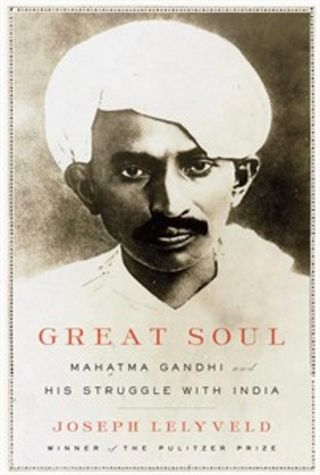
Gandhi led mass agitations against the British raj in roughly decennial cycles. Lelyveld mentions the civil disobedience movement launched in 1930 with the salt satyagraha (protesting the government’s tax on salt) as its centerpiece, but his narrative thread for the Depression decade is supplied by the debates on the caste issue between Gandhi and B.R. Ambedkar, a member of and spokesman for the “Depressed Classes.” Ambedkar, who stood for the destruction of the caste system, found Gandhi’s attitude toward the “untouchables”—Harijans, or children of God, as he dubbed them—a trifle patronizing. Lelyveld skillfully unravels the story of Gandhi’s fast in 1932 against separate electorates for the “Depressed Classes,” his anti-untouchability campaign of 1933, and his stunning characterization of the Bihar earthquake of 1934 as divine chastisement for the sin of untouchability. The unreason inherent in that statement elicited a rebuke from none other than Rabindranath Tagore, the poet who had granted Gandhi the “Great Soul” epithet.

Lelyveld’s analysis of Gandhi on caste and of the vexed Gandhi-Ambedkar relationship is brilliant. But his lack of interest in covering what he describes as “the political ins and outs of the movement” entails a loss and a missed opportunity to explore Gandhi’s ties with younger radicals like Jawaharlal Nehru and Subhas Chandra Bose. Gandhi was, after all, primarily the leader of India’s anti-colonial movement and had vigorous debates with these compatriots on the social and economic reconstruction of free India.

Lelyveld is right on the mark in suggesting that Gandhi was “never more elusive or complex” than in the final decade of his life, as he sought to balance his values with “the strategic needs of his movement.” The decision to call upon the British to “quit India” in August 1942 reveals, in Lelyveld’s words, “a flash of the fully possessed ‘do or die’ Gandhi, the fervent commander.” “Your president,” Gandhi had said to Louis Fischer, a young American journalist and future biographer, in June 1942, “talks about the Four Freedoms. Do they include the freedom to be free?”

Targeted Killing

Quads0305_JeremyWaldron Jeremy Waldron in the LRB blog:

The killing of Osama bin Laden is an instance of a much more general policy pursued by the United States and its allies – the targeted killing of named individuals in the war against terrorism and against various insurgencies in Iraq and Afghanistan. In the midst of American celebration of the fact that al-Qaida has lost its charismatic leader, it is worth getting clear about targeted killing in general, i.e. about the legality and the desirability of a policy of this kind. Targeted killings are of two kinds. The first involves killing people who are actually engaged in carrying out terrorist acts – planting a bomb or preparing someone for a suicide bombing. The second involves the elimination of high-profile individuals whose names appear on a special list of active commanders and participants in terrorism or insurgency. These killings are part of a strategy of disruption and decapitation directed against terrorist organisations.

Killings of either kind can be problematic from a legal point of view (the more so if they involve the violation of another country’s sovereignty). But they may be lawful depending on the circumstances. What is certainly forbidden is targeted killing for the sake of justice or vengeance, both of which have been cited by American authorities as justifications in this case. Calling the killing of Osama bin Laden ‘justice’ summons up very primitive notions of retribution, utterly dislocated from the rule-of-law processes that the civilised world prides itself on. If justice in the strict sense had really been in question, an attempt would have to have been made to capture the man alive. Despite some initial equivocation, it is plain that no such attempt was contemplated.

I think the only possible justification for the shooting of bin Laden was as a legitimate act of war.

On Bin Laden’s Lingering Face

ID_IC_MEIS_BINLA_AP_001 Morgan Meis being characteristically wise, over at The Smart Set:

The most surprising thing about the death of Osama bin Laden was his funeral. Islamic law declares that a person must be buried within 24 hours of death. “We are ensuring that it is handled in accordance with Islamic practice and tradition,” Time reported a U.S. official as saying, “This is something that we take very seriously. And so therefore, this is being handled in an appropriate manner.”

Bin Laden was buried at sea, presumably so that there will be no burial site, no country that owns him, no place on Earth could be associated with him ever after. The sea gets him, being the only place capacious enough to take on the burden. There is dignity in having done it this way. Not dignity for him, but dignity for us. It is understandable that people want to celebrate the death of a man who scared us, who was the author of a traumatizing act of violence, who plotted the deaths of thousands and dreamed of the deaths of thousands upon thousands more. But I am not sure that celebrating death ever does anything very good for the one who celebrates.

I shuddered for the souls of the men at Saddam Hussein's execution. The footage is, now, widely available on the Internet. It was captured surreptitiously on a cell phone video camera. Saddam is brought into a dingy room in what looks like a basement. He is bustled toward a noose and begins praying. Some of the people standing below begin to shout. They are calling out, “Muqtada,” in reference to Muqtada al-Sadr, the Shia religious and political leader. Saddam says the name Muqtada back to them and then asks, “Do you call this courage?” Another person yells at Saddam to go to hell. He replies, “the hell that is Iraq?” Then he goes back to praying. All of a sudden, the trap door beneath Saddam opens and he plummets. He is gone. It is impossible to watch that footage without feeling that Saddam stole his dignity back in those final moments. The people in the room gave Saddam the opportunity to do it. They gave him a moment to be the honorable one in death. It lessened those men, those witnesses. They became small in the face of the ultimate thing, the death of a human being.

The last few days have seen a lot of talk about whether or not it is appropriate to celebrate the killing of Osama bin Laden. I would phrase the question in a different way. What does it do to one human being to celebrate the killing of another human being, whatever the circumstances? What happens inside you, how does it make you feel? Is that something you want to feel? Is it a way you want to be?

Darwin meets the citizen scientists

Carl Zimmer in his excellent blog, The Loom:

ScreenHunter_04 May. 08 17.25 Charles Darwin was the original crowd-sourced scientist. He may have reputation as a recluse who hid away on his country estate, but he actually turned Down House into the headquarters for a massive letter-writing campaign that lasted for decades. In her magisterial biography of Darwin, Janet Browne observes that he sometimes wrote over 1500 letters in a single year. Darwin was gathering biological intelligence, amassing the data he would eventually marshall in his arguments for evolution. In the letters he wrote to naturalists around the world, Darwin asked for details about all manner of natural history, from the color of horses in Jamaica to the blush that shame brought to people’s cheeks.

Given the skill with which Darwin used the nineteenth-century postal system, I always wonder what he would have done with the Internet. A new paper offers a clue: he might have enlisted thousands of citizen scientists to observe evolutionary change happening across an entire continent.

Darwin used his Victorian crowd-sourcing to collect evidence that was consistent with his evolutionary theory; he didn’t expect that he could actually document evolutionary change happening in his own lifetime. Ironically, he probably could have. Gregor Mendel worked out the basic rules of genetics around the time Darwin published The Origin of Species. At the time, pollution from England’s coal was turning trees dark, giving an evolutionary edge to dark moths over light ones. A naturalist even wrote directly to Darwin in 1878 to raise the possibility that natural selection was driving the shift in moth color. But it wasn’t until 14 years after Darwin’s death that a naturalist explicity put this idea into print.

More here.

Child victim of Nazi medical experiments recounts horrors

Alvin Powell in the Harvard Gazette:

ScreenHunter_03 May. 08 16.54 The table slab was cold and hard beneath 6-year-old Irene Hizme as doctors and nurses took measurements and blood samples. She didn’t know what was happening to her, and by the time it was all over, she wouldn’t care. She was found lying nearly comatose on the ground by a woman who brought her home to begin her recovery.

Though it’s routine for children to be examined by physicians, that was hardly the case here. Her doctor was Josef Mengele, the infamous Nazi who conducted cruel experiments on inmates at the Auschwitz concentration camp during World War II.

Hizme, who survived both her imprisonment and Mengele’s experiments, told her story to a rapt audience at Harvard Medical School’s Joseph Martin Conference Center in the New Research Building on April 14. Hizme was participating in a program to kick off the opening of an exhibit at Harvard Medical School’s Countway Library of Medicine, “Deadly Medicine: Creating the Master Race.”

The exhibit, created by the U.S. Holocaust Memorial Museum in collaboration with a long list of institutional sponsors, addresses physicians’ roles in the evolution of what became the Holocaust through the early decades of the 1900s to the horror of its full execution during World War II.

More here.