Kleist: Eine Biographie

Schulz-kleist Alexander Kosenina reviews Gerhard Schulz's Kleist: Eine Biographie and Jens Bisky's Kleist: Eine Biographie in The Modern Language Review:

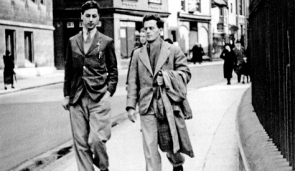
Heinrich von Kleist, the most modern of all classic authors, has had hardly any attention from biographers in recent decades. The opposite might have been expected given his uninterrupted popularity among theatregoers and readers. To a far greater extent than Lessing, Goethe, or Schiller, Kleist was on an existential quest. He did not write to live, but lived to write, 'weil ich es nicht lassen kann'. Not until Kafka would any other author sound so possessed again. Puzzles about the inexpressible 'I' and the innermost core of being are his bread and butter. His works do not permit clear answers or distance from the text. His complex, difficult life, a marked contrast with his disciplined oeuvre, reads like a modern novel. A Kleistbiography is a considerable challenge; Jens Bisky and Gerhard Schulz have now taken it up at the same time.

Both books are beautifully written, and they have more in common than their identical titles. The wealth of information they present and their attention to lesser-known details are further similarities. Both authors have resisted the temptation, prevalent in research on Kleist, to dress conjecture as fact for want of sources. Life is harder here with Kleist than with other German Klassiker. The body of source material is comparatively sparse and patchy: his correspondence, for example, spans nineteen years (1793-1811) with only two hundred and forty letters and twenty replies, and by and large it is addressed only to family members and a handful of friends. There are no extent diaries or Ideenmagazine. Cryptic allusions and quotations turn the biographer into a literary detective. Kleist's letters, a fascinating read in themselves, are also the key to his life and works. They reveal intimate facts, their language is intoxicating, and they are an education in visual observation. They contain almost all the basic motifs of the literary works. Schulz, indeed, asks whether these letters are a work of fiction with Kleist as its sole hero–a question as pertinent as it is shrewd.
American Grace: How Religion Divides and Unites Us

Croft-1 James Croft reviews Robert D. Putnam and David E. Campbell's new book, in The Humanist:

American religion is a conundrum. Americans manage to combine deep religious devotion with wide religious diversity, all the while remaining remarkably tolerant of each other. What factors have shaped the current religious landscape in the United States? What characteristics do people of faith have, in comparison to those of other faiths and those with none? And what explains America’s unique combination of diversity, devotion, and tolerance?

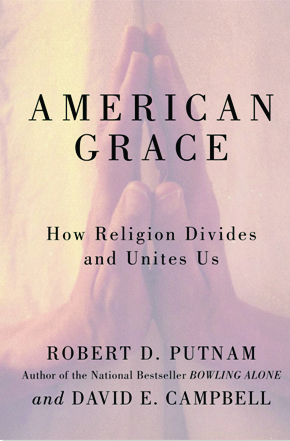
These are the questions that Robert Putnam, Harvard professor of public policy and the sociologist who shone a spotlight on American community in Bowling Alone, and David Campbell, professor of political science at Notre Dame, set out to answer in their book American Grace. In short, the authors seek to provide a definitive snapshot and analysis of the state of contemporary religiosity in America. They ask about the relationship between religion and politics, between religion and civic values, whether religion plays a divisive role or brings people together and, in the opening chapters, how America got to where it is today, religiously speaking. The breadth of the book’s ambition, along with its hefty dimensions (the main text runs to 550 pages) and steepled hands on the cover, convey the intention clearly: this is to be the new bible for sociologists of religion.

The majority of the book is based on two large surveys (3,108 participants in the first, and 1,909 in the second) conducted in 2006 and 2007. The sample drawn for the first was representative of the population of the United States and was randomly selected. The second followed up with as many of the individuals surveyed in the first as possible, and asked most of the same questions. Therefore, the authors argue, it is possible to see how some measures change (like church attendance) between one year and the next. This second survey is important because it enables the authors to “test” whether one variable alters with another: if making a friend of another religion coincides with a warmer view of that religion, for example, then one might plausibly hypothesize that making friends with people of another faith leads to warmer feelings for others of that same faith. This is not enough to establish causality, but it does give useful hints that would not emerge without the second survey.

Joseph Brodsky and the Fortunes of Misfortune

110523_r20902_p465 Keith Gessen in The New Yorker:

In the fall of 1963, in Leningrad, in what was then the Union of Soviet Socialist Republics, the young poet Dmitry Bobyshev stole the young poet Joseph Brodsky’s girlfriend. This was not cool. Bobyshev and Brodsky were close friends. They often appeared, in alphabetical order, at public readings around Leningrad. Bobyshev was twenty-seven and recently separated from his wife; Brodsky was twenty-three and intermittently employed. Along with two other promising young poets, they’d been dubbed “the magical chorus” by their friend and mentor Anna Akhmatova, who believed that they represented a rejuvenation of the Russian poetic tradition after the years of darkness under Stalin. When Akhmatova was asked which of the young poets she most admired, she named just two: Bobyshev and Brodsky.

The young Soviets felt the sixties even more deeply than their American and French counterparts, for, while the Depression and the Occupation were bad, Stalinism was worse. After Stalin died, the Soviet Union began inching toward the world again. The ban on jazz was lifted. Ernest Hemingway was published; the Pushkin Museum in Moscow hosted an exhibit of the works of Picasso. In 1959, Moscow gave space to an exhibition of American consumer goods, and my father, also a member of this generation, tasted Pepsi for the first time.

The libido had been liberated, but where was it supposed to go? People lived with their parents. Their parents, in turn, lived with other parents, in what were known as communal apartments. “We never had a room of our own to lure our girls into, nor did our girls have rooms,” Brodsky later wrote from his American exile. He had half a room, separated from his parents’ room by bookshelves and some curtains. “Our love affairs were mostly walking and talking affairs; it would make an astronomical sum if we were charged for mileage.” The woman with whom Brodsky had been walking and talking for two years, the woman who broke up the magical chorus, was Marina Basmanova, a young painter. Contemporaries describe her as enchantingly silent and beautiful. Brodsky dedicated some of the Russian language’s most powerful love poetry to her. “I was only that which / you touched with your palm,” he wrote, “over which, in the deaf, raven-black / night, you bent your head. . . . / I was practically blind. / You, appearing, then hiding, / taught me to see.”

Almost unanimously, people in their circle condemned Bobyshev. Not because of the affair—who didn’t have affairs?—but because, as soon as Bobyshev began to pursue Basmanova, Brodsky began to be pursued by the authorities.

Egypt: Why Are the Churches Burning?

GettyImages_109868491_jpg_470x396_q85 Yasmine El Rashidi in the NYRB blog:

On a recent afternoon this month, in a busy downtown Cairo street, armed men exchanged gunfire, threw rocks and Molotov cocktails, and freely wielded knives in broad daylight. The two-hour fight, which began as an attempt by some shop-owners to extort the customers of others, left eighty-nine wounded and many stores destroyed. In the new Egypt, incidents like this are becoming commonplace. On many nights I go to bed to the sound of gunfire, and each morning I leaf through newspapers anticipating more stories of crime. Stopped at gun-point; car stolen; head severed; kidnapped from school, held at ransom; armed men storm police station opening fire and killing four; prison cells unlocked—91 criminals on the loose. Many people I know have already bought guns; on street corners metal bludgeons are being sold for $3; and every week I receive an email, or SMS, or Facebook message about a self-defense course, or purse-size electrocution tool, or new shipments of Mace. “These are dangerous times,” my mother told me recently as she handed me a Chinese-made YT-704 “super high voltage pulse generator.” “You have to take precautions, keep it in your bag.”

Even more worrying, it seems increasingly clear that a variety of groups have been encouraging the violence, in part by rekindling sectarian tensions that had disappeared during the Tahrir Square uprising, when Muslim and Coptic protesters protected one another against Mubarak’s thugs. Since then, there have been a series of attacks on Copts, and the perpetrators seem to include hardline Islamists (often referred to as Salafis), remnants of the former regime, and even, indirectly, some elements of the military now in charge, who have allowed these attacks to play out—all groups that in some way have an interest in disrupting a smooth transition to a freely elected civil government and democratic state.

Wednesday Poem

Angels of Choice

We lie trapped beneath
The Masonic geometry of Washington,
our bodies racked by long vistas,
our hearts bearing the tall spike’s pain.
Black-windowed limos rake my chest
with the loose gravel of power.

One of my hands reaches into a pocket
and small coins become bombs.
The other marks an X beside the black man’s name,
and soon he begins to lie.
Along the lines of my flesh I hear
the dark weeping of the disappeared.

There is no escape from the weight of this geometry.
My shackled movements shake small dirt
from boots that are always marching.
Ignorance is pressed into us as
we accept the banked protocol that
drives there along the avenues of shame.

Year after year, I unwrap the paper skin
of a garlic bulb, separate the cloves,
press each piece of the pinwheel
into cool October soil, while in my mind
green spears arise from the dirt
as April’s earth turns light.

Here I could dwell, here I could
let words fall out of the sky onto a white page,
here I could cradle the head of a neighbor
old now and fallen from his heights.
Here geometry is written on paper as thin
as a summer cloud disappearing.

by Susie Patlove

Excavation

From Guernica:

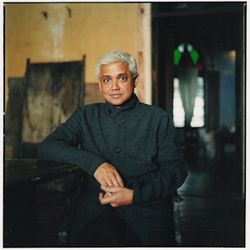
Amitav Lila Azam Zanganeh interviews Amitav Ghosh:

Many novelists start out dreaming in their bed at night. As Sartre describes in The Words, they dream of how they’ll write these wild romantic novels. But Amitav Ghosh seems to come from quite a different place. As a young man he worked as a journalist; his first job was at the Indian Express newspaper, based in New Delhi. He next earned a PhD at Oxford in social anthropology, followed by a stint in Egypt. As he tells Lila Azam Zanganeh, our “Nabokovian“ interviewer, his background in anthropology—as opposed to, say, an MFA—might have been the best training imaginable for his fiction and essays: “What does an anthropologist do?” he asks. “You just go and talk to people, then at the end of the day you write down what you see.… It trains you to observe, and it trains you to listen to the ways in which people speak.”

Ghosh published the first of his six novels, The Circle of Reason, in 1986, and his career was given a boost when France awarded the book a prestigious Prix Médicis Etranger. While he lives in Brooklyn, writes in English and feels at home in the New York publishing scene, his sensibility is clearly that of an internationalist. Enabled in his career by writers such as Salman Rushdie and V.S. Naipaul, he cares almost nothing about identity in its narrowest sense. Why? Because of India. “One of the reasons why is because anybody who's lived in India knows that India is incredibly, incredibly diverse.… That’s one of the wonderfully liberating things about India; it lets you be exactly who you want to be.”

More here.

Stress can shorten telomeres in childhood

From Nature:

Orph A long-term study of children from Romanian orphanages suggests that the effects of childhood stress could be visible in their DNA as they grow up. Children who spent their early years in state-run Romanian orphanages have shorter telomeres than children who grew up in foster care, according to a study published today in Molecular Psychiatry1. Telomeres are buffer regions of non-coding DNA at the ends of chromosomes that prevent the loss of protein-coding DNA when cells divide. Telomeres get slightly shorter each time a chromosome replicates during cell division, but stress can also cause them to shorten. Shorter telomeres are associated with a raft of diseases in adults from diabetes to dementia. The study is part of the Bucharest Early Intervention Project, a programme started in 2000 by US researchers who aimed to compare the health and development of Romanian children brought up in the stressful environment of an orphanage with those in foster families, where they receive more individual attention and a better quality of care.

When the study began, state orphanages were still common in Romania, and a foster care system was established specifically for this project. The study focused on 136 orphanage children aged between 6 and 30 months, half of whom were randomly assigned to foster families. The other half remained in orphanages. The researchers obtained DNA samples from the children when they were between 6 and 10 years old, and measured the length of their telomeres. They found that the longer the children had spent in the orphanage in early childhood – before the age of four and half – the shorter their telomeres. “It shows that being in institutional care affects children right down to the molecular level,” says clinical psychiatrist Stacy Drury of Tulane University in New Orleans, Louisiana, one of the lead authors on the study.

More here.

Tuesday, May 17, 2011

The case against using plants as monuments

Rochelle Gurstein in The New Republic:

Twoers2 As we headed toward the Cherry Esplanade at the Brooklyn Botanic Garden so that we could take in one of the great joys of spring in New York—cherry trees in full, glorious bloom—we entered a path between a double row of youngish oak trees that were now beginning to attain the height and fullness that will eventually give them the stately architectural elegance of an allée. I was asking my husband if he remembered how forlorn they had looked as saplings when we noticed a bronze plaque at the foot of a tree just filling in with deep green leaves. It read: “In Memory of the Heroes of Engine Company 280 and Ladder Company 132 Who Made the Supreme Sacrifice On September 11, 2001 In Defense of Their Country,” followed by the names of seven men who were killed. And with that, our delight in the beauty of what was a perfect spring day was interrupted by the presence of September 11.

We were taken off guard, but then we remembered that a number of years ago these oaks had been planted to replace the magnificent allée of old, soaring Norway maples that had been planted by the first generation of Brooklyn Botanic gardeners in 1918 to honor the Armistice and that had sadly come to the end of their natural life spans over 80 years later.

More here.

Monk, Mystic, Mechanic

1687071034 Avner Shapira in Ha'aretz:

Ludwig Wittgenstein may have declared at the beginning of his book “Philosophical Investigations” that “explanations come to an end somewhere,” but as far as his philosophy is concerned, the finish line is still nowhere in sight. Since his death 60 years ago, on April 29, 1951, numerous explanations and interpretations of his philosophy, or to be more precise, his philosophies, have been proposed. His influence has seeped into other spheres of knowledge and his unique personality has also been the subject of many analyses and portrayals.

The exhibition “Ludwig Wittgenstein: Contextualizations of a Genius,” at the Schwules Museum in Berlin offers new keys to understanding one of the 20th century's greatest intellects, who helped lay the foundations for the linguistic revolution that occurred in the world of philosophy. It underscores the connections between his philosophy and his life and sheds light on two key yet murky aspects of his biography: his ambivalent attitude toward his family's Jewish origins and his sexual identity.

At the entrance to the exhibition, a series of self-portraits of Wittgenstein, taken in 1922, are screened in a continuous loop. His changing expressions allude to the exhibition's aim – exposing the many facets of his personality. “On the 60th anniversary of his death, we wished to sketch character by means of observation not only of his pioneering theories, but also of his family, the culture from whence he came, the historical and intellectual sources that influenced him, his social connections and the many places that he lived,” says Kristina Jaspers, the exhibition's co-curator and the co-editor of the book of the same title (with Jan Drehmel ).

Jaspers says that making a connection between the philosophy and the biography of the philosopher is apt in Wittgenstein's case because he himself discerned such an affiliation. “He believed that in order to do philosophy properly, you had to live properly – in other words, that life and philosophy go hand in hand. The changes that occurred in his philosophical views could become clear in light of his biography: On the one hand, there is the indecision, the doubts and fear of mistakes that constantly haunted him, in life as well as in his theoretical pursuits; and on the other hand, whenever he felt that he needed to change his life or when he became convinced that he had erred in his philosophical conclusions, he made firm decisions and resolutely stuck to them.”

When Will Scientists Grow Meat in a Petri Dish?

Inside-the-meat-lab_1 Jeffrey Bartholet in Scientific American:

It is not unusual for visionaries to be impassioned, if not fanatical­, and Willem van Eelen is no exception. At 87, van Eelen can look back on an extraordinary life. He was born in Indonesia when it was under Dutch control, the son of a doctor who ran a leper colony. As a teenager, he fought the Japanese in World War II and spent several years in prisoner-of-war camps. The Japanese guards used prisoners as slave labor and starved them. “If one of the stray dogs was stupid enough to go over the wire, the prisoners would jump on it, tear it apart and eat it raw,” van Eelen recalls. “If you looked at my stomach then, you saw my spine. I was already dead.” The experience triggered a lifelong obsession with food, nutrition and the science of survival.

One obsession led to another. After the Allies liberated Indonesia, van Eelen studied medicine at the University of Amsterdam. A professor showed the students how he had been able to get a piece of muscle tissue to grow in the laboratory. This demonstration inspired van Eelen to consider the possibility of growing edible meat without having to raise or slaughter animals. Imagine, he thought, protein-rich food that could be grown like crops, no matter what the climate or other environmental conditions, without killing any living creatures.

If anything, the idea is more potent now. The world population was just more than two billion in 1940, and global warming was not a concern. Today the planet is home to three times as many people. According to a 2006 report by the Food and Agriculture Organization, the livestock business accounts for about 18 percent of all anthropogenic greenhouse gas emissions—an even larger contribution than the global transportation sector. The organization expects worldwide meat consumption to nearly double between 2002 and 2050.

Sex, Hope, and Rock and Roll: Michael Bérubé on Ellen Willis

Michael Bérubé over at Crooked Timber:

Somewhere between the end of my spring semester at Penn State on April 29 and the beginning of my month-long guest-teaching gig at Cornell College in Mt. Vernon, Iowa (founded over a decade before that Johnny-come-lately Cornell in upstate New York) on May 2, I found some time to speak at this totally awesome conference on the work of Ellen Willis. Just glad to be on the bill, you know. Anyway, here’s a slightly expanded version of what I said that morning. Why slightly expanded? Because I’m including 15 percent more of Ellen Willis’s prose, which makes my remarks 15 percent better. That is why.

Ellen Willis took freedom seriously: “I believe that the struggle for freedom, pleasure, transcendence, is not just an individual matter. The social system that organizes our lives, and as far as possible channels our desire, is antagonistic to that struggle; to change this requires collective effort” (No More Nice Girls 266). And she was deadly serious about pleasure, too: “does it sound like a dirty word to you? No wonder, given how relentlessly it’s been attacked not only by puritanical conservatives but by liberals who uncritically accept the Reaganite equation of pleasure with greed and callousness…. Yet life without pleasure—without spontaneity and playfulness, sexuality and sensuality, esthetic experience, surprise, excitement, ecstasy—is a kind of death” (NMNG 272). It’s probably too much (or too cliché?) to say that her life was saved by rock and roll, but I do think she found in the music the rhythm of a social revolution she could dance to—and I think her willingness to think about freedom and pleasure rigorously served her well throughout her intellectual career.

That’s easy enough to see when you look at her writings on the drug wars of the 1980s, which Willis was right to see not just as an extension of state power and the carceral society in which we are all required to piss on demand, not only as a war on some classes of people who use drugs, but also as a frontal assault on the very idea that an illegal drug could have a beneficial effect on one’s being in the world. (By the mid-80s it was damn near impossible to say such a thing in public, so, of course, she went ahead and said it, more than once.) And it’s easy to see in Willis’s scathing critiques of antiporn feminism and so-called pro-life leftism, as well. But I see it suffusing every aspect of her work at every stage of her career, even in her writings on race, on The Satanic Verses, on “class first” leftism, and on the world after 9/11. It wasn’t just that she had one of the most accurate bullshit detectors known to modern science…

Tuesday Poem

The Explosion

On the day of the explosion
Shadows pointed towards the pithead:
In the sun the slagheap slept.

Down the lane came men in pitboots
Coughing oath-edged talk and pipe-smoke
Shouldering off the freshened silence.

One chased after rabbits; lost them;
Came back with a nest of lark's eggs;
Showed them; lodged them in the grasses.

So they passed in beards and moleskins
Fathers brothers nicknames laughter
Through the tall gates standing open.

At noon there came a tremor; cows
Stopped chewing for a second; sun
Scarfed as in a heat-haze dimmed.

The dead go on before us they
Are sitting in God's house in comfort
We shall see them face to face–

plian as lettering in the chapels
It was said and for a second
Wives saw men of the explosion

Larger than in life they managed–
Gold as on a coin or walking
Somehow from the sun towards them

One showing the eggs unbroken.

by Philip Larkin
from High Windows,1974

A New Gauge to See What’s Beyond Happiness

John Tierney in The New York Times:

Happy Martin Seligman now thinks so, which may seem like an odd position for the founder of the positive psychology movement. As president of the American Pyschological Association in the late 1990s, he criticized his colleagues for focusing relentlessly on mental illness and other problems. He prodded them to study life’s joys, and wrote a best seller in 2002 titled “Authentic Happiness.” But now he regrets that title. As the investigation of happiness proceeded, Dr. Seligman began seeing certain limitations of the concept. Why did couples go on having children even though the data clearly showed that parents are less happy than childless couples? Why did billionaires desperately seek more money even when there was nothing they wanted to do with it? And why did some people keep joylessly playing bridge? Dr. Seligman, an avid player himself, kept noticing them at tournaments. They never smiled, not even when they won. They didn’t play to make money or make friends. They didn’t savor that feeling of total engagement in a task that psychologists call flow. They didn’t take aesthetic satisfaction in playing a hand cleverly and “winning pretty.” They were quite willing to win ugly, sometimes even when that meant cheating.

“They wanted to win for its own sake, even if it brought no positive emotion,” says Dr. Seligman, a professor of psychology at the University of Pennsylvania. “They were like hedge fund managers who just want to accumulate money and toys for their own sake. Watching them play, seeing them cheat, it kept hitting me that accomplishment is a human desiderata in itself.” This feeling of accomplishment contributes to what the ancient Greeks called eudaimonia, which roughly translates to “well-being” or “flourishing,” a concept that Dr. Seligman has borrowed for the title of his new book, “Flourish.” He has also created his own acronym, Perma, for what he defines as the five crucial elements of well-being, each pursued for its own sake: positive emotion, engagement (the feeling of being lost in a task), relationships, meaning and accomplishment.

More here.

The larger truth in Three Cups of Tea

Bapsi Sidhwa in Houston Chronicle:

Greg I met Greg Mortenson, author of Three Cups of Tea, for the second time in October 2010 at a fundraiser in Dallas. As a recipient of an award, I sat at his table and found him to be courteous, disarmingly shy and self-effacing. He was the last to make a presentation, and as he spoke, I was alarmed by the way he intermittently fought for breath and paused between sentences. It was obvious he was exhausted and ill. I am shocked that he continued his grueling speaking schedule for almost six months after that — visiting schools and addressing fundraisers on a daily basis. I know now that he has a hole in his heart and is due for surgery. The way in which a 60 Minutes reporter interrupted Mortenson at an event for children in Atlanta and ambushed him with questions about allegations that he had falsified parts of his book was not only a bullying tactic, but also dangerous in view of his health.

“If you're looking for truth, read fiction; if you're in the mood for fiction read autobiography.” I have heard something to this effect repeated so often that it has become a truism – and, paradoxically, the axiom is often dismissed as a witticism. But there is more accuracy in these words than first meets the eye. As a writer, I know there are many ways of arriving at a truth, and fiction, with its accruements of imagination, intuition and arsenal of complex trajectories, can help a writer to express her or his thoughts as exactly and completely as is possible and in doing so arrive at the truth. Hard autobiography and biography, with their insistence on fact, appear to demand only one-dimensional slivers of truth, and whenever I've attempted autobiography I've sat frozen before my computer – wall-eyed with writer's block.

More here.

Monday, May 16, 2011

Sunday, May 15, 2011

One Professor’s Attempt to Explain Every Joke Ever

Ff_humorcode5_f Joel Warner in Wired:

[Peter] McGraw didn’t set out to become a humorologist. His background is in marketing and consumer decisionmaking, especially the way moral transgressions and breaches of decorum affect the perceived value of things. For instance, he studied a Florida megachurch that tarnished its reputation when it tried to reward attendees with glitzy prizes. The church’s promise to raffle off a Hummer H2 to some lucky congregant was met with controversy in the community—what the hell did that have to do with eternal salvation? But when McGraw related the anecdote at presentations, it prompted laughter—a holy Hummer!—rather than repulsion. This confused him.

“It had never crossed my mind that moral violations could be amusing,” McGraw says. He became increasingly preoccupied with the conundrum he saw at the heart of humor: Why do people laugh at horrible things like stereotypes, embarrassment, and pain? Basically, why is Sarah Silverman funny?

Philosophers had pondered this sort of question for millennia, long before anyone thought to examine it in a lab. Plato, Aristotle, and Thomas Hobbes posited the superiority theory of humor, which states that we find the misfortune of others amusing. Sigmund Freud espoused the relief theory, which states that comedy is a way for people to release suppressed thoughts and emotions safely. Incongruity theory, associated with Immanuel Kant, suggests that jokes happen when people notice the disconnect between their expectations and the actual payoff.

But McGraw didn’t find any of these explanations satisfactory. “You need to add conditions to explain particular incidents of humor, and even then they still struggle,” he says. Freud is great for jokes about bodily functions. Incongruity explains Monty Python. Hobbes nails Henny Youngman. But no single theory explains all types of comedy. They also short-circuit when it comes to describing why some things aren’t funny. McGraw points out that killing a loved one in a fit of rage would be incongruous, it would assert superiority, and it would release pent-up tension, but it would hardly be hilarious.

These glaringly incomplete descriptions of humor offended McGraw’s need for order. His duty was clear. “A single theory provides a set of guiding principals that make the world a more organized place,” he says.

McGraw and Caleb Warren, a doctoral student, presented their elegantly simple formulation in the August 2010 issue of the journal Psychological Science. Their paper, “Benign Violations: Making Immoral Behavior Funny,” cited scores of philosophers, psychologists, and neuroscientists (as well as Mel Brooks and Carol Burnett). The theory they lay out: “Laughter and amusement result from violations that are simultaneously seen as benign.”

An Open Letter to Mexico’s Politicians and Criminals

Emiliano_Zapata_en_la_ciudad_de_Cuernavaca Javier Sicilia in Naked Punch:

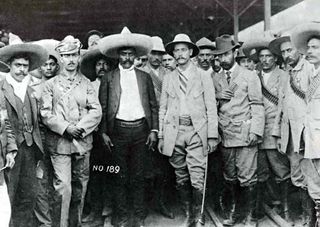
The brutal assassination of my son, Juan Francisco, of Julio César Romero Jaime, of Luis Antonio Romero Jaime, and of Gabriel Anejo Escalera, is added to so many other boys and girls who have been assassinated just the same throughout the country, not only because of the war unleashed by the government of Calderón against organized crime, but also the rotting of the heart that has been wrought by the poorly labeled political class and the criminal class, which has broken its own codes of honor.

I do not wish, in this letter, to speak with you about the virtues of my son, which were immense, nor of those of the other boys that I saw flourish at his side, studying, playing, loving, growing, to serve, like so many other boys, this country that you all have shamed. Speaking of that doesn’t serve for anything more than to move what already moves the heart of the citizenry to indignation. Neither do I wish to talk about the pain of my family and the families of each one of the boys who were destroyed. There are not words for this pain. Only poetry can come close to it, and you do not know about poetry. What I do wish to say to you today from these mutilated lives, from the pain that has not name because it is fruit of something that does not belong in nature – the death of a child is always unnatural and that’s why it has no name: I don’t know if it is orphan or widow, but it is simply and painfully nothing – from these, I repeat, mutilated lives, from this suffering, from the indignation that these deaths have provoked, it is simply that we have had it up to here.

We have had it up to here with you, politicians – and when I say politicians I do not refer to any in particular, but, rather, a good part of you, including those who make up the political parties – because in your fight for power you have shamed the fabric of the nation. Because in middle of this badly proposed, badly made, badly led war, of this war that has put the country in a state of emergency, you have been incapable – due to your cruelties, your fights, your miserable screaming, your struggle for power – of creating the consensus that the nation needs to find the unity without which this country will not be able to escape. We have had it up to here because the corruption of the judicial institutions generates the complicity with crime and the impunity to commit it, because in the middle of that corruption that demonstrates the failure of the State, each citizen of this country has been reduced to what the philosopher Giorgio Agamben called, using a Greek word, “zoe”: an unprotected life, the life of an animal, of a being that can be violated, kidnapped, molested and assassinated with impunity. We have had it up to here because you only have imagination for violence, for weapons, for insults and, with that, a profound scorn for education, culture, and opportunities for honorable work, which is what good nations do. We have had it up to here because your short imagination is permitting that our kids, our children, are not only assassinated, but, later, criminalized, made falsely guilty to satisfy that imagination. We have had it up to here because others of our children, due to the absence of a good government plan, do not have opportunities to educate themselves, to find dignified work and spit out onto the sidelines become possible recruits for organized crime and violence. We have had it up to here because the citizenry has lost confidence in its governors, its police, its Army, and is afraid and in pain. We have had it up to here because the only thing that matters to you, beyond an impotent power that only serves to administrate disgrace, is money, the fomentation of rivalry, of your damn “competition,” and of unmeasured consumption which are other names of the violence.

Countervailing Powers: On John Kenneth Galbraith

JohnKennethGalbraithOWI Kim Phillips-Fein in The Nation:

In a 1930 essay titled “Economic Possibilities for our Grandchildren,” John Maynard Keynes ridiculed economists for having a high opinion of themselves and their work. As the Great Depression engulfed the world, Keynes looked back at historic rates of economic growth, arguing that the real problem people would face in the future was not poverty but the moral quandary of how to live in a society of such abundance and wealth that work would cease to be necessary. The “economic problem,” as he put it, was technical, unimportant in the larger scheme of things. “If economists,” he wrote, “could manage to get themselves thought of as humble, competent people, on a level with dentists, that would be splendid!” John Kenneth Galbraith—the Harvard-based economist whose books shaped the public conversation on economic matters for a generation in mid-twentieth-century America—would have agreed.

Today, given the rise of mathematical methods and computer modeling, economics is if anything even more labyrinthine, esoteric and inaccessible to the layman than it was in the days of Keynes and Galbraith. It is also more intellectually and politically ascendant than it was in the 1930s. Its methods now dominate much of the social sciences, having made inroads in law and political science. Its central theme of the superiority of free markets is the gospel of political life. This makes the publication of the Library of America edition of four of Galbraith’s best-known books—American Capitalism; The Great Crash, 1929; The Affluent Society and The New Industrial State—a cause for celebration. (The volume is edited by Galbraith’s son James, also an economist.) Galbraith delighted in puncturing the self-importance of his profession. He was a satirist of economics almost as much as a practitioner of it. He took generally accepted ideas about the economy and turned them upside down. Instead of atomistic individuals and firms, he saw behemoth corporations; instead of the free market, a quasi-planned economy. Other economists believed that consumers were rational, calculating actors, whose demands and tastes were deserving of the utmost deference. Galbraith saw people who were easily manipulated by savvy corporations and slick advertising campaigns, who had no real idea of what they wanted, or why. In many ways, our economic world is quite different from the one Galbraith described at mid-century. But at a time when free-market orthodoxy seems more baroque, smug and dominant than ever, despite the recession caused by the collapse of the real estate bubble, his gleeful skewering of the “conventional wisdom” (a phrase he famously coined) remains a welcome corrective.

Twilight for Qaddafi?

Qaddafi_6 Stephen M. Walt in Foreign Policy:

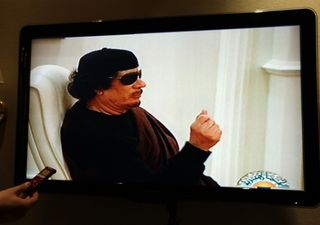
With the U.S. and NATO's thumb firmly on the scale, the balance of power in Libya seems to be shifting steadily toward the rebel forces. That's bad news for the Qaddafi family, though their lack of attractive alternatives to fighting on makes it unlikely that they will simply surrender. This outcome is also not that surprising, as the Libyan military was never a first-class fighting force and it was not going to have real trouble standing up to the rebel forces once they started getting lots of outside help. The danger, however, is that the rebel forces will not be able to consolidate control over the entire country without a lot more fighting, including the sort of nasty urban warfare that can get lots of civilians killed.

As with the invasion of Iraq, in short, the issue wasn't whether the West could eventually accomplish “regime change” if it tried. Rather, the key questions revolved around whether it was in our overall interest to do so and whether the benefits would be worth the costs. In the Iraqi case, it is obvious to anyone who isn't a diehard neocon or committed Bush loyalist that the (dubious) benefits of that invasion weren't worth the enormous price tag. There were no WMD and no links between Saddam and al Qaeda, and the war has cost over a trillion dollars (possibly a lot more). Tens of thousands of people died (including some 4500 Americans), and millions of refugees had to flee their homes. And for what? Mostly, a significant improvement in Iran's influence and strategic position.

In the Libyan case, same basic question. Hardly anyone thinks the Qaddafi family deserves to run Libya, and few if any will mourn their departure. But assuming the rebels win, will the benefits of regime change be worth the costs?