
Category: Recommended Reading
surrender
let england shake
Parenting guru Bryan Caplan prescribes less fuss – and more fun
From Guardian:

He added: “Parents can sharply improve their lives without hurting their kids. Nature, not nurture, explains most family resemblance, so parents can safely cut themselves a lot of additional slack.” Caplan's style of “serenity parenting” comes in stark contrast to other models advocated, most prominently this year by Amy Chua, a Yale professor whose bestselling book Battle Hymn of the Tiger Mother extolled the virtues of tough love and hard work. Caplan believes, however, that “investment parenting” – piano and violin lessons, organised sports and educational games – doesn't have the slightest effect when the children move into adulthood. He suggests letting children drop sports and other activities unless they really love doing them.
More here.
Humans wired for grammar at birth
From MSNBC:

This pointing and babbling is all a part of the language learning process, they say, even though the process itself remains largely a mystery. One prominent, though controversial, hypothesis is that some knowledge of grammar is hardwired into our brains. “There's some knowledge that the learner has that actually makes this process easier,” Jennifer Culbertson, a postdoctoral fellow at the University of Rochester, explained to me today. This hypothesis was originally proposed 50 years ago by philosopher and linguist Noam Chomsky at the Massachusetts Institute of Technology. Culbertson recently confirmed it with an experiment featuring a virtual green blob for a teacher named Glermi who speaks a nonsensical language called Verblog.
More here.
Saturday, May 14, 2011
a book to make one feel deeply and painfully, and also to think hard

Woodrow Wilson’s fatuous claim about the European war of 1914-18 — sarcastically annexed by Adam Hochschild for the title of this moving and important book — was an object of satire and contempt even as it was being uttered. “A peace to end peace,” commented Sir Alfred Milner, that powerhouse of the British war cabinet, as he surveyed the terms of the Versailles treaty that supposedly brought the combat to a close. Increasingly, modern historians have come to regard that bleak November “armistice” as a mere truce in a long, terrible conflict that almost sent civilization into total eclipse and that did not really terminate until the peaceful and democratic reunification of Germany after November 1989. Even that might be an optimistic reading: the post-1918 frontiers of the former Ottoman Empire (one of the four great thrones that did not outlast the “First” World War) are still a suppurating source of violence and embitterment. In his previous works, on subjects as diverse as the Belgian Congo and the victims of Stalinism, Hochschild has distinguished himself as a historian “from below,” as it were, or from the viewpoint of the victims. He stays loyal to this method in “To End All Wars,” concentrating on the appalling losses suffered by the rank and file and the extraordinary courage of those who decided that the war was not a just one. Since many of the latter were of the upper classes, some of them with close relatives in power, he is enabled to shift between the upstairs-downstairs settings of post-Edwardian England, as its denizens began in their different ways to realize that the world they had cherished was passing forever.
more from Christopher Hitchens at the NY Times here.
Liberalism: A Counter-History
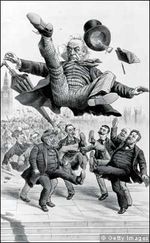
Liberal has been a dirty word in US politics for some time. President Barack Obama can supply convincing answers to the two preposterous charges about his identity that he has faced recently. One, that he is not really an American, was dismissed by producing his birth certificate. The other, that he is a socialist, is more difficult. It could be exploded by declaring that he is self-evidently liberal in his political convictions. But we can be fairly confident that he will not be using the L-word, even though it claims a political pedigree stretching back to the founding fathers. George Washington himself, that unillusioned soldier and great patriot, extolled “the benefits of a wise and liberal Government” and advocated “a liberal system of policy”. There was not only political principle but political expediency in proclaiming oneself motivated by liberal ideas in that era. The fact that the American Revolution was made in terms of this political prospectus helps explain its ultimate success. There were simply too many Britons who felt that the colonists actually had the better of the argument – they were the better liberals. For British Whigs, too, looked back reverently on canons of government that extolled liberty in thought, speech, religion, government and trade alike. It was part of the heritage of the Glorious Revolution of 1688. Indeed, for some more incendiary spirits on both sides of the Atlantic, the Good Old Cause of republican virtue was at stake. Little wonder, then, that the history of liberalism has often taken this Anglo-American tradition as its great exemplar.
more from Peter Clarke at the FT here.
monsters, etc.
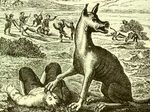
Scan through digital images from the Aberdeen Bestiary and you’ll find a marvelous stew of myth and reality. Alongside familiar animals — leopards, panthers, hyenas — this glorious 12th century illuminated manuscript includes some strange ones: A satyr, for instance, with a humanoid shape and a thoughtful expression on its face, and a dazzling phoenix, resting in a goblet as flames encircle the cup’s rim. Bestiaries were attempts in the Middle Ages to catalog the world’s living things, whether they had been truly observed or rumored to exist. And it’s no wonder that modern writers have been inspired by the idea of a fanciful menagerie to create whimsical bestiaries of their own — Borges did it, and so have the VanderMeers, Ann and Jeff, to give just two examples. Several new books made me think of these golden, beastly books of yore, for the subjects of “Tracking the Chupacabra,” “Monsters of the Gévaudan,” and “Kraken” seem like nothing less than fugitives from a bestiary — creatures that have slipped from its pages and fled to the jungles of South America, the woods of France and the depths of the sea.
more from Nick Owchar at the LA Times here.
As time goes by, it gets tougher to ‘just remember this’
From PhysOrg:
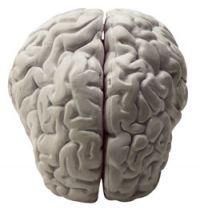
According to a Johns Hopkins neuroscientist, however, the real trouble is that our aging brains are unable to process this information as “new” because the brain pathways leading to the hippocampus — the area of the brain that stores memories — become degraded over time. As a result, our brains cannot accurately “file” new information (like where we left the car that particular morning), and confusion results.
More here.
The Good Muslim
From The Telegraph:
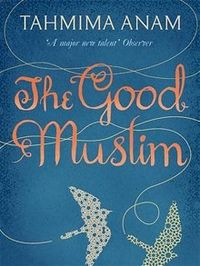
The two time strands on which the book balances create the suspense of discovering how they will converge. There are some half-hearted attempts to shift the narrative perspective between brother and sister, but this novel is really Maya’s story – only in the prologue and denouement do we enter Sohail’s consciousness. Despite its title, the themes are less about faith or morality than the personality traits common to radicals and idealists. It is about the differences between citizens and rebels, and those contradictory elements within us all.
More here.
Friday, May 13, 2011
Does Lack of Income Take Away the Brain’s Horses?
Daniel Lende over at Neuroanthroplogy [h/t: Linta Varghese]:
I don’t mean the pretty horses people ride, but the hippocampus (or sea horse) circuits in your brain, which are crucial to memory. New research in PLoS One, Association between Income and the Hippocampus, demonstrates a link between lower socioeconomic status and lower hippocampal grey matter density.
In Wednesday’s round-up I linked to Philip Cohen’s post, Income gradient for children’s mental health. Here’s the opening graph so you can get a sense of the gravity of the situation. The percentage of children with serious mental or behavioral difficulties is shown as a percentage on the left. The drop-off as income rises is dramatic.
In 2008 we documented that poverty poisons the brain:
As the article explained, neuroscientists have found that “many children growing up in very poor families with low social status experience unhealthy levels of stress hormones, which impair their neural development.” The effect is to impair language development and memory — and hence the ability to escape poverty — for the rest of the child’s life. So now we have another, even more compelling reason to be ashamed about America’s record of failing to fight poverty.
And then in 2009, we focused on how it’s really the social side of things doing the poisoning:
Empirical research on the connection between poverty and intellectual development can cut both ways—leading some to write off poverty as biological destiny, and others to look deeper into missed opportunities to lift youth over economic barriers…
While I advocate for the role that brain processes can play in social theory, the sword cuts both ways. Referencing the brain as central mediator of poverty hides the truth, and distorts our understanding. To take a more extreme example to illustrate the same point, it’s like saying that slavery is both harmful to people and morally wrong because it impacts brains.
This new research brings us back to a focus on the brain. The article, whose lead author Jamie Hanson is a graduate student in psychology at Wisconsin-Madison, brings a broader focus than just stress, through cortisol, acting as poison to the developing brain.

The 2011 Edge Question: What Scientific Concept Would Improve Everybody’s Cognitive Toolkit?

Focusing Illusion
Daniel Kahneman
Eugene Higgins Professor of Psychology…
“Nothing In Life Is As Important As You Think It Is, While You Are Thinking About It”
Education is an important determinant of income — one of the most important — but it is less important than most people think. If everyone had the same education, the inequality of income would be reduced by less than 10%. When you focus on education you neglect the myriad other factors that determine income. The differences of income among people who have the same education are huge.
Income is an important determinant of people's satisfaction with their lives, but it is far less important than most people think. If everyone had the same income, the differences among people in life satisfaction would be reduced by less than 5%.
Income is even less important as a determinant of emotional happiness. Winning the lottery is a happy event, but the elation does not last. On average, individuals with high income are in a better mood than people with lower income, but the difference is about 1/3 as large as most people expect. When you think of rich and poor people, your thoughts are inevitably focused on circumstances in which their income is important. But happiness depends on other factors more than it depends on income.
Paraplegics are often unhappy, but they are not unhappy all the time because they spend most of the time experiencing and thinking about other things than their disability. When we think of what it is like to be a paraplegic, or blind, or a lottery winner, or a resident of California we focus on the distinctive aspects of each of these conditions. The mismatch in the allocation of attention between thinking about a life condition and actually living it is the cause of the focusing illusion.
Should Political Scientists Care More About Politics?
Archon Fung in the Boston Review:
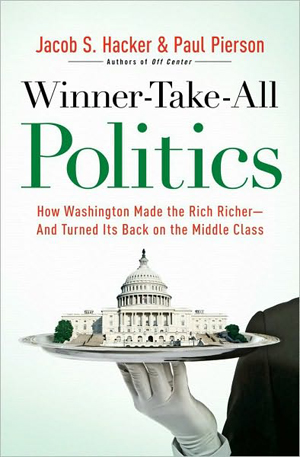
Winner-Take-All Politics is concerned first and foremost with economic inequality in America. The book cites a mountain of data to show how the very highest tiers in the nation’s income distribution—not just the top 10 percent, but the top 1 percent and the top 0.1 percent—have become much wealthier while income growth has stagnated at the middle and bottom. In 1974 the top 0.1 percent of American families earned 2.7 percent of all income in the country. By 2007, Hacker and Pierson write, “the top 0.1 percent have seen their slice of the pie grow . . . to 12.3 percent of income—a more than fourfold increase” (emphasis in original).
But why, other than in service of envy, should we care how much more the rich rake in? One reason is welfare—greater redistribution would help those who are less well off. A second reason is democracy. In pondering the question of how much equality democracy requires, Rousseau answered, “no one should be so poor as to have to sell himself, nor so rich that he can buy another.” From this vantage, the danger of inequality is not immiseration (though there is plenty of that), but domination.
More here.
two for one
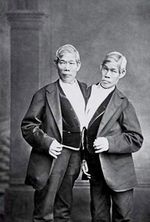
We take it for granted, then, that Siamese twins would separate if they could choose, especially now that 21st-century medical advances make it possible. In a 2000 BBC documentary, South African surgeon Heinz Röde — a leading specialist in the division of conjoined twins — summed up their condition as such: “My own philosophy,” he said, “ is that twins are born to be separated.” Which is to say, he believes people are born to be separate. In separating conjoined twins, we feel that we are saying to them, “You have a right to be alone, to be individuals alone, in your own body alone, determining your own destiny, alone.” Isn’t this the very definition of a free self, the knowledge that you can always extract yourself from another? Yet, if you ask conjoined twins, most seem quite comfortable with their shared bond. “We’d never agree to an operation,” Dasha Krivoshlyapova told the BBC. “We just don’t need it.” “Even when we were little we didn’t want one,” said Masha Krivoshlyapova. “We are a little collective.” This last sentiment is simultaneously adorable and horrifying. For what would it mean to turn our lives into a “little collective,” to permanently, inextricably attach our fate to another’s and always experience our lives in terms of another? Would it not make us unsure where our own “self” began and ended, unsure that we were the tellers of our own jokes, the designers of our own hopes, the caretakers of our own needs? How could we accept thinking of “me” as “us,” accept being unfree? In other words, what we see, and fear, in Chang and Eng is love.
more from Stefany Anne Golberg at The Smart Set here.
terror in misurata

It is 2 May, my twelfth full day in Misurata, and I’ll start with a man I met at a private clinic that had been turned into the city’s main trauma hospital. The uprising against Muammar Gaddafi was two months old. Loyalist forces surrounded Misurata and controlled parts of the city centre, but the thowar – or revolutionaries – were putting up fierce resistance despite being outgunned. The battle crackled and boomed day and night. Dr Tahar Alkesa, a surgeon, was sitting on the curb outside one of the white tents erected in front of the clinic to serve as a makeshift emergency ward. He is 31 years old and undoubtedly handsome, but the hours and stress had marked and changed him. He was sallow and unshaven, with dark rings under his puffy eyes. The evening light was soft and fading fast as we chatted. He rubbed his arms for warmth. I had seen Alkesa at work earlier in the day, when fresh casualties were arriving at the hospital every few minutes. An ambulance or pick-up truck would screech to a halt outside the tent, amid cries of “Allahu akbar”. If the victim was a thowar, he usually had a bullet wound, having been picked off by a sniper.
more from Xan Rice at The New Statesman here.
The Struggle For Middle East Democracy
Shadi Hamid in The Cairo Review:
It always seemed as if Arab countries were ‘on the brink.’ It turns out that they were. And those who assured us that Arab autocracies would last for decades, if not longer, were wrong. In the wake of the Tunisian and Egyptian revolutions, academics, analysts and certainly Western policymakers must reassess their understanding of a region entering its democratic moment.
What has happened since January disproves longstanding assumptions about how democracies can—and should—emerge in the Arab world. Even the neo-conservatives, who seemed passionately attached to the notion of democratic revolution, told us this would be a generational struggle. Arabs were asked to be patient, and to wait. In order to move toward democracy, they would first have to build a secular middle class, reach a certain level of economic growth, and, somehow, foster a democratic culture. It was never quite explained how a democratic culture could emerge under dictatorship.
In the early 1990s, the United States began emphasizing civil society development in the Middle East. After the attacks of September 11, 2001, the George W. Bush administration significantly increased American assistance to the region. By fiscal year 2009, the level of annual U.S. democracy aid in the Middle East was more than the total amount spent between 1991 to 2001.
But while it was categorized as democracy aid, it wasn’t necessarily meant to promote democracy. Democracy entails ‘alternation of power,’ but most NGOs that received Western assistance avoided anything that could be construed as supporting a change in regime.
The reason was simple. The U.S. and other Western powers supported ‘reform,’ but they were not interested in overturning an order which had given them pliant, if illegitimate, Arab regimes.
More here.
Rap Battle: Einstein vs. Stephen Hawking
Gandhi, bin Laden and the Global Chessboard
Anjum Altaf in The South Asian Idea:
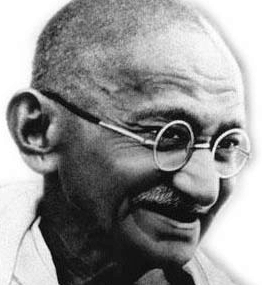
Let me state my conclusion at the outset: the personalities bear no comparison but the contextual similarities highlight major political issues that bear exploration and attention.
The word ‘precursor’ suggests clearly that it is the contextual similarity that prompts Lelyveld’s remark. To spell it out: the existence of a foreign oppressor; the emerging resistance to the oppression; the impotence of lawful resistance; the transition to mass agitation; its reliance on the wellsprings of religious humiliation; the ensuing conflict; and the resulting blowback.
More here.
Friday Poem
Syrinx
.
Like the foghorn that’s all lung,
the wind chime that’s all percussion,
like the wind itself, that’s merely air
in a terrible fret, without so much
as a finger to articulate
what ails it, the aeolian
syrinx, that reed
in the throat of a bird,
when it comes to the shaping of
what we call consonants, is
too imprecise for consensus
about what it even seems to
be saying: is it o-ka-lee
or con-ka-ree, is it really jug jug,
is it cuckoo for that matter?—
much less whether a bird’s call
means anything in
particular, or at all.
Syntax comes last, there can be
no doubt of it: came last,
can be thought of (is
thought of by some) as a
higher form of expression:
is, in extremity, first to
be jettisoned: as the diva
onstage, all soaring
pectoral breathwork,
takes off, pure vowel
breaking free of the dry,
the merely fricative
husk of the particular, rises
past saving anything, any
more than the wind in
the trees, waves breaking,
or Homer’s gibbering
Thespesiae iachē:
those last-chance vestiges
above the threshold, the all-
but dispossessed of breath.
.
by Amy Clampitt
from The Collected Poems of Amy Clampitt
Alfred A. Knopf, 1997
The Birth of the Mouse
From The Independent:
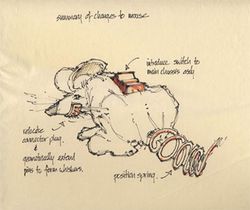
He had brought a big plastic bag full of the artifacts of that moment: diagrams scribbled on lined paper, dozens of differently sized plastic mouse shells, a spool of guitar wire, a tiny set of wheels from a toy train set, and the metal lid from a jar of Ralph’s preserves. He turned the lid over. It was filled with a waxlike substance, the middle of which had a round indentation, in the shape of a small ball. “It’s epoxy casting resin,” he said. “You pour it, and then I put Vaseline on a smooth steel ball, and set it in the resin, and it hardens around it.” He tucked the steel ball underneath the lid and rolled it around the tabletop. “It’s a kind of mouse.”
Hovey has shared some of his photographs and sketches from the days of development, presented here with excerpts from Gladwell’s piece.
More here.