
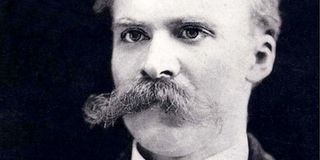
It seems like Nietzsche is one of the few philosophers whom lots of people who have never studied philosophy still enjoy reading. Why do you think he’s so appealing in this way?
I think the most important reason to start with is that he’s a great writer, and that is not the norm in philosophy. He’s a great stylist, he’s funny, he’s interesting, he’s a bit wicked, he’s rude. And he touches on almost every aspect of human life and he has something to say about it that’s usually somewhat provocative and intriguing. I think that’s the crucial reason why Nietzsche is so popular. Indeed, he’s probably more popular outside academic philosophy because he’s so hostile to the main traditions in Western philosophy.
Do you think people who haven’t studied philosophy can get quite a lot out of him? You might not really enjoy Spinoza’s Ethics, for instance, if you just picked it up randomly in a bookshop or in the library. Would you say that’s the case with Nieztsche?
I think people without that philosophical background do miss quite a lot – because a lot of what is going on in Nietzsche is reaction to and sometimes implicit dialogue with earlier philosophers. If you don’t know any Kant or Plato or the pre-Socratics, you’re not going to understand a lot of what’s motivating Nietzsche, what he’s reacting against. You get a much richer appreciation of Nietzsche if you are reading him against the background of certain parts of the history of philosophy.
Nietzsche himself was not trained in philosophy, he was trained in classics. But that included a great deal of study of ancient Greek philosophy. And then he taught himself a lot of other philosophy. Kant and Schopenhauer were particularly important to him.
Category: Recommended Reading
An Interview With Raymond Geuss
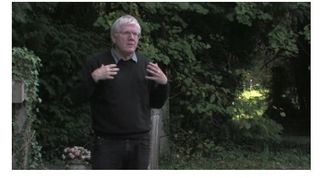
Raymond Geuss is a professor of philosophy at the University of Cambridge, who works in the general areas of political philosophy and the history of continental philosophy. We interviewed Geuss on Oct. 7, 2010, at Ascension Parish Burial Ground in Cambridge, where Ludwig Wittgenstein, among others, is buried. We included Geuss for historical perspective on the themes of our project, his unconventional and often critical views and his preference for pre-modern and ancient Greek categories of thinking. As Guess rejected most of the premises of our questions, the interview was one of the more agonistic we filmed. His unique humor and mannerisms made it one of the more enjoyable.
The Science of Sarcasm? Yeah, Right
From Smithsonian:

Sarcasm so saturates 21st-century America that according to one study of a database of telephone conversations, 23 percent of the time that the phrase “yeah, right” was used, it was uttered sarcastically. Entire phrases have almost lost their literal meanings because they are so frequently said with a sneer. “Big deal,” for example. When’s the last time someone said that to you and meant it sincerely? “My heart bleeds for you” almost always equals “Tell it to someone who cares,” and “Aren’t you special” means you aren’t.
More here.
Quantum theorem shakes foundations: The wavefunction is a real physical object
From Nature:

“I don't like to sound hyperbolic, but I think the word 'seismic' is likely to apply to this paper,” says Antony Valentini, a theoretical physicist specializing in quantum foundations at Clemson University in South Carolina. Valentini believes that this result may be the most important general theorem relating to the foundations of quantum mechanics since Bell’s theorem, the 1964 result in which Northern Irish physicist John Stewart Bell proved that if quantum mechanics describes real entities, it has to include mysterious “action at a distance”. Action at a distance occurs when pairs of quantum particles interact in such a way that they become entangled. But the new paper, by a trio of physicists led by Matthew Pusey at Imperial College London, presents a theorem showing that if a quantum wavefunction were purely a statistical tool, then even quantum states that are unconnected across space and time would be able to communicate with each other. As that seems very unlikely to be true, the researchers conclude that the wavefunction must be physically real after all. David Wallace, a philosopher of physics at the University of Oxford, UK, says that the theorem is the most important result in the foundations of quantum mechanics that he has seen in his 15-year professional career. “This strips away obscurity and shows you can’t have an interpretation of a quantum state as probabilistic,” he says.
More here.
The Beastly Péter Nádas
Our own Morgan Meis in Slate:
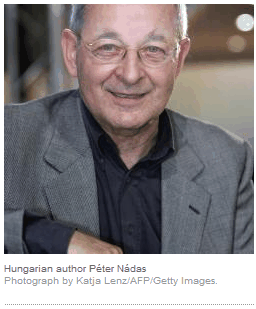
But we are getting ahead of ourselves. You, after all, have never really heard of Péter Nádas. He is not exactly a household name in Bohemia, as of yet. Be careful though. It is getting less and less respectable not to know about Nádas. Susan Sontag proclaimed his previous novel A Book of Memories, “the greatest novel written in our time, and one of the great books of the century.” Granted, Sontag always had a soft spot for Hungarians, but one ignores that kind of effusiveness at one's own intellectual peril.
More here.
What Obama should have said about the OWS eviction from Zuccotti Park
John Cassidy in The New Yorker:

Hi everybody. Before we arrive, I just wanted to say that I saw what happened in New York this morning and give you my reaction. As I said shortly after the Occupy Wall Street protest began, I think it expresses the frustrations that many ordinary Americans feel. The demonstrators in New York and other cities are giving voice to a broad-based anger and frustration. We had the biggest financial crisis since the Great Depression, with huge collateral damage throughout the country, and yet some of the same folks who acted irresponsibly are still fighting efforts to crack down on abusive practices that got us into this mess in the first place.
Second, I think the protestors have performed a valuable public service by raising two issues we have neglected for too long: the sharp rise in income and wealth inequality, and the corrosive role that money plays in American politics. When the protestors say that rich people need to pay their fair share of taxes, and that we in Washington often pay too much attention to the wishes of Wall Street and other powerful interest groups, and too little attention to the interests of middle-class families, they are only stating what most Americans know to be true. Indeed, the money problem is getting worse. Under a recent ruling from the Supreme Court, corporations and billionaires can make unlimited contributions to political parties. Some of them, as you know, are already financing ads aimed at me and my policies.
Third, as a former lecturer on Constitutional Law, I have a great appreciation for the rights afforded Americans under the First Amendment, which includes freedom of speech and freedom of expression, but also the right to peaceably assemble.
More here.
Mongolian throat singer Bukhchuluun Ganburged sings Waltzing Matilda
So Much Aid, So Little Development: Stories from Pakistan
Sakuntala Narasimhan reviews Samia Altaf's book in Dawn:

Maternal mortality is still unacceptably high in these regions (the Asian subcontinent accounts for a quarter of global maternal deaths). Infants are dying in unacceptably large numbers, of illnesses that are preventable. So why haven’t the massive doses of aid from overseas succeeded in delivering what they set out to address?
A candid answer to that question can be found in a new publication, titled So Much Aid, So Little Development written by Samia Waheed Altaf, a Pakistani specialist in public health who was a member of an international team that oversaw the Social Action Programme (SAP) in Pakistan during the 1990s. She has observed and chronicled the way decisions are made, in disbursing aid from multilateral agencies.
Using real life stories of aid recipients and beneficiaries, the book describes how giving and receiving aid has become an end in itself — the donor agencies have the satisfaction of putting on record that so many millions were spent on such-and-such projects, while the receiving country pats itself on its back on the inflow.
Invariably, however, the American or European ‘experts’ who fly in to devise, and advise on, health projects, have no idea of the local constraints, and come up with strategies that guarantee failure in terms of real improvements in ground realities.
More here.
Thursday, November 17, 2011
After the Eviction

Last night, in what seems to be part of a coordinated crackdown on occupations across the country, Zuccotti Park was raided. Thousands of us who had subscribed to the text alert system, or who got emails or phone calls or panicked Twitter messages, went to Wall Street. But we could not get near the camp. Two blocks south of Liberty Plaza on Broadway, blocked by a police barricade that circled the whole area, I found myself part of a small crowd straining to see what was happening. In the distance, Zuccotti Park was lit like a sports field, glaring eerily, and I could make out a loud speaker, blasting announcements and threats. Sounds of people chanting and screaming floated towards us. While we paced the street, seething and sorrowful, tents were trampled, people’s possessions piled up, and occupiers arrested. Later I would come across a camper I had met earlier in the day sobbing on the sidewalk. A few blocks west, maybe thirty minutes after I arrived, the police line broke so two huge dump trucks could pass through. So that was it: we, and everything we had made and were trying to make, were trash.
The authorities must be ashamed, because they so badly did not want anyone to see what happened last night. First they attacked the senses, flooding the park with bright light and using sound cannons. Then they corralled the press into pens, arrested reporters, and shut down airspace over lower Manhattan, so that no news stations could broadcast from above. As we strained our necks over their barricades they kept telling us that there was nothing to see. But clearly there was! We knew they were lying. And when we told them so, they, with batons in hand, forced us away. We were herded like sheep, and I felt like one, meekly following orders, a terrible coward. Those who resisted—those who stood their ground on a public sidewalk we all have a right to stand on—got maced in the face, right in the eyes. The authorities so badly did not want anyone to see what happened last night they were willing to temporarily blind us.
Occupy vs Tea Party: What Their Twitter Networks Reveal
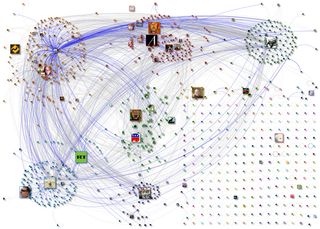
According to some political commentators, Occupy Wall Street is the left's answer to the Tea Party – driven by a similar anger towards elites. But the social networks of people tweeting about the two movements suggest that they have rather different dynamics.
Those tweeting about the Tea Party emerge as a tight-knit “in crowd”, following one another's tweets. By contrast, the network of people tweeting about Occupy consists of a looser series of clusters, in which the output of a few key people is being vigorously retweeted.
The Occupy network also has many casual unconnected tweeters, shown to the bottom right of the diagram below. Whether Occupy takes off as a coherent movement may depend on its success in bringing these potential recruits into the fold.
This view of how the two movements are impacting the Twitterverse comes from Marc Smith of the Social Media Research Foundation in Belmont, California. “These are very differently organised groups,” he says. “Occupy is much more diffuse and diverse.”
Smith has analysed tweets containing “occupywallstreet” or “teaparty”, drawing connections between the Twitter users involved if one follows one other (shown in grey), or if they retweeted, replied or mentioned one another (shown in blue).
The Occupy network above visualises almost 1400 tweets posted in less than 30 minutes on 15 November. The size of each user depends on their number of followers. The clusters, with users shown in different colours, are defined by an algorithm that looks for “islands” after subtracting the influence of people who “bridge” different parts of the network.
Occupy's clusters look like a series of firework explosions, as supporters retweet the posts of a few key individuals and organisations.
Social Networks Matter: Friends Increase the Size of Your Brain
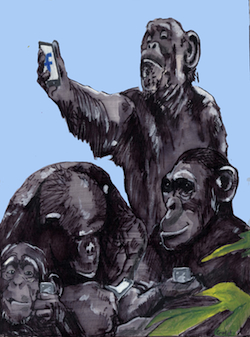
In the 1990s the British evolutionary anthropologist Robin Dunbar championed an idea known as the Social Brain Hypothesis. He found that mammals who lived in the largest social groups often had the largest neocortex to brain ratio. Since the neocortex — composed chiefly of gray matter that forms the outermost “rind” of our cantaloupe-sized stuff of thought — is associated with sensory perception and abstract reasoning, Dunbar hypothesized that the demands of group living resulted in a selection pressure that promoted the expansion of neocortical growth.
In 2009 I co-authored a study in the Journal of Human Evolution with colleagues Evan MacLean, Nancy Barrickman, and Christine Wall of Duke University that found no relationship between relative brain size and group size in lemurs (a clade of strepsirrhine primates that last shared a common ancestor with the haplorhine monkeys and apes about 75 million years ago). However, where it comes to these more recently evolved haplorhines, the data is remarkably consistent with Dunbar’s interpretation (see Figure 1 below).
Primates, and humans in particular, are such good social cooperators because we can empathize with others and coordinate our activities to build consensus. It is what also makes us so remarkably deceitful, allowing us to manipulate other members of our group by intentionally making them think we will behave one way when our actual plans are quite different. A successful primate is therefore one who can keep track of these subtle details in behavior and anticipate their potential outcome.
But therein lies a chicken-and-egg problem. How do we know whether it’s the social networks that have promoted an increase in neocortical growth or whether that same expansion of gray matter simply allowed these social networks to expand? A new study published in the November 4th edition of Science addressed this question by housing monkeys in different sized groups to find out if their neocortical gray matter increased as the number of individuals grew.
An Adventure in the Nth Dimension
Brian Hayes in American Scientist:

Some 50 years after my first exposure to the formulas for area and volume, I have finally had occasion to look into these broader questions. Finding the master formula for n-dimensional volumes was easy; a few minutes with Google and Wikipedia was all it took. But I’ve had many a brow-furrowing moment since then trying to make sense of what the formula is telling me. The relation between volume and dimension is not at all what I expected; indeed, it’s one of the zaniest things I’ve ever come upon in mathematics. I’m appalled to realize that I have passed so much of my life in ignorance of this curious phenomenon. I write about it here in case anyone else also missed school on the day the class learned n-dimensional geometry.
More here.
Natacha Atlas – “Mistaneek”
[Thanks to Lawrence Osborne.]
Has a Harvard Professor Mapped Out the Next Step for Occupy Wall Street?
Lawrence Lessig's call for state-based activism on behalf of a Constitutional Convention could provide the uprooted movement with a political project for winter.
Alesh Houdek in The Atlantic:

Lawrence Lessig has an answer. In his new book, Republic, Lost: How Money Corrupts Congress — and a Plan to Stop It, he spends 20 pages reviewing the the 30 years of deregulation that led up to the financial crisis and outlining our present circumstances. In fact, this book, published just before Occupy Wall Street began, is perfectly positioned to become the movement's handbook. While few protesters will need convincing that the government is corrupted by money, the book lays out the case in a such a comprehensive and persuasive manner — and proposes such specific and radical solutions — that it seems tailor-made for the Occupy movement. And it's ambitious proposal for state-based activism on behalf of a Constitutional Convention could provide the movement with a next organizing step as it nears its two-month anniversary Thursday — and faces such questions as how to ride out the winter and how to respond to police crackdowns.
Lessig, director of the Edmond J. Safra Foundation Center for Ethics at Harvard University and a professor at Harvard Law School, spent 10 years fighting to reform the nation's copyright laws. The effort produced a half-dozen books, led to the creation of the Creative Commons licensing system and a case before the Supreme Court, which ultimately failed. Rather than dissuading him, Lessig concluded four years ago that this failure perfectly situated him to take on an infinitely harder challenge — the reform of Congress itself. The shift in focus led him to leave Stanford University and relocate his family to the east coast to teach at Harvard in 2008, where he began the research and activity that gave rise to his latest book.
More here.
Thursday Poem
Seeing Making Waking
1
The eye you see is not
an eye because you see it;
it is an eye because it sees you.
The eye you see is not
an eye because you see it;
it is an eye because it sees you.
8
Form your letters slowly and well:
making things well
is more important than making them.
Form your letters slowly and well:
making things well
is more important than making them.
10
Beyond living and dreaming
there is something more important:
waking up.
.
Beyond living and dreaming
there is something more important:
waking up.
.
by Antonio Machado
from Moral Proverbs and Folk Songs
from Moral Proverbs and Folk Songs
Female Comedians, Breaking the Taste-Taboo Ceiling
From The New York Times:
…
More here.
for the love of cinema, hit him hard

SOMEWHERE IN THE SUN-DAPPLED greenery of the Shomali plains, an hour’s drive out of Kabul, Salim Shaheen stands ankle deep in mud, urging on two men in a shallow stream who are locked in a grim clench. “Fight you guys, fight,” he urges, in a voice that is almost painfully hoarse, but carries further than a megaphone. The blows rain down as Shaheen builds up to a crescendo. “I implore you, for the love of cinema, hit him hard, hard, hit him like an Afghan, man, not a sissy foreigner.” Finally, with a thumping punch to the jaw, the actor flips his costar into the water with a dramatic and almighty splash that soaks most of the production team huddled around them, and nearly wets the camera. The crew and the watching crowd break into applause, and Shaheen wades into the water to exclaim over and examine the punched face. “See how beautiful it looks, behenji,” he yells out to me on the other side of the stream in that ill-used voice, “swelling up for real. Not like in Mumbai where they only pretend to hit each other. Watch how we make films in Afghanistan.” This last line is something of a recurring theme in conversations with Salim Shaheen, one of Afghanistan’s leading heroes, directors and producers. Portly, bombastic and with enough energy to run a small power station, Shaheen seems at first glance an unlikely candidate for Afghanistan’s poster boy. But for an entire generation of Afghans who watched his blood-soaked, action-packed movies, he is the quintessential dhishum-dhishum hero; the hyperbolic, gun-toting, fist-smashing, song-singing hero who gets the girl and pulps the villain—all in the best traditions of masala Hindi movies from the 1970s and 1980s.
more from Taran N Khan at The Caravan here.
Study shows left side of brain more active in immoral thinking
From PhysOrg:
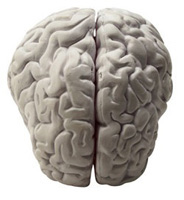
The idea behind all three experiments was to present volunteers with material that is generally believed to be immoral while watching blood flow patterns in their brains using fMRI, as compared to what happens when moral or neutral material is viewed. In the first study, volunteers were told that they would be engaging in a memory test. They were then shown a series of statements, followed by another series of statements after that. During the second series they were asked to press a button to indicate if the statement they were being shown had been among those shown in the first series. The statements shown were divided into four classes: pathogen related (non-sexually gross stuff), incestuous acts, nonsexual immoral acts and neutral acts. In the second study, volunteers were shown three types of statements in random order: 50 examples describing acts that most people think of as immoral, 50 statements that most think of as pro-moral (morally good) and 50 statements that most people think of as neutral. And finally, in the third study, volunteers were shown three types of pictures in random order: immoral, non-moral (negative without morality), and neutral. After analyzing and normalizing the data, the researchers found that the left hemisphere of the brain showed increased blood flow in response to immoral stimuli throughout all three studies, while the right did not.
More here.
island troubles

Stevenson, as has been said, was disarmingly candid about the material he borrowed for Treasure Island. One name, however, is missing from the extensive catalogue of self-confessed “plagiarisms”. That one missing name was brought to public attention by Robert Leighton (1858–1934). Later in life a respected novelist and literary editor of the Daily Mail, Leighton was, in 1881, an assistant editor to James Henderson on Young Folks. Writing in the Academy in March 1900, Leighton recalled that early in 1881 – sometime, allegedly, before late August – James Henderson had offered to consider a story from Stevenson and, “as indicating the kind of story he desired for Young Folks, he gave to Stevenson copies of the paper containing a serial by Charles E. Pearce, entitled Billy Bo’swain”. Pearce’s novel, as Leighton notes, had a chart and buried treasure: “its whole plan and construct were similar”. Leighton’s version wholly contradicts the received view that the story originated, entirely, at Braemar, within the family, with the famous map drawn up at Lloyd’s easel, and no thought of the London market. From what he knew, Leighton maintained that “I have always believed that Stevenson wrote Treasure Island with an eye on Young Folks”. It was conceived not as family entertainment, but as a product to be sold in the literary marketplace. Leighton’s bombshell was thrown after Stevenson’s death and after “My First Book” had recorded a radically more romantic account of Treasure Island’s genesis.
more from John Sutherland at the TLS here.
mengele’s skull

Modern human rights forensics began in Argentina with the victims, and in Brazil with the perpetrator. And it began with the same question asked of the bones: “Who are you?” Like testimony, forensics has political, ethical, and aesthetic manifestations. The emergence of a forensics aesthetics—marked for us most clearly by Helmer’s video presentation in São Paulo—signals a shift in emphasis from the living to the dead, from subject to object, in the aftermath of atrocity and the pursuit of human rights. But just as the survivors of the camps required the space of the trial itself to emerge as witnesses, and in a real sense emerged as such in the very act of speaking, so too things do not simply come with their agency already fully operational. A forum, which in this case was a scientific-aesthetic space, and all the techniques of presentation (of making-evident) that come with it, is required for facts to be debated. If things have begun to speak in the context of war-crimes investigation and human rights, it is not simply that we have acquired better listening skills, or that the forums of discussion have been liberally enlarged. The very entry of bones and other things into these forums has changed the meanings and the practices of discussion themselves. In fact, the entry of non-humans into the field of human rights has transformed it.
more from Thomas Keenan and Eyal Weizman at Cabinet here.