a cobbled together life

65997568

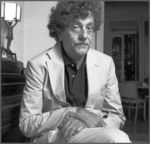
It’s dangerous to begin a biography with what amounts to an advertisement for oneself. “Someone else could cobble together a so-so version of your life just by mining what’s stored in library boxes and electronic files. And it will happen soon, I think,” Charles J. Shields writes in the introduction to “And So It Goes: Kurt Vonnegut: A Life,” quoting a note he sent his then-potential-subject in summer 2006. “But I’m the guy for the job — for doing it right, that is. … And I’m a damn good researcher and writer.” What we have here is the literary equivalent of a come-on, Shields buttering up Vonnegut, appealing to his vanity. But it also raises elusive questions, such as: What is the connection between biographer and biographee? And: Who is all this really about? To his credit, Shields removes himself from the book once he finishes the introduction, but an afterimage lingers, like residue. Vonnegut died at 84 in April 2007; Shields met with him on only two occasions, and then, in an irony worthy of the author’s fiction, was left to “cobble together” a version of the life.

more from David L. Ulin at the LA Times here.
kissinger on kennan

13KISSINGER-COVER-articleInline

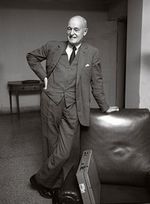
While writing this essay, I asked several young men and women what George F. Kennan meant to them. As it turned out, nearly all were essentially oblivious of the man or his role in shaping American foreign policy. Yet Kennan had fashioned the concept of containment in the name of which the cold war was conducted and won and almost concurrently had also expressed some of the most trenchant criticism of the way his own theory was being implemented. To the present generation, Kennan has receded into a vague past as has their parents’ struggle to bring forth a new international order amid the awesome, unprecedented power of nuclear weapons. For the surviving participants in the emotions of that period, this state of affairs inspires melancholy reflections about the relevance of history in the age of the Internet and the 24-hour news cycle. Fortunately, John Lewis Gaddis, a distinguished professor of history and strategy at Yale, has brought again to life the dilemmas and aspirations of those pivotal decades of the mid-20th century. His magisterial work, “George F. Kennan: An American Life,” bids fair to be as close to the final word as possible on one of the most important, complex, moving, challenging and exasperating American public servants. The reader should know that for the past decade, I have occasionally met with the students of the Grand Strategy seminar John Gaddis conducts at Yale and that we encounter each other on social occasions from time to time. But Gaddis’s work is seminal and beyond personal relationships.

more from Henry Kissinger at the NY Times here.

Friday, November 11, 2011

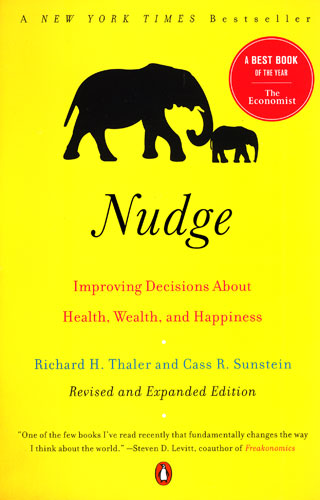
‘Nudge’ Policies Are Another Name for Coercion

Thaler-nudgeHenry Farrell and Cosma Shalizi in New Scientist:

WE HAVE all cringed watching friends and family make terrible decisions, and been tempted by visions of the pain spared if we could only make them follow our advice. The same feeling motivates well-intentioned technocrats to take charge of the public: people are plainly making sad blunders they will regret.

Economist Richard Thaler and legal scholar Cass Sunstein (now a senior policy-maker in the Obama administration) present the latest, and subtlest, version of this temptation in their influential work on “nudging” people into making wiser choices. They argue that wise decision-makers should tweak the options and information available so that the easiest choice is the right one. For example, this can guide people to donate their organs if they die unexpectedly by making organ donation an opt-out rather than an opt-in choice. And it can encourage people to plan for their pensions by making pension contributions automatic for everyone who does not explicitly opt out of the system.

“Nudging” is appealing because it provides many of the benefits of top-down regulation while avoiding many of the drawbacks. Bureaucrats and leaders of organisations can guide choices without dictating them. Thaler and Sunstein call the approach “libertarian paternalism”: it lets people “decide” what they want to do, while guiding them in the “right” direction.

Much criticism of this approach comes, in fact, from libertarians, who see little difference between guiding a person's choices and eliminating them. A nudge is like a shove, they argue, only more disreputable because it pretends otherwise. The real problem, though, is that Thaler and Sunstein's ideas presume good technocrats can use statistical and experimental results to guide people to make choices that serve their real interests. This is a natural belief for scientists and intellectuals, especially those who see the awful ways scientific knowledge is abused politically, and think life would be better if scientists had more authority.

However natural, though, this won't work because libertarian paternalists are often wrong on the underlying social science.

wordsworth, the self-shaper

William-Wordsworth-001-150x150

Humans are inveterate storytellers. We make incessant and insistent narrative sense of the world around us and of our place in it—so much so that some scholars have suggested “homo narrans” as a more appropriate identifying description for our species than “homo sapiens”.1 Indeed, a long-standing tradition holds that our very self-identities have an essentially narrative shape: that who each of us is is determined by the stories of our lives, and that in some sense we create our selves by crafting those stories. In this essay, I focus on an especially compelling case of narrative self-construction: Wordsworth’s Prelude. I argue that we do need rich, substantive selves of the sort delivered by narratives like The Prelude, both in order to evaluate our past actions and to guide future ones. However, the very feature which makes Wordsworth’s poem so rhetorically powerful as an autobiography—his invocation of a robust teleological structure, which is imposed on him from infancy by Nature—also prevents us from embracing it as a model for our own self-understanding, because it conflicts sharply with modern views about ontology. Contemporary advocates of a narrative conception of the self, such as Jerome Bruner, Alasdair MacIntyre and Marya Schectman, drop The Prelude’s objectionable ontological assumptions. But rather than placing the narrative conception of self on a firm metaphysical foundation, this actually intensifies the threat of fictionalism: the risk that the selves we fashion through stories are mere self-deluding illusions. I conclude by gesturing toward the characters within stories as an alternative literary model which avoids many of these problems.

more from Elisabeth Camp at nonsite here.

the beauty and the sorrow

51fy0cSFxDL._SS500_

Mr. Englund’s book is a deviation from standard history books. It is a corrective too to the notion that World War I was only about the dire trench warfare on the Western Front. “The Beauty and the Sorrow” expertly pans across other theaters of war: the Alps, the Balkans, the Eastern Front, Mesopotamia, East Africa. Soldiers in this book have beehives fall on them; one has Christmas in Egypt under the pyramids; tsetse flies are an intractable problem. This is a moving book, almost from the start. War floods these people’s lives like a natural catastrophe, a Hurricane Katrina that reeks of cordite. When cannon fire is heard in the distance, and you are a woman at home with your children, do you stay or flee? Who is coming, anyway? Almost no one understands what’s happening, even why this war is to be fought. “Lack of facts,” Mr. Englund observes, “has been padded out with guesses, suppositions, hopes, fears, idées fixes, conspiracy theories, dreams, nightmares and rumors.” “The Beauty and the Sorrow” follows individuals like Florence Farmborough, an English nurse in the Russian Army, and Richard Stumpf, a young German high-seas fleet seaman. Their stories are mostly taken from memoirs, letters and other already published material. The accounts of their lives can be terrifying or stirring, but are most fully alive in Mr. Englund’s accumulation of small moments, stray details.

more from Dwight Garner at the NY Times here.

that old social media problem

Racine

If you feel overwhelmed by social media, you’re hardly the first. An avalanche of new forms of communication similarly challenged Europeans of the 17th and 18th centuries. “In the 17th century, conversation exploded,” said Anaïs Saint-Jude, director of Stanford’s BiblioTech program. “It was an early modern version of information overload.” The Copernican Revolution, the invention of the printing press, the exploration of the New World – all needed to be digested over time. There was a lot of catching-up to do. “It was a dynamic, troubling, messy period,” she said. Public postal systems became the equivalent of Facebook, Twitter, Google+ and smartphones. Letters crisscrossed Paris by the thousands daily. Voltaire was writing 10 to 15 letters a day. Dramatist Jean Racine complained that he couldn’t keep up with the aggressive letter writing. His inbox was full, so to speak. Stanford’s Mapping the Republic of Letters project, which forms part of the context for Saint-Jude’s remarks, shows that 40 percent of Voltaire’s letters were sent to correspondents relatively close by.

more from Cynthia Haven at The Book Haven here.

The free market secret of the Arab revolutions

Hernando de Soto in the Financial Times:

ImgDebatesHernandoDeSotoA few weeks ago I met Salem, the younger brother of the brave Tunisian fruit vendor whose self-immolation triggered the Arab uprising. When I asked him what his brother in heaven would say if we asked what he hoped his sacrifice would bring to the Arab World, Salem did not hesitate: “That the poor also have the right to buy and sell.”

It is worth remembering these words as experts busily debate the challenges for the future of the Arab revolution as countries balance the quest for democracy, fidelity to Islam, with secularism and tribal power.

In the wake of the overthrow of three autocrats, not enough credit has been given to the mighty consensus that triggered the uprising – the desire of a vast, underclass of people to work in a legal market economy. In the culturally diverse Middle East and north Africa, the one common thread is its informal economy. This is the key to future growth and indeed stability.

More here.

Composers as Gardeners

From Edge:

Brian_eno_01Brian Eno [11.10.11] “My topic is the shift from 'architect' to 'gardener', where 'architect' stands for 'someone who carries a full picture of the work before it is made', to 'gardener' standing for 'someone who plants seeds and waits to see exactly what will come up'. I will argue that today's composer are more frequently 'gardeners' than 'architects' and, further, that the 'composer as architect' metaphor was a transitory historical blip.”

About the time when I first started making records, I was also starting to become aware of a new sort of organizing principle in music. I think like many people, I had assumed that music was produced, or created in the way that you imagine symphony composers make music, which is by having a complete idea in their head in every detail and then somehow writing out ways by which other people could reproduce that. In the same way as one imagines an architect working. You know, designing the building, in all its details, and then having that constructed. In the mid-'60s, there started to appear some music that really wasn't like that at all. And in fact, it was about the time I started making music, and I found that I was making music in this same rather unusual new way. So that the music I was listening to then in particular, in relation to this point, was Terry Riley's “In C” and Steve Reich's famous tape pieces, “It's Gonna Rain” and “Come Out.” And various other pieces as well.

Of course, I was also familiar with Cage and his use of randomness, and new ways of making musical decisions. Or not making them. What fascinated me about these kinds of music was that they really completely moved away from that old idea of how a composer worked. It was quite clear with these pieces, for example “In C,” that the composer didn't have a picture of the finished piece in his head when he started. What the composer had was a kind of menu, a packet of seeds, you might say. And those musical seeds, once planted, turned into the piece. And they turned into a different version of that piece every time. So for me, this was really a new paradigm of composing. Changing the idea of the composer from somebody who stood at the top of a process and dictated precisely how it was carried out, to somebody who stood at the bottom of a process who carefully planted some rather well-selected seeds, hopefully, and watched them turn into something. Now, I was sort of looking for support for that idea. The term 'bottom-up' hadn't come into existence then. Chaos theory, complexity theory, so on, they didn't exist. I don't even think we had catastrophe theory then.

More here.

Interesting thoughts on the mathematics of polling

John Allen Paulos in the New York Times:

John_Allen_PaulosOne way to get a clearer picture of an electorate’s preferences is to ask prospective voters to rank the candidates and not merely say which one is their first choice. Who is their second choice, third, fourth, fifth? Doing this allows us to get a better overall view of their appeal or lack thereof. It also makes clear that “Who’s ahead?” is not by any means a question with a single, simple answer.

Let’s imagine that likely Republican voters were asked to rank Herman Cain, Newt Gingrich, Ron Paul, Rick Perry, and Mitt Romney (Michele Bachmann, Jon Huntsman and Rick Santorum, please accept my apologies). This is for illustration only, although it’s not that far off the mark, so let’s further imagine:

that 36.3% of them favored Romney to Gingrich to Paul to Cain to Perry;

and 27.3% of them favored Cain to Paul to Gingrich to Perry to Romney;

and 18.2% of them favored Perry to Paul to Gingrich to Cain to Romney;

and 9.1% of them favored Gingrich to Perry to Cain to Paul to Romney;

and 9.1% of them favored Paul to Gingrich to Perry to Romney to Cain.

Romney is clearly preferred by the highest percentage of voters so using the conventional method of plurality, Romney, the most conventional candidate, is the clear leader.

But impressed that the second highest percentage of voters prefer him (“Wow! 27.3% is almost exactly the sum of my 9-9-9 plan”), Cain might well argue that a runoff between him and Romney is appropriate. In such a runoff, the numbers above suggest that Cain would win since 54.6% all of the voters polled ranked him higher than Romney.

More here.

Sickle-cell mystery solved

From Nature:

It has been a medical mystery for 67 years, ever since the British geneticist Anthony Allison established that carriers of one mutated copy of the gene that causes sickle-cell anaemia are protected from malaria1. The finding wasn’t trivial: in equatorial Africa, where Allison did his work, up to 40% of people are carriers of this mutated gene. Since then, scientific sleuths have wondered how exactly the gene protects them. With a paper published today in Science2, the answer — or a large part of it — seems to be at hand.

Michael Lanzer and his colleagues at Heidelberg University in Germany and the Biomedical Research Center Pietro Annigoni in Ouagadougou, Burkina Faso, used powerful electron microscopy techniques to compare healthy red blood cells both with 'normal' cells infected with the malaria parasite Plasmodium falciparum and with infected cells from people carrying the mutated “S” gene that causes sickle-cell disease, as well as another mutation, dubbed “C,” which occurs at the same spot. Both mutations lead to the substitution of a single amino acid in the hemoglobin molecule, causing the haemoglobin to aggregate abnormally inside the cell. In people with two copies of the S mutation, they deform into a half-moon shape — the 'sickle cells' that give the disease its name..

More here.

Friday Poem

Coolie Mother

Jasmattie live in bruk-
Down hut big like Bata shoe-box,
Beat clothes, weed yard, chop wood, feed fowl
For this body and that body and every blasted body
Fetch water, all day water like if the
Whole slow-flowing Canje river God create
Just for she one bucket.

Till she foot bottom crack and she hand cut-up
And curse swarm from she mouth like red ants
And she cough blood on the ground but mash it in:
Because Jasmattie heart hard, she mind set hard.

To hustle save she one-one penny,
Because one-one dutty make dam cross the Canje
And she son Harrilal got to go school in Georgetown
Must wear clean starch pants, or they go laugh at he,
Strap leather on he foot, and he must read book,
Learn talk proper, take exam, go to England university,
Not turn out like he rum-sucker chamar dadee.

by David Dabydeen
from Coolie Odyssey, 1988

Six Questions for Slavoj Žižek

J. Nicole Jones in Harper's Magazine:

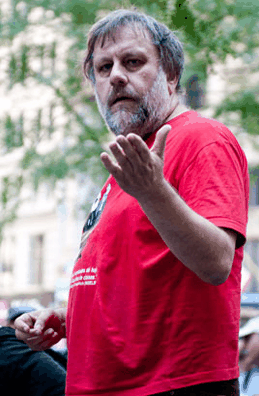
ScreenHunter_09 Nov. 11 10.59For a philosopher who claims to eschew the carnivalesque, Slavoj Žižek creates quite a circus wherever he goes. After his concluding remarks as host of a recent conference in New York called Communism: A New Beginning?, the Marxist thinker, whose marriage of pop culture and theory has made him possibly the most famous Slovenian ever, was immediately mobbed by admirers. Like a rock star, he headed for the back door, leading me through a meandering underground passageway before we emerged to the streets of Manhattan. As we made our way to a nearby café, he collected a new entourage around him — mostly autograph-seekers and undergraduate fanboys grilling him for term-paper advice. He obliged the autograph-hunters, asked that aspiring intellectuals email him with specific questions, and initially insulted a man who wanted a photograph, saying “One idiot more!” The man withdrew his request with polite apologies, and a strange tug of war ensued as Žižek then insisted on being photographed.

Žižek seems to thrive on contradiction. As we spoke, he veered from one stream of thought to another in his famously thick accent. Although he claimed at one point to prefer solitude, he delighted in making attention-drawing remarks — proclaiming with impish glee, for example, that Gandhi was technically more violent than Hitler, or advising me to tell panhandlers, “Yes I have some change. Fuck off!”

More here.

Thursday, November 10, 2011

Could Jazz Provide the Occupy Wall Street Soundtrack?

Jazz1-460x307I had the chance to see Darcy James Argue's Secret Society and graphic novelist Danijel Zezelj's amazing show Brooklyn Babylon at BAM last night. Martin Johnson in Salon:

In the late ’50s and ’60s, during the peak of the civil rights movement, marches and meetings had a jazz soundtrack. Masterworks like Max Roach’s “Freedom Now Suite,” Charles Mingus’ “Fables of Faubus” and Sonny Rollins’ “Freedom Suite” were equal parts incendiary and innovative — brilliant music that reflected their times with precision and passion. As that era gave way to the heyday of Black Nationalism, political themes continued in the vibrant jazz of musicians like Archie Shepp, Sunny Murray and Julius Hemphill, among others.

Yet by the ’80s, fight-the-power odes died down in jazz, especially as rap and hip-hop emerged to carry the flag. Jazz veered toward easy listening instead. “I think jazz went through a period in the 1980s and 1990s where it was trying very hard to be ‘America’s Classical Music,’” says composer and bandleader Darcy James Argue. “The intentions behind this were laudable. The movement clearly succeeded in increasing respect for jazz in elite circles — but it also defanged the music by stripping away the social and political context, or by trying to frame it in broadly inoffensive terms.”

Argue is one of the most prominent of a growing number of jazz musicians whose work features overtly political themes. They are reflected in major shows upcoming on both coasts.

The Reign of the One Percenters: Income inequality and the death of culture in New York City

Christopher Ketcham in Orion Magazine:

OneFor my daughter’s benefit, so that she might know the enemy better, know what he looks like, where he nests, and when and where to throw eggs at his head, we start the tour at Wall Street. It’s hot. August. We’re sweating like old cheese. Here are the monuments that matter, I tell her: the offices of Deutsche Bank and Bank of New York Mellon; the JPMorgan Chase tower up the block; around the corner, the AIG building. The structures dwarf us, imposing themselves skyward. “Linked together like rat warrens, with air conditioning,” I tell her. “These are dangerous creatures, Léa. Sociopaths.” She doesn’t know what sociopath means. “It’s a person who doesn’t care about anybody but himself. Socio, meaning society—you, me, this city, civilization. Patho, like pathogen—carrying and spreading disease.” Long roll of eyes.

I’m intent on making this a teachable moment for my daughter, who is fifteen, but I have to quit the vitriol, break it down for her. I have to explain why the tour is important, what it has to do with her, her friends, her generation, the future they will grow up into. On a smaller scale, I want Léa to understand what New York, my birthplace and home, once beloved to me, is really about. Because I’m convinced that the beating heart of the city today is not its art galleries, its boutiques, its restaurants or bars, its theaters, its museums, nor its miserable remnants in manufacturing, nor its creative types—its writers, dancers, artists, sculptors, thinkers, musicians, or, god forbid, its journalists. “Here,” I tell her, standing in the canyons of world finance, “is what New York is about. Sociopaths getting really rich while everyone else just sits on their asses and lets it happen.”

More here.

Protein love triangle key to crowning bees queens?

From PhysOrg:

BeesA honey bee becomes a royal queen or a common worker as a result of the food she receives as a larva. While it has been well established that royal jelly is the diet that makes bees queens, the molecular path from food to queen is still in dispute. However, scientists at Arizona State University, led by Adam Dolezal and Gro Amdam, have helped reconcile some of the conflicts about bee development and the role of insulin pathways and partner proteins. Their article “IIS and TOR nutrient-signaling pathways act via juvenile hormone to influence honey bee cast fate” has been published in the December issue of the Journal of Experimental Biology. Central to the dispute within the scientific community about “who would be queen” has been a ground-breaking study published in the journal Nature by Japanese scientist Masaki Kamakura in 2011. He found that a single protein in royal jelly, called royalactin, activated queen development in larval bees through interaction with an epidermal growth factor receptor (EGFR). Kamakura's work suggested that insulin signals do not play a role in queen development, despite previous studies suggesting otherwise, including work pioneered with the insulin receptor protein by Amdam's group.

Undeterred by Kamakura's findings, Dolezal, a doctoral student, and Amdam, a Pew Biomedical Scholar and professor in ASU's School of Life Sciences, looked for ways to resolve the disparity between the research studies. Amdam's team's first step involved taking control of the insulin receptor's partner protein, IRS, which the insulin receptor relies upon for signaling. The scientists found that by blocking IRS, they caused a central developmental hormone to crash, which forced larval bees into the worker mold despite their diet of royal jelly. Amdam's team then “rescued” the now worker-destined bees. They found that by giving the bees hormone treatments, the bees could then develop along the queen trajectory.

More here.

20 Favorite Vonnegut-isms

Art15761widea.jpegEmily Temple in Flavorwire:

“If you want to really hurt your parents, and you don’t have the nerve to be gay, the least you can do is go into the arts. I’m not kidding. The arts are not a way to make a living. They are a very human way of making life more bearable. Practicing an art, no matter how well or badly, is a way to make your soul grow, for heaven’s sake. Sing in the shower. Dance to the radio. Tell stories. Write a poem to a friend, even a lousy poem. Do it as well as you possibly can. You will get an enormous reward. You will have created something.” — A Man Without a Country, 2005

“If you make people laugh or cry about little black marks on sheets of white paper, what is that but a practical joke? All the great story lines are great practical jokes that people fall for over and over again.” — a “composite self-interview” in The Paris Review, 1977

“We are here on Earth to fart around. Don’t let anybody tell you any different.” — A Man Without a Country, 2005

“Jokes can be noble. Laughs are exactly as honorable as tears. Laughter and tears are both responses to frustration and exhaustion, to the futility of thinking and striving anymore. I myself prefer to laugh, since there is less cleaning up to do afterward — and since I can start thinking and striving again that much sooner.” — “Palm Sunday”, a sermon delivered at St. Clement’s Church, New York City, originally published in The Nation as “Hypocrites You Always Have With You”

“We are what we pretend to be, so we must be careful about what we pretend to be.” — the introduction to Mother Night, 1961

The Last Crusade

Malik2_200x200Kenan Malik in Eurozine:

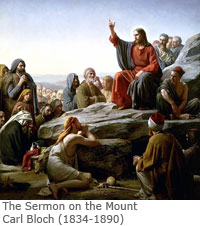
In the warped mind of Anders Breivik, his murderous rampages in Oslo and Utoya earlier this year were the first shots in a war in defence of Christian Europe. Not a religious war but a cultural one, to defend what Breivik called Europe's “cultural, social, identity and moral platform”. Few but the most psychopathic can have any sympathy for Breivik's homicidal frenzy. Yet the idea that Christianity provides the foundations of Western civilisation, and of its political ideals and ethical values, and that Christian Europe is under threat, from Islam on the one side and “cultural Marxists” on the other, finds a widespread hearing. The erosion of Christianity, in this narrative, will lead inevitably to the erosion of Western civilisation and to the end of modern, liberal democracy.

The claims about the “Muslim takeover” of Europe, while widely held, have also been robustly challenged. The idea of Christianity as the cultural and moral foundation of Western civilisation is, however, accepted as almost self-evident – and not just by believers. The late Oriana Fallaci, the Italian writer who perhaps more than most promoted the notion of “Eurabia”, described herself as a “Christian atheist”, insisting that only Christianity provided Europe with a cultural and intellectual bulwark against Islam. The British historian Niall Ferguson calls himself “an incurable atheist” and yet is alarmed by the decline of Christianity which undermines “any religious resistance” to radical Islam. Melanie Phillips, a non-believing Jew, argues in her book The World Turned Upside Down that “Christianity is under direct and unremitting cultural assault from those who want to destroy the bedrock values of Western civilisation.”

Christianity has certainly been the crucible within which the intellectual and political cultures of Western Europe have developed over the past two millennia. But the claim that Christianity embodies the “bedrock values of Western civilisation” and that the weakening of Christianity inevitably means the weakening of liberal democratic values greatly simplifies both the history of Christianity and the roots of modern democratic values – not to mention underplays the tensions that often exist between “Christian” and “liberal” values.

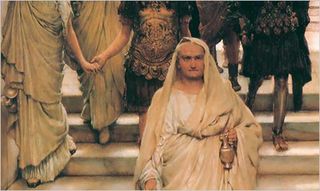
Tacitus and Tiberius

Tacitus1_AFAdam Kirsch in the Barnes and Noble Review:

After 100 years, the Loeb Classical Library is not just a repository of history — it is itself a historical document, through which you can trace the evolution of modern understandings of the ancient world. Take, for instance, the introduction to the 1931 Loeb edition of the Annals of Tacitus. The translator, John Jackson, grants that “the greatness” of the Roman historian's intellect and literary style can still “be felt after the lapse of eighteen centuries.” But “how long they will continue to be felt, one must at whiles wonder,” he goes on to write. On the whole, Jackson finds Tacitus' picture of corruption and political violence in imperial Rome too uniformly dark to be credible. He speaks of the historian's “wild exaggerations” and “poisoned” rhetoric, and complains that he lacked “a charity that thinks no evil.” At best, Jackson hoped that “as long as Europe retains the consciousness of her origins,” Tacitus would continue to find “some” readers.

The historical irony could not be thicker; for within the decade, modern Europe would become an uncannily perfect reflection of Tacitus' Rome. With the rise of totalitarianism in Germany, Italy, and Russia, Tacitus' descriptions of Rome under the early Caesars would no longer seem like “wild exaggerations” but daily news reports. Secret police, anonymous denunciations, constant shifts of the government “line,” whole societies cowering before the whims of rulers: Tacitus described it all, two millennia earlier. The critic Lionel Trilling, writing about Tacitus in his 1950 book The Liberal Imagination, titled his essay “Tacitus Now”: “our political education of the last decades has given us to understand the historian of imperial Rome,” Trilling declared, with his litany of “dictatorship and repression, spies and political informers, blood purges and treacherous dissension.”

Waves of Memories

247517_10150256442837848_538727847_8828545_8012558_n

Somewhere around Bentota, you start to notice the graveyards. Small clusters of tombstones emerge here and there along the coastal road, grown over with tropical shrubbery and mold. Some of the graves fall back into the hills, where fishermen’s wives hang laundry, and some are right along the beach, not far from the little wooden shacks where locals mingle around tables of freshly caught fish. The graves look old. But they aren’t old — it just doesn’t take long for anything left alone in Sri Lanka to be invaded by the erosion of damp clingy natural stuff. When the bus slows down to avoid a stray dog or road bump, you see the date repeated: 26-12-2004, 26-12-2004. Everything here is so close to the shoreline: the road, the graves, the people, the small abandoned houses that are also covered with mold, plus shrubs and laundry and the morning’s fish haul. On one hand, the scene from the bus window is just daily life. Conversation, homemaking, the marketplace. The activities are innocuous. At the same time, civilization here is at its most vulnerable, because behind the road is the pounding, pulsing, thirsty Indian Ocean. You can imagine how, with one good push of the sea, life could easily come tumbling apart. Being an island, Sri Lanka is never far from the ocean in any direction. The water is always there and everybody knows it.

more from Stefany Anne Golberg at The Smart Set here.