Sunday Poem

Prophets

Prophets have light
Screwed tight in their eyes. They cannot see the darkness
Inside their own loincloth. Their speech has grace
And their voice tenderness. When prophets arrive
Dogs do not bark. They only wag their tails
Like newspaper reporters. Their tongues hang out
And drool as profusely
As editorials.
Crowds in the street
Split up like watermelons
When prophets arrive.

But there are times when even the fuse of heavenly stars is blown
Space boils like a forgotten kettle
The screw comes off from the eyes
And the blinded prophet is stunned
It is then that he comprehends the spiral staircase of heaven made of iron
The complexity of its architecture.

It is the first time that he apprehends God’s inhuman boredom
And the size of His shoes. The weight of His foot.
And the total monopoly reflected
In His every movement. It is then that he realises that
His journey so far is only
The space and time of His almighty yawn.

by Viju Chitre

from Ekoon Kavita -3

publisher: Popular Prakashan, Mumbai, 1999©
Translation: 2008, Dilip Chitre
fom Shesha: Selected Marathi Poems (1954–2008)
publisher: Poetrywala, Mumbai, 2008
Stunning Images

From Scientific American:

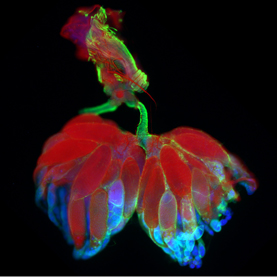
Capture-tiniest-creatures-under-microscope_1The Olympus BioScapes International Imaging Competition provides a selection of photographs that flame off our pages each December in riotous color. A good portion of the magazine would have to be given over to the contest to give every photo its due. We’re bringing you an additional selection here of worthy stills and videos that we’re sure will fascinate and amaze.

» View the Tiniest Creatures Slide Show

» Slide Show: Dazzling Miniatures: View Highlights from BioScapes Photo Contest

Saturday, November 19, 2011

Open Letter to Chancellor Linda P.B. Katehi

Police overreaction, often unprovoked brutality, seems to be one of the searing images of the Occupy movements. At UC Davis:

Nathan Brown to his Chacellor:

I am a junior faculty member at UC Davis. I am an Assistant Professor in the Department of English, and I teach in the Program in Critical Theory and in Science & Technology Studies. I have a strong record of research, teaching, and service. I am currently a Board Member of the Davis Faculty Association. I have also taken an active role in supporting the student movement to defend public education on our campus and throughout the UC system. In a word: I am the sort of young faculty member, like many of my colleagues, this campus needs. I am an asset to the University of California at Davis.

You are not.

I write to you and to my colleagues for three reasons:

1) to express my outrage at the police brutality which occurred against students engaged in peaceful protest on the UC Davis campus today

2) to hold you accountable for this police brutality

3) to demand your immediate resignation

Today you ordered police onto our campus to clear student protesters from the quad. These were protesters who participated in a rally speaking out against tuition increases and police brutality on UC campuses on Tuesday—a rally that I organized, and which was endorsed by the Davis Faculty Association. These students attended that rally in response to a call for solidarity from students and faculty who were bludgeoned with batons, hospitalized, and arrested at UC Berkeley last week. In the highest tradition of non-violent civil disobedience, those protesters had linked arms and held their ground in defense of tents they set up beside Sproul Hall. In a gesture of solidarity with those students and faculty, and in solidarity with the national Occupy movement, students at UC Davis set up tents on the main quad. When you ordered police outfitted with riot helmets, brandishing batons and teargas guns to remove their tents today, those students sat down on the ground in a circle and linked arms to protect them.

What happened next?

Without any provocation whatsoever, other than the bodies of these students sitting where they were on the ground, with their arms linked, police pepper-sprayed students. Students remained on the ground, now writhing in pain, with their arms linked.

What Is The Meaning Of “Organic” (And Inorganic) Food?

L-silverLee Silver in Science 2.0:

Before the 18th century, scientists and non-scientists alike assumed that the material substance of living organisms was fundamentally different from that of non-living things — organisms and their products were considered organic by definition, while non-living things were mineral or inorganic.

With the invention of chemistry in the late 18th century, scientists uncovered the incoherence of the traditional distinction: all material substances are constructed from the same set of chemical elements. Today we understand that the special properties of living organic matter emerge from the interactions of a large variety of large molecules built mostly with atoms of carbon, oxygen, and hydrogen.

Chemists now use the word organic to describe all complex, carbon-based molecules—whether or not they are actually products of an organism or products of laboratory synthesis. But many educated people in Western countries think that only some crops and cows are organic, while all others are not. How can one simple word — organic — have such different meanings?

Through the 19th and 20th centuries, increased scientific understanding, technological innovations, and social mobility changed the face of American agriculture. Large-scale farming became more industrialized and more efficient. In 1800, farmers made up 90% of the American labor force; by 1900, their proportion had decreased to 38%, and in 1990, it was only 2.6%. However, not everyone was happy with these societal changes, and there were calls in the United States and Europe for a return to the preindustrial farming methods of earlier times.

The Hipsterfication Of America

Coachella_wideLinton Weeks in NPR:

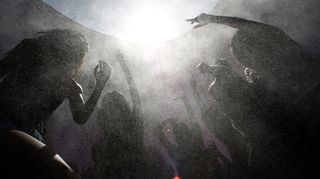
To many the American hipster represents more than ironic graphic T's and gourmet grilled cheese sandwiches. “I like to believe there's something smarter lurking within our romance with hip … an idea of enlightenment and awareness,” says John Leland, a New York Times reporter and author of the 2004 book Hip: The History.

America does have a long love affair with being hip — not only up to date and au courant, but ahead of the curve. The Urban Dictionary defines hipsters as “a subculture of men and women typically in their 20s and 30s who value independent thinking, counter-culture, progressive politics, an appreciation of art and indie-rock, creativity, intelligence, and witty banter.”

The greatest concentrations of hipsters, the hiptionary definition continues, “can be found living in the Williamsburg, Wicker Park and Mission District neighborhoods of major cosmopolitan centers such as New York, Chicago, and San Francisco respectively.”

Sure enough, just a couple of years ago everyone was writing about discrete hipster enclaves. A 2009 essay in Time magazine focused on the Brooklyn neighborhood of Williamsburg, noting that because of a lagging economy and neighborhood gentrification, “Hipsterdom's largest natural habitat, it seems, is under threat.”

But in fact, the opposite happened. In the past couple of years, Hipsterdom has entered — and in some cases, dominated — dominant culture. Hipsters, after all, know how to adapt: how to make the cheap chic, the disheveled dishy, the peripheral preferable. A shaky, shabby economy is the perfect breeding ground for hipsters.

Famous Authors’ Harshest Rejection Letters

103552_5372020303_5d5d60edf5_oOver at the Atlantic:

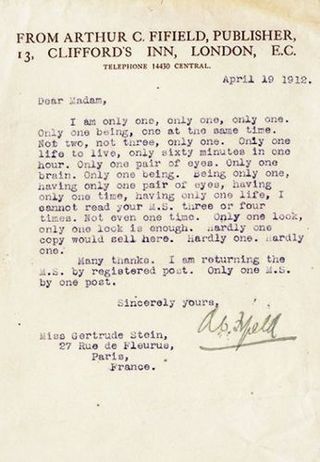
Publisher Arthur Fifield must have been very proud of this lampoon of [Gertrude] Stein’s — admittedly confounding, provocative — style. At the time, 1912, she was only beginning to enter the literary scene and hadn’t yet established the reputation that would draw in great artists, writers, and personalities through the rest of her career and life. The manuscript in question might not have amounted to much, but after being rejected by Fifield, she did become an accomplished, bestselling author, with titles like The Autobiography of Alice B. Toklas. Moreover, her expat Paris living room became the epicenter of a rich art world, one her famed contemporaries visited for contacts, review, and social company — and one whose fruits are, today, examined and reexamined by theorists, academics, and critics worldwide.

The letter reads:

Dear Madam, I am only one, only one, only one. Only one being, one at the same time. Not two, not three, only one. Only one life to live, only sixty minutes in one hour. Only one pair of eyes. Only one brain. Only one being. Being only one, having only one pair of eyes, having only one time, having only one life, I cannot read your M.S. three or four times. Not even one time. Only one look, only one look is enough. Hardly one copy would sell here. Hardly one. Hardly one.”

Sincerely Yours,

A.C. Fifield

Cosmic Geometry

Lauren O'Neill-Butler in The Paris Review:

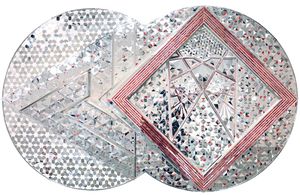
TriangleSquareBorn in a small town in northwest Iran in 1924, Monir Farmanfarmaian studied fine arts at the University of Tehran for only six months before deciding to move to Paris. But, with World War II raging, the ambitious young artist was denied entry in France; she opted instead for the United States, landing in New York City in 1944. “She traveled to the right place at the right time,” argues her old friend Frank Stella in Cosmic Geometry, Farmanfarmaian’s first and much-anticipated monograph, a testament of her continuing importance to contemporary Iranian art. Stella goes on to describe her facility with Abstract Expressionism’s “flatness” and “imagelessness”—her childhood home was filled with stained glass and wall murals—but neglects to mention all the other juicy details of her first decade in New York: how she rubbed elbows with the great artists of the day, including Pollock, de Kooning, and Rothko, at the Cedar Tavern and at the Arts Students League; how she worked as an illustrator for Bonwit Teller under Andy Warhol. “I wasn’t bad looking,” she says, “so everyone invited me to their parties.”

In 1957, she moved back to Tehran, married a young, American-educated lawyer named Abolbashar Farmanfarmaian, and began working with broken glass and mirrors in her studio—materials that became her hallmarks. She recounts traveling in 1966 to the Shāh Chérāgh mosque in Shiraz, Iran, a shrine “filled with high ceilings, domes, and mirror mosaics with fantastic reflections.” “We sat there for half an hour, and it was like a living theater,” she notes. “People came in all their different outfits and wailed and begged to the shrine, and all the crying was reflected all over the ceiling … I said to myself, I must do something like that, something that people can hang in their homes.”

More here. (Note: For the brilliant poet, writer and dear friend of 3qd Zara Houshmand who introduced us to Ms. Farmanfarmaian through her fabulous biography: A Mirror Garden: A Memoir)

Annie Hall and Family, Off the Screen

Janet Maslin in The New York Times:

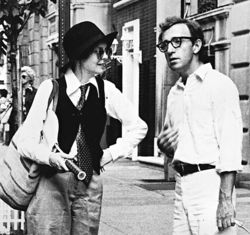
BookDiane Keaton’s book about her life is not a straight-up, chronological memoir. It’s a collage that mixes Ms. Keaton’s words with those of her mother, Dorothy Deanne Keaton Hall, who died in 2008. Since Ms. Hall left behind 85 scrapbooklike journals, a huge and chaotic legacy, there is every reason to expect that Ms. Keaton’s braiding of her own story with her mother’s in “Then Again” will be a rambling effort at best.

Instead it is a far-reaching, heartbreaking, absolutely lucid book about mothers, daughters, childhood, aging, mortality, joyfulness, love, work and the search for self-knowledge. Show business too. The collage format works so well for Ms. Keaton that she can easily weave her love affairs with three very famous film luminaries into the larger tapestry of her life with family and friends. Not many lives would lend themselves to this kind of autobiographical treatment. But Ms. Keaton’s timing is so different from her mother’s that the contrasts between their lives are full of drama. “At 63, I’m doing what Dorothy did when she was 24,” writes Ms. Keaton, who adopted the first of her two children when she was 50. Dorothy was a young housewife when she raised Diane and her three younger siblings (two sisters and a brother). And when they left home, they left her at a loss, and the journal writing began.

More here.

Saturday Poem

I Have News For You

There are people who do not see a broken playground swing as a symbol of ruined childhood  and there are people who don't interpret the behavior of a fly in a motel room as a mocking representation of their thought process.  There are people who don't walk past an empty swimming pool and think about past pleasures unrecoverable  and then stand there blocking the sidewalk for other pedestrians. I have read about a town somewhere in California where human beings  do not send their sinuous feeder roots deep into the potting soil of others' emotional lives  as if they were greedy six-year-olds sucking the last half-inch of milkshake up through a noisy straw;  and other persons in the Midwest who can kiss without debating the imperialist baggage of heterosexuality.  Do you see that creamy, lemon-yellow moon? There are some people, unlike me and you,  who do not yearn after fame or love or quantities of money as unattainable as that moon; thus, they do not later have to waste more time defaming the object of their former ardor.  Or consequently run and crucify themselves in some solitary midnight Starbucks Golgotha.  I have news for you— there are people who get up in the morning and cross a room  and open a window to let the sweet breeze in and let it touch them all over their faces and bodies.
by Tony Hoagland

a sort of brilliance in the room

CharlesDickens

Dickens was twenty-eight in February 1840, and had another thirty years ahead of him. He was living in a country that had been at peace for a quarter of a century. Dickens was still a young man. His grammar could be shaky, his clothes too flamboyant — “geraniums and ringlets” mocked Thackeray — his hospitality too splendid, his temper fierce, but his friends — mostly artists, writers and actors — loved him, and their love was reciprocated. When he went out of London in order to have peace to write, he would within days summon troops of friends to join him. He was a giver of celebratory parties, a player of charades, a dancer of quadrilles and Sir Roger de Coverleys. He suffered from terrible colds and made them into jokes: “Bisery, bisery,” he complained, or “I have been crying all day … my nose is an inch shorter than it was last Tuesday, from constant friction.” He worked furiously fast to give himself free time. He lived hard and took hard exercise. His day began with a cold shower, and he walked or rode every day if he could, arduous expeditions of twelve, fifteen or twenty miles out of town, often summoning a friend to go with him. He might be in his study from ten at night until one in the morning, or up early to be at his desk by 8:30, writing with a quill pen he sharpened himself and favoring dark blue ink. He was taking French lessons from a serious teacher. He was also doing his best to help a poor carpenter with literary ambitions, reading what he had written and finding him work.

an excerpt from Claire Tomalin’s Dickens biography at the LA Times here.

metamaus

E0dd162c-1165-11e1-a95c-00144feabdc0

When the German translation of Maus was published in 1987, an aggressive reporter asked Art Spiegelman: “Don’t you think that a comic book about Auschwitz is in bad taste?” He replied: “No, I thought Auschwitz was in bad taste.” Nothing could be further from the abysmal genre of “Holokitsch”, as Spiegelman calls it, than his comic-strip history of his parents’ survival in the place he calls “Mauschwitz”. If you don’t believe that a comic, by definition, can deliver the full load of tragic truth, by representing Jews as mice, Nazis as cats, and Poles as pigs then it may be time, 25 years on from its original publication, for you to read Maus yourself. MetaMaus, Spiegelman’s retrospective reflections in textual and graphic form on how he came to write Maus, is a wonderfully obsessional book in its own right, and may be a perfect point of entry for the uninitiated. You get a CD containing the two-volume original strip and you get a trip, and I use the word advisedly, around the fabulously and curiously stocked attic that is Spiegelman’s brain.

more from Simon Schama at the FT here.

the prague cemetery

Bkr-Goldstein-t_CA0-articleInline

Napoleonic imperialists, Jesuits, Freemasons: where are the nefarious Jews? It was Barruel who first introduced them into the mix, a few years after his anti-­Masonic book, when he received a letter from a retired army officer named J. B. Simonini warning of a “Judaic sect” that was the world’s most formidable and demonic power. This irresistible Semitic gloss to the theory of a conspiracy behind all despised social trends was expanded upon by, among others, a novelist named Hermann Goedsche, who was also a Prussian agent provocateur specializing in the forging of documents to incriminate democratic leaders. Goedsche’s 1868 novel ­“Biarritz” had a chapter called “In the Jewish Cemetery of Prague,” which, detached from the novel, was widely circulated, especially after its translation into Russian, and became a source for the “Protocols.” (The chief of the Russian secret service helped advance the fraud.)

more from Rebecca Newberger Goldstein at the NY Times here.

Friday, November 18, 2011

Why Only Germany Can Fix the Euro

Blyth_411Matthias Matthijs and Mark Blyth in Foreign Affairs [h/t: Jonathan Hopkin]:

What, we must ask, has driven Europe to this point? Since the beginning of the current economic crisis, analysts have offered multiple explanations. American economists call it a “crisis of design,” arguing that Europe had it coming. Fiscal hawks the world over prefer the budgetary explanation, focusing on Greece's underreported public spending, bloated state, and generous pension system. They then generalize these problems to all of Europe (never mind that Italian private debt is relatively low, as is its public spending in comparison to most other developed countries). For their part, elites in Germany blame lagging competitiveness and “too-high” real wages in the Mediterranean countries. Still others point to intra-European macroeconomic imbalances. There is probably something to all of these explanations. But the depth and duration of this crisis call for a more complex, systemic, and historical account. After all, when explaining the collapse of a bridge, there is little point in blaming the last vehicle that crossed it.

This complex of causes does however have a common root: Germany's failure to act as a responsible hegemon in Europe. It is not that Germany should be unseating democracies and enforcing deflation, as it has attempted to do by installing Papademos in Greece and Monti in Italy. Rather, it should be stabilizing the eurozone by providing a set of public goods that the institutions and policies of the region have singularly failed to supply. To solve the European crisis and avoid repeating the mistakes of the late 1920s and the 1930s, those sitting in Berlin and Brussels should put down their Andrew Mellon and read Charles Kindleberger.

In The World in Depression: 1929-1939, Kindleberger argued that “the 1929 depression was so wide, so deep, and so long because the international economic system was rendered unstable by British inability and U.S. unwillingness to assume responsibility for stabilizing it.” Indeed, Kindleberger's critique of the United States' role in that era's crisis summitry might well have been written about Germany today: “The World Economic conference of 1933 did not lack ideas … [but] the one country capable of leadership was bemused by domestic concerns and stood aside.”

Behind Murakami’s Mirror

Baxter_1-120811_jpg_230x787_q85Charles Baxter in the NYRB:

Early in Haruki Murakami’s new novel, a character describes to an editor at a Japanese publishing house a manuscript of a novel that has come to his attention, and what he says sounds like a preview of the book we are about to read:

You could pick it apart completely if you wanted to. But the story itself has real power: it draws you in. The overall plot is a fantasy, but the descriptive detail is incredibly real. The balance between the two is excellent. I don’t know if words like “originality” or “inevitability” fit here, and I suppose I might agree if someone insisted it’s not at that level, but finally, after you work your way through the thing, with all its faults, it leaves a real impression—it gets to you in some strange, inexplicable way that may be a little disturbing.

After arriving at page 925 of 1Q84, the reader is likely to see an analogue. In this book, Murakami, who is nothing if not ambitious, has created a kind of alternative world, a mirror of ours, reversed. Even the book’s design emphasizes that mirroring: as you turn the pages, the page numbers climb or drop in succession along the margins, with the sequential numerals on one side in normal display type but mirror-reversed on the facing page. At one point, a character argues against the existence of a parallel world, but the two main characters in 1Q84 (Q=”a world that bears a question”) are absolutely convinced that they live not in a parallel world but in a replica one, where they do not want to be. The world we had is gone, and all we have now is a simulacrum, a fake, of the world we once had. “At some point in time,” a character muses, “the world I knew either vanished or withdrew, and another world came to take its place.”

The De-politicization of Politics

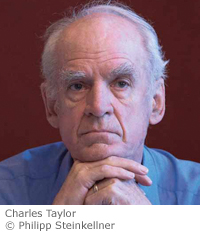
Taylor_200x232Slawomir Sierakowski and Charles Taylor over at Eurozine:

Slawomir Sierakowski: Don't you have the impression that liberal democracy is dead? Dead, I mean, in the same way that God is dead in the writings of Nietzsche. The realization has dawned that it was always just a myth. Not only do we now know that there has never been a time when democracy existed – democracy defined not only as an act of voting, but also as genuine participation, as a situation in which the demos truly organizes around a political community – but we have also learned to accept this fact.

Charles Taylor: I definitely think that democracy, liberal democracy, is more alive when it's establishing itself. When there's such a thing as demos that is taking power from the elites or former rulers – what we might call the Tahrir Square phase. Then we have high participation and a very good understanding what the problems are. But, as we can see in American history and that of several Western European countries, this moment can go on for long. These countries had higher participation during periods when a sort of class war was being fought: Labour and Conservatives in Britain; Socialists and Gaullists in France, Social Democrats and Christian Democrats in Germany, and so on. So there was a struggle of a people, a demos: peasants and workers against the others, and these others mobilized themselves too. This led to the posing of clear alternatives, a high level of participation. The same thing is happening in India today. Among the Dalits – the lowest strata of the Indian caste system – there's this tremendous sense that democracy is a chance for them to make this very inegalitarian society less so. In the West, the more rich and educated you are, the more you vote; in India, the less you have, the less educated you are, the more you vote: Dalits and women vote more than other social groups. So the challenge for liberal democracy is to remain liberal democracy – particularly with regard to participation – when it has passed beyond the phase of struggle against the various kinds of structures that benefit the elites. Most Western democracies are at this stage and the level of participation is falling.