The Euro and the Resilience-Stability Tradeoff

Eurozone-spread-history1.jpegAshwin Parameswaran over at Macroeconomic Resilience:

In complex adaptive systems, stability does not equate to resilience. In fact, stability tends to breed loss of resilience and fragility or as Minsky put it, “stability is destabilising”. Although Minsky’s work has been somewhat neglected in economics, the principle of the resilience-stability tradeoff is common knowledge in ecology, especially since Buzz Holling’s pioneering work on the subject. If stability leads to fragility, then it follows that stabilisation too leads to increased system fragility. As Holling and Meffe put it in another landmark paper on the subject titled ‘Command and Control and the Pathology of Natural Resource Management’, “when the range of natural variation in a system is reduced, the system loses resilience.” Often, the goal of increased stability is synonymous with a goal of increased efficiency but “the goal of producing a maximum sustained yield may result in a more stable system of reduced resilience”.

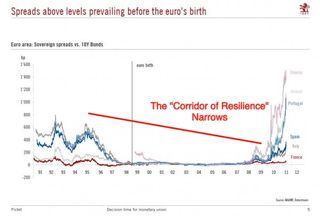
The entire long arc of post-WW2 macroeconomic policy in the developed world can be described as a flawed exercise in macroeconomic stabilisation. But there is no better example of this principle than the Euro currency project as the below graph (from Pictet via FT Alphaville) illustrates.

Instead of a moderately volatile mix of different currencies and interest rates, we now have a mostly stable currency union prone to the occasional risk of systemic collapse. If this was all there is to it, then it is not clear that the Euro is such a bad idea. After all, simply shifting the volatility out to the tails is not by itself a bad outcome. But the resilience-stability tradeoff is more than just a simple transformation in distribution. Economic agents adapt to a prolonged period of stability in such a manner that the system cannot “withstand even modest adverse shocks”. “Normal” disturbances that were easily absorbed prior to the period of stabilisation are now sufficient to cause a catastrophic transition. Izabella Kaminska laments the fact that sovereign spreads for many Eurozone countries (vs 10Y Bunds) now exceed pre-Euro levels. But the real problem isn’t so much that spreads have blown out but that they have blown out after a prolonged period of stability.

the united states of europe

OB-QQ587_europe_G_20111118185927

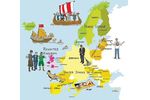
Welcome to Europe, 2021. Ten years have elapsed since the great crisis of 2010-11, which claimed the scalps of no fewer than 10 governments, including Spain and France. Some things have stayed the same, but a lot has changed. The euro is still circulating, though banknotes are now seldom seen. (Indeed, the ease of electronic payments now makes some people wonder why creating a single European currency ever seemed worth the effort.) But Brussels has been abandoned as Europe’s political headquarters. Vienna has been a great success. “There is something about the Habsburg legacy,” explains the dynamic new Austrian Chancellor Marsha Radetzky. “It just seems to make multinational politics so much more fun.” The Germans also like the new arrangements. “For some reason, we never felt very welcome in Belgium,” recalls German Chancellor Reinhold Siegfried von Gotha-Dämmerung. Life is still far from easy in the peripheral states of the United States of Europe (as the euro zone is now known).

more from Niall Ferguson at the WSJ here.

this last intransigence of modernism

Clar05_3322_03

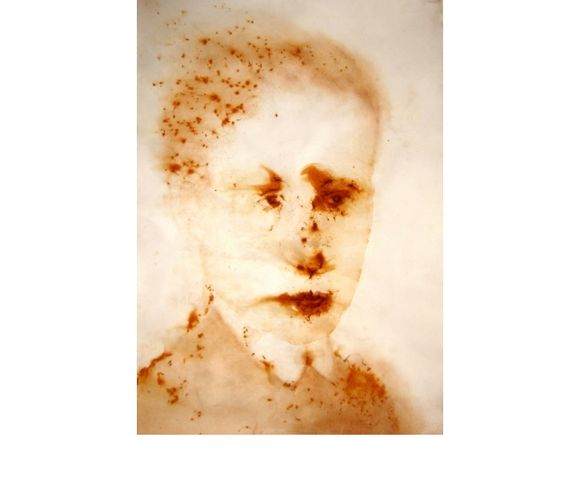
The word ‘blur’ has come up. ‘Richter’s blur’, it is called in the literature. Again, the term may be insufficient. When one gets to the moment in the show when Richter reinvents his ‘blur’ in the context of abstract painting – the two versions of Abstraktes Bild from 1977 are particularly astonishing, and still hard to look at – it is immediately clear how far from a description of what happens in the paintings, and what its effect might be on the viewer, the monosyllable is. Critics have come up with alternatives. In the context of abstraction – that strange episode in art’s endgame – all the suggestions seem charged. Have we to do, for instance, with some kind of deliberate loss of focus or of register? Maybe with a form of willed inaccuracy on the artist’s part. Or even vagueness. This last, it might seem, is very much not a modern art value; though that might mean Richter was right to try to make it one. I like the story Richard Rorty told against himself late in life, when he heard that a philosophy department had just hired someone whose speciality was vagueness, and he raised an eyebrow. ‘Dick, you’re really out of it,’ his host said. ‘Vagueness is huge.’

more from T.J. Clark at the LRB here.

deception starts with self

20111019_2011+43deceit_w

Deception is a very deep feature of life. Viruses practise it, as do bacteria, plants, insects and a wide range of other animals. It is everywhere. Even within our genomes, deception flourishes as selfish genetic elements use deceptive molecular techniques to over-reproduce at the expense of other genes. Deception infects all the fundamental relationships in life: parasite and host, predator and prey, plant and animal, male and female, neighbour and neighbour, parent and offspring. Viruses and bacteria often actively deceive to gain entry into their hosts: for instance, by mimicking body parts so as not to be recognised as foreign. Or, as in HIV, by changing coat proteins so often as to make mounting an enduring defence almost impossible. Predators gain from being invisible to their prey or resembling items attractive to them – a fish that dangles a part of itself like a worm to attract other fish, which it eats – while prey gain from being invisible to their predators or mimicking items noxious to the predator. Deception within species is expected in almost all relationships, and deception possesses special powers.

more from Robert Trivers at The New Statesman here.

George’s God

From The Weekly Standard:

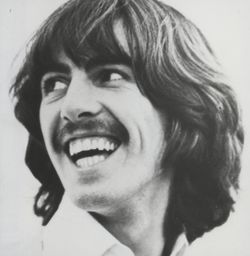
HarrisonAs a reader who has compulsively consumed the ever-expanding body of Beatles literature for 40 years, I have trouble picking out a favorite anecdote or most memorable quote. Is it John’s “If there is such a thing as a genius, I am one”? Or the note Paul sent John one day in the waning days of the group: “You and your Jap tart think you’re hot s—”? Or maybe it’s the time an airline stewardess offered George a glass of wine, not knowing he was deep in meditation. “F— off,” the spiritual Beatle replied.

I don’t know. I could go on with stories like this all day. None of them involve Ringo, by the way.

Given the vastness and variety of the literature, it would be incorrect to say that the Beatles story has been whitewashed, not when it includes so many get-even tell-alls and book-sized sumps of sensational gossip. But there is a quasi-official version of events, and when it is reissued periodically from the tireless Beatles public relations machine, the narrative does tend to take on the unblemished pallor of approved history. For 50 years the Beatles have been the rock group you could take home to meet Mom, and nobody close to their stupendous commercial enterprise seems eager to undo the image.

More here.

Tuesday Poem

The Ball
.

As long as nothing can be known for sure
(no signals have been picked up yet),
as long as Earth is still unlike
the nearer and more distant planets,
.
as long as there's neither hide nor hair
of other grasses graced by other winds,
of other treetops bearing other crowns,
other animals as well-grounded as our own,
.
as long as only the local echo
has been known to speak in syllables,
,
as long as we still haven't heard word
of better or worse mozarts,
platos, edisons somewhere,
.
as long as our inhuman crimes
are still committed only between humans,
.
as long as our kindness
is still incomparable,
peerless even in its imperfection,
.
as long as our heads packed with illusions
still pass for the only heads so packed,
.
as long as the roofs of our mouths alone
still raise voices to high heavens–
.
let's act like very special guests of honor
at the district-firemen's ball
dance to the beat of the local oompah band,
and pretend that it's the ball
to end all balls.
.
I can't speak for others–
for me this is
misery and happiness enough:
.
just this sleepy backwater
where even the stars have time to burn
while winking at us
unintentionally.

by Wislawa Szymborska
from Monologue of a Dog: New Poems
translation: C. Cavanagh and S. Baranczak

A Serving of Gratitude May Save the Day

Nicholas Wade in The New York Times:

ThanksThe most psychologically correct holiday of the year is upon us. Thanksgiving may be the holiday from hell for nutritionists, and it produces plenty of war stories for psychiatrists dealing with drunken family meltdowns. But it has recently become the favorite feast of psychologists studying the consequences of giving thanks. Cultivating an “attitude of gratitude” has been linked to better health, sounder sleep, less anxiety and depression, higher long-term satisfaction with life and kinder behavior toward others, including romantic partners. A new study shows that feeling grateful makes people less likely to turn aggressive when provoked, which helps explain why so many brothers-in-law survive Thanksgiving without serious injury. But what if you’re not the grateful sort? I sought guidance from the psychologists who have made gratitude a hot research topic. Here’s their advice for getting into the holiday spirit — or at least getting through dinner Thursday:

Start with “gratitude lite.” That’s the term used by Robert A. Emmons, of the University of California, Davis, for the technique used in his pioneering experiments he conducted along with Michael E. McCullough of the University of Miami. They instructed people to keep a journal listing five things for which they felt grateful, like a friend’s generosity, something they’d learned, a sunset they’d enjoyed. The gratitude journal was brief — just one sentence for each of the five things — and done only once a week, but after two months there were significant effects. Compared with a control group, the people keeping the gratitude journal were more optimistic and felt happier. They reported fewer physical problems and spent more time working out.

More here.

Parrondo’s Paradox: Winning Two Games You’re Guaranteed to Lose

From io9:

Ce4c6bcdd21fd1621803609bab495fa0JM Parrondo is a casino and con artist's worst nightmare. In the 1990s, he invented two games that are sure to lose you everything. They're both mathematically designed to make you go broke, but play them one after another and you are guaranteed to win.

Parrondo's Paradox was dreamed up in the 1990s by physicist Juan Manuel Rodriguez Parrondo. It spawned a whole new approach to games — specifically, a distrustful approach to games by those who were sure the odds were stacked in their favor. The paradox is simple: two games, if played separately, will always result in you losing your shirt. They're played with a biased coin to make sure of it. If you switch off between them, though, you'll win a fortune. Suddenly, your loss turns into a win.

The first game is simple and always the same. You flip a coin, knowing that the two-faced, lying, no-good cheater you're playing against has weighted it so that your chance of winning is not fifty-fifty. Instead your chance of winning is (0.5 – x), with x being whatever the cheater dared weight it with. If you win, you get a dollar. If you lose, you lose a dollar. Since whenever “x” is more than zero you'll lose slightly more than you'll win, you are guaranteed to lose over the long run.

More here.

The Presidential Turkey “Pardon” as Dark Parody

Justin E. H. Smith in the New York Times:

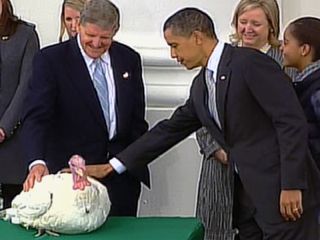
Noco_obamaturkey_1125_480x360In just a few days, we will once again endure the annual spectacle of the president of the United States pardoning a turkey that would otherwise have been fated for the Thanksgiving table. This event is typically covered in the media as a light-hearted bit of fluff — and fluff is what it might well be, if there were not actual humans on death row awaiting similar intervention. In the current American context, however, the turkey pardon is a distasteful parody of the strange power vested in politicians to decide the earthly fates of death-row prisoners. There is in it an implicit acknowledgment that the killing of these prisoners is a practice that bears real, non-jocular comparison to the ritual slaughter of birds for feasts.

I am not saying that this slaughter of birds for food is wrong ― not here anyway ― but only that the parallel the presidential ritual invites us to notice is revealing. To riff on Dostoyevsky’s famous line about prisoners: you can tell what a nation is like by the way it treats its turkeys. Obama’s pardoning of one randomly selected bird at Thanksgiving not only carries with it an implicit validation of the slaughtering of millions of other turkeys. It also involves an implicit validation of the parallel practice for human beings, in which the occasional death-row inmate is pardoned, or given a stay by the hidden reasoning of an increasingly capricious Supreme Court, even as the majority of condemned prisoners are not so lucky. In this respect, the Thanksgiving pardon is an acknowledgment of the arbitrariness of the system of capital punishment.

More here.

Egypt’s uprising happened when three distinct currents of protest—labor, professional, and popular—finally converged

Mona El-Ghobashy in the Boston Review:

ScreenHunter_02 Nov. 22 11.07A revolution is inherently romantic, so it’s no surprise that Egypt’s has inspired exceptional narratives. Journalists saw something fundamentally novel in the eighteen days and the subsequent small-scale protests—“a new culture of street demonstrations,” said USA Today. The uprising became the defining event of Egyptian politics, a turning point separating before and after. Before, a brutal dictatorship maintained fear and silence. After, liberated citizens poured into the streets to exercise their freedom.

Against this temptation to cast the uprising as a watershed is the equally attractive idea that Egypt was ripe for revolt. In this telling, various public ills—rising food prices, unemployment, government corruption—are strung together into a neat chain that leads inexorably to social explosion.

But neither story does the revolution justice. The first erases the uprising’s pre-history; the second overdoses on the role of the past. Both conceal the very real contingency of the event, neither inevitable nor entirely alien to Egyptian politics.

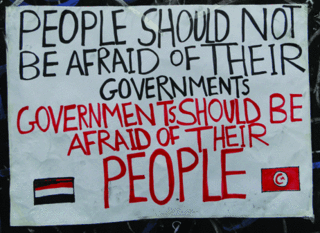
Egypt’s was no cartoon dictatorship that indiscriminately banned protests. For at least a decade before Mubarak’s ouster, Egyptians were doing their politics outdoors. Citizens assembled daily on highways, in factory courtyards, and in public squares to rally against their unrepresentative government. Mubarak’s regime responded with a million-man police force that alternately cajoled and crushed the demonstrators. The goal was not to ban protests, but to obstruct any attempt to unify different groups and prevent sympathetic bystanders joining them.

Egypt’s uprising happened when three distinct currents of protest—labor, professional, and popular—finally converged.

More here.

Monday, November 21, 2011

Stephen M. Walt to Judge 3rd Annual 3QD Politics & Social Science Prize

UPDATE 12/19/11: The winners have been announced here.

UPDATE 12/12/11: The finalists have been announced here.

UPDATE 12/11/11: The semifinalists have been announced here.

UPDATE 12/5/11: Voting round now open. Click here to see full list of nominees and vote.

Dear Readers, Writers, Bloggers,
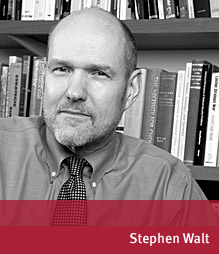
IMPACT_10summer_waltWe are very honored and pleased to announce that Professor Stephen M. Walt, who was also the winner of the 3QD politics prize last year, has agreed to be the final judge for our 3rd annual prize for the best blog writing in politics & social science. (Details of the inaugural prize, judged by Tariq Ali, can be found here, and more about last year's prize, judged by Lewis H. Lapham can be found here.) Please note that we have explicitly widened the scope of possible entries to “politics & social science” so that writings in anthropology, economics, history, and sociology are also elligible.

Stephen M. Walt is the Robert and Renée Belfer Professor of International Affairs at the Harvard Kennedy School of Government, where he served as Academic Dean from 2002 to 2006. He previously taught at Princeton and the University of Chicago, where he was Deputy Dean of Social Sciences. He is a contributing editor at Foreign Policy magazine, co-editor of the Cornell Studies in Security Affairs, and co-chair of the editorial board of the journal International Security. He was elected a Fellow of the American Academy of Arts and Sciences in May 2005.

Professor Walt is the author of numerous articles and books on international relations, security studies, and U.S. foreign policy. His books include The Origins of Alliances, which received the 1988 Edgar S. Furniss National Security Book Award, and Taming American Power: The Global Response to U.S. Primacy, which was a finalist for the Lionel Gelber International Affairs Book Award and the Arthur Ross Book Prize. His most recent book, The Israel Lobby and U.S. Foreign Policy (co-authored with John J. Mearsheimer) was a New York Times best-seller and has been translated into twenty foreign languages. His daily weblog is http://walt.foreignpolicy.com

As usual, this is the way it will work: the nominating period is now open, and will end at 11:59 pm EST on December 3, 2011. There will then be a round of voting by our readers which will narrow down the entries to the top twenty semi-finalists. After this, we will take these top twenty voted-for nominees, and the four main editors of 3 Quarks Daily (Abbas Raza, Robin Varghese, Morgan Meis, and Azra Raza) will select six finalists from these, plus they may also add up to three wildcard entries of their own choosing. The three winners will be chosen from these by Professor Walt.

The first place award, called the “Top Quark,” will include a cash prize of one thousand dollars; the second place prize, the “Strange Quark,” will include a cash prize of three hundred dollars; and the third place winner will get the honor of winning the “Charm Quark,” along with a two hundred dollar prize.

(Welcome to those coming here for the first time. Learn more about who we are and what we do here, and do check out the full site here. Bookmark us and come back regularly, or sign up for the RSS feed.)

Details:
Politics-Announcement-2011The winners of this prize will be announced on December 19, 2011. Here's the schedule:

November 21, 2011:

  • The nominations are opened. Please nominate your favorite blog entry by placing the URL for the blog post (the permalink) in the comments section of this post. You may also add a brief comment describing the entry and saying why you think it should win. (Do NOT nominate a whole blog, just one individual blog post.)
  • Blog posts longer than 4,000 words are strongly discouraged, but we might make an exception if there is something truly extraordinary.
  • Each person can only nominate one blog post.
  • Entries must be in English.
  • The editors of 3QD reserve the right to reject entries that we feel are not appropriate.
  • The blog entry may not be more than a year old. In other words, it must have been written after November 20, 2010.
  • You may also nominate your own entry from your own or a group blog (and we encourage you to).
  • Guest columnists at 3 Quarks Daily are also eligible to be nominated, and may also nominate themselves if they wish.
  • Nominations are limited to the first 200 entries.
  • Prize money must be claimed within a month of the announcement of winners.

December 3, 2011

  • The nominating process will end at 11:59 PM (NYC time) of this date.
  • The public voting will be opened soon afterwards.

December 10, 2011

  • Public voting ends at 11:59 PM (NYC time).

December 19, 2011

  • The winners are announced.

One Final and Important Request

If you have a blog or website, please help us spread the word about our prizes by linking to this post. Otherwise, post a link on your Facebook profile, Tweet it, or just email your friends and tell them about it! I really look forward to reading some very good material, and think this should be a lot of fun for all of us.

Best of luck and thanks for your attention!

Yours,

Abbas

Sunday, November 20, 2011

Michael S. Gazzaniga Challenges Old Ideas about Free Will

Just to stick with Robin's theme-of-the-day of what neuroscience means for free will, here is Gareth Cook in Scientific American:

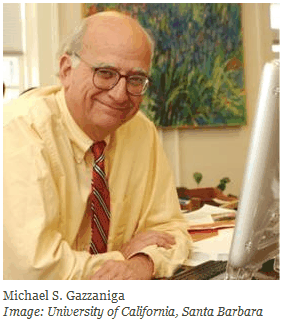
ScreenHunter_12 Nov. 20 18.06Do we have free will? It is an age-old question which has attracted the attention of philosophers, theologians, lawyers and political theorists. Now it is attracting the attention of neuroscience, explains Michael S. Gazzaniga, director of the SAGE Center for the Study of the Mind at the University of California, Santa Barbara, and author of the new book, “Who’s In Charge: Free Will and the Science of the Brain.” He spoke with Mind Matters editor Gareth Cook.

Cook: Why did you decide to tackle the question of free will?

Gazzaniga: I think the issue is on every thinking person’s mind. I can remember wondering about it 50 years ago when I was a student at Dartmouth. At that time, the issue was raw and simply stated. Physics and chemistry were king and while all of us were too young to shave, we saw the implications. For me, those were back in the days when I went to Church every Sunday, and sometimes on Monday if I had an exam coming up!

Now, after 50 years of studying the brain, listening to philosophers, and most recently being slowly educated about the law, the issue is back on my front burner. The question of whether we are responsible for our actions — or robots that respond automatically — has been around a long time but until recently the great scholars who spoke out on the issue didn’t know modern science with its deep knowledge and implications.

More here.

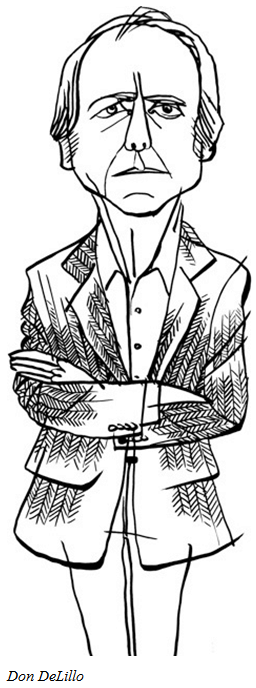
Don DeLillo’s prophetic soul

Martin Amis in The New Yorker:

ScreenHunter_11 Nov. 20 17.46When we say that we love a writer’s work, we are always stretching the truth: what we really mean is that we love about half of it. Sometimes rather more than half, sometimes rather less. The vast presence of Joyce relies pretty well entirely on “Ulysses,” with a little help from “Dubliners.” You could jettison Kafka’s three attempts at full-length fiction (unfinished by him, and unfinished by us) without muffling the impact of his seismic originality. George Eliot gave us one readable book, which turned out to be the central Anglophone novel. Every page of Dickens contains a paragraph to warm to and a paragraph to veer back from. Coleridge wrote a total of two major poems (and collaborated on a third). Milton consists of “Paradise Lost.” Even my favorite writer, William Shakespeare, who usually eludes all mortal limitations, succumbs to this law. Run your eye down the contents page and feel the slackness of your urge to reread the comedies (“As You Like It” is not as we like it); and who would voluntarily curl up with “King John” or “Henry VI, Part III”?

Proustians will claim that “In Search of Lost Time” is unimprovable throughout, despite all the agonizing longueurs. And Janeites will never admit that three of the six novels are comparative weaklings (I mean “Sense and Sensibility,” “Mansfield Park,” and “Persuasion”). Perhaps the only true exceptions to the fifty-fifty model are Homer and Harper Lee. Our subject, here, is literary evaluation, so of course everything I say is mere opinion, unverifiable and also unfalsifiable, which makes the ground shakier still. But I stubbornly suspect that only the cultist, or the academic, is capable of swallowing an author whole. Writers are peculiar, readers are particular: it is just the way we are. One helplessly reaches for Kant’s dictum about the crooked timber of humanity, or for John Updike’s suggestion to the effect that we are all of us “mixed blessings.” Unlike the heroes and heroines of “Northanger Abbey,” “Pride and Prejudice,” and “Emma,” readers and writers are not expressly designed to be perfect for each other.

I love the work of Don DeLillo.

More here.

Secret Pakistani-U.S. memo offering overthrow of military leadership revealed

Josh Rogin in Foreign Policy:

ScreenHunter_10 Nov. 20 17.38The Cable has obtained the document at the center of the “memo-gate” controversy, sent allegedly from the highest echelons of Pakistani's civilian leadership to Adm. Michael Mullen in the wake of the killing of Osama bin Laden. The memo offered to reshape Pakistan's national security leadership, cleaning house of elements within the powerful military and intelligence agencies that have supported Islamic radicals and the Taliban, drastically altering Pakistani foreign policy — and requesting U.S. help to avoid a military coup.

The Cable confirmed that the memo is authentic and that it was received by Mullen. The Pakistani Ambassador to the United States Husain Haqqani — the rumored author of the memo — has offered to resign over what has become a full-fledged scandal in Islamabad. The Cable spoke this evening to the man at the center of the controversy and the conduit of the memo, Pakistani-American businessman Mansoor Ijaz.

“Civilians cannot withstand much more of the hard pressure being delivered from the Army to succumb to wholesale changes,” reads the memo, sent to Mullen via an unidentified U.S. interlocutor by Ijaz.

More here.

Will Neuroscience Kill the Novel?

BrainbookTo stick with the theme, Austin Allen responds to some of the ever-thoughtful Marco Roth's contentions, over at Big Think:

All fiction has, at its heart, the enigma of character. Its most basic pleasures involve analyzing how human beings act, speculating as to what motivates their actions, and, ultimately, judging those actions. What happens if science largely co-opts the first two projects, and undermines the legitimacy of the third?

In a 2009 n + 1 article called “Rise of the Neuronovel,” Marco Roth called neuroscience a “specter…haunting the contemporary novel.” Roth charts the two-decade-long surge of neurological references in the work of such authors as Jonathan Lethem, Richard Powers, and Ian McEwan. The trend has given us a slew of neurologically abnormal characters, and even a neurosurgeon narrator in McEwan’s Saturday. It's also brought an increase in sentences like these:“‘Oh,’ I said, my palms beginning to sweat as random sensuality carbonated up to my cortex.”

Roth skillfully argues that the neuronovel has begun supplanting the psychological novel. Characters (and authors) who once thought in terms of neurosesand libidos now speak of glial cells and synapses and serotonin levels. Dr. Perowne in Saturday is the modern analogue for psychologist Dick Diver inTender Is the Night: both come to us as ambassadors from the latest science of mind. And yet where Freud’s discipline always carried a strong whiff of myth, neuroscience is orders of magnitude more complex and precise. Roth’s conclusion is that we now confront “the loss of the self,” and that “the neuronovel, which looks on the face of it to expand the writ of literature, appears as another sign of the novel’s diminishing purview.”

Poignant as this is, I think it overstates the case. The novel will survive, though some of the current vocabulary surrounding it—critical and metaphysical—probably won’t.

Is Neuroscience the Death of Free Will?

12thestone-img-blog427Eddy Nahmias over at the NYT's Opinionator (via Andrew Sullivan):

Is free will an illusion? Some leading scientists think so. For instance, in 2002 the psychologist Daniel Wegner wrote, “It seems we are agents. It seems we cause what we do… It is sobering and ultimately accurate to call all this an illusion.” More recently, the neuroscientist Patrick Haggard declared, “We certainly don’t have free will. Not in the sense we think.” And in June, the neuroscientist Sam Harris claimed, “You seem to be an agent acting of your own free will. The problem, however, is that this point of view cannot be reconciled with what we know about the human brain.”

Such proclamations make the news; after all, if free will is dead, then moral and legal responsibility may be close behind. As the legal analyst Jeffrey Rosen wrote in The New York Times Magazine, “Since all behavior is caused by our brains, wouldn’t this mean all behavior could potentially be excused? … The death of free will, or its exposure as a convenient illusion, some worry, could wreak havoc on our sense of moral and legal responsibility.”

Indeed, free will matters in part because it is a precondition for deserving blame for bad acts and deserving credit for achievements. It also turns out that simply exposing people to scientific claims that free will is an illusion can lead them to misbehave, for instance, cheating more or helping others less. [1] So, it matters whether these scientists are justified in concluding that free will is an illusion.

Here, I’ll explain why neuroscience is not the death of free will and does not “wreak havoc on our sense of moral and legal responsibility,” extending a discussion begun in Gary Gutting’s recent Stone column. I’ll argue that the neuroscientific evidence does not undermine free will. But first, I’ll explain the central problem: these scientists are employing a flawed notion of free will. Once a better notion of free will is in place, the argument can be turned on its head. Instead of showing that free will is an illusion, neuroscience and psychology can actually help us understand how it works.

Transhumanism and the Problem of Personal Identity

LockeJ. Hughes over at the Institute for Ethics and Emerging Technologies blog:

Enlightenment values presume an independent self, the rational citizen and consumer who pursues her self-interests. Since Hume, however, Enlightenment empiricists have questioned the existence of a discrete, persistent self. Today, continuing that investigation, neuroscience is daily eroding the essentialist model of personal identity. Transhumanism has yet to come to grips with the radical consequences of the erosion of the liberal individualist subject for projects of enhancement and longevity. Most transhumanist thought still reflects an essentialist idea of personal identity, even as we advance projects of radical cognitive enhancement that will change every element of consciousness. How do ethics and politics change if personal identity is an arbitrary, malleable fiction?

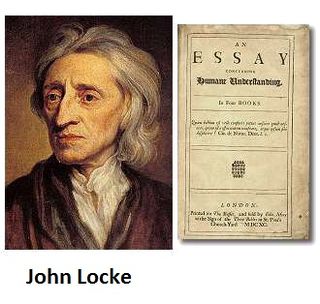
The Enlightenment thinkers attempted to move past the idea of human nature as being defined by God-given immortal souls inhabiting flesh, to the view that we are rational minds emerging out of and transforming nature. John Locke, for instance, believed an immaterial soul was an unnecessary explanation for the self. He argued that since we are thinking matter, which is as much in God’s power to create as an immaterial soul, that it is our capacity to think which makes us ensouled persons. He considered however that this created a problem for the identity of the soul at the Resurrection of Souls at the Judgment. If consciousness resides in the body, and the resurrected body at the end of time has none of the matter of the original body, then how could you be the same person?