America the Possible

James Gustave Speth in Orion Magazine:

Part one of this article.

AmericaWE NEED A COMPELLING VISION for a new future, a vision of a better country—America the Possible—that is still within our power to reach. The deep, transformative changes sketched in the first half of this manifesto provide a path to America the Possible. But that path is only brought to life when we can combine this vision with the conviction that we will pull together to build the necessary political muscle for real change. This article addresses both the envisioning of an attractive future for America and the politics needed to realize it. A future worth having awaits us, if we are willing to struggle and sacrifice for it. It won’t come easy, but little that is worth having ever does.

By 2050, America the Possible will have marshaled the economic and political resources to successfully address the long list of challenges, including basic social justice, real global security, environmental sustainability, true popular sovereignty, and economic democracy. As a result, family incomes in America will be far more equal, similar to the situation in the Nordic countries and Japan today. Large-scale poverty and income insecurity will be things of the past. Good jobs will be guaranteed to all those who want to work. Our health-care and educational systems will be among the best in the world, as will our standing in child welfare and equality of women. Racial and ethnic disparities will be largely eliminated. Social bonds will be strong. The overlapping webs of encounter and participation that were once hallmarks of America, “a nation of joiners,” will have been rebuilt, community life will be vibrant, and community development efforts plentiful. Trust in each other, and even in government, will be high.

More here.

An Introvert Steps Out: How the Author of ‘Quiet’ Delivered a Rousing Speech

Susan Cain in The New York Times:

CainI awoke one January morning from uneasy dreams to find myself transformed. For seven blissful years I had spent my time reading, writing and researching a book about introversion. But the publication date had arrived, the idyll was over and my metamorphosis was complete. I was now that impossibly oxymoronic creature: the Public Introvert. Having never given a single media interview in the first 43 years of my life, I appeared that day on “CBS This Morning” to promote my book, a critique of our overly loquacious culture. Then I shuttled uptown to my publisher’s office to continue talking — for 21 radio interviews. My book is about the power of being quiet. About the perils of a society that appreciates good talkers over good ideas. And about the terrible pressure to entertain, to sell ourselves and never to be visibly anxious. I believe all this passionately — which puts me in an interesting pickle. Promoting my work requires doing the very thing my book questions: putting down my pen and picking up a microphone. Now, in what I’ve come to think of as my Year of Speaking Dangerously, I’ve gone on national TV to talk about being the kind of person who dislikes going on national TV. I let my friends talk me into having a big book party, even though my book advises introverts to stay home on New Year’s Eve if they feel like it (I usually feel like it). And in February I took the stage at the 2012 TED conference before an audience of 1,500 people to critique a society that favors the kind of person who craves an audience.

For me, TED embodied the paradox that lay at the heart of my book tour. On the one hand, TED stands for everything I love. Its mission is to promote “Ideas Worth Spreading,” and how many tranquil evenings have I spent at my kitchen table, listening as thinkers of various stripes delivered eloquent soliloquies from deep inside my laptop? TED takes scholars and turns them into rock stars. On the other hand, this approach emphasizes the need to be a rock star in the first place. TED presenters share their brain waves from a backlighted, red-carpeted dais while giant cameras glide overhead, capturing their every gesture from multiple angles and projecting them onto Jumbotron megascreens. Implicit in the stellar production values is the notion that people might pay less attention without them.

More here.

the unlikely icon

2b77312c-8ff6-11e1-beaa-00144feab49a

How odd it is that, long before she died of cancer in 2004, Susan Sontag should have become the intellectual icon of postwar America. Her saturnine looks were of course photographed more keenly and frequently than those of her peers – right up to her last moments. There was also something stentorian about her many public pronouncements: the impatient 1960s cultural radical who called for a new “erotics of art” and denounced the white race, after a visit to the war in Vietnam, as a “cancer”; who described communism in 1982 as “fascism with a human face”, staged Waiting for Godot in besieged Sarajevo in 1993 and then responded to 9/11 with a broadside against US politicians and opinion-makers and their apparently joint “campaign to infantilise the public”. Her reputation may still seem unearned. Alfred Kazin, whose recently published journals are a remarkable document of American intellectual life, was a much finer reader of individual texts. William F Buckley, Christopher Lasch and C Wright Mills had more influence on their contemporaries. Gore Vidal, Noam Chomsky, James Baldwin and Norman Mailer sold more books.

more from Pankaj Mishra at the FT here.

detroit: a biography

600

In February 1863, Thomas Faulkner, a Detroit saloon owner of mixed-race background, was arrested on the charge of raping a 9-year-old white girl. Despite his protestations of innocence, Faulkner was convicted and sentenced to life in prison. The Civil War-era incident incited a white mob to burn 35 homes, kill at least two black people and injure numerous others. It’s a chilling story — all the more so because there was no rape. The witnesses recanted, and Faulkner was pardoned “after serving seven years in prison for a crime that never happened,” Scott Martelle writes in “Detroit: A Biography.” Martelle, a former staff writer for the Los Angeles Times and the Detroit News, caps this account by quoting a disturbing letter from a woman on a farm outside Detroit to her lawyer-husband in the city: “Abstractly considered, the burning of those houses was something to be thankful for.” This, Martelle notes dryly, “was a timeless indicator of the relations between Detroit’s future suburbs and the core of the city.”

more from Julia M. Klein at the LA Times here.

the song of achilles

Mendelsohn-articleInline

To the long catalog of odd hybrids that inhabit Greek myth — the half-human, half-equine centaurs, the birdlike Harpies with their human faces, the man-eating Scylla with her doglike nether parts — we may now add Madeline Miller’s first novel, “The Song of Achilles.” In it, Miller has taken on an (appropriately) heroic task: to fashion a modern work of literature out of very ancient stories — specifically, the tale of the Greeks at Troy, one of the oldest and most seminal of all legends in the Western tradition. The idea of recasting the Greek classics began with the ancients themselves; Virgil’s “Aeneid” is, in many ways, both a rewriting of and a commentary on the Homeric epics. More recently, it has challenged ambitious writers like Mary Renault, whose 1958 novel “The King Must Die” brilliantly reimagined the Theseus legend as narrated by the hero himself, and David Malouf, whose terrific 2009 novel “Ransom” invents a moving episode toward the end of the “Iliad.” But in the case of Miller, who earned undergraduate and graduate degrees in classics at Brown, the epic reach exceeds her technical grasp. The result is a book that has the head of a young adult novel, the body of the “Iliad” and the hindquarters of Barbara Cartland.

more from Daniel Mendelsohn at the NY Times here.

Friday, April 27, 2012

How (Not) to Write About Gender and Foreign Affairs: More On Foreign Policy’s “Sex Issue” and Its Cover

Charli Carpenter in Duck of Minerva:

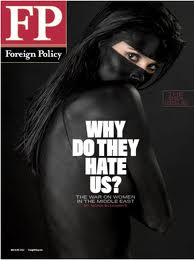
Let's start with the DON'TS, shall we? 1) Don't Use Women's Naked Bodies To Sell Articles About How Godawful It Is To Use Women's Naked Bodies. Seriously, guys? No wonder tweets reacting to the issue included the following:

To be fair, there was lots of praise for the issue as well, and to their credit, FP responded to the outrage by posting a round-table 24 hours later as a forum for critique, featuring female Muslim voices from around the world. I am with those who thought the article was important yet the picture was a mistake, among them Naheed Mustafa:

“The image works against [Mona Eltawahy's] essay. It belies the nuance and breadth of the writing by reducing a subject to one easily consumable image… an image that doesn't even speak to the kind of women Eltahawy is writing about. If anything, the imagine does exactly what Eltahawy accuses Islamists of doing: reducing women to one-dimesnional caricatures with little or no autonomy… and it's not just about Muslim women. The illustration is insulting to women in general. It takes the profoudn probelm of gender-based violence and reduces it to sexual imagery: 'Hey, we might be talking about the endemic hatred of one gender for another, but here's a naked painted lady to keep you company!'”

Yep, that about says it.

2) Don't Pit Women Against One Other. I don't know what Mona El-Tahawny originally titled her piece, but the subtitle Foreign Policy's editors chose (“the real war on women is in the Middle East“) was a needless slap in the face to women fighting in the US for pay equity, reproductive health and to safety in our homes, streets and workplaces. The “real” war on women – and other gender minorities – is everywhere. It just takes different forms. What is a constant in world affairs is the use of finger-pointing about “other cultures' women” to create a sense of our own cultural superiority.

Sexissue

Also Sherene Seikaly and Maya Mikdashi in Jadaliyya:

[T]there is the visual. A naked and beautiful woman’s flawless body unfolds a niqab of black paint. She stares at us afraid and alluring. We are invited to sexualize and rescue her at once. The images reproduce what Gayatri Spivak critiqued as the masculine and imperial urge to save sexualized (and racialized) others. The photo spread is reminiscent of Theo van Gogh's film Submission, based on Ayyan Hirsli Ali’s writings, in which a woman with verses of the Quran painted on her naked body and wearing a transparent chador writhes around a dimly lit room. Foreign Policy’s “Sex Issue” montage is inspired by the same logic that fuels Submission: we selectively highlight the plight of women in Islam using the naked female body as currency. The female body is to be consumed, not covered!

For those of us now long familiar with the depictions of the Arab/Muslim woman as repressed but uncontrollable sex object, these images only reify the fascination with the hidden underside of that liberated, secularized self.

Our Complex, Difficult & Fragile Enlightenments

KaterinadeligiorgiRichard Marshall interviews Katerina Deligiorgi in 3:AM Magazine:

3:AM: You argue that the Enlightenment is still a live issue. You cite Foucault who claimed, rather like yourself, that the ‘event that is called Aufklarung… has determined, at least in part, what we are, what we think, and what we do today?’ You call the Enlightenment ‘Janus faced.’ And you want to engage with the Enlightenment without being in historical bad faith. So can you tell us about these issues and how you approach them?

KD: This question is about the Enlightenment, as opposed to enlightenment, that is, about a period in European history in which the concept of enlightenment became current and its meaning intensely debated, at least in the German intellectual scene. Out of this debate emerges the concept I set out briefly in the previous answer. As I try to show in the book this does not boil down to have a critical attitude, which is what I think Foucault advises in his own writings. In fact, my take on enlightenment goes against this subjectivisation or perhaps better, privatisation of enlightenment.

The Janus face metaphor is intended to convey that the concept is forward looking since it describes a project and a goal, but it also has a past, a history of debate, of right and wrong turns, that must inform our current views of it.

3:AM: So according to your approach, Kant sets up a tribunal of enlightenment to put enlightenment on trial? Can you say what you mean by this?

KD: In the German debate about the meaning of the enlightenment, there was a lot of what I called earlier sloganising, including unsupported claims about the good things that would come out of this project, movement, cast of mind (it was different things to different people). There was also a lot of anxiety about its corrosive aspects. Often Kant comes to debates that are polarised and changes them by altering the way in which the problem is set. In this case, there is a ‘rationalist’ sense in which enlightenment means reason’s shining forth to illuminate all our practices and to guarantee progress; conservative critics pointed out that this shining forth is an intellectualist fantasy that has nothing to do with the condition in which most people find themselves and is likely to destroy values embedded in traditions. There is also an ‘empiricist’ sense that sees open discussion as best means for advancing our affairs, to which the counter-argument is that the cost benefit analysis here is rigged.

So enlightenment appears on the tribunal in pretty bad shape, accused of both dogmatism and scepticism. Kant rescues it by identifying its legitimacy as residing in the critical employment of our reason and this last as expressing a value of autonomy.

Fifty Years On: the Triumph of the Penguin Modern Poets

Wootten_263446hWilliam Wootten in the TLS:

Contemporary poetry began in 1962 – in April to be precise – with the publication of A. Alvarez’s Penguin anthology The New Poetry, the first two volumes of the Penguin Modern Poets series, and the first number of Ian Hamilton’s little magazine, the Review. As with the beginning of sexual intercourse, dated by Philip Larkin’s “Annus Mirabilis” to the following year, the fact that April 1962 fell between the end of the Chatterley ban and the Beatles’ first LP was significant. On the one hand, sales of D. H. Lawrence’s book had greatly enriched Penguin Books, which allowed the recently appointed chief editor, Tony Godwin, to pursue ambitious new projects; on the other, the Fab Four had yet to ensure that the new and relevant would be more culturally synonymous with Pop than with Lawrentian intensities and critical seriousness.

In “Beyond the Gentility Principle”, his introductory essay to The New Poetry, A. Alvarez was not short of either: Lawrence stands as the “only English writer . . . able to face the most uncompromising forces at work in our time”, a writer who had “almost nothing to do with middle-class gentility” and whose example validates the verse of the young Ted Hughes. Lawrence also means F. R. Leavis, invoked at the opening and close of “Beyond the Gentility Principle”, whose criticism helped shape The New Poetry’s contributors, editor and readership alike. Which is not to say that Alvarez’s ideas had not moved on a good way from those of the Leavisites pur sang.

The significance of Alvarez’s essay tends to be portrayed in terms of its reactions: to the stuffiness and repression of post-war Britain, to the poetic attitudes of the Movement, to the anti-modernism and insularity of English literature. However, its advocacy of a path forward is quite as notable, if less likely to meet with agreement.

Woman, Fighter, Philosopher

26stone-ruthbarcanmarcus-articleInlineDiana Raffman on Ruth Barcan Marcus in the NYT's The Stone:

I first met the renowned Yale professor Ruth Barcan Marcus in the ladies’ room at the Marlboro Music Festival during the summer of 1977. As a music major in Yale College I had taken only a few philosophy courses, and none with Marcus. But word of the arrival in 1973 of the formidable philosopher had reached even the musty practice rooms in the bowels of Harkness Hall; and I had seen her several times, from a safe distance, on campus. Perhaps because this initial encounter occurred on musical rather than philosophical terrain, I managed to ask the woman adjusting her collar in the mirror next to me whether she was Ruth Marcus, “the famous logician.” She laughed and said yes, and then asked what I planned to do with my Yale degree. I told her I wanted to go to graduate school in philosophy, but feared that a major in music, rather than philosophy, would be an obstacle. She replied, “I don’t see why that should stop you.”

Those words were to be my first lesson from Professor Marcus, who died in February at the age of 90. They were emblematic of the whole of her intellectual and professional life. Yes she was brilliant, and famous, and powerful; yes her writings changed the course of philosophical history; and yes she demolished her philosophical opponents when she thought they deserved it. But what made Marcus more than a great philosopher were her unflinching honesty, her unfailing integrity and a will of steel. I first thought to describe her as the most courageous person I’ve ever known; but really she wasn’t courageous. Courage requires fear, and Marcus was fearless. She said what she thought and did what she thought was right, no matter the consequences.

Review of Jonathan Haidt’s new book, The Righteous Mind

Srivas Prasad in Accidental Blogger:

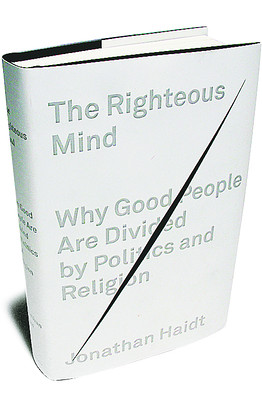
Ob-sf834_bkrvha_dv_20120315153035Jonathan Haidt is a moral psychologist best known for his work on the moral foundations, identifying the dimensions along which peoples' moral responses vary. The most fundamental moral concerns of human beings include, he says, care or harm, fairness or cheating, liberty or oppression, loyalty or betrayal, authority or subversion, and sanctity or degradation. The neat fact uncovered by his research is that not all people weigh these dimensions of morality seriously, that whilst conservatives bring all these dimensions to bear upon moral deliberation, liberals and libertarians use only the first three. The ''money'' plot is here, showing how much people of different political orientations care about a given moral concern. A significant portion of Haidt's new book, ''The Righteous Mind'' is devoted to explaining these dimensions and findings.

An important concern for Haidt is that liberals and conservatives in contemporary America are increasingly divided (his book is subtitled ''Why Good People Are Divided by Politics and Religion''), and he thinks his moral dimensions help explain why. We simply respond to different moral criteria. We have different ''moral taste-buds'', he says, in an image used repeatedly in the book. It is not just moral disagreement he is interested in however, but moral incomprehension, the fact that we can literally fail to understand what someone on the opposite side might be thinking, or why he isn't a moral monster just because we disagree with him. Here he thinks a significant portion of the blame rests with the liberal side of the divide.

More here.

Pakistan on the Brink

From The Telegraph:

Gardham_main_2197955bAs Britain desperately tries to rescue some pride from its imminent withdrawal from Afghanistan, the best-case scenario may be that we leave behind a less stable and more corrupt version of Pakistan. The vision of that country painted by Ahmed Rashid, one of the leading analysts of the “Af-Pak” relationship, is not an encouraging one. “Pakistan is now considered the most fragile place in the world… It is the most unstable country and the most vulnerable to terrorist violence, political change or economic collapse,” he writes in his latest book, Pakistan on the Brink.

While it is not yet a failed state, Rashid admits that its multiple long-term and short-term problems seem “insurmountable by the present military and civilian leadership”. Among the myriad problems are the corrupt and rundown bureaucracy, judiciary and police force and an elite that “lacks all sense of responsibility towards the public, refuses to pay taxes and is immeasurably corrupt”. There is no drinking water for a third of the population, no electricity for up to 16 hours a day and half the school-age children do not go to school, meaning “young men face a future of little promise and are ready to sign on to jihad”. The judiciary is a “broken instrument incapable of handing down judgments to the real criminals” and retired intelligence officers spread conspiracy theories and blame America on a plethora of high-octane chat shows

More here.

Why Pygmies of Africa are so short

From MSNBC:

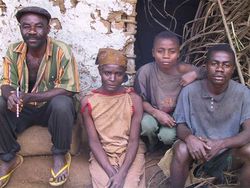
PygsWhy the Pygmies of West Africa have such short stature, while neighboring groups don't, has been somewhat of a mystery. Now new research suggests unique changes in the Pygmy's genome have both led to adaptations for living in the forest as well as kept them short. Researchers analyzed the genomes, the “building code” that directs how an organism is put together, of Western African Pygmies in Cameroon, whose men average 4 feet, 11 inches tall, and compared them with their neighboring relatives, the Bantus, who average 5 feet, 6 inches, to see whether these differences were genetic or a factor of their environment.

…The data revealed height had a genetic component related to Bantu ancestry: The more Bantu ancestry an individual from the Pygmy tribe had, the taller that individual tended to be. One part of the genome, on chromosome 3, was especially important in this trait, the researchers said. “We kept seeing a lot of them [these single-letter differences] highlight that region in chromosome 3,” Tishkoff said. “It just seemed like a hot spot for selection and for very high differentiation and, as it turns out, very strong association with height as well.”

Height genes
The researchers zoomed in on the genes in this area of the genome. One of the genes they found had already been associated with height changes in other populations, but the rest hadn't. They found new changes in hormone pathways and immunity that seemed to correlate to the pygmy's short stature. These could have been selected for because of their influence on height or because changes in these genes play other roles in the body that were advantageous to the Pygmies, Tishkoff said. For example: An immunity component might be selected for because it helps the pygmies fight off infections, which are prevalent in their habitat. And the link to hormone pathways also makes sense, Tishkoff said, because changes to them could help the Pygmies reproduce at earlier ages. Shorter height could just be a byproduct of these changes.

More here.

oxford

1335351353258

Growing up in Oxford I looked out the window and saw low grey skies and red-brick walls, a deeply fixed and bounded place. ‘Can’t complain’ was the brightest affirmation I heard; ‘could be worse’ spelled almost ecstasy. My parents, eager products of British India, took me to see Lear at Stratford and we all noticed the power the old patriarch wielded at the play’s beginning, even if he was notionally dividing up his kingdom. We didn’t see that the broken, weeping, almost posthumous king at the end might be closer to the spirit of the land around us. We moved from north Oxford to southern California in 1964 – when I was seven – and suddenly I noticed that living in the future tense could be as treacherous as living in the past; it was ideal so long as you were young and on the move, but it could be exasperating if ever you wanted to lay foundations underneath your feet. Small places were more conducive to enmities and smugness, I came to see, as soon as I was in the devouring open spaces of the Far West, but they were also home to idiosyncrasy, a sense of fun and to privacy.

more from Pico Iyer at Granta here.

kraftwerk

120430_r22133_p465

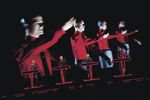
On an August night in 1981, the German band Kraftwerk played at the Ritz, on East Eleventh Street in Manhattan, in support of its latest album, “Computer World.” The only instruments onstage were actually machines: reel-to-reel tape recorders, synthesizers, keyboards, and a calculator. All four members of the group had short hair and dressed identically, in black button-down shirts, black pants, and shiny shoes, which made them look more like valets than like musicians. That didn’t bother them, as they didn’t like the idea of being a band—or even musicians—and often referred to themselves as “operators.” For the song “Pocket Calculator,” one member triggered percussion with a drumstick. Another used a Stylophone, a metal keyboard played with a small stylus. Florian Schneider, a founding member, played the calculator, which was wired into the sound system, so that pressing the keys made audible beeps. His partner, Ralf Hütter, who is the only remaining original member of Kraftwerk, sang the lyrics of the song in a monotone—an approach that he calls Sprechgesang, or “spoken singing”—and played a small Mattel keyboard. “By pressing down a special key / it plays a little melody,” he intoned. Schneider responded by playing something sort of like a melody with the calculator. At one point, Hütter bent down and let the audience play the keyboard. Recently, Hütter said, “I wanted to show them that anyone could make electronic music.”

more from Sasha Frere-Jones at The New Yorker here.

Thursday, April 26, 2012

On the Quebec Student Strike

Justin E. H. Smith at his own blog:

ScreenHunter_09 Apr. 26 23.17On April 23, writing in the Chronicle of Higher Education, Lilian Radovac aptly described the past few months of upheaval across Quebec as “the biggest student uprising you've never heard of.” This movement, which began building from early February of this year, has at its peak involved over 300,000 students across the province. A demonstration on March 22 attracted over 200,000 participants to the streets of Montreal. There have been scores of arrests.

The official reason for the movement is student opposition to the announcement from the government of provincial prime minister Jean Charest of its intention to raise university tuition around 75% over the next five years, to a little under $4000 per year. At the end of this period, Quebec tuition will still be the lowest of all Canadian universities, which are in turn much less expensive than all American public universities.

In spite of what many outside of the province consider a deal too good to complain about, one frequent demand of the demonstrators is for something even better than what Quebec students had before the hikes: free university education for all. This is of course a tall order, and that it can be made at all has much to do with the unique place of Quebec in North American society, and with the sense of many in this province that it is a society based on a different set of values, and a different set of choices, than those of the rest of the continent. As Sameer Zuberi wrote recently in the Huffington Post, “Quebecers have made a societal choice to keep education accessible to all, regardless of income.”

One question right now is whether Quebec will in fact be able to hold out against the consumer model of education that is sweeping the world around it.

More here.

Paul Theroux on What’s Really Wrong With Africa

Travel writer Paul Theroux on why his latest book, “The Lower River”, looks at the damage done by nongovernmental organizations in Africa.

Maria Streshinsky in Pacific Standard:

Question: You have said it is contemptible “to stay home and invent the exotic, as Saul Bellow did, conjuring up an Africa he had never seen.” Since a strong theme in your new book is the damage nongovernmental organizations have inflicted over the years, how often have you returned?
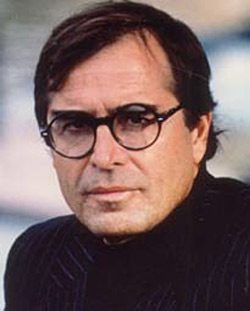
Cls-a0a0z9-aAnswer: My novel is, among other things, an adventure story, a sort of descent by an unsuspecting American into the unknown, and into a trap. It’s an ordeal — my favorite kind of narrative, whether fiction or travel. I have been back to Africa and to Malawi many times. Teaching in Malawi was my first job, from 1963 to 1965, and then I spent four years in Uganda as a teacher. This seems a long time ago! Our mission was pretty simple: start schools, educate the students, and help create a system that would be self-sustaining. The students would become teachers and our role would be phased out. There were many students and enough aid to see them through. And the students were, on the whole, conscientious. But something changed. What was supposed to happen, didn’t happen.

On my repeated trips back, I saw the pattern I have described — foreign teachers, African students, and now, almost 50 years later, there are still not enough African teachers. The Peace Corps is still at it! It seems an endless cycle, and worse, a deteriorating educational system. So what happened — or, rather, what didn’t happen? I think that the foreign teachers, with the best of motives, unintentionally subverted the system. Malawians don’t want to be teachers — it’s an underpaid and underappreciated profession; and though there is now a medical school in Malawi, few graduates have stayed to be doctors in Malawi, where there is an average of two physicians for every 100,000 people.

Development seemed logical back in the 1960s, but did not take into account political tyranny, corruption, and the simple expedient of emigration. The main character in my book, for whom Africa was an Eden, has to confront this and much else.

More here.

Thinking in a Foreign Language Makes Decisions More Rational

Brandon Keim in Wired:

ScreenHunter_08 Apr. 26 22.39To judge a risk more clearly, it may help to consider it in a foreign language.

A series of experiments on more than 300 people from the U.S. and Korea found that thinking in a second language reduced deep-seated, misleading biases that unduly influence how risks and benefits are perceived.

“Would you make the same decisions in a foreign language as you would in your native tongue?” asked psychologists led by Boaz Keysar of the University of Chicago in an April 18 Psychological Science study.

“It may be intuitive that people would make the same choices regardless of the language they are using, or that the difficulty of using a foreign language would make decisions less systematic. We discovered, however, that the opposite is true: Using a foreign language reduces decision-making biases,” wrote Keysar’s team.

Psychologists say human reasoning is shaped by two distinct modes of thought: one that’s systematic, analytical and cognition-intensive, and another that’s fast, unconscious and emotionally charged.

In light of this, it’s plausible that the cognitive demands of thinking in a non-native, non-automatic language would leave people with little leftover mental horsepower, ultimately increasing their reliance on quick-and-dirty cogitation.

Equally plausible, however, is that communicating in a learned language forces people to be deliberate, reducing the role of potentially unreliable instinct. Research also shows that immediate emotional reactions to emotively charged words are muted in non-native languages, further hinting at deliberation.

More here.

Our steadfast pursuit of a freer Saudi Arabia

Waleed Abu Alkhair in the Washington Post:

ScreenHunter_07 Apr. 26 22.31Hamza Kashgari visited me several times before he wrote the ill-fated tweets that led to his arrest in February and then to solitary confinement in a Riyadh prison. We discussed social, political and philosophical issues, including some that are taboo in Saudi Arabia. I warned him that his thoughts, if expressed publicly, would lead religious hard-liners to call for his blood.

I find it outrageous that in the 21st century one person could threaten another with death merely for embracing ideas other than religion, God and the prophet Muhammad. But that is exactly what happened at a weekly salon that focuses on political, religious and human rights issues. I named the salon “samood,” a richly textured Arabic word meaning “resistance” or “steadfastness.”

Every week, I am host to several dozen people at my home, most of them politically engaged Saudi youth. I started the salon after government and religious authorities clamped down on gatherings of liberal youth in cafes and bookstores in the wake of Hamza’s arrest, severely constricting the space for free expression in this city. The oppressive trend has accelerated as religious hard-liners have mounted a vicious campaign to cleanse society of what they deem “unbelief” and “deviant thought”: in reality, any ideology different from their own.

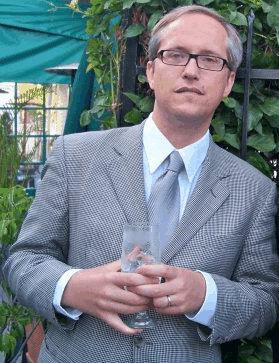
More here. [Waleed Abu Alkhair, in photo above, is a human rights activist in Saudi Arabia.]