does art matter?

ThinkPiece_2

The epilogue of DeLillo’s Point Omega returns the reader to the narrator’s sixth and final viewing of Gordon’s 24-Hour Psycho. During this visit, the protagonist interacts with other visitors and incorporates personal memories into his interpretation of the video sculpture in the gallery. His ruminations on news media, Hitchcock’s film, Gordon’s installation and his own experiences (detailed earlier in the novel), intermingle. In effect, these four forms of media – mainstream press, a classic film, a video installation and an award-winning novel – each reach their publics in different ways. But often they overlap, one folded into the other. This seems to be DeLillo’s point. His narrator’s deeply engaged reading of a contemporary art installation offers a dynamic model of the process by which art emerges from other practices, crystallizes in form and experience, only to move beyond those conditions in often-unpredictable ways to generate new narratives and knowledge. Art works are social subjects in this way, and not simply aesthetic objects. They are meaningful only when seen in relationship to a wider network of beliefs and practices, economies and exchanges. Art is the current, not the fixture.

more from Alexander Alberro at Frieze here.

Why Barack Obama And Benjamin Netanyahu Don’t Get Along

Obama-netanyahu-2Peter Beinart gave a lecture at the Everet Jewish Life Center in Chautauqua on the personal, religious, and Zionist roots on both sides of the Obama-Netanyahu relationship. The audio's not perfect but it's really worth a listen, so I recommend headphones.

Listen to the speech here.

For Beinart's bio, along with the rest of the series' speakers, click here.

Monday, July 23, 2012

Mr. Wrong: Ifti Nasim (1946 – 2011)

Note: In honor of my best friend's first death anniversary, I am posting again the obituary I wrote (with a brokem heart).

by Azra Raza

According to every convention, my friend Ifti was all wrong. He was born at the wrong time. He should have been born in 2150. He was born in the wrong country. He should have been born in Hollywood. He was born to the wrong parents. He should have been Tallulah Bankhead’s child. He was born to the wrong siblings. He should have been my sister. He was born in the wrong body. He should have been Marilyn Monroe. He was born to the wrong friends in Pakistan. His friends should have been Oscar Wilde, Dorothy Parker, Joan Crawford, Tennessee Williams, and Bette Davis. He was born to lead a life of luxury, dividing his time between the French Riviera and throwing extravagant parties in Manhattan. Instead he became a car salesman.

And if he had to become a car salesman, he should have been wearing the conventional salesman’s clothing. Ifti wore silks and brocades. He should have cinched his best car deals by groveling in front of clients. Instead, he succeeded by sassily telling Oprah Winfrey when she asked him how big the engine of the Mercedes was, “Are you going to sleep with it?” And when Mary Anne Childers asked him to open the trunk of the car she was buying from him, he famously remarked, “Honey, do it yourself, I just got my nails done.”

And while other salesmen were attending classes to polish up their PR skills, Ifti was busy being a gay activist. He created SANGAT, the organization devoted to Gays and Lesbians of South Asian origin. And why couldn’t SANGAT be content with their periodic display of solidarity by marching through town in the Annual Gay and Lesbian Pride Day Parade? Instead, Ifti raised funds to hire lawyers who have successfully fought cases to earn Immigration status for individuals seeking asylum because of their sexual preferences. And why did I regularly meet strangers in Ifti’s home who had found sanctuary in his ever-welcoming apartment?

Ifti could have been a highly successful stand-up comic. Instead he became a writer. And if he had to become a writer, he could have stuck to one genre alone. Instead he wrote poetry in Urdu, English and Punjabi; he published several books of short stories and became a serious journalist writing pithy, enormously unsettling, weekly columns unmasking the hypocrisy of some of our more pious and decent members of society; he started his own highly successful radio talk show.

And if he did decide to write about homosexuality, why could he not follow the traditions of the “love that dare not speak its name” and convey his agony through innuendo and metaphor? Instead he published the first ever book in Urdu devoted openly to homosexual love. Nirman (or Hermaphrodite) uses direct, graphic imagery and explicit language.

More here.

Sunday, July 22, 2012

Tino Sehgal’s Turbine Hall commission: ‘Attention is what I work with’

He's put children asking difficult questions into galleries, and lovers kissing. Now artist Tino Sehgal plans to revolutionise Tate Modern's Turbine Hall.

Charlotte Higgins in The Guardian:

ScreenHunter_07 Jul. 23 10.39Tino Sehgal is no ordinary interviewee. Tall, tousled, quick of speech and almost professorial in manner, the Anglo-German artist resists the general rule of the interview: that it's about the journalist harvesting maximum information from the subject. Instead, and somewhat disconcertingly, he wants us to have an actual conversation. Having been tipped off that I trained as a classicist, I can hardly get him out of the ancient world: he speculates on speech versus writing in Socrates and Plato, the politics of the act of prostration in Procopius, and the Latin derivation of the word religion.

At one point, as we sit talking in the cafe atTate Modern, I incline my head ironically and he starts talking about the decline of bowing and kneeling in western culture. A single word can set the 36-year-old artist off on a tangent: when I say “fetish”, he starts unpicking the whole concept. “I am for fetishisation!” he announces. “All of us have our favourite things and they speak to us.” Born in Britain and raised in Germany, Sehgal speaks fluent but heavily accented English.

This kind of conversational discursiveness is a key to Sehgal's work. The precise nature of the piece he is preparing for Tate Modern's Turbine Hall will remain, as with all past Unilever commissions, a secret until the moment of its unveiling next week.

More here. [The show opens today.]

Cruelty on the border

John Carlos Frey on abuses by American Border Patrol agents, via Salon:

BorderBorder Patrol protocol requires agents to provide detainees with food, drinking water and emergency medical services, to hold them under humane conditions, and to refrain from making degrading remarks, but this is rarely honored in practice, say human rights advocates. Over the past 15 years, reports documenting human rights abuses at the hands of Border Patrol agents have been published by Amnesty International, the ACLU, No More Deaths, even the United Nations. Contrary to their own protocols, Border Patrol agents have been accused of systematically denying food and water to migrants in custody, forcing them into overcrowded cells, stealing their money, confiscating medications, and denying them medical treatment. Migrants have described agents hurling verbal abuse, racial slurs and curses, and inflicting sexual assault, physical violence, even death. At least 14 migrants and border residents have died at the hands of Border Patrol agents over the past two years. These practices appear to be systemic, amounting to what No More Deaths calls “a culture of cruelty.”

Read the rest here.

Alexander Cockburn and the Radical Power of the Word

Cockburn_imgJohn Nichols in The Nation:

Alex, who has died too young at age 71 in Bad Salzhausen, Germany, loved writing. He loved it so much that he met his deadlines even as a two-year battle with cancer progressed toward its final stages. Alex's commitment to the craft—to the radical power of the word—extended far beyond his own contribution. He poked, prodded and inspired the rest of us. When I was working on an article at my home computer, he would lean over me and make suggestions. Invariably, Alex wanted to see a paragraph added on some new evil done by a corporation, some third-party candidate who had not gotten enough attention or some third-world cause that had gotten even less attention. Alex’s suggestions did not always fit where he proposed that I add them, and I asked them about this once.

“Sometimes you just have to get the story out,” he said, “anywhere you can.”

But, of course, Alex never just got the story out. His prose, honed during an Anglo-Irish childhood when he learned at the side of the master—his father Claud, the great radical British journalist of mid-century who lent him the title of his column, “Beat the Devil”—never failed. Alex knew how good he was. He knew that he could take readers where other writers could not, to the fields of India where Coca-Cola was stealing water from peasants, to the barricades of neglected labor battles in Austin, Minnesota, and Toledo, Ohio; to “The City” of London where the Libor scandal now unfolds. There were times when the going got rough; Alex's radicalism was genuine, and he could offend not just foes on the right but friends on the left. He parted company with mainstream liberals on issues ranging from gun control to global warming.

But no one could skewer the banksters, the robber barons and the crony capitalists of this broken era quite so ably as Alex.

10 Things Holden Caulfield Hates

Heba Hasan in The Atlantic:

041938_beerpong_crop[Last week was] the 61st anniversary of J.D Salinger's The Catcher in the Rye, a novel that introduced us to the most beloved/hated embodiment of disaffected youth in all of literature—and quite possibly pop culture as a whole. To celebrate, we've rounded up ten things that Holden Caulfield hates. We could have taken the easy way out and just said all of humanity, but that wouldn't have been nearly as entertaining. And besides, nothing makes you feel more grateful about the fact that you're not a self-destructive, angst-ridden teenager (anymore) than reminding yourself exactly why Holden Caulfield loathes Jesus' Disciples.

1. Bros

“He was one of those guys that think they’re being a pansy if they don’t break around forty of your fingers when they shake hands with you. God, I hate that stuff.”

Can’t you just picture Holden at a frat party? Sitting on a couch by himself and judging how phony all those guys at the beer pong table are?

More here.

Let my mother go

Michael Wolff has stood by while doctors keep his mother alive, despite the fact that she has severe dementia. Here, in this provocative and heartbreaking plea, he reveals why our obsession with longevity is making old age a living hell.

Michael Wolff in The Guardian:

Wolff-008On the way to visit my mother one recent rainy afternoon, I stopped in, after quite some constant prodding, to see my insurance salesman. He was pressing his efforts to sell me a long-term-care policy with a pitch about how much I'd save if I bought it now, before the rates were set to precipitously rise. I am, as my insurance man pointed out, a “sweet spot” candidate. Not only do I have the cash (though not enough to self-finance my decline) but a realistic view: like so many people in our 50s – in my experience almost everybody – I have a parent in an advanced stage of terminal breakdown.

I didn't need to be schooled in the realities of long-term care: the costs for my mother, who is 86 and who, for the past 18 months, has not been able to walk, talk or to address her most minimal needs and, to boot, is absent a short-term memory, come in at about $17,000 a month. And while her insurance hardly covers all of that, I'm certainly grateful she had the foresight to carry such a policy. (Although the carrier has never paid on time and all payments involve hours of being on hold with its invariably unhelpful helpline operators – and please fax them, don't email.) My three children deserve as much.

And yet, on the verge of writing the cheque, I backed up.

What I feel most intensely when I sit by my mother's bed is a crushing sense of guilt for keeping her alive. Who can accept such suffering – who can so conscientiously facilitate it?

“Why do we want to cure cancer? Why do we want everybody to stop smoking? For this?” wailed a friend of mine with two long-ailing and yet tenacious in-laws.

More here.

The Turkish paradox

Mehdi Hasan at Al Jazeera:

ScreenHunter_06 Jul. 22 16.21Turkey is a paradox: it is secular and Islamic, modern and traditional, wants to be Western – yet tends to looks eastwards. But whatever Turkey is doing, it seems to be working.

Last year, Turkey emerged as a source of inspiration for countries in the Middle East during the Arab Spring; the country is now considered to be a regional superpower. Wherever Prime Minister Recep Tayyip Erdogan goes in the Arab world, he is mobbed by cheering crowds.

Meanwhile, Turkey's dynamic economy is breaking records. In 2011, it became the fastest growing economy in Europe – and the second fastest in the world. Foreign businesses are queuing up to invest in Turkey.

Is it any wonder that the country is thus held up as “the model”, both for emerging economies and for Muslim-majority countries struggling with the transition to democracy? However, inside Turkey, some say liberal democracy and secular freedoms are under assault. There does seem to be a climate of fear in the country's largest city. In Istanbul, I met nervous journalists and bloggers willing to speak only in hushed tones about the growing number of restrictions on free speech. Within 24 hours of our arrival, one of my Al Jazeera colleagues was detained by police officers, who went through his bag and rifled through one of our scripts. They loudly objected to a line referring to the country's “increasingly authoritarian government”. Who says that Turks don't do irony?

More here.

Compassion Made Easy

David DeSteno in the New York Times:

15GRAY-articleInlineEmpirically speaking, does the experience of compassion toward one person measurably affect our actions and attitudes toward other people? If so, are there practical steps we can take to further cultivate this feeling? Recently, my colleagues and I conducted experiments that answered yes to both questions.

In one experiment, designed with the psychologist Paul Condon and published in the Journal of Experimental Social Psychology, we recruited people to take part in a study that was ostensibly about the relation of mathematical ability to taste perception — but that in actuality was a study of how the experience of compassion affects your behavior.

Each experimental session consisted of three individuals: a real participant and two confederates (i.e., people who secretly worked for us). First, the participants were told that they had four minutes to solve as many of 20 difficult math problems as they could and that they would receive 50 cents for each one they solved correctly. Twenty was far more than the typical person could do; the average number solved was 4. After time expired, the experimenter approached each person to ask how many problems he or she had solved, paid the person accordingly, and then had the person place his or her work in the shredder.

More here.

Is Your Child Gay?

From Scientific American:

Is-your-child-gay_1We all know the stereotypes: an unusually light, delicate, effeminate air in a little boy's step, an interest in dolls, makeup, princesses and dresses, and a strong distaste for rough play with other boys. In little girls, there is the outwardly boyish stance, perhaps a penchant for tools, a square-jawed readiness for physical tussles with boys, and an aversion to all the perfumed, delicate trappings of femininity.

These behavioral patterns are feared, loathed and often spoken of directly as harbingers of adult homosexuality. It is only relatively recently, however, that developmental scientists have conducted controlled studies to identify the earliest and most reliable signs of adult homosexuality. In looking carefully at the childhoods of gay adults, researchers are finding an intriguing set of behavioral indicators that homosexuals seem to have in common. Curiously enough, the age-old homophobic fears of many parents reflect some genuine predictive currency.

More here.

A Visit With Art-World Hero Chuck Close

From The Village Voice:

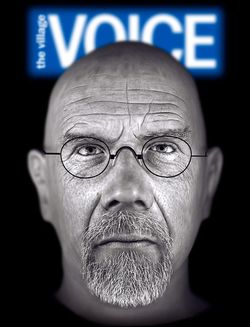
CcLou Reed's got wrinkles in his wrinkles.” Artist Chuck Close and I are in his ground-floor studio on Bond Street. He's describing a giant tapestry of Reed's face that he's hoping to have ready by mid October. The studio is jammed with assistants color-correcting dyes, poring over photographic images, and managing office business. It's an especially busy time for Team Close—the 72-year-old painter is preparing for his long-awaited fall show at Chelsea's Pace Gallery. Arrayed around the walls are some of his closest friends—Roy, Paul, Philip, Laurie, Cindy. In his relaxed company, it's practically immaterial that they're all celebrities. “I always wanted to make paintings of ordinary, undistinguished people,” Close says as if reading my thoughts. “It's not my fault they became famous.” There's a certain kind of virtuosity that amplifies its achievements by a million trillion. Beethoven composed his Ninth Symphony while deaf. James Joyce wrote Finnegans Wake with a magnifying glass. Barack Obama became the 44th president of the United States while black.

For people who love art, young or old, with-it or fusty, Republican or Democrat, the painter Chuck Close has long formed part of this virtuosic pantheon. An artist celebrated like few people in or out of the art world, Close commands not just attention, but also bona fide affection. To see him at huge museum affairs, art-fair openings, or charitable events is to see Moses part waters thick with social climbing, calculation, and envy. His presence—like that of a civil rights leader or sports hero—is mollifying. As he once put it to me, “For the last 14 years, I've not gone a day where I go outside and don't have someone tell me how much they like what I do. I'm really very, very lucky.” Never mind that Chuck Close is a partial quadriplegic and largely confined to a wheelchair.

More here.

Sunday Poem

Sonnet 91

Some glory in their birth, some in their skill,
Some in their wealth, some in their bodies' force,
Some in their garments, though new-fangled ill,
Some in their hawks and hounds, some in their horse;
And every humour hath his adjunct pleasure,
Wherein it finds a joy above the rest:
But these particulars are not my measure;
All these I better in one general best.
Thy love is better than high birth to me,
Richer than wealth, prouder than garments' cost,
Of more delight than hawks or horses be;
And having thee, of all men's pride I boast:
Wretched in this alone,that thou mayst take
All this away and me most wretched make.

by William Shakespeare

A Real-Life Fairy Tale, Long in the Making and Set to Old Tunes

From Larry Rohter in the NYTimes:

RodriguezIt’s a real-life tale of talent disregarded, bad luck and missed opportunities, with an improbable stop in the Hamptons and a Hollywood conclusion: A singer-songwriter is signed to a contract in the late 1960s after producers with ties to Motown Records see him playing in a smoky Detroit nightclub called the Sewer. He makes a pair of albums that sell almost nothing and then drops out of sight. So why, 40 years later, would anyone feel compelled to make a movie about this obscure artist, known professionally as Rodriguez?

Because, as it turns out, on the other side of the globe, in South Africa, Rodriguez had become as popular as the Rolling Stones or Elvis Presley. But he never knew of that success. He never saw a penny in royalties from it, and he spent decades doing manual labor to make ends meet and raise his three daughters. It wasn’t until fans in South Africa, trying to verify rumors he was dead, tracked him down through the Internet and brought him there to perform to adoring multitudes, that his career was resuscitated.

“This was the greatest, the most amazing, true story I’d ever heard, an almost archetypal fairy tale,” said Malik Bendjelloul, the Swedish director of “Searching for Sugar Man,” a documentary that opens on Friday in New York and Los Angeles. “It’s a perfect story. It has the human element, the music aspect, a resurrection and a detective story.” Because of an odd confluence of circumstances it is also a story unlikely ever to occur again.

More, including some great song samples, here.

Saturday, July 21, 2012

The Minority’s Minority: Ahmadis in India

Sunni supremacist groups have terrorised the Ahmadiyyas in Pakistan and declared them non-Muslims. This hatred is now taking roots in India.

Sai Manish in Tehelka:

ScreenHunter_04 Jul. 21 17.22“The breed of Qadianis will never change. They may multiply up to 99 generations; still the 100th one will continue to be a dualist-infidel and apostate. The reason is that their crime is a never-ending one. The offence will never cease to exist in their progeny. Let it be clear to every Muslim that the crime of apostasy runs throughout the lineage of a Qadiani. If he is adamant and refuses to renounce his apostasy, then Allah’s sacred soil deserves to be cleaned of his foul existence. By the law of Shariat, they should be awarded capital sentence because they are dualist-infidels (zindiq). If they are masquerading as Muslims on the globe, it is because they have not been sentenced. Hunt the liar in his mother’s haunt [Britain]. I ask my Muslim brethren — Don’t you have any grace left in you to answer these shameless Qadianis? Peel their camouflage off from every nook and corner of the world, just as it has been done in Pakistan.”

From a booklet published by the Majlise-Tahaffuz-e-Khatm-e-Nubuwwat Trust, Hyderabad, Andhra Pradesh

More here.

Great Books—and the Best Places to Read Them

From Smithsonian:

About 10 years ago, while passing a hot afternoon on the deck of a tourist lodge in Belize, a friend on his way out to go bird-watching asked why on earth I had my nose buried in a book. “Here we are in the jungle of Belize,” he said. “There are jaguars in the woods, and crocodiles in the swamp, and grackles in the trees—and you’re reading a book?” I explained that reading while traveling—if done right—can serve as a sensory supplement to one’s surrounding environment, not necessarily a distraction, as he believed. I explained that many years from now, any mention of Dovea sailing memoir by Robin Graham—would sweep me right back to these Belizean tropical forests where I read the book, and the coral reefs off the coast, and the croc-filled lagoons, and the villages, sulking in the boggy Caribbean heat and odors of fermenting cashew apples and mangoes. And I was right. When I think of Dove, I go right back to Belize. Because reading a book charges up the mind with information and memories. These become entangled with the scents and flavors of reality, and rather than detract from an experience, a good book can enrich it. Never in the past 15 years have I left home for a week or more without a piece or two of literature, and below I list some of my favorite reads—and where best to read them.

Top Picks:

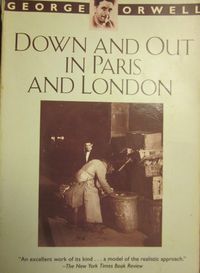
BooksDownAndOutBIGParis, Down and Out in Paris and London. Ernest Hemingway may have spent his days in Paris thoughtfully fingering his beard at sidewalk cafes and drinking the house wine, but George Orwell voluntarily dived into a life of grim poverty as he made a journalistic effort to understand the plight of Europe’s working classes. In Down and Out in Paris and London, Orwell describes short-term jobs in the Parisian restaurant circuit, weeks of unemployment, living in a pay-by-the-week hotel and selling his clothes to scrape up the rent. He lives franc to franc, describing the logistics of saving coins and managing free meals and dodging the landlady. In one especially dismal spell, Orwell and a friend named Boris, living together at the time, go three days without food. Following false rumors of job openings, they drag their feet throughout the city, growing weaker every hour. Orwell even goes fishing in the Seine in the hopes of landing something to fry in a pan. When the pair finally acquires a loaf of bread and a bottle of wine, they devour what must be among the most satisfying dinners ever eaten in Paris. Orwell eventually lands steady work, but not before learning how strangely liberating it is to hit rock-bottom, to own nothing in the world but the clothes you’re wearing and have no worries but finding a bite to eat. T. S. Eliot, an editor at Faber & Faber at the time, would later decline the manuscript offered by the young writer: “We did find [the book] of very great interest,” Eliot wrote, “but I regret to say that it does not appear to me possible as a publishing venture.”

More here.