in general, erotic art is never happy

Hilton_07_12

It was the relationship between art and human sensuality, a problem that worried the Victorians and has baffled all subsequent generations. The question at issue is nude painting. Ruskin – who wrote of ‘anatomy’, scarcely ever using the word ‘nude’ – believed that obsession with nakedness had damaged such a great mind as that of Michelangelo. Perhaps he thought similarly about Turner, especially since the English artist’s figural drawings are so weak, sometimes inept. They are indeed a record of failure. The superb landscapist had always wished to join the Old Masters through grand figurative painting. The real theme of Warrell’s selection of drawings is of Turner’s frustration in preparing for that endeavour. His nudes on paper are impatient with the demands of the Royal Academy life class, yet do not go beyond the limits of instruction. However, we do see an occasional more relaxed view of the model’s limbs; and here and there a glimpse of pubic hair, which cheers the eye because of disobedience to the chilliness of marble.

more from Tim Hilton at Literary Review here.

stalker

1342075059

Just where is the Zone, anyway? In the film, a caption says that it’s in a small country, surrounded by barbed wire. But this was just a ruse to keep the censors at bay. To a Soviet audience, a forbidden area surrounded by barbed wire naturally conjured up a big swath of countries surrounded by lots and lots of barbed wire. Dyer points out another meaning: the very word ‘zone’ would call up the Gulags. To prisoners, the world outside was known as the bolshaya zona, the big zone, as opposed to the little one of the camps. At the time, it could also refer to other forbidden zones in the Soviet Union, such as the secret research complexes like Arzamas-16 and Chelyabinsk-40, where the components of the Soviet atom bomb were produced — secret cities that didn’t appear on any map. Now, the word seems to refer prophetically to the exclusionary zone around Chernobyl.

more from Jacob Mikanowski at the LA Review of Books here.

He has been blessed with size

120723_r22386_p233

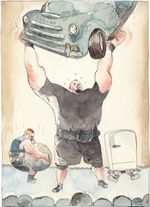
The giant of Fort Lupton was born, like a cowbird’s chick, to parents of ordinary size. His father, Jay Shaw, a lineman for a local power company, was six feet tall; his mother, Bonnie, was an inch or so shorter. At the age of three months, Brian weighed seventeen pounds. At two years, he could grab his Sit ’n Spin and toss it nearly across the room. In photographs of his grade-school classes, he always looked out of place, his grinning, elephant-eared face floating like a parade balloon above the other kids in line. They used to pile on his back during recess, his mother told me—not because they didn’t like him but because they wanted to see how many of them he could carry. “I just think Brian has been blessed,” she said. “He has been blessed with size.” Fort Lupton is a city of eight thousand on the dry plains north of Denver. In a bigger place, Shaw might have been corralled into peewee football at eight or nine, and found his way among other oversized boys. But the local teams were lousy and, aside from a few Punt, Pass & Kick contests—which he won with discouraging ease—Shaw stuck to basketball. By seventh grade, he was six feet tall and weighed more than two hundred pounds.

more from Burkhard Bilger at The New Yorker here.

A young rapper with explosive lyrics breaks taboos in Pakistan

Tom Hussain in the Kansas City Star:

39759_424627651444_6184226444_4656319_6664830_nIn September, rap fans will be treated to the online release of “The Mushroom Cloud Effect,” a hardcore album by a debutant artist featuring collaborations with American powerhouses like B-Real, Xzibit and Everlast.

The improbable star of the album is Adil Omar, a 21-year-old Pakistani who works from a studio in the corner of his bedroom in an affluent suburb of Islamabad.

A relative newcomer to Pakistan's thriving music scene, Omar has struck a chord with educated Pakistani youth who – after five years of Taliban terrorist attacks – are using artistic expression to rebel against the moral policing of their conservative society and being labeled as extremists in the West.

True to the rap genre, Omar's lyrics are a scornful, frequently abusive commentary on those stereotypes.

“I make a terrorist tear a wrist, prepare for his funeral, and I'm way beyond your government's or parents' approval,” he rapped in “Paki Rambo,” a 2011 hit whose YouTube video has generated more than 260,000 views.

The song also provided the inspiration for the title of his new album, with Omar wryly commenting on the nuclear arms race between Pakistan and its archenemy, India: “There's no silver lining to a mushroom cloud.”

More here.

What’s going on in Israel?

Stephen M. Walt in Foreign Policy:

ScreenHunter_12 Jul. 18 09.18One of the more enduring myths in the perennial debate on the Israel-Palestine conflict is the claim that Israel has always been interested in a fair and just peace, and that the only thing standing in the way of a deal is the Palestinians' commitment to Israel's destruction. This notion has been endlessly recycled by Israeli diplomats and by Israel's defenders in the United States and elsewhere.

Of course, fair-minded analysts of the conflict have long known that this pernicious narrative was bogus. They knew that former Prime Minister Yitzhak Rabin (who signed the Oslo Accords) never favored creating a viable Palestinian state (indeed, he explicitly said that a future Palestinian entity would be “less than a state.”) The Palestinians' errors notwithstanding, they also understood that Prime Minister Ehud Barak's offers at Camp David in 2000 — though more generous than his predecessors' — still fell well short of a genuine two-state deal. But the idea that Israel sought peace above all else but lacked a genuine “partner for peace” has remained an enduring “explanation” for Oslo's failure.

Over the past several weeks, however, the veil has fallen off almost completely. If you want to understand what's really going on, here are a few things you need to read.

More here.

Tuesday, July 17, 2012

Sartre and Camus in New York

Andy Martin in the New York Times:

Camus sartreIn December 1944, Albert Camus, then editor of Combat, the main newspaper of the French Resistance, made Jean-Paul Sartre an offer he couldn’t refuse: the job of American correspondent. Perhaps, in light of the perpetual tension and subsequent acrimonious split between the two men, he was glad to get him out of Paris. What is certain is that Sartre was delighted to go. He’d had enough of the austerities and hypocrisies of post-liberation France and had long fantasized about the United States. Camus himself would make the trip soon after, only to return with a characteristically different set of political, philosophical and personal impressions.

In some sense, existentialism was going home. The “roots” of 20th-century French philosophy are canonically located on mainland Europe, in the fertile terrain of Hegel, Kierkegaard, Nietzsche, Husserl and Heidegger. But it was not entirely immune to the metaphysical turmoil of the United States at the end of the 19th century. French philosophy retained elements of the pragmatism of C.S. Peirce and the psychologism of William James (each receives an honorable mention in Sartre’s “Being and Nothingness”). More significantly, both Camus and Sartre had learned and borrowed from 20th-century writers like Faulkner, Hemingway and dos Passos —and, of course, from the films of Humphrey Bogart. Camus, in particular, cultivated the trench coat with the upturned collar and described himself as a mix of Bogart, Fernandel and a samurai.

More here.

Toni Morrison on love, loss and modernity

From The Telegraph:

Toni-1-reuters_2272684bMorrison has written 10 novels and won a multitude of highly respected awards.Her best-seller Beloved won the Pulitzer Prize and was voted by The New York Times the best work of American fiction in the past 25 years. Her 1977 novel Song of Solomon won the National Book Critics Circle Award. Her first novel, The Bluest Eye, was published in 1970, when she was 39 years old and at the time, working at Random House as an editor. Because her literary success came later in life, when did she begin to trust her instincts – was it immediate? “Oh, I trust something else,” she says, thinking it through. “Which is the intelligence to examine my instincts.”

…Morrison has spoken in the past about her resistance to explaining black life to a white audience. What did she mean by that? “In American literature, African American male writers justifiably write books about their oppression,” she says. “Confronting the oppressor who is white male or white woman. It’s race. And the person who defines you under those circumstances is a white mind – tells you whether you’re worthy or what have you. And as long as that’s your preoccupation, you’re defending yourself against that. Reacting to it. Reacting to the definition – saying it’s not true. African American women never do that. They never write about white men. I couldn’t care less – I didn’t want to spend my energy refuting that gaze.”

More here.

A Bone Here, a Bead There: On the Trail of Human Origins

John Noble Wilford in The New York Times:

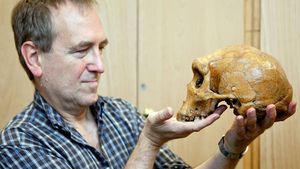
Video-stringer-articleLargeWho are we, and where did we come from? Scientists studying the origin of modern humans, Homo sapiens, keep reaching deeper in time to answer those questions — toward the last common ancestor of great apes and humans, then forward to the emergence of people more and more like us in body and behavior. Their research is advancing on three fronts. Fossils of skulls and bones expose anatomical changes. Genetics reveals the timing and place of the Eve of modern humans. And archaeology turns up ancient artifacts reflecting abstract and creative thought, and a growing self-awareness. Just last month, researchers made the startling announcement that Stone Age paintings in Spanish caves were much older than previously thought, from a time when Neanderthals were still alive.

To help make sense of this cascade of new information, a leading authority on modern human evolution — the British paleoanthropologist Chris Stringer — recently sat for an interview in New York that ranged across many recent developments: the evidence of interbreeding between Neanderthals and Homo sapiens; the puzzling extinct species of little people nicknamed the hobbits; and the implications of a girl’s 40,000-year-old pinkie finger found in a Siberian cave.

More here.

Romney is not merely a fatuous, unoriginal hack of a politician, but also a genuinely repugnant human being

Matt Taibbi in Rolling Stone:

A16d209fcdade9484b748bac7089e50bb5ba6c3aWow. If you live long enough, you’ll see some truly gross things in politics, but Mitt Romney’s work this past week “courting black support” was enough to turn even the strongest stomach.

Romney really showed us something in his luridly self-congratulating N.A.A.C.P. gambit, followed by the awesomely disgusting “free stuff” post-mortem speech he delivered the next night in front of friendlier audiences. The twin appearances revealed the candidate to be not merely unlikable, and not merely a fatuous, unoriginal hack of a politician, but also a genuinely repugnant human being, a grasping corporate hypocrite with so little feel for how to get along with people that he has to dream up elaborate schemes just to try to pander to the mob.

At first, it was hard to say what exactly Romney was thinking when he decided to address the N.A.A.C.P. He plunged into the speech with a creepy kamikaze smile and a rushed, weird (even for him) delivery, acting like someone proud of what a ballsily moronic dare he was attempting – like a high school kid mooning a squad car from the back of a school bus, or Peter McNeeley rushing face-first into the ring with Mike Tyson.

More here.

The Id, The Ego, And The Superhero: What Makes Batman Tick?

Linda Holmes on psychologist Robin Rosenberg's new book, from NPR's Weekend Edition:

BatmanPerhaps the problem, she suggests, doesn't lie in the gifted Bruce Wayne, but in the people who assume something has to be wrong with him in the first place. Perhaps we're just not accustomed to his kind of self-sacrifice. “People who are truly selfless,” she says, “who have given so much of themselves, are confusing to most of us. And I think some of us, in cynical moments, say, 'There must be something the matter with someone who would do that.'”

She argues that our confusion at why Bruce Wayne would throw himself in the path of all manner of catastrophes misses the point that there's something in it for him, too. “I think it misses that it's about getting a whole life,” she says. “He experienced something that is terrifying as a kid, but his decision to become Batman gave his life meaning and purpose. It found a silver lining in tragedy.” And perhaps there's something in it for the rest of us: “The idea of superheroes that we carry around in our heads may help us to actually do good in our own lives.”

More here.

Meet Dr Love

Oliver Burkeman at The Guardian talks to Paul Zak, an expert on oxytocin, aka 'the moral molecule':

Paul ZakThe American academic Paul Zak is renowned among his colleagues for two things that he does to people disconcertingly soon after meeting them. The first is hugging: seeing me approach across the library of his club, in midtown Manhattan, New York, he springs to his feet, ignoring my outstretched hand, and enfolds me in his arms. The second is sticking needles in their arms to draw blood.

…What drives Zak's hunger for human blood is his interest in the hormone oxytocin, about which he has become one of the world's most prominent experts. Long known as a female reproductive hormone – it plays a central role in childbirth and breastfeeding – oxytocin emerges from Zak's research as something much more all-embracing: the “moral molecule” behind all human virtue, trust, affection and love, “a social glue”, as he puts it, “that keeps society together”. The subtitle of his book, “the new science of what makes us good or evil”, gives a sense of the scale of his ambition, which involves nothing less than explaining whole swaths of philosophical and religious questions by reference to a single chemical in the bloodstream. Being treated decently, it turns out, causes people's oxytocin levels to go up, which in turn prompts them to behave more decently, while experimental subjects given an artificial oxytocin boost – by means of an inhaler – behave more generously and trustingly. And it's not solely because of its effects on humans that oxytocin is known as “the cuddle hormone”: for example, male meadow voles, normally roguishly promiscuous in their interactions with female meadow voles, become passionately monogamous when their oxytocin levels are raised in the lab.

Read more here.

No, I’m not free at 11 pm for sex

Sonali K in Open:

10168.sex-columnistBeing a sex columnist is a double-edged sword; you never know which side it’s going to fall on any given day. Some days it turns a conversation into a beautiful relationship, other days it automatically casts you in the role of a one-night-stand. There have been as many bitter epiphanies as exciting moments on this journey.

Being a sex columnist means…

» Getting used to mild cardiac arrests on a daily basis. Like when my little brother grabs my laptop before I’ve cleared my browser history. It also means sackfuls of emails from lecherous men each time a new issue hits the stands. “No, I’m not available for sex at 2300 hours next Saturday, Sir. That’s right, not even if you pay me by the minute.”

» Directing porn films starring friends. How do you stop a hysterical friend from describing her lover’s erectile problem in graphic detail? And how do you look at said paramour in the eye when you meet him at a party two days later?

More here.

monkey problems

ID_PI_GOLBE_MONKE_FT_001

The battle between Delhiites and their monkeys has been going on for some time now. As frustrated Delhiites look for solutions, others are trying to understand the reasons behind the increase in monkeys and monkey chutzpah. Loss of habitat due to the vast expansion of the city is one. What now belongs to the streets once belonged to the monkeys. Others point out that the Hindu citizens of New Delhi have been feeding the monkeys on Tuesdays and Saturdays even as they complain about them on other days of the week. They do this to honor Hanuman, the monkey god and a symbol of strength and devotion. (Ironically, the langurs that have been employed to intimidate Delhi’s monkeys are called “Hanuman langurs.”) Authorities plead with Delhiites and threaten them with fines in the hope that this will curb the wanton public feeding of the monkeys. But it is to no avail. A few years back, food collection centers to regulate monkey feeding were set up near Hanuman temples. The collection boxes remained empty. It was not enough for Hanuman worshipers to know the monkeys would be fed in their honor. For it is the direct relationship between human and monkey that makes the act of worship meaningful. A spokesperson for the Municipal Corporation of Delhi told the Indo-Asian News Service that “religious sentiment” was the campaign’s biggest challenge.

more from Stefany Anne Golberg at The Smart Set here.

It had to be awesome, not just pleasant and slick

Image

When we think of modern architecture, two modes come to mind. The first is the sleek, planar, glass-and-steel style established by Mies Van Der Rohe and his interpreters at Skidmore, Owings & Merrill and elsewhere, epitomized by Mies’s Seagram Building (1958). The second is heavy, sculptural steel-reinforced concrete, with much of its artistry in the treatment of the cast concrete surface, most closely associated with the late work of Le Corbusier. The architectural term brutalism is said to have its origins in Corbusier’s use of the phrase béton brut, or “raw concrete,” the brut connoting not brutality or brutishness (although critics would play up that association) but the decision to leave the concrete’s surface rough and unfinished, and often impressed with the wood grain, joints, and other irregularities of the boards with which it was cast. The concept of “the New Brutalism” was brought into being by the critic Reyner Banham’s 1966 book of that name, which highlighted the work of postwar British architects Alison and Peter Smithson.

more from Thomas de Monchaux at n+1 here.

the bookless library

Bookless Library

THEY ARE, in their very different ways, monuments of American civilization. The first is a building: a grand, beautiful Beaux-Arts structure of marble and stone occupying two blocks’ worth of Fifth Avenue in midtown Manhattan. The second is a delicate concoction of metal, plastic, and glass, just four and a half inches long, barely a third of an inch thick, and weighing five ounces. The first is the Stephen A. Schwarzman Building, the main branch of the New York Public Library (NYPL). The second is an iPhone. Yet despite their obvious differences, for many people today they serve the same purpose: to read books. And in a development that even just thirty years ago would have seemed like the most absurd science fiction, there are now far more books available, far more quickly, on the iPhone than in the New York Public Library. It has been clear for some time now that this development would pose one of the greatest challenges that modern libraries—from institutions like the NYPL on down—have ever encountered. Put bluntly, one of their core functions now faces the prospect of obsolescence.

more from David A. Bell a TNR here.

Sunday, July 15, 2012

Religions are failed sciences

Sam Harris at Big Think:

Question: What is religion?

ScreenHunter_09 Jul. 15 23.33Sam Harris: Well I think we are misled by this very term “religion”. We use that word “religion” as though it meant a distinct thing….as though it meant one phenomenon in human discourse. And there’s really a range of infatuations and practices that go by the name of religion. And therefore many points on this continuum don’t have much in common with others. So if you take a religion like “Jainism” – a religion in India – its core principle is non-violence. Now there is where Gandhi got his conception of non-violence. And the Jains are vegetarian. They have no doctrine of holy war. In fact, they don’t even have a doctrine – a proper doctrine of self-defense. I mean they’re pacifists. They don’t want to hurt a fly. And then on the other end of the continuum, you have something like Islam where it has explicitly a doctrine of holy war, and a notion of….Combat and death, in certain contexts, is actually the highest obligation a religious person can fulfill. So these are both religions. And so religion is a word like “sport”. You have a sport like badminton, and you have a sport like, you know, boxing. They’re not….they’re both sports that, you know, one is much more dangerous. So I’m concerned….I’m obviously more concerned about religions like Islam that….wherein you have this marriage of a variety of spiritual and ethical concerns; but also certain kinds of metaphysical certainties that inspire people to not only die, but to kill others in the process. And you don’t have that in other religions. So I think that we have to be clear about how this term religion can mislead us.

More here.

Anatomy of a Successful Rape Joke

Jessica Valenti in The Nation:

Believe it or not, jokes about rape can be funny. (Yes, even feminists think so.) But Daniel Tosh’s hotly debated “joke” aimed at a female heckler was far from humorous—in fact, it was a perfect example of hownot to joke about rape.

Tosh has come under fire this week after a woman blogged about her experience seeing Tosh at a comedy club. According to her, Tosh was talking about how rape jokes were always “hilarious.” She called out, “Actually, rape jokes are never funny!”

After I called out to him, Tosh paused for a moment. Then, he says, “Wouldn’t it be funny if that girl got raped by like, 5 guys right now? Like right now? What if a bunch of guys just raped her…”

Her post has since gone viral, prompting Tosh to write a tepid apology on his Twitter account:

all the out of context misquotes aside, i’d like to sincerely apologize j.mp/PJ8bNs

— daniel tosh (@danieltosh) July 10, 2012

In the meantime, hordes of fans and other comedians have come to his defense, some in the most violently misogynist way possible.

Elissa Bassist at The Daily Beast gets to the heart of why what Tosh said wasn’t funny—in fact, why it wasn’t a joke at all.

Tosh says he was joking. Comedians make rape jokes every day, so why is this one getting so much attention? Because Tosh was more than “just kidding.” He was angry. His “joke” was reactive to the so-called heckler who called him out in front of an audience. He used humor to cut her down, to remind her of own vulnerability, to emphasize who was in control. The “joke” ignited a backlash because it was not a joke; it was vastly different from other jokes about rape.

Jokes about rape that work—those that subvert rather than terrify—do exist. Sarah Silverman has one about being raped by a doctor: “…so bittersweet for a Jewish girl,” she says.

More here. See also this.