
Nick Stang at Notre Dame Philosophical Reviews:
 Readers of Kant’s third Critique, the Critique of the Power of Judgment, are presented with a set of puzzles about the unity, indeed, the very existence, of the very book before them: why did Kant think his critical system was ‘incomplete’ without a critique of the power of judgment, and why would such a critique complete that system? Why must that critique contain a critique of aesthetic judgment and a critique of teleological judgment? Are each equally necessary to the critical project? To borrow a trope from Kant himself, is this book a mere aggregate of its parts, or is it unified by an idea of the whole that determines those parts? And if so, what is that idea, and does it determine that the third Critique must have these, and only these, parts (no more, no fewer)?
Ido Geiger’s excellent new book, Kant and the Claims of the Empirical World: a Transcendental Reading of the Critique of the Power of Judgment, offers a bold new take on some of these foundational issues about the unity and structure of the third Critique. Geiger’s leading thread is that the CPJ continues the project, begun in the Critique of Pure Reason (CPR), of uncovering transcendental conditions for the possibility of experience.
more here.
Enjoying the content on 3QD? Help keep us going by donating now.
 We tend to think
 Turmeric has been used as a spice and medicine for thousands of years. And in recent decades, it’s become popular as a dietary supplement, often sold as curcumin — a chemical compound found in dried turmeric — with claims that it can soothe joint pain, reduce inflammation and improve mobility. In Thailand, turmeric is also often consumed in its spice or supplement form to quell gastrointestinal symptoms like bloating and indigestion, said Dr. Krit Pongpirul, an associate professor of preventive and social medicine at Chulalongkorn University in Bangkok. But only a few
 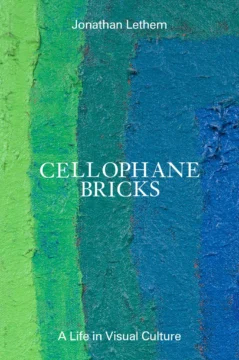 JONATHAN LETHEM is perhaps best known as a writer of pastiche-driven, omnidirectionally intelligent fiction. His novels include a Chandler-inspired detective story (Gun, with Occasional Music), an academic satire (As She Climbed Across the Table), and a work of entrancing social realism (Fortress of Solitude). His latest book, Cellophane Bricks, arrives at genre-mixing fiction via a slightly different angle. Modestly subtitled “A Life in Visual Culture,” the work is a multivalent, multiform achievement: a portrait of the writer as a young artist, a valentine to Lethem’s artist father, an Aladdin’s cave of allusions. Many of the pieces in the collection were occasioned by artists inviting Lethem to write something to accompany their art or exhibitions. He adhered to a personal rule of responding to these requests with stories, with “scenes and situations and voices, characters and set pieces, sprung from my response to the art.” “Sprung” is key here: There’s a sense, throughout the book, of Lethem cutting his own desire path away from traditional/scholarly approaches to art writing, crafting scenes and situations swagged with idiosyncrasy and refreshingly unburdened by what Nietzsche called a “columbarium of concepts.”
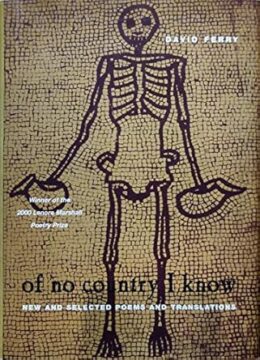 I first read “Johnson on Pope” by David Ferry in his 1960 first book, On the Way to the Island. I felt immediately that I had learned something about the art of poetry. Ferry’s poem demonstrated the crucial difference between prose and poetry as vocal: a matter of sound. That limited, technical point had its power.
 Because of their tremendous impact in shaping our collective human story, figuring out when, why and how horses became domesticated is a key step toward understanding the world we live in now.
 I am not a Wikipedian. I’m an observer. And what I observe is that hardcore Wikipedians – the sort of people who spend their precious summer holidays attending a conference of Wikipedians — are some of the loveliest people I’ve ever met. Which really isn’t a surprise. After all, these are people who spend enormous amounts of spare time researching, editing, discussing, organizing, working on IT, resolving disputes, and doing the many other tasks required to build and run Wikipedia. And they do it all for free. They don’t even get so much as a byline. Or a “thanks” from the billions of people – yes, billions – who benefit from their labours. Their motivations? It’s mostly curiosity, generosity, and community. These are people who absolutely love finding and sharing knowledge. In a word, these people are nerds. I adore them.
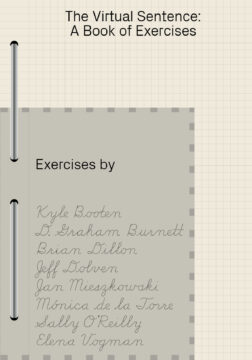 The Virtual Sentence is an exercise book for the era of ChatGPT. Its title is indebted to Gilles Deleuze, who uses “virtual” to name a reality that is neither actual (already here), nor potential (not yet here). Said of the sentence, the term points to the articulate alternatives that surround what gets spoken out loud or committed to ink and pixel. This is neither the total space of linguistic possibility, nor the particulars of what you might have said, considered afterward in a spirit of regret, or relief. In other words, the virtual sentence is not concerned with the before or with the after. Rather, it is what you might be saying, even as you say what you actually say, and what you might be hearing, even as you hear what you actually hear—a “might” that is in fact simultaneous with sentence making, surrounding it and making it meaningful. The virtual sentence inhabits a space defined by a kind of immanent syntactic and lexical alterity. What might be otherwise is already there.
 T
T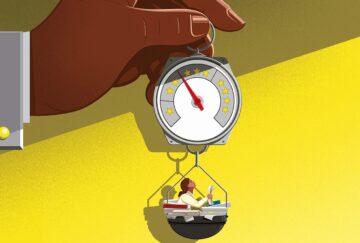 The term ‘REF-able’ is now in common usage in UK universities. “Everyone’s constantly thinking of research in terms of ‘REF-able’ outputs, in terms of ‘REF-able’ impact,” says Richard Watermeyer, a sociologist at the University of Bristol, UK. He is referring to the UK Research Excellence Framework (REF), which is meant to happen every seven years and is one of the most intensive systems of academic evaluation in any country. “Its influence is ubiquitous — you can’t escape it,” says Watermeyer. But he and other scholars around the world are concerned about the effects of an extreme audit culture in higher education, one in which researchers’ productivity is continually measured and, in the case of the REF, directly tied to research funding for institutions. Critics say that such systems are having a detrimental effect on staff and, in some cases, are damaging researchers’ mental health and departmental collegiality.
 J
J The central gag of Slough House, the organization, is that the worst spies in London have been thrown together in one building and punished with terrible, useless jobs. When MI5 rookie River Cartwright is sent to Slough House, for example, he’s put to work sorting through garbage he steals from bins. When he asks Jackson Lamb, his boss, what he’s meant to be looking for, Lamb cracks, “The remnants of a once promising career.”