Why Has Obama Pardoned So Few Prisoners?

Official_portrait_of_Barack_Obama

Sasha Abramsky in The Nation:

While in the White House, Bill Clinton pardoned well over 100 people. So did President Bush. To date, Obama has pardoned less than two dozen and commuted even fewer sentences. His first commutation wasn’t until late November 2011, when, according to CBS News, he ordered the release of a woman who had served ten years of a twenty-two-year sentence for cocaine distribution. CBS reported that “the latest numbers from the US Pardon Attorney show that since taking office Obama has denied 872 applications for pardons and 3,104 for commutations of sentence.” A year later, ThinkProgress reported that the only presidential pardon granted in 2012 was for the lucky turkey, as part of the Thanksgiving tradition.

A president who talks the talk about more sensible, nuanced drug policy, and whose oratory frequently invokes what is best in the American political imagination, has shown himself remarkably reluctant to use one of the most important of presidential prerogatives—the power to right judicial wrongs. “This president,” says Anderson, “has been unbelievably timid and disinclined to do justice in cases that scream out for commutation. There’s not a lot of moral or political fortitude in play.”

On January 5, The New York Times ran an editorial calling on the president to exercise his pardon power—while also pointing out that the Justice Department, too, “has undermined the process with huge backlogs and delays, and sometimes views pardons as an affront to federal efforts to fight crime.” The Times also blamed Ronald Rodgers, the lawyer who runs the Office of the Pardon Attorney and has obstructed the process, and argued that his office should be replaced with “a new bipartisan commission under the White House’s aegis, giving it ample resources and real independence.”


against the web

Spy-Jaron-Lanier-631

I couldn’t help thinking of John Le Carré’s spy novels as I awaited my rendezvous with Jaron Lanier in a corner of the lobby of the stylish W Hotel just off Union Square in Manhattan. Le Carré’s espionage tales, such as The Spy Who Came In From the Cold, are haunted by the spectre of the mole, the defector, the double agent, who, from a position deep inside, turns against the ideology he once professed fealty to. And so it is with Jaron Lanier and the ideology he helped create, Web 2.0 futurism, digital utopianism, which he now calls “digital Maoism,” indicting “internet intellectuals,” accusing giants like Facebook and Google of being “spy agencies.” Lanier was one of the creators of our current digital reality and now he wants to subvert the “hive mind,” as the web world’s been called, before it engulfs us all, destroys political discourse, economic stability, the dignity of personhood and leads to “social catastrophe.” Jaron Lanier is the spy who came in from the cold 2.0.

more from Ron Rosenbaum at The Smithsonian here.

Raphael’s passions

Hall_316944h

Nonetheless, Raphael’s love of art usually came before his love of women. So when in 1814 Ingres painted the first historical genre scene of Raphael with La Fornarina in the studio (during a lunch break at 1.30 pm), she sits fully clothed on his lap, but he keeps hold of his porte-crayon and turns away to look at the underdrawing for her portrait. The implication is that underdrawings are even more interesting than undergarments. Raphael now becomes something very important: a model for the artist whose sexual energies are sublimated in his art. The case was made with typical robustness by Nietzsche in The Will to Power, possibly while looking at a print of Ingres’s painting. He was equally dismissive of the idea that Raphael indulged in casual sex. Great artists have to be physically strong, with plenty of sexual energy – “without a certain overheating of the sexual system a Raphael is unthinkable”. Yet despite the artist’s susceptibility to sensory stimulation and intoxication – “how wise it is at times to be a little tipsy!” – he is usually chaste. His dominant instinct “does not permit him to expend himself in any casual way”.

more from James Hall at the TLS here.

shopping, old school

Rome+shopping

It is often said that shopping in the modern meaning of the word – that familiar combination of economic exchange, voyeurism and leisure pastime – is a relatively recent invention. The English verb ‘to shop’, for example, in the sense of retail activity (rather than its earlier – now slang – meaning of ‘to imprison or inform on someone’), is not attested until the mid-18th century; and the noun ‘shopper’ not until a hundred years after that. But this poem about a ladies’ outing to the shoe emporium seems to show that a very similar kind of activity, with some of the same pleasures, took place in the ancient Mediterranean. In fact it is not so different from another (fictional) shopping trip, more than two thousand years later, also in Alexandria. In the middle of Evelyn Waugh’s Officers and Gentlemen, Mrs Stitch goes off to the bazaar with Guy Crouchback, visits the shoemaker’s shop, is given a stool to sit on, listens to the sales pitch while she inspects the stock – and then goes away, the proud possessor of a lovely pair of crimson slippers.

more from Mary Beard at the LRB here.

Confessions of an analyst

Stephen Grosz in The Telegraph:

FreudHI1_2444641bI want to tell you a story about a patient who shocked me.

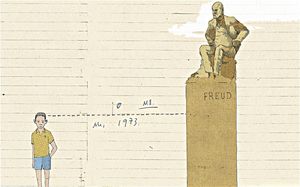
When I was first starting out as a psychoanalyst, I rented a small consulting room in Hampstead, on a wide leafy street called Fitzjohns Avenue. It was near a number of well-known psychoanalytic clinics and a few minutes’ walk from the Freud Museum. At the south end of Fitzjohns Avenue, there is a large bronze statue of Freud. My consulting room was quiet and spare. There was a desk just large enough for writing up notes and preparing my monthly bills, but no bookshelves or files – the room wasn’t for reading or research. As in most consulting rooms, the couch wasn’t a couch, but a firm single bed with a dark fitted cover. At the head of the bed was a goose-down cushion, and on top of that a white linen napkin that I changed between patients. The psychoanalyst who rented the room to me had hung one piece of African folk art on the walls many years before. She still used the room in the mornings, and I used it in the afternoons. For that reason it was impersonal, ascetic even. I was working part-time at the Portman Clinic, a forensic outpatient service. In general, patients referred to the Portman had broken the law; some had committed violent or sexual crimes. I saw patients of all ages and I wrote quite a few court reports. At the same time, I was building up my private practice. My plan was to reserve my mornings for clinic work; in the afternoons I hoped to see private patients who had less extreme or pressing problems.

More here.

Drug-resistant melanoma tumors shrink when therapy is interrupted

From PhysOrg:

DrugresistanResearchers in California and Switzerland have discovered that melanomas that develop resistance to the anti-cancer drug vemurafenib (marketed as Zelboraf), also develop addiction to the drug, an observation that may have important implications for the lives of patients with late-stage disease. The team, based at the University of California, San Francisco (UCSF), the Novartis Institutes for Biomedical Research (NIBR) in Emeryville, Calif., and University Hospital Zurich, found that one mechanism by which melanoma cells become resistant to vemurafenib also renders them “addicted” to the drug. As a result, the melanoma cells nefariously use vemurafenib to spur the growth of rapidly progressing, deadly and drug-resistant tumors.

As described this week in the journal Nature, the team built upon this basic discovery and showed that adjusting the dosing of the drug and introducing an on-again, off-again treatment schedule prolonged the life of mice with melanoma. “Remarkably, intermittent dosing with vemurafenib prolonged the lives of mice with drug-resistant melanoma tumors,” said co-lead researcher Martin McMahon, PhD, the Efim Guzik Distinguished Professor of Cancer Biology in the UCSF Helen Diller Family Comprehensive Cancer Center. It is therefore possible that a similar approach may extend the effectiveness of the drug for people – an idea that awaits testing in clinical trials.

More here.

Thursday Poem

Bullet

I have a bullet made of icy silver to give you.

I prepared it last night with dirty, sweet, infallible blood. I prayed
with it for hours. I attended it with candles and the most secret
invocations.

First off, I blinded it, because a bullet must never see the ominous air
or the body it will encounter. After, I deafened it, so that it wouldn’t
hear the cries or threats or music of the flesh and bones while shattering.

I only left its lips so it could whistle.

Understand what I say:

whistles are bullets’ words: they are their ruthless final kisses piercing
the smoothness of the night; their wonder and their plea, their breath.

by Carlos López Degregori
translation 2010, Robin Myers
publisher: PIW, 2010


Read more »

Wednesday, January 9, 2013

Wednesday Poem

My Money

My money is beautiful.
Like having a flower, a tree, the sky,
‘Gioconda’,
These are beautiful things,
But my money is beautiful, too.
It lies in my pocket and I can touch it –
It’s little and much loved.
It’s so enchanting without being coy,
I can show it to you again and again,
And I can fix it to my buttonhole like a tulip.

My money,
My money . . .

This is a colourful performance,
This is a poor decoration,
This the shiny skin of non-existence.

I will wave it and enter into existence,
where there is a flower, a tree, the sky,
‘Gioconda’.

I shall enter.
I shall enter.

A ticket for me,
And a ticket for you – be my guest.

You know, life is beautiful,
If you attain it with beautiful money.

When I become an old man,
I think I shall give my beautiful money
To the museum of life
As a permanent exhibit.

People will come and enjoy
Looking at my beautiful money.

They will stand there for a long time, excited,
Then they will go home and think about it,
What’s good about it,
When you have a beautiful life,
A beautiful house,
A beautiful poem.

They will think about it,
What’s good about it,
When your money is as beautiful
As your pregnant wife.
.

by Shota Iatashvili
from pankari tsasji (‘Pencil in the Air ’)
publisher: Caucasian House, Tbilisi, 2004
translation: 2007, Donald Rayfield


The Self in Self-Help

From New York Magazine:

Selfhelp130107_schulz_560In The Age of Anxiety, W.H. Auden observed that we human beings never become something without pretending to be it first. The corollary is more prosaic but, regrettably, at least as true: We humans never become most of the things we pretend we will someday be. Nevertheless, last Monday, you and I and several billion other incorrigible optimists raised our glasses and toasted all the ways we will be different in 2013.

It’s easy to understand why we want to be different. We are twenty pounds overweight; we are $20,000 in debt; we can’t believe we slept with that guy; we can’t believe we didn’t. What’s harder to understand is why transforming ourselves is so difficult. Changing other people is notoriously hard; the prevailing wisdom on that one is Don’t hold your breath. But it’s not obvious why changing oneself should present any difficulty at all. And yet, demonstrably, it does. The noted self-help guru Saint Augustine identified this problem back in the fourth century A.D. In his Confessions, he records an observation: “The mind gives an order to the body and is at once obeyed, but when it gives an order to itself, it is resisted.” I cannot improve upon Augustine’s insight, but I can update his examples. Say you want to be skinny. You’ve signed on with Weight Watchers, taken up Zumba, read everything from Michael Pollan to French Women Don’t Get Fat, and scrupulously recorded your every workout, footstep, and calorie on your iPhone. So whence the impulsive Oreo binge? Or say you are a self-identified co-dependent. You know your Melody ­Beattie, listen to your therapist, and tell yourself every morning, quite firmly, just what you will and will not do that night. So what are you doing back in bed with that man? Or say you are a professional writer who values being conscientious, respects her editors, and passionately believes that good writing requires time. So—well, let’s drop the pretense. Why am I sitting here typing this at 4 a.m., two days past deadline?

I don’t know, but misery loves company, and such acts of auto-insubordination happen all the time.

More here. (Note: Thanks to Ruchira Paul)

Are Babies Born Good?

From Smithsonian:

Born-to-Be-Mild-angel-devil-631Arber Tasimi is a 23-year-old researcher at Yale University’s Infant Cognition Center, where he studies the moral inclinations of babies—how the littlest children understand right and wrong, before language and culture exert their deep influence.“What are we at our core, before anything, before everything?” he asks. His experiments draw on the work of Jean Piaget, Noam Chomsky, his own undergraduate thesis at the University of Pennsylvania and what happened to him in New Haven, Connecticut, one Friday night last February. It was about 9:45 p.m., and Tasimi and a friend were strolling home from dinner at Buffalo Wild Wings. Just a few hundred feet from his apartment building, he passed a group of young men in jeans and hoodies. Tasimi barely noticed them, until one landed a punch to the back of his head. There was no time to run. The teenagers, ignoring his friend, wordlessly surrounded Tasimi, who had crumpled to the brick sidewalk. “It was seven guys versus one aspiring PhD,” he remembers. “I started counting punches, one, two, three, four, five, six, seven. Somewhere along the way, a knife came out.” The blade slashed through his winter coat, just missing his skin. At last the attackers ran, leaving Tasimi prone and weeping on the sidewalk, his left arm broken. Police later said he was likely the random victim of a gang initiation. After surgeons inserted a metal rod in his arm, Tasimi moved back home with his parents in Waterbury, Conn­­ecticut, about 35 minutes from New Haven, and became a creature much like the babies whose social lives he studies. He couldn’t shower on his own. His mom washed him and tied his shoes. His sister cut his meat.

Spring came. One beautiful afternoon, the temperature soared into the 70s and Tasimi, whose purple and yellow bruises were still healing, worked up the courage to stroll outside by himself for the first time. He went for a walk on a nearby jogging trail. He tried not to notice the two teenagers who seemed to be following him. “Stop ca­tastrophizing,” he told himself again and again, up until the moment the boys demanded his headphones. The mugging wasn’t violent but it broke his spirit. Now the whole world seemed menacing. When he at last resumed his morality studies at the Infant Cognition Center, he parked his car on the street, feeding the meter every few hours rather than risking a shadowy parking garage. “I’ve never been this low in life,” he told me when we first met at the baby lab a few weeks after the second crime.

“You can’t help wonder: Are we a failed species?”

More here.

Tuesday, January 8, 2013

The Psychoanalysis of Ruins

Ruins2

Dylan Trigg in 3:AM Magazine:

Freudianism is an explicit and thematized archaeology.
– Ricoeur, Freud and Philosophy

Time Out of Joint
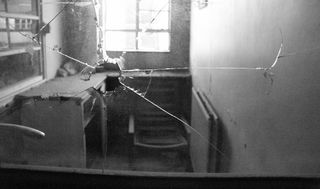
How does a ruin — be it the remains of an industrial factory or the relic of an ancient civilization — fit into the landscape of a city? Beyond its warped mass of broken materiality, a ruin is also a disordering of time. It maligns time, dissolving boundaries between past and present. The question is not where the ruin is located, but when? Not in the present, but neither in the past. Time out of joint, to invoke the spectre of Hamlet.

More than this, the ruin undercuts our attachment to places. If there is sometimes a tendency to become overly attached to our little corner in the world, then where that corner is a ruin, such attachment is overrun by constant change. Becoming overly attached to one’s favourite ruin is likely to result in heartbreak. Impossible, after all, to become nostalgic about something that resists a fixed identity. No matter how much we want the ruin to testify to a past of our own — to be one’s own ruin — in the glance of an eye, it assumes a different past, and wholly disconnected to the one we may have incorporated as our own.

Ruins return. This is one of the great surprises that the ruin presents to us: its persistence in time alongside its disordering of time. Far from the waste matter of culture, the ruin always resists repression, finding ways to fend off the very decay that constitutes the ruin in the first instance.

No wonder, then, given this complex structure that Freud elected the ruin to the principle metaphor not only for the practice of psychoanalysis but also for the mind itself. In the archaeological excavation of the ruin, Freud found the means to articulate a set of themes central to his thinking as a whole, not least the very preservation of the past in the mind.

Why the image of the ruin? What can it tell us about psychoanalysis — and equally, what can psychoanalysis tell us about ruins? And moreover, if Freud’s concern is with the ruins of classical Rome and Athens, then how can psychoanalysis contend with the contemporary ruins of Detroit and Chernobyl?

Snap Goes the Crocodile

Akhmedova_2_468w

Marina Akhmedova in Eurozine:

On 28 July, “Crocodile”, my reportage on life inside a drug den in provincial Russia, was published in the Russian magazine, Russky reporter. Three days later, Roskomdadzor, the Russian media regulator issued an official warning against the publisher for so-called promotion of narcotics, and demanded that my article be pulled from the magazine's website. The warning mentioned the fact that the piece contained information about how to prepare “crocodile”, i.e. desomorphine, a hard drug produced using everyday medicines and now increasingly popular within Russia.

All I can say is the following: if these same officials had undertaken some basic research, they would understand that preparing “crocodile” is, in fact, a very complicated process, and one that cannot be mastered from a few short sentences. Even after long periods of addiction, not every drug user is able to prepare it (indeed, those who can't are expected to buy all the ingredients and share the dose out among those present in the kitchen). I included such details in my article only as background in an attempt to create an atmosphere faithful to what I saw.

On Theory And Finance: Review Of Berardi’s “The Uprising”

OCC_1

Jonathon Kyle Sturgeon in The American Reader:

Franco “Bifo” Berardi’s newly translated book The Uprising: On Poetry and Financeis light on two things: poetry and finance. What Berardi gives the reader instead is a poetics loaded with quasi-literary keywords and bits of post-Marxist critique, a poetics that is semiotized and Search Engine Optimized for the reader of contemporary theory. If we were to give this poetics a name, we might call it reverse symbolism, for Berardi means quite literally to reverse the project of symbolist poetry, or what he calls “the main thread of twentieth century poetic research.” The symbolist culprit, the moving target of Berardi’s reversionism, is what he calls the “dereferentialization” of language, the tearing apart of the signifier and the referent. To put this in another way, The Uprising argues that symbolist experiments with language in the early twentieth century have found their deepest expression in our current predicament. We now find ourselves in the throes of a symbolist “semio-capitalism” where the word and the world are no longer linked together in meaning.

Semio-capitalism is a portable concept; it is easy to pack and travels light. In parable form, it goes something like this:

Financialization and the virtualization of human communication
are obviously intertwined: thanks to the digitization of exchanges,
finance has turned into a social virus that is spreading everywhere,
transforming things into symbols. The symbolic spiral of financialization
is sucking down and swallowing up the world of physical things, of
concrete skills and knowledge. The concrete wealth of Europeans is
vanishing into a black hole of pure financial destruction.

Now, I’ve never seen a symbol “suck down” or “swallow up” anything—including matter, skills, and knowledge—but Berardi does tie another knot between symbolist poetry and finance: deregulation. Citing Rimbaud’s phrase “dérèglement des sens et des mot,” Berardi, through sleight of hand, hitches the symbolist (or proto-symbolist) “deregulation (or derangement) of the senses and the word” to the economic project of financial deregulation that took place throughout the 1980s, 1990s, and 2000s in Europe and America. The idea is that symbolism “deregulated” language by divorcing it from the world in much the same way that financial deregulation led to a disconnect between financial instruments and the value of labor.

Cairo Vision 2050

Cairo_deknatel_ftr

In Cairo, there is a street named after the Arab League. It’s a grand boulevard that cuts through Mohandiseen, a neighborhood built in the 1950s to house engineers and other civil servants, whose ranks swelled during the 1960s with the guarantee of employment under the state socialism of President Gamal Abdel Nasser. These days, the boulevard is lined with luxury car showrooms, drab mid-rises and fast-food chains, all forming the commercial spine of an upscale area too expensive for most clerks and bureaucrats. Last December, on one of the quiet streets that radiates off the boulevard, I visited the office of an architect named Dina Shehayeb. A professor at the Housing and Building National Research Center in Cairo, Shehayeb also runs her own firm, which focuses on community-based development and the revitalization of historic areas. The deadly street battles of late November between the police and unarmed protesters on Mohamed Mahmoud Street near Tahrir Square had ended, and the attacks on protesters by military police outside the People’s Assembly near Tahrir were a week away. Cairo was relatively calm. But in her office, Shehayeb spoke heatedly of a city transformed during the reign of the recently deposed president, Hosni Mubarak.

more from Frederick Deknatel at The Nation here.

I’m wired up, baby

Cn_image.size.quantified-self-wolcott

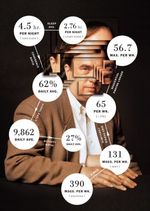
Along with my digital wristbands, I am packing an emWave2 pocket-size Personal Stress Reliever, which, through an earlobe attachment or thumb sensor, measures heart-rate variability (H.R.V.) and doubles as a biofeedback meditation assistant. By breathing in unison with a climbing and descending column of illuminated beads and thinking happy thoughts of ballerinas, I seek to raise my coherence level from red (low) to blue (medium) to green (high), achieving a steady-state flow of relaxed awareness that will undulate through the day, until somebody annoying calls. It’s like a mood ring for the heart. I practice with the emWave2 five minutes at a stretch, because any longer than that and its beeps begin to bug me and drop me into the red zone, which defeats the purpose. On sunny days I dude myself out with a pair of Pivothead sunglasses, which have a spy camera dead center in the nose bridge that can take multiple shots at sequential intervals. Another technological advance in voyeurism, perhaps, but I didn’t purchase them with pervy intent, honest, Officer. Ever since I read Gordon Bell and Jim Gemmell’s Total Recall: How the E-Memory Revolution Will Change Everything (later reissued as Your Life, Uploaded, perhaps so as not to be mistaken for the Arnold Schwarzenegger film), I’ve been intrigued with the notion of digitizing life into a present-tense documentary, a first-person narrative capturing and preserving events as they unfold and filing them away as visual evidence rather than putting them through the filtration process of the brain, where they survive as scraps and scratchy flashbacks of unreliable memory.

more from James Wolcott at Vanity Fair here.

changed by pots

Waal_12_12

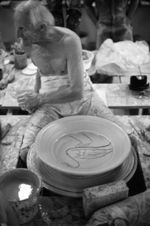
There is an image of the potter Michael Cardew in old age, almost as wrinkled as Auden, gaunt and with sunken cheeks, dressed in a medieval-looking shirt with cut-off arms, wearing shorts, throwing a pot on a kick-wheel. He has wet clay plastered up his arms, and his hands are in mid-flight and are as wild as any conductor’s. He is surrounded by young students and he looks completely and utterly enthused, in the grip of the compulsion to make and talk and inspire. The photograph seems to suggest that making a pot is simply not enough – discipleship is called for. In Tanya Harrod’s magnificent biography of Cardew she traces his complicated trajectory from the romantic attempt to revive a folk-tradition of country pottery in the Cotswolds through his 25 years of experiment in West Africa to his later life as counter-cultural seer in Cornwall. The people who fell into his orbit were rarely unchanged by his charisma, the fierceness of his arguments, or, indeed, by his pots.

more from Edmund de Waal at Literary Review here.

Wodehouse and Fitzgerald – emblems of a lost age

From The Guardian:

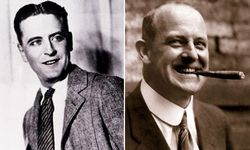
F-Scott-Fitzgerald-and-PG-007English literature is full of likely encounters one would love to know more about. Marlowe bumping into Shakespeare, perhaps, or Oscar Wilde at dinner with Henry James. In the department of lost meetings, one near-miss that's always fascinated me is the on-off friendship between F Scott Fitzgerald and PG Wodehouse, both of whom came to prominence in America at the end of the Great War. Wodehouse shared a literary agent (Paul Reynolds) with Fitzgerald, a connection that strengthened when Wodehouse moved to Great Neck on Long Island in 1923. At that point the author of post-war bestseller The Inimitable Jeeves was riding high on Broadway. Indeed, if he had been run over by a bus in the 1920s (he was, in fact, knocked down by a car but remained miraculously unscathed), he would have been noted as much for his musical lyrics as for Bertie Wooster, or indeed for Lord Emsworth and the Empress of Blandings. Fitzgerald was out there in Great Neck, too, riding high on the success of This Side of Paradise (1920) and The Beautiful and Damned (1922), and beginning to work on his masterpiece, The Great Gatsby, a novel set in Manhattan and Long Island.

We know the two men met, but that's about it. Wodehouse writes to his daughter Leonora about seeing “Scott” on the train to the city: “I believe those stories you hear about his drinking are exaggerated,” he wrote. “He [FSF] seems quite normal, and is a very nice chap indeed. You would like him. The only thing is, he does go into New York with a scrubby chin, looking perfectly foul. I suppose he gets a shave when he arrives there, but it doesn't show him at his best in Great Neck. I would like to see more of him.” And there, tantalisingly, the scene fades. If they did “see more” of each other, Wodehouse does not mention it. All we know is that, towards the end of his life, Wodehouse occasionally wrote about Fitzgerald's work, in rather disparaging terms, I regret to say. Certainly, he never vouchsafed any biographical snippet to interest posterity. Too bad. Now, almost a hundred years later, the respective worlds of Wodehouse and Fitzgerald are coming back into view with the imminent launch of the BBC TV series, Blandings, and the forthcoming spring premiere of Baz Luhrmann's re-make of The Great Gatsby. Each, in different ways, represent archetypal visions of Britain and America.

More here.

The Long Life of the ‘Perfect’ Woman

Pam Belluck in The New York Times:

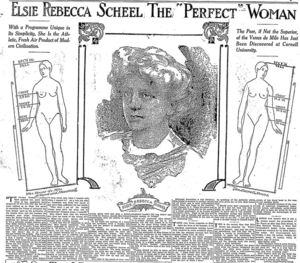
ElsieWhat did happen to Elsie Scheel, the “perfect” woman mentioned in an article in Wednesday’s New York Times that described how people considered overweight had a slightly lower risk of dying than those of normal weight? A century ago, at age 24, Miss Scheel was the subject of a spate of news media coverage after the “medical examiner of the 400 ‘co-eds’ ” at her college, Cornell University, described her as the epitome of “perfect health,” according to a 1912 New York Times article. That article and others also gave her dimensions: 5-foot-7 and 171 pounds, which would have corresponded to a body mass index of 27, putting Miss Scheel in the overweight category. Miss Scheel, it turns out, lived a long life, dying in 1979 in St. Cloud, Fla., three days shy of her 91st birthday. But though it may be tempting to conclude that Miss Scheel’s longevity exemplifies the benefits of a not-too-low B.M.I, her case is only one anecdote, of course. And, according to family members and to hints provided in early articles, she was a person who valued being active and athletic, had a strong and confident attitude, and, as a daughter of a doctor and a mother of a doctor, may have been steeped in healthy habits that were much more relevant to her survival than her weight.

“She never took an aspirin or a Tylenol,” a granddaughter, Karen Hirsh Meredith, of Broken Arrow, Okla., said in an interview Wednesday. She kept up hobbies like stamp collecting and wrote pieces for the St. Cloud newspaper. And, Ms. Meredith said, “she was still driving late in life.” Ms. Meredith said she did not recall her grandmother having any illnesses or being hospitalized except for shortly before she died, when she went into the hospital with stomach pain. She ended up having surgery for a perforated bowel and died the next day, Ms. Meredith said. A death notice said Miss Scheel, who was Mrs. Hirsh when she died, had been a “practical nurse,” although Ms. Meredith said the family believed she did not work after she had children. In 1918 she married Frederick Rudolph Hirsh, an architect who supervised the building of the New York Public Library and who was a widower with two children, Frederick Jr. and Mary. He died in 1933 at 68, leaving his wife to raise a son, John, and a daughter, Elise. She moved to Florida from Mount Vernon, N.Y., in the 1940s and never remarried. Miss Scheel’s mother, Sophie Bade Scheel, a physician educated at New York Medical College, maintained an active medical practice at a time when relatively few women did. And Miss Scheel may have benefited from good genes: her three siblings were 79, 88 and 93 when they died. Published reports from 1912 and 1913 provide glimpses of the type of person Miss Scheel was and of her immediate-post-“perfect” experience.

More here.

Tuesday Poem

How the Stone Found Its Voice
.
We had waited through so many lifetimes
for the stone to speak, wondered if

it would make compelling pronouncements,
anything worth writing down.

Then after the war of wars
had ground to a shattering halt, the stone

emitted a small grinding sound rather like
the clearing of a throat.

Let us be indifferent to indifference,
the stone said.

And then the world spoke.
.

by Moniza Alvi
from How the Stone Found Its Voice
publisher: Bloodaxe, Tarset, 2005