Women cause a species to become endangered

Jason Gale & Shannon Pettypiece at Bloomberg:

ScreenHunter_103 Jan. 15 14.15Pubic lice, the crab-shaped insects that have dwelled in human groins since the beginning of history, are disappearing. Doctors say bikini waxing may be the reason.

Waning infestations of the bloodsuckers have been linked by doctors to pubic depilation, especially a technique popularized in the 1990s by a Manhattan salon run by seven Brazilian sisters. More than 80 percent of college students in the U.S. remove all or some of their pubic hair — part of a trend that’s increasing in western countries. In Australia, Sydney’s main sexual health clinic hasn’t seen a woman with pubic lice since 2008 and male cases have fallen 80 percent from about 100 a decade ago.

“It used to be extremely common; it’s now rarely seen,” said Basil Donovan, head of sexual health at the University of New South Wales’s Kirby Institute and a physician at the Sydney Sexual Health Centre. “Without doubt, it’s better grooming.”

The trend suggests an alternative way of stemming one of the globe’s most contagious sexually transmitted infections. Pubic lice are usually treated with topical insecticides, which once included toxic ones developed before and during World War 2. While they aren’t known to spread disease, itchy skin reactions and subsequent infections make pubic lice a hazardous pest.

More here.

No, Seriously, Just Disable Java in Your Browser Right Now

NOTE: I have already acted on this advice.

Will Oremus in Slate:

Important_web_design2So while many media reports will direct you to the Oracle website to promptly install Java 7 update 11, there remains a far better option. Unless you’re one of the few Web users who regularly uses an important site that requires Java, take the advice of security experts like Adam Gowdiak of Security Explorations and H.D. Moore of Rapid7 and just disable it in your browser already.

As noted before, disabling the Java plug-in on your Web browser doesn’t require uninstalling it from your machine entirely, and it won’t prevent you from Java-based software outside of your Web browser. It just means that you’ll see an image like the screenshot above when you happen to visit one of the relatively few remaining websites that use Java applets. If you find you really need it for some sites, you can always disable it in your main browser but keep it enabled in a secondary browser that you use just for those sites.

Basic instructions for unplugging Java from your browser are below, and more comprehensive how-tos are available here and here. Note: Do not confuse Java with Javascript, which is unrelated and is essential to the proper functioning of far more websites. Disable Java, but leave Javascript enabled. If you have more questions, the blog Krebs on Security has an excellent FAQ here. (No, you aren’t necessarily safe just because you don’t visit sketchy websites, or because you’re using Linux or a Mac.)

More here.

Tuesday Poem

Silence
.
There is the sudden silence of the crowd
above a player not moving on the field,
and the silence of the orchid.
.
The silence of the falling vase
before it strikes the floor,
the silence of the belt when it is not striking the child.
.
The stillness of the cup and the water in it,
the silence of the moon
and the quiet of the day far from the roar of the sun.
.
The silence when I hold you to my chest,
the silence of the window above us,
and the silence when you rise and turn away.
.
And there is the silence of this morning
which I have broken with my pen,
a silence that had piled up all night
.
like snow falling in the darkness of the house—
the silence before I wrote a word
and the poorer silence now.
.
by Billy Collins

Rich Man, Poor Man: The radical visions of St. Francis

From The New Yorker:

Francis“Why you?” a man asked Francesco di Bernardone, known to us now as St. Francis of Assisi. Francis (1181/2-1226) was scrawny and plain-looking. He wore a filthy tunic, with a piece of rope as a belt, and no shoes. While preaching, he often would dance, weep, make animal sounds, strip to his underwear, or play the zither. His black eyes sparkled. Many people regarded him as mad, or dangerous. They threw dirt at him. Women locked themselves in their houses. Francis accepted all this serenely, and the qualities that at the beginning had marked him as an eccentric eventually made him seem holy. His words, one writer said, were “soothing, burning, and penetrating.” He had a way of “making his whole body a tongue.” Now, when he arrived in a town, church bells rang. People stole the water in which he had washed his feet; it was said to cure sick cows.

Years before he died, Francis was considered a saint, and in eight centuries he has lost none of his prestige. Apart from the Virgin Mary, he is the best known and the most honored of Catholic saints. In 1986, when Pope John Paul II organized a conference of world religious leaders to promote peace, he held it in Assisi. Francis is especially loved by partisans of leftist causes: the animal-rights movement, feminism, ecology, vegetarianism (though he was not a vegetarian). But you don’t have to be on the left to love Francis. He is the patron saint (with Catherine and Bernardino of Siena) of the nation of Italy.

More here.

Birds of a Feather

From Smithsonian:

Chris Maynard is obsessed with feathers. The artist, based in Olympia, Wash., thinks feathers show “life’s perfection,” in the way that they overlap and contour to a bird’s body. “Their complexity as a covering beats any clothing we make,” he writes on his Web site. Going back a few years, Maynard started by photographing feathers. Then, he arranged them in shadow boxes. But, in his experiments in showcasing feathers, Maynard eventually came up with his own unique art form. The artist creates fascinating, feather-light sculptures, by cutting the silhouettes of various types of birds from actual plumage.

Maynard collects molted feathers from generous zoos, private aviaries and nonprofit bird rescue organizations. “Sometimes finding the right feather is the hard part,” he says. The artist may go into a design with a particular color or size of feather in mind. He uses pheasant and parrot feathers mostly, and, from them, he has cut out a whole slew of birds—hummingbirds, woodpeckers, cranes, swans, cockatoos, macaws, peacocks, turkeys, grouse, bitterns, crows and pigeons. Maynard sketches possible designs in notebooks, but to really nail one, he says, “I need to have a feeling about the bird I am portraying.” Maynard, an active member of his local Audubon group and supporter of a land trust that buys property for conservation, balances work in his studio with quality time in the outdoors. “I go out and observe a woodpecker whacking away at a snag or watch crows relating to each other,” he says. Next comes the cutting. ”When I work, I put on big nerdy magnifying glasses to see the feathers’ details,” Maynard says on his Web site. He also uses fine eye surgery tools he inherited from his father, an ophthalmologist. The scalpels and forceps are not completely foreign to Maynard, whose academic background is in entomology–the study of insects.

More here.

Monday, January 14, 2013

Sunday, January 13, 2013

Will Saudi Arabia Ever Change?

Hugh Eakin in the New York Review of Books:

ScreenHunter_110 Jan. 13 20.17Indeed there are few signs that the Saudi monarchy is even contemplating serious reforms. During a recent visit to several parts of the country, I spoke to academics, journalists, members of the Shia minority, and young bloggers, as well as clerics and government officials, and many were outspoken in criticizing the government; one journalist who had worked for official media told me, within minutes of our acquaintance, “I can’t wait for this regime to collapse!” But almost without exception, no one seemed to think that would happen anytime soon. I asked one prominent women’s rights activist why more Saudis weren’t agitating for a full written constitution—a moderate reform that could provide a more rigorous legal frame for continued Al Saud rule and that was discussed publicly during a brief opening after the September 11 attacks. She replied: “No one’s talking about it anymore. All the constitutional monarchists have been jailed.”

Among the many enigmas about the increasingly elderly group of brothers who have ruled Saudi Arabia since 1953—the year in which their father, Abdul Aziz, the country’s modern founder, died—is how they have continually evaded the forces of change. Despite Saudi control of the largest petroleum reserves in the world, decades of rapid population growth have reduced per capita income to a fraction of that of smaller Persian Gulf neighbors. Even the people of Bahrain, a country with little oil that has roiled with unrest since early 2011, are wealthier. Having nearly doubled in twenty years to 28 million, the Saudi population includes over eight million registered foreign residents, many of them manual laborers or domestic workers. Illegal migrants, who enter on Hajj (pilgrimage) visas, or across the porous Yemeni border, may account for two million more.

With three quarters of its own citizens now under the age of thirty, Saudi Arabia faces many of the same social problems as Egypt and Yemen. By some estimates, nearly 40 percent of Saudis between the ages of twenty and twenty-four are unemployed, and quite apart from al-Qaeda, there is a long and troubled history of directionless young men drawn to radicalism. The country suffers from a housing crisis and chronic inflation, there have been recurring bouts of domestic terrorism, and the outskirts of Riyadh and Jeddah are plagued by poverty, drugs, and street violence—problems that are not acknowledged to exist in the Land of the Two Holy Mosques.

More here.

The Science of Why Comment Trolls Suck

Chris Mooney in Mother Jones:

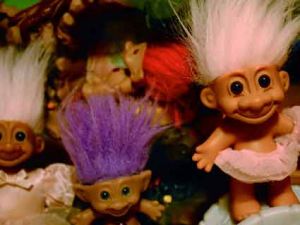
Trolls-masterIn a recent study, a team of researchers from the George Mason University Center for Climate Change Communication and several other institutions employed a survey of 1,183 Americans to get at the negative consequences of vituperative online comments for the public understanding of science. Participants were asked to read a blog post containing a balanced discussion of the risks and benefits of nanotechnology (which is already all around us and supports a $91 billion US industry). The text of the post was the same for all participants, but the tone of the comments varied. Sometimes, they were “civil”—e.g., no name calling or flaming. But sometimes they were more like this: “If you don’t see the benefits of using nanotechnology in these products, you're an idiot.”

The researchers were trying to find out what effect exposure to such rudeness had on public perceptions of nanotech risks. They found that it wasn't a good one. Rather, it polarized the audience: Those who already thought nanorisks were low tended to become more sure of themselves when exposed to name-calling, while those who thought nanorisks are high were more likely to move in their own favored direction. In other words, it appeared that pushing people's emotional buttons, through derogatory comments, made them double down on their preexisting beliefs.

More here.

Happiness is…learning to live with TINA

From Spiked:

The politics of happiness encourages us to accept our lot, breathing life back into the patronising idea that you can be ‘poor but happy’.

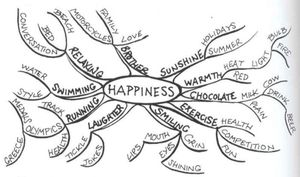
Happiness-mind-map…There are many reasons why happiness, thus conceived, was widely embraced. Most significantly, many implicitly accept Margaret Thatcher’s famous mantra that ‘there is no alternative’ to capitalism (TINA). If we cannot hope to change society in real, material terms, then individual minds and behaviours become some of the few sites open to change. With the political outlook narrowed in this way, ideas like ‘rediscovering happiness’ as the ultimate goal of society can sound radical, utopian even. They also offer a way of bypassing uncertain political identities, connecting with people using the lowest common denominator. After all, who doesn’t want to be happy?

But constructing issues in such broadly agreeable terms makes it difficult to imagine how they might be challenged or opposed. Everyone seemingly agrees that ‘money can’t buy happiness’. The problem with the politics of happiness is that it abstracts this emotion from individual and social experience, and makes it into a flat, measurable policy objective. I have no idea what the future holds, in the same way that no one in 1800, if they had been handed a ‘happiness survey’, would have rated themselves less happy in the expectation of modern innovations like access to electricity. Each generation finds happiness in accordance with the world they take for granted. As a measure of ‘progress’, happiness defaults to an affirmation of the present as the best of all possible worlds.

More here.

Darwin Was Wrong About Dating

Dan Slater in The New York Times:

CoverBUT if evolution didn’t determine human behavior, what did? The most common explanation is the effect of cultural norms. That, for instance, society tends to view promiscuous men as normal and promiscuous women as troubled outliers, or that our “social script” requires men to approach women while the pickier women do the selecting. Over the past decade, sociocultural explanations have gained steam. Take the question of promiscuity. Everyone has always assumed — and early research had shown — that women desired fewer sexual partners over a lifetime than men. But in 2003, two behavioral psychologists, Michele G. Alexander and Terri D. Fisher, published the results of a study that used a “bogus pipeline” — a fake lie detector. When asked about actual sexual partners, rather than just theoretical desires, the participants who were not attached to the fake lie detector displayed typical gender differences. Men reported having had more sexual partners than women. But when participants believed that lies about their sexual history would be revealed by the fake lie detector, gender differences in reported sexual partners vanished. In fact, women reported slightly more sexual partners (a mean of 4.4) than did men (a mean of 4.0).

In 2009, another long-assumed gender difference in mating — that women are choosier than men — also came under siege. In speed dating, as in life, the social norm instructs women to sit in one place, waiting to be approached, while the men rotate tables. But in one study of speed-dating behavior, the evolutionary psychologists Eli J. Finkel and Paul W. Eastwick switched the “rotator” role. The men remained seated and the women rotated. By manipulating this component of the gender script, the researchers discovered that women became less selective — they behaved more like stereotypical men — while men were more selective and behaved more like stereotypical women. The mere act of physically approaching a potential romantic partner, they argued, engendered more favorable assessments of that person.

More here.

Sunday Poem

The Ants

The ants moved into a house
right below ours;
our address did not become theirs:
a sand hill under the floor

The hessian road of the ants
ran from the kitchen cupboards
past the drainpipes, and vice versa
down to their factory shop floors
The stream of workers dressed in
shining black trotted to and fro
in an Asian rhythm

In their footsteps the song of substance
droned, ‘Matter, matter’
– There is nothing but matter
They transported strawberry particles
but dust flecks too and other burdens
to their underground warehouse,
their tinning factory

If I were to fall to pieces
by the kitchen sink,
then they would lift sweet portions of lip;
ant centurions would bear
my no longer functioning eyeball
How the conveyor belt would rattle,
there in the depths

The ants show no mercy
I wouldn’t like to fall down
under the kitchen cupboards
alone with the ants

.
by H.H. ter Balkt
from In de waterwingebieden: gedichten 1953-1999
publisher: De Bezige Bij, Amsterdam, 2000
translation: 2008, Willem Groenewegen

Read more »

Prosecutor as Bully

800px-Aaron_Swartz_2_at_Boston_Wikipedia_Meetup,_2009-08-18_

Larry Lessig has more on Aaron Swartz over at his blog v2 (image from Wikimedia Commons):

The billions of snippets of sadness and bewilderment spinning across the Net confirm who this amazing boy was to all of us. But as I’ve read these aches, there’s one strain I wish we could resist:

Please don’t pathologize this story.

No doubt it is a certain crazy that brings a person as loved as Aaron was loved (and he was surrounded in NY by people who loved him) to do what Aaron did. It angers me that he did what he did. But if we’re going to learn from this, we can’t let slide what brought him here.

First, of course, Aaron brought Aaron here. As I said when I wrote about the case(when obligations required I say something publicly), if what the government alleged was true — and I say “if” because I am not revealing what Aaron said to me then — then what he did was wrong. And if not legally wrong, then at least morally wrong. The causes that Aaron fought for are my causes too. But as much as I respect those who disagree with me about this, these means are not mine.

But all this shows is that if the government proved its case, some punishment was appropriate. So what was that appropriate punishment? Was Aaron a terrorist? Or a cracker trying to profit from stolen goods? Or was this something completely different?

Early on, and to its great credit, JSTOR figured “appropriate” out: They declined to pursue their own action against Aaron, and they asked the government to drop its. MIT, to its great shame, was not as clear, and so the prosecutor had the excuse he needed to continue his war against the “criminal” who we who loved him knew as Aaron.

Here is where we need a better sense of justice, and shame.

Remembering Aaron Swartz

Aaron_Swartz_wmc_img

Aaron Swartz, the activist, programmer and writer, took his own life a couple of days ago. He was the target of a case by the US government, MIT and JSTOR, and was facing possibly decades in prison. (Update: JSTOR was for dropping the case early and had a sense of proportionality, whereas MIT seems to have no such sense. But here is a statement from MIT President L. Rafael Reif indicating that MIT will start an investigation.) Rick Perlstein in The Nation (image via Wikimedia Commons):

I remember a creature who seemed at first almost to be made up of pure data, disembodied—a millionaire, I had to have guessed, given his early success building a company sold to Condé Nast, but one who seemed to live on other people’s couches. (Am I misremebering that someone told me he crashed in his apartment for a while, curling up to sleep under a sink?)

Only slowly, it seems, did he come to learn that he possessed a body. This is my favorite thing he wrote: about the day “I looked up and realized I couldn’t read the street sign. I definitely used to be able to read that sign, but there it was, big and bright and green along the highway, and all I could make out was a blur. I had gone blind.” Legally blind, it turned out; and then when he got contact lenses, he gave us an account of what it felt like to leave Plato’s cave: “I had no idea the world really looked like this, with such infinite clarity. It looks like a modernist photo or a hyperreal film, everything in focus everywhere. Everyone kept saying ‘oh, do you see the leaves now?’ but the first thing I saw was not the leaves but the people. People, individuated, each with brilliant faces and expressions at gaits, the sun streaming down upon them. I couldn’t help but smile. It’s much harder being a misanthrope when you can see people’s faces.”

This man is dead now.

Yes, and not a person of pure data after all. I remember the time, at the height of our friendship, when he announced he was taking a month off from connecting to any computer. I remember him telling me afterward about what it felt like: glorious, radiant, strange, alive, true (he mostly read history books). Dude got to see what it was like outside Plato’s Cave two separate times in his life. How many of us can say that?

More here, here, and here.

Saturday, January 12, 2013

How self-help ate America

Boris Kachka in New York Magazine:

Selfhelp130107_selfhelpbook_560How-to writers are to other writers as frogs are to mammals,” wrote the critic Dwight MacDonald in a 1954 survey of “Howtoism.” “Their books are not born, they are spawned.”

MacDonald began his story by citing a list of 3,500 instructional books. Today, there are at least 45,000 specimens in print of the optimize-everything cult we now call “self-help,” but few of them look anything like those classic step-by-step “howtos,” which MacDonald and his Establishment brethren handled only with bemused disdain. These days, self-help is unembarrassed, out of the bedside drawer and up on the coffee table, wholly transformed from a disreputable publishing category to a category killer, having remade most of nonfiction in its own inspirational image along the way.

Many of the books on Amazon’s current list of “Best Sellers in Self-Help” would have been unrecognizable to MacDonald: Times business reporter Charles Duhigg’s The Power of Habit, a tour of the latest behavioral science; Paulo Coelho’s novel The Alchemist, a fable about an Andalusian shepherd seeking treasure in Egypt; Susan Cain’s Quiet: The Power of Introverts in a World That Can’t Stop Talking, a journalistic paean to reticence; publisher Will Schwalbe’s memoir The End of Your Life Book Club, about reading with his dying mother; and A Child Called “It,” David Pelzer’s recollections of harrowing and vicious child abuse. And these are just the books publishers identify as self-help; other hits are simply labeled “business” or “psychology” or “religion.” “There isn’t even a category officially called ‘self-help,’ ” says William Shinker, publisher of Gotham Books. Shinker discoveredMen Are From Mars, Women Are From Venus and now publishes books on “willpower” and “vulnerability”—“self-help masquerading as ‘big-idea’ books.”

Twenty years ago, when Chicken Soup for the Soul was published, everyone knew where to find it and what it was for. Whatever you thought of self-help—godsend, guilty pleasure, snake oil—the genre was safely contained on one eclectic bookstore shelf. Today, every section of the store (or web page) overflows with instructions, anecdotes, and homilies.

More here.

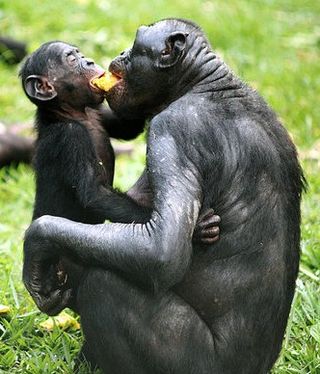
Milk of Human Kindness Also Found in Bonobos

Sindya N. Bhanoo in the New York Times:

ScreenHunter_108 Jan. 13 14.31Bonobos will happily share their food with a stranger, and even give up their own meal — but only if the stranger offers them social interaction, evolutionary anthropologists at Duke University report in the journal PLoS One. The researchers, Jingzhi Tan and Brian Hare, say their findings may shed light on the origins of altruism in humans.

Along with chimpanzees, bonobos are among the closest primates to humans. Chimpanzees, however, do not display similar behavior toward strangers.

“If you only studied chimps you would think that humans evolved this trait of sharing with strangers later,” Mr. Tan said. “But now, given that bonobos do this, one scenario is that the common ancestor of chimps, humans and bonobos had this trait.”

The subjects were all orphaned bonobos at the Lola ya Bonobo sanctuary in the Democratic Republic of Congo. In one phase of the study, bonobos were given a pile of food, then given the opportunity to release a stranger or a group mate (or both) from other rooms.

The bonobos chose to release strangers and share their food. Not only that, but the just-released bonobo would then release the third.

More here.

‘Singing penis’ sets noise record for water insect

Ella Davies at the BBC:

ScreenHunter_107 Jan. 13 14.22A tiny water boatman is the loudest animal on Earth relative to its body size, a study has revealed.

Scientists from France and Scotland recorded the aquatic animal “singing” at up to 99.2 decibels, the equivalent of listening to a loud orchestra play while sitting in the front row.

The insect makes the sound by rubbing its penis against its abdomen in a process known as “stridulation”.

Researchers say the song is a courtship display performed to attract a mate.

Micronecta scholtzi are freshwater insects measuring just 2mm that are common across Europe.

The team of biologists and engineering experts recorded the insects using specialist underwater microphones.

On average, the songs of M. scholtzi reached 78.9 decibels, comparable to a passing freight train.

More here.