edna

EdnaStVincentMillay

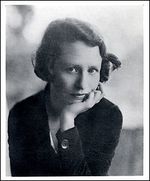
It isn’t easy to even think about Edna St. Vincent Millay’s body of work without also thinking about her—well—actual body. This is entirely her doing. Born in Maine in 1892, she was blessed with not only uncommon genius but the romantic Gibson Girl looks prized by her era—winsome face, comely curves, heavy masses of auburn hair—and she wasn’t afraid to use them. In the spring of 1912, just 20, she put the finishing touches on her epic poem “Renascence” and submitted it to the prestigious Lyric Year poetry contest. When the editor, a man, responded with a letter praising her verse, she replied with a photograph of herself. He asked if he could keep it. Let’s just say Millay placed fourth in the Lyric Year poetry contest but won the war. Published alongside the victors in a commemorative anthology, her poem incited a public sensation that biographer Daniel Mark Epstein ranks on par with that of “The Waste Land” and “Howl”: readers fought the verdict in letters and newspaper columns; the winner recused himself from the awards banquet.

more from Kate Bolick at Poetry here.

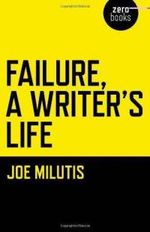
Failure, A Writer’s Life

Failure-writers-life-joe-milutis-paperback-cover-art

Duras writes: “Published literature represents only one percent of what is written in the world. It seems worthwhile to talk about the rest, an abyss, a black night out of which comes that ‘bizarre thing’, literature, and into which almost all of it disappears again without a trace.” I can imagine the whoop of joy Milutis must have hollered when he read the term Duras uses for this Gehenna of ­Letters: “virtual literature”. Failure, A Writer’s Life is a pere­grination through the unpub­lishable, the unreadable, the abandoned, the abortive, the illegible and the indecipherable. He takes in both the esoteric (Charles Fort, HP Lovecraft, the brilliant Christian Bök, who has “written” a poem into the genetic code of a virus) and the canonical (Ernest Hemingway, William Carlos Williams, John Ashbery), as well as digressing to cover photography, film, spam, archives and the nature of the digital text more generally. ­Duras may have imagined her “virtual literature” as a sealed, silent place of the utterly lost; we, nowadays, have her abyss in perpetual, blaring, online Technicolor.

more from Stuart Kelly at The Scotsman here.

Raymond Tallis: Time’s arrow

Raymond Tallis at the website of the Institute of Art and Ideas:

ScreenHunter_118 Feb. 21 12.56While most philosophers of time would be content to abandon the notion that time “flows”, “passes” or “moves”, the idea that time has a “direction” is more adhesive. Insofar as it is a consequence of the conception of time as a fourth dimension on a par with the three of space, it should, like flow , etc be incompatible with it. After all, the spatial dimensions do not have a direction. Collectively the spatial dimensions are the possibility of direction, just as they are the possibility of movement. Clearly, the direction of time – or the possibility of its having a direction – could not be provided by space. It would not make sense to say that time was pointing from left to right or up and down.

But there is something else, which is absolutely central; namely that the unfolding of time appears to be one way. This is in contrast to any direction in space – or any line marking a direction or trajectory in space. The line from A to B is also from B to A; any path going from a lower point to a higher point is also a path going from a higher point to a lower point. The apparent absence of this reversibility is all that there is to the direction of time. The link between earlier time t1 and later time t2 can be traversed in one direction- earlier-to-later – but not in the other direction – later-to-earlier. The path from t1 to t2 is inescapable while the path from t2 to t1 is blocked.

The hunt has therefore been on for something that will give time a direction in this very restricted sense of moving “forward” but not “backward”. This something will account for the difference between time and its spatial companions, a difference that will account for the fact that we can wander at will in space but not in time.

More here.

We Real Cool

A poem by the great Gwendolyn Brooks:

The Pool Players.
BrooksSeven at the Golden Shovel.

We real cool. We
Left school. We

Lurk late. We
Strike straight. We

Sing sin. We
Thin gin. We

Jazz June. We
Die soon.

Q. How about the seven pool players in the poem “We Real Cool”?

A. They have no pretensions to any glamor. They are supposedly dropouts, or at least they're in the poolroom when they should possibly be in school, since they're probably young enough, or at least those I saw were when I looked in a poolroom, and they. . . . First of all, let me tell you how that's supposed to be said, because there's a reason why I set it out as I did. These are people who are essentially saying, “Kilroy is here. We are.” But they're a little uncertain of the strength of their identity.

The “We”—you're supposed to stop after the “We” and think about their validity, and of course there's no way for you to tell whether it should be said softly or not, I suppose, but I say it rather softly because I want to represent their basic uncertainty, which they don't bother to question every day, of course.

Q. Are you saying that the form of this poem, then, was determined by the colloquial rhythm you were trying to catch?

A. No, determined by my feeling about these boys, these young men.

Q. These short lines, then, are your own invention at this point? You don't have any literary model in mind; you're not thinking of Eliot or Pound or anybody in particular . . . ?

A. My gosh, no! I don't even admire Pound, but I do like, for instance, Eliot's “Prufrock” and The Waste Land, “Portrait of a Lady,” and some others of those earlier poems. But nothing of the sort ever entered my mind. When I start writing a poem, I don't think about models or about what anybody else in the world has done.

from “An Interview with Gwendolyn Brooks”.

More here. (Note: At least one daily post throughout February will be devoted to African American History Month)

Thursday Poem

Dawn

It is truly good
to have colors disappear at the end of each day
for me who has a heart so joyfully excited
waiting for them to be born afresh tomorrow morning

My dear one, who has not shown yourself to me
though you are believed to be in this space
That I cannot see you now is also good
for me anxiously waiting for the new morning light –
like I wait for the fir tree, all alone,
to gradually start to glow
casting its shadow like a wingless bird
in the chilly air that allows a faint view of just the curvature of the earth

.
by Kiyoko Nagase
from Bara Shishuh

In Defense of Drones

William Saletan in Slate:

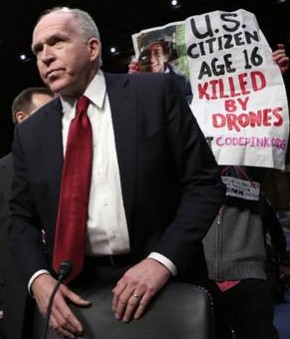
ScreenHunter_117 Feb. 21 12.52UN: Drones killed more Afghan civilians in 2012,” says the Associated Press headline. The article begins: “The number of U.S. drone strikes in Afghanistan jumped 72 percent in 2012, killing at least 16 civilians in a sharp increase from the previous year.” The message seems clear: More Afghans are dying, because drones kill civilians.

Wrong. Drones kill fewer civilians, as a percentage of total fatalities, than any other military weapon. They’re the worst form of warfare in the history of the world, except for all the others.

Start with that U.N. report. Afghan civilian casualties caused by the United States and its allies didn’t go up last year. They fell 46 percent. Specifically, civilian casualties from “aerial attacks” fell 42 percent. Why? Look at the incident featured in the U.N. report (Page 31) as an example of sloppy targeting. “I heard the bombing at approximately 4:00 am,” says an eyewitness. “After we found the dead and injured girls, the jet planes attacked us with heavy machine guns and another woman was killed.”

Jet planes. Machine guns. Bombing. Drones aren’t the problem. Bombs are the problem.

Look at last year’s tally of air missionsin Afghanistan. Drone strikes went way up. According to the U.N. report, drones released 212 more weapons over Afghanistan in 2012 than they did in 2011. Meanwhile, manned airstrikes went down. Result? Fifteen more civilians died in drone strikes, and 124 fewer died in manned aircraft operations. That’s a net saving of 109 lives.

More here.

Your Brain on Klimt

From Columbia Magazine:

In his new book, The Age of Insight, University Professor Eric Kandel explores the interface of art and neuroscience through portraits by three turn-of-the-century Austrian painters.

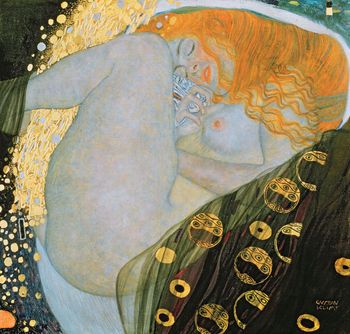
Your-brain-on-klimt-01This cross-pollination of scientific and artistic ideas was carried further by Klimt’s presence in the salon of Berta Zuckerkandl, whose husband, Emil Zuckerkandl, was a great anatomist and pathologist who worked with Rokitansky. Berta was an art historian, an art critic, and an enthusiastic supporter of Klimt. The Zuckerkandls introduced Klimt to biology, and he became fascinated with it. He read Darwin, attended Rokitansky’s lectures and dissections, looked through the microscope, and began to incorporate images of cells and other structures into his paintings. The oval shapes you see as decorative elements in some of the paintings were meant to represent ova, for instance, and rectangular shapes were his symbols for sperm. You see this in his painting The Kiss, and most explicitly in the painting Danaë, wherein Zeus impregnates Danaë in a shower of golden coins. Rectangular symbols indicate that the coins are really sperm. She’s like a reproductive machine; as the viewer moves from the left side of the canvas to the right, Danaë turns the rectangular sperm and circular ova into fertilized embryos, symbolizing conception.

One of the cornerstones of psychoanalytic thought is that the way to explore other people’s unconscious minds is to first explore your own. The Interpretation of Dreams is essentially Freud’s self-analysis. Klimt never painted any self-portraits or even portraits of men. He painted women exclusively.

More here.

Wednesday, February 20, 2013

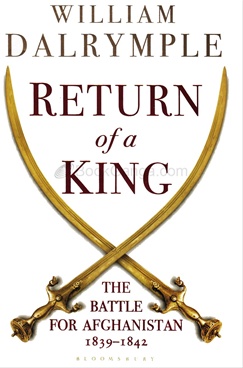
William Dalrymple’s “Return of a King: The Battle for Afghanistan”

Piers Brendon in Literary Review:

16781c6410d94514951f7c0200326604As William Dalrymple shows in this definitive study, Britain's first invasion of Afghanistan in 1839 bore marked resemblances to the war currently being waged in that unforgiving land. Then as now, the conflict was based on 'doctored intelligence about a virtually non-existent threat'. Getting into Afghanistan was relatively easy but the infidel occupation provoked a fierce resistance that made getting out hideously problematic. The same tribal rivalries and alien stupidities bedevilled the campaign. Atrocities occurred on both sides and the cost in blood and treasure was inconceivably greater than any benefit that the invaders might have gained. When the present British forces withdraw, David Cameron will undoubtedly proclaim victory, as the governor-general did in 1842. But, Dalrymple observes, the Herat Museum that displays the detritus of other abortive attempts to subjugate Afghanistan, ranging from Victorian cannon to Soviet helicopter gunships, will undoubtedly be able to add shot-up American Humvees and British Land Rovers to its collection.

Of course, as Dalrymple acknowledges, history does not repeat itself exactly. The first British assault on Afghanistan was unique in important respects, not least in being the opening gambit in the Great Game against Russia – the Lion's century-long struggle to secure India's northwest frontier against the Bear. It is Dalrymple's achievement to elucidate this distinctive initial episode through a treasure trove of original sources.

More here.

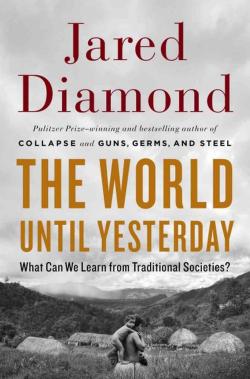
Can You Trust Jared Diamond?

Bryn Williams in Slate:

130212_ARTS_theworlduntilyesterday.jpg.CROP.article250-mediumJared Diamond is a master of cultural and historical bricolage. His books weave epic stories about the human condition from the disparate cultural practices of a wide range of people living in different environments. In his Pulitzer Prize–winning Guns, Germs, and Steel, Diamond used this eclectic empiricism to tell a story about the role of geography in human history. In Collapse, he used the same approach to stage a morality play about the dangers of disregarding those geographic conditions. In his new book, The World Until Yesterday: What Can We Learn from Traditional Societies?, Diamond probes the differences between modern cultures and traditional societies that subsist through hunting and gathering, and he comes to several bold conclusions about their relative merits. His examples are evocative and his narration is powerful, but Diamond ultimately fails to substantiate his arguments. By the end of the book, it is impossible to tell if one has finished reading a masterpiece of rigorous analysis or a masterfully written collection of just-so stories.

Each chapter offers a window into a specific cultural practice. These chapters typically follow this script: He posits a difference between traditional and modern society, cherry-picks a few examples from ethnographic or archaeological sources, and provides an evaluation about potential benefits (and/or drawbacks) of the traditional compared with the modern approach. The choice of topics is eclectic: Danger, religion, diet, dispute resolution, childrearing, linguistic diversity, and the treatment of the elderly all get a hearing.

More here.

The war Bangladesh can never forget

Philip Hensher in The Independent:

ScreenHunter_115 Feb. 20 18.51Bangladesh’s capital Dhaka is a noisy, exciting city, full of energy and argument. The massive chaos of its constantly stationary traffic is often riven by protests, strikes, marches. These can be on any number of grievances. But this is a country driven by a national agony at its creation which has never been fully addressed. The protest now happening outside the national museum is of an unprecedented nature, and on an unprecedented scale.

Since 5 February, Bangladesh has been transfixed by this ongoing, immense protest. Hundreds of thousands have occupied Shahbagh Square in protest at a verdict passed by the International Crimes Tribunal on war crimes committed during the genocide which preceded the founding of the country in 1971. One of those found guilty, Abdul Kalam Azad, was sentenced to death. Another, however, Abdul Quader Mollah, the assistant secretary general of a Muslim party which collaborated with the genocidaires, the Jamaat–e-Islami, was given life imprisonment. The protests which followed, and are still continuing, are led by intelligent and liberal people; they are, however, calling with great urgency for the death penalty to be passed on Mollah and other convicted war criminals.

The genocide is still too little known about in the West. It is, moreover, the subject of shocking degrees of denial among partisan polemicists and manipulative historians. Before 1971, Bangladesh was East Pakistan, detached from the main body of the country. The founders had believed that the unity of religion would bind it together. Over time, however, the incompatibility of secular cultures had grown overwhelming. Parts of the Pakistani rulers regarded the Bengalis with open racist contempt.

More here.

playing god and other dworky thoughts

Dworkin

No other chapter of our science, including cosmology, has been more exciting in recent decades than genetics. And none has been remotely as portentous for the kinds of lives our descendants will lead. Some of the moral and political problems which the new technology presents are in the future. If it becomes possible to clone human beings, for example, or radically to alter the chromosomes of an early foetus to make a child more intelligent or less aggressive, then people will have to decide whether these interventions should be forbidden or not. But many of the problems are already upon us. Tests, for example, can identify genetic predictors of disease or of predisposition to disease. So we already face difficult questions about how far and when these tests should be allowed, or required, or forbidden; and how far employers and insurance companies should be allowed to ask for the results. Critics of genetic testing have cited various kinds of harm which might result from dissemination of its results.

more from the recently deceased Ronald Dworkin at Prospect Magazine here.

orlando

Woolf

Orlando, written as a romp, a love letter, a gay book in every sense of the word, turned out to be the engine of an exploding freedom in her style. Writing Orlando did Woolf good. Begun as a gift to Sackville-West it became a gift to herself. It is the most joyful of her books. Woolf’s mind was always first-rate, but when she came to write her next book, A Room of One’s Own (1929), she carried across the full-heartedness of Orlando. A Room of One’s Ownis a masterpiece because it is more than a polemic; when she writes about women, about men, about the interplay of the mind, about creativity – above all, about writing – all her thoughts are steeped in feeling. The tract is much more than an argument; it is a passion for life as it could be lived. Sackville-West, who was not a great writer or a deep thinker, and certainly not a faithful lover, released something in Woolf – something that had been pressing at the bars since Mrs Dalloway (1925). The quality of mind that Woolf (following Coleridge) called “androgyny” is really an adventure of the spirit (think Emily Dickinson).

more from Jeanette Winterson at The New Statesman here.

dung beetles and the stars

ID_PI_GOLD_DUNGB_AP_001

We’ve known for a while that dung beetles always roll straight, without doubling back. “If they don’t roll straight,” said Eric Warrant, a co-author of Dung Beetles Use the Milky Way for Orientation, “something is wrong.” Yet how beetles manage this, even when they hit a road bump or get temporarily off course, was, until recently, a mystery. The researchers eventually found that dung beetles orient themselves by day with sunlight and by following moonbeams at night. But what continued to intrigue Dr. Dacke, the study’s leader, and her colleagues was how the dung beetles stay their course even on dark nights when the moon is new. What they found was that the earthbound dung beetle can also steer by the stars, using star clusters or the band of the Milky Way as a compass. Our tiniest astronomers, dung beetles are the only known insect — and the only known animal save seals, birds, and people — to navigate by watching the galaxy. If most of human civilization has been designed around the avoidance of dung, the rest has been designed around the avoidance of insects. Insects with a fancy for excrement, like the dung beetle, are even more anathema than many parasites, like mosquitoes.

more from Stefany Anne Golberg at The Smart Set here.

Wednesday Poem

Forever

Forever some customer happy to sing along with the supermarket muzak, no matter how hackneyed or crass.

Forever the plangent sound of a motorcycle in the early hours, conjuring a world you once had access to.

Forever the young couple shutting the front door, leaving to conjecture what their next move may be.

Forever the van driver slowing down to check a house number against a delivery invoice.

Forever an old boy on a rickety bike with a loyal following of one terrier-type mongrel.

Forever the husband skulking outside the boutique while his wife seeks approval from a mirror.

Forever the kind who believe in God (a little) and horoscopes (a lot) and cannot resist a buy-one-get-one offer.

Forever those with a lump in the throat at every reconciliation scene, the theme music’s pathos never failing to work its way straight to the left atrium of the heart.

Forever the cleaning woman tapping the pub window with a coin and the helmeted courier leaning his gob to the intercom.

Forever a caller so long on hold she wonders should she redial and brave the bossy touch-tone menu again.

Forever a youngster hacking the grass with bat or stick in what serves as a green space near the housing estate.

Read more »

Little Rock Crisis, 1957

From BlackPast:

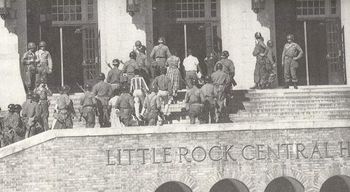
Little_Rock__101st_Airborne_Div_In 1954, the United States Supreme Court declared public school segregation unconstitutional in Brown v. The Board of Education. One year later the Court reiterated its ruling calling on school districts throughout the United States to desegregate their public schools “with all deliberate speed.” While some school districts began developing strategies to resist public school desegregation, school officials at Little Rock, Arkansas stated that they would comply with the Supreme Court's ruling. School district officials created a system in which black students interested in attending white only schools were put through a series of rigorous interviews to determine whether they were suited for admission. School officials interviewed approximately eighty black students for Central High School, the largest school in the city. Only nine were chosen, Melba Patillo Beals, Elizabeth Eckford, Ernest Green, Gloria Ray Karlmark, Carlotta Walls Lanier, Terrance Roberts, Jefferson Thomas, Minnijean Brown Trickey, and Thelma Mothershed Wair. They would later become known around the world as the “Little Rock Nine.” Although skeptical about integrating a former white-only institution, the nine students arrived at Central High School on September 3, 1957 looking forward to a successful academic year. Instead they were greeted by an angry mob of white students, parents, and citizens determined to stop integration. In addition to facing physical threats, screams, and racial slurs from the crowd, Arkansas Governor Orval M. Faubus intervened, ordering the Arkansas National Guard to keep the nine African American students from entering the school. Faced with no other choice, the “Little Rock Nine” gave up their attempt to attend Central High School which soon became the center of a national debate about civil rights, racial discrimination and States’s rights.

On September 20, 1957, Federal Judge Ronald Davies ordered Governor Faubus to remove the National Guard from the Central High School’s entrance and to allow integration to take its course in Little Rock. When Faubus defied the court order, President Dwight Eisenhower dispatched nearly 1,000 paratroopers and federalized the 10,000 Arkansas National Guard troops who were to insure that the school would be open to the nine students. On September 23, 1957, the “Little Rock Nine” returned to Central High School where they were enrolled. Units of the United States Army remained at the school for the rest of the academic year to guarantee their safety.

More here. (Note: At leas t one daily post throughout February will be devoted to African American History Month)

The Future

From The Telegraph:

Colvile_main_2480982bOne of the many grave problems our planet faces, according to Al Gore – or rather, one of the many, many problems, each of them graver than the last – is overpopulation. On which score, his new book will definitely help address that particular concern. For it would be a brave man or woman, after reading this extensive jeremiad, who dares to bring a child into a world so set on self-destruction. It is easy, particularly on this side of the Atlantic, to dismiss Gore as a bloated blowhard – a swag-bellied hypocrite who campaigns against Big Oil while selling his Left-wing television network (the little-watched Current TV) to the gas barons of Qatar, in a deal that has reportedly left him richer than Mitt Romney. The trouble is, he makes a worryingly convincing case. Gore’s essential argument is that the world is rapidly spinning out of control – that we have entered a turbulent new age, in which technology is running amok, the planet is being pillaged ever more rapaciously, and governing institutions have been suborned by vested interests obsessed with short-term gain rather than long-term sustainability. To give a sample of the issues he raises: economically, global outsourcing and “robo-sourcing” – the replacement of human workers with computers – threaten to leave the middle and working classes jobless, while the rich reap the gains. Our financial markets are at the mercy of algorithms whose high-frequency trades are carried out in microseconds. We are engaged in the wholesale manipulation (genetic and otherwise) of the environment, and of our own bodies. Even if you ignore the millions of tons of carbon being pumped into the air, we are losing vital resources – such as water and topsoil – at an unsustainable rate.

…Indeed, perhaps the most striking aspect of this book is the sheer scorn Gore has for the practice of politics. “Not since the 1890s has US government decision-making been as feeble, dysfunctional and servile to corporate and other special interests as it is now,” he thunders, a sentiment repeated elsewhere at length. It is impossible to imagine the man who here bewails a “crippling of democracy” coming within a million miles of the Oval Office, let alone having lost it thanks to a handful of dangling chads; certainly, one senses some personal trauma being worked out.

More here.

Tuesday, February 19, 2013

to stop growth

Farley_220w

Ecological economists in contrast believe that humans are complex creatures with a variety of needs and wants. Society has multiple economic goals about which reasonable people can disagree. All economic production requires energy and raw materials, and generates waste. The raw materials we use also serve as the structural building blocks of ecosystems, and their conversion to economic production and hence waste inevitably degrades the life-sustaining services provided by healthy ecosystems. These services are largely non-substitutable. The ecological economic system is highly complex, characterized by both positive and negative feedback loops, emergent phenomena and surprises. For example, under some conditions, an increase in prices will lead to a decrease in demand, but under other conditions, such as we recently witnessed with speculative investments in land, food, and oil, rising prices increase speculative demand, leading to further price increases. Positive feedback loops in a finite system are self-limiting, and must ultimately collapse in another positive feedback loop where falling prices reduce demand. Facts are scarce and uncertain, and both the economic system and the global ecosystem that sustains and contains it are rapidly evolving.

more from Joshua Farley and Almantas Samalavicius at Eurozine here.

the new gandhi

53372562

IN CONVERSATIONS, social theorist Ashis Nandy fondly recalls an exchange between philosopher Ramachandra Gandhi and poet Umashankar Joshi. The philosopher argued that MK Gandhi was inconceivable without his spiritual strivings, while the poet—and one suspects Ashis Nandy too—insisted that Gandhi’s significance lay in his willingness to engage and transform the “slum of politics”. This divide between the religious, spiritual Gandhi and the political one or, more aptly, the divide between Gandhi the ashramite and Gandhi the satyagrahi has come to shape not only our academic engagement with the life and thought of Gandhi, but also our memory of the man whom we revere, revile or remain indifferent to. The dichotomy is a superficial one. Gandhi saw himself as a satyagrahi and an ashramite. His politics was imbued with spiritual strivings and his relationship with religion was a deeply political one. A long, rich and diverse biographical tradition, which has deepened our understanding of Gandhi’s life and his strivings, has not escaped this divide either.

more from Tridip Suhrud at The Caravan here.