
Category: Recommended Reading
On Writing With Others
John Kaag in the New York Times:
I become a co-author because I can’t stand writing by myself.
Margaret Atwood has said, “Perhaps I write for no one. Perhaps for the same person children are writing for, when they scrawl their names in the snow.” Perhaps she’s just wrong about this. Many children may scrawl their names in snow — and in sand, on dirty windows, bathroom stalls and old desks — with the secret hope that someone will take note. At least some of these children go on to become academics whose feverish scrawling belies the fear that all of it will go unacknowledged. If they go into the humanities, as I did, this fear may never go away.
If I’m really honest, I’ll acknowledge that it’s this fear that drove me to do the unthinkable, at least for a philosopher. It drove me to write with others.
More here.
The Social Life of Memory
From Harvard Magazine:
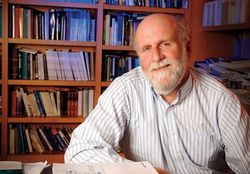
Now research by Kenan professor of psychology Daniel Schacter and several coauthors, published in the March issue of the journal Cerebral Cortex, suggests that the brain, when making behavioral predictions, uses the part devoted to memory. During the past decade, Schacter says, a revolution has occurred in the field of memory science: researchers have shown that memory is responsible for much more than the simple recall of facts or the sensation of reliving events from the past. “Memory is not just a readout,” he explains. “It is a tool that’s used by the brain to bring past experience to bear when thinking about future situations.” In fact, Schacter continues, memory and imagination involve virtually identical mental processes; both rely on a specific system known as the “default network,” previously thought to be activated only when recalling the past. This discovery led to a rich vein of research, he reports. For instance, the link between memory and imagination could explain why those with memory problems, such as amnesiacs or the elderly, often struggle to envision the future.
More here.
Plants perform molecular maths
From Nature:
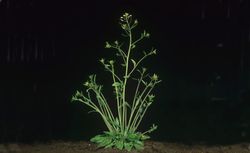
To Alison Smith and Martin Howard of the John Innes Centre in Norwich, UK, and their colleagues, this suggested that a more sophisticated molecular calculation was at work. The team hypothesized the existence of two molecules: one, S, that tells the plant how much starch remains, and another, T, that informs it about the time left until dawn. The researchers built mathematical models to show that, in principle, the interactions of such molecules could indeed drive the rate of starch breakdown such that it reflected a continuous computation of the division of the amount of remaining starch by the amount of time until dawn. For example, the models predicted that plants would adjust the rate of starch breakdown if the night were interrupted by a period of light. During that period of light, the plants could again produce starch. When the lights went out again, the rate of starch breakdown should adjust to that increase in stored starch, the models predicted — a result that the researchers confirmed in Arabidopsis plants. The team then trawled the literature looking for Arabidopsis mutants with known handicaps at different steps along the starch-degradation pathway. These showed that the models were compatible with the behaviour of these mutants, which result in a higher than usual amount of starch remaining at the end of the night.
More here.
Tuesday Poem
The Factory
These were her father’s last words: “I have a dread of chaos in my heart.”
Or, “I have a dread of the chaos in my heart.” The two others present–
her mother, her brother—and she later cannot agree. It was perhaps
a critique of the cryptic vehicles of concealment—symmetry and white noise,
city blocks and hinterlands—she thinks now, as she watches her son watch
a praying mantis watch a caterpillar. The caterpillar is famously playing
dead. Suddenly she wonders if her father is watching her
watching her son watching the praying mantis watching the caterpillar
playing dead. Windows within windows within something window-shaped.
“Kilroy was here” means he’s not anymore—a kind of geometry nobody
cannot configure. She imagines her father working, somewhere, in a factory
that churns out checkerboards, one after another, black and red,
ordinate and abscissa, drawing the axis between obsess and abyss.
Confess and confuse: there is a blind spot in her blind spot in the shape of
a heart in chaos, or chaos in a heart, red on black, or vice versa.
.
by Jessica Goodfellow
from Thrush Poetry Journal, March 2010
Monday, June 24, 2013
You Are an Abstraction: Mistakes of Metaphysical Individualism
by Stephen T. Asma

Steven Pinker expresses a well-worn normative suggestion when he says that the world should move away from tribal or group thinking and feeling, and embrace the “rights tradition” of individualism. He argues, in The Better Angels of Our Nature, that violence recedes as individualism rises. The rest of the world could profit from the recognition, Pinker argues, that we are individuals, and individuals are the ones that “really count” (they actually feel the pleasure and pain). “Groups,” he says, “are a kind of abstraction.”[1]
I'm going to disagree here and argue, somewhat counter-intuitively, that Pinker is the abstraction. I am the abstraction. You, gentle reader, are the abstraction.
The independent individual is a hero to WEIRD cultures (Western, Educated Industrialized, Rich and Democratic), and it serves as the starting place for both pessimistic and romantic theories of the social contract. Whether you're a Hobbesian who thinks the selfish ego must be constrained by the community, or a Rousseauian who laments such constraint (or even a Rawlsian), you still start from a metaphysic of individualism. But what if the individual is actually an ecological, developmental, and political construct?
The primacy of the individual is what philosopher R. G. Collingwood (1889-1943) might call an “absolute presupposition” –an assumed principle that governs certain inquiries and ways of thinking. In fact, digging down to these deep presuppositions was the preferred way, according to Collingwood, to do metaphysics (without getting hung-up on ontology). So, in the spirit of Collingwood's metaphysics, let me suggest an alternative, wherein the collective group is primordial and the individual is derivative.
perceptions
Sunday, June 23, 2013
The Strange Case of Barrett Brown
Amid the outrage over the NSA's spying program, the jailing of journalist Barrett Brown points to a deeper and very troubling problem.
Peter Ludlow in The Nation:
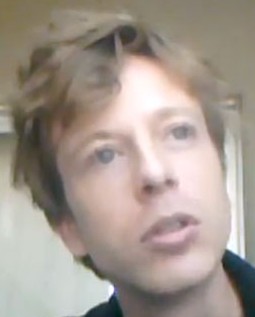
By then, Brown was already considered by his fans to be the Hunter S. Thompson of his generation. In point of fact he wasn’t like Hunter S. Thompson, but was more of a throwback—a sharp-witted, irreverent journalist and satirist in the mold of Ambrose Bierce or Dorothy Parker. His acid tongue was on display in his co-authored 2007 book, Flock of Dodos: Behind Modern Creationism, Intelligent Design and the Easter Bunny, in which he declared: “This will not be a polite book. Politeness is wasted on the dishonest, who will always take advantage of any well-intended concession.”
But it wasn’t Brown’s acid tongue so much as his love of minutiae (and ability to organize and explain minutiae) that would ultimately land him in trouble. Abandoning his book on pundits in favor of a book on Anonymous, he could not have known that delving into the territory of hackers and leaks would ultimately lead to his facing the prospect of spending the rest of his life in prison. In light of the bombshell revelations published by Glenn Greenwald and Barton Gellman about government and corporate spying, Brown’s case is a good—and underreported—reminder of the considerable risk faced by reporters who report on leaks.
More here.
Fermilab names Nigel Lockyer as new director
Nicola Jones in Nature:

Absolutely not. There’s half a dozen really interesting questions where Fermilab can play a really interesting role. We’re looking to have a flagship programme where we can ‘own the podium’, as they said in Canada during the Olympics.
What will that flagship be?
This is determined by the international landscape. Europe is really focusing on the Large Hadron Collider (LHC). They say if you want to study neutrinos, talk to the US or Japan. So what Fermilab is pursuing is the Long Baseline Neutrino Experiment (LBNE). I personally find the science there very inviting. One issue is charge parity violation, looking to see if neutrinos are different from anti-neutrinos. This could broach completely new ground. The second goal is to look at proton decay, which gets into Grand Unified Theory questions. The third thing is people are very interested in detecting neutrinos from supernovae.
What the US government has given a bit of a green light to is a detector on the surface that I would argue is too small. I’d like to make it twice as big and put it a kilometer underground. The challenge is to work with European and Japanese colleagues to see if we can do that.
More here.
Wine-tasting: it’s junk science
Experiments have shown that people can't tell plonk from grand cru. Now one US winemaker claims that even experts can't judge wine accurately. What's the science behind the taste?
David Derbyshire in The Guardian:

And in most years, the results are surprisingly inconsistent: some whites rated as gold medallists in one contest do badly in another. Reds adored by some panels are dismissed by others. Over the decades Hodgson, a softly spoken retired oceanographer, became curious. Judging wines is by its nature subjective, but the awards appeared to be handed out at random.
So drawing on his background in statistics, Hodgson approached the organisers of the California State Fair wine competition, the oldest contest of its kind in North America, and proposed an experiment for their annual June tasting sessions.
Each panel of four judges would be presented with their usual “flight” of samples to sniff, sip and slurp. But some wines would be presented to the panel three times, poured from the same bottle each time. The results would be compiled and analysed to see whether wine testing really is scientific.
The first experiment took place in 2005. The last was in Sacramento earlier this month. Hodgson's findings have stunned the wine industry. Over the years he has shown again and again that even trained, professional palates are terrible at judging wine.
More here.
earth died screaming
ways of seeing 3
For Esme With Love and Squalor
Gorgeous Microscopy and Visual Journalism
From Scientific American:
Over at AudioVision, a project of Southern California Public Radio, Mae Ryan and others bring us the best in visual journalism. Mae contacted me about last month’s feature on David Scharf, electron microscoper extraordinaire. His images are simply stunning, and I had to share. AudioVision is not a science-specific project, so I’m especially thrilled to see science imagery there. I wish more news outlets would incorporate science into their everyday stories. It seems as if science news is always shoved into the corner by major media outlets, and the assumption becomes that science news has to be pursued all by itself, which means people have to take initiative to find it (by visiting Scientific American blogs for instance!), but it doesn’t often find its way to the average viewer who isn’t actively looking for it. Unless it’s coverage of a new study that shows chocolate is healthy and you can eat as much as you want, it stays within the science circle.
Picture: Various allergens by David Scharf.
More here.
The Man I Married
Beth Kissileff in Tablet:
My husband isn’t the same man he used to be. But that’s OK: I’m not the same woman he married, either.

He is certainly not the man I married. But unlike my neighbor from all those years ago, I don’t see this as a crisis. Because he’s not the only one who’s changed.
More here.
Sunday Poem
Writing
Taking away
writing is
taking away,
so that
all I leave
is a flower-pot
standing brick-red
on the window-sill
and watch twilight
fill in a corner
of the room
like a pencil
.
by Roland Jooris
from Bloemlezing uit de poëzie van Roland Jooris
publisher: Poëziecentrum, Gent, 1997
translation: 2005, Peter Nijmeijer
Read more »
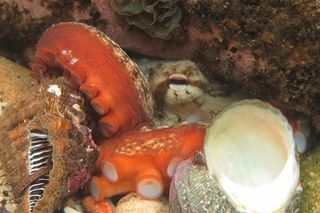
On Being an Octopus
Peter Godfrey-Smith in Boston Review:
If octopuses did not exist, it would be necessary to invent them. I don’t know if we could manage this, so it’s as well that we don’t have to. As we explore the relations between mind, body, evolution, and experience, nothing stretches our thinking the way an octopus does.
In a famous 1974 paper, the philosopher Thomas Nagel asked: What is it like to be a bat? He asked this in part to challenge materialism, the view that everything that goes on in our universe comprises physical processes and nothing more. A materialist view of the mind, Nagel said, cannot even begin to give an explanation of the subjective side of our mental lives, an account of what it feels like to have thoughts and experiences. Nagel chose bats as his example because they are not so simple that we doubt they have experiences at all, but they are, he said, “a fundamentally alien form of life.”
Bats certainly live lives different from our own, but evolutionarily speaking they are our close cousins, fellow mammals with nervous systems built on a similar plan. If we want to think about something more truly alien, the octopus is ideal. Octopuses are distant from us in evolutionary terms, have a nervous system of very different design, and bodies with no bones and little fixed shape at all. What is it like to be an octopus? The question is intrinsically interesting and, beyond that, provides a good way to chip away at the problem Nagel raised for a materialist understanding of the mind.
Saturday, June 22, 2013
the unwinding
The Unwinding is the right title for George Packer’s epic, sad and unsettling history of the last four decades in the US. His topic is the coming apart of something in the national fabric: the unravelling of unspoken agreements about the limits to Wall Street’s greed; about what a congressman would or wouldn’t do for the right price; about what a company owes its workers, or what the wealthy should contribute in tax. The result of all this unwinding is more personal freedom than ever before: “Freedom to change your story, get your facts, get hired, get fired, get high, marry, divorce, go broke, begin again, start a business, have it both ways, take it to the limit, walk away from the ruins, succeed beyond your dreams.” But it is the loneliest sort of freedom. What Packer’s disparate characters share – as his narrative moves up and down the spectrum of inequality, from inner-city Ohio to Silicon Valley, to the exurban McMansions of Florida, to Washington’s corridors of power – is that each is fundamentally on his or her own.
more from Oliver Burkeman at The Guardian here.
bad boy
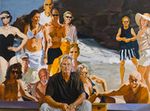
For Fischl, the suppurating wound was his mother. Depressed, alcoholic, beautiful, creatively thwarted, subject to fits of epic rage for which she blamed her children and husband, she should have had her own chapter in “The Feminine Mystique.” Betty Friedan reported mordantly on suburban women who suddenly go berserk and run shrieking through the streets naked; Fischl’s mother actually was picked up by the police running through the streets of suburban Long Island naked. She walked around the house naked too, throwing her adolescent son off kilter. After threatening for years to kill herself, she finally succeeded, driving her car into a tree. His family’s secrecy and shame about these ordeals migrated into the anxious, discomfiting iconography of Fischl’s paintings. At first he wasn’t aware of it, embarking on a series of crude images about an imaginary near-eponymous family he called “the Fishers,” whose story grew increasingly miserable. As his process became more free-associational, what eventually emerged were the “psychosexual suburban paintings” he became famous for. “Bad Boy” doubles as the title of a potent early example, a vaguely incestuous scene of a young boy stealing something from the pocketbook of an inattentive naked woman, who lies spread-eagle on a bed.
more from Laura Kipnis at the NY Times here.
The Faraway Nearby
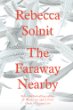
Stories are compasses and architecture,” writes Rebecca Solnit in The Faraway Nearby, “we navigate by them, we build our sanctuaries and our prisons out of them, and to be without a story is to be lost in the vastness of a world that spreads in all directions like arctic tundra or sea ice.” Much of Solnit’s work is concerned to locate her, and consequently us, within the world by telling stories about it. At its best her writing is an exhilarating form of literary cartography, meandering through subjects as diverse as the development of photography, the philosophy of popular protest and the history of walking while always keeping us in touch with the people at the centre of those stories. The Faraway Nearby, her 14th book, is in some respects a consummation of her method. It is composed of a series of loosely connected essays – on love, trauma, family and fairy tales – which nestle within one another like matryoshka dolls. The loose structure is held together with threads of metaphor and allusion, enacting something of the aimless meanderings of grief itself.
more from Jon Day at the FT here.