Why Rachel Wetzsteon is her generation’s best love poet

Xwetzsteon-rachel.jpg.pagespeed.ic.hnVdh4WtIzAdam Kirsch at Poetry Magazine:

The type of writer who falls prey to the “not quite,” who thinks deeply about it and makes it a major theme of her work, tends to be at the same time sentimental and ironic. The sentiment comes from her longing for the ordinary, for un-self-conscious emotion and experience; her irony comes from her secret feeling of superiority to that kind of simplicity. (Mann, again, is the classic example of this kind of artist—Tonio Kröger says just about everything there is to say on the subject.) For of course, if you were to offer the artist the chance to stop writing and start living, she would never take it; she is too deeply defined by her own distance from life to dare to close it.

Rachel Wetzsteon, who died in 2009 at the age of 42, was her generation’s best poet of the “not quite.” During her tragically brief career, Wetzsteon earned her share of the small honors that are in the poetry world’s gift: her debut collection, The Other Stars (1994), was chosen for the National Poetry Series by John Hollander; she won prizes, and was the poetry editor of the New Republic (where I was proud to be her colleague). But she had produced only three books of poetry before she died—a fourth, Silver Roses, came out posthumously—and she had not yet reached the level of seniority or acclaim where her work was much reviewed.

more here.

King Krule’s lineage

130923_r23977_p465Sasha Frere-Jones at The New Yorker:

Last week, Marshall played the Bowery Ballroom with his current band, made up of bass, guitar, and drums. He emerged in a suit jacket that looked three sizes too big, as most clothing does on him, and carrying a Fender Telecaster guitar. When playing it, he looked slightly hemmed in, as if he sensed that the band might be getting too close to a familiar entity. When he put down the guitar and just sang, gripping the microphone and doubling over as he yelled, the sound came into focus. He introduced each of the musicians in the band, as if it were a genuine jazz ensemble, but that’s not what has drawn people to King Krule. Though Marshall sounds as if he had stumbled into a recording studio by accident (and confesses that he likes many of his demos better than the final studio versions), he manages to be a confirmed, dedicated romantic. His voice curls around his lyrics as if he were disgusted with everything, but the words fight his delivery. In “Borderline,” which features one of his loveliest choruses over a swift series of chord changes, he sang, “And the soul chokes to cause the tide to enforce divide—this whole devotion has morphed in time. I’ll escort her mind to solve my crimes, reach slow motion to con the mind.”

more here.

in Gaudí’s great cathedral

Sagrada-familia-large

Casey N. Cep at The Paris Review:

Gaudí wanted the interior of Sagrada Família to look like a forest. The columns of the nave stretch like tree trunks from the floor to the ceiling, branching to support the heavy weight of the ceiling, but also sprawling, reaching like tendrils for the sky. The church is beautiful because of its continual incompletion, its revelation that human construction is not so unlike natural construction: you plant a sapling as a child, then years later it is still growing into something taller, something more; your grandparents planted daffodils that decades later you see still returning every spring; you sit reading the newspaper on a bench in a park that your father tells you was once under water, the river having receded miles from its ancient reaches.

Cathedrals reveal human construction for what it is. In “The Cathedral,” Rainer Maria Rilke wrote “Their birth and rise, / as our own life’s too great proximity / will mount beyond our vision and our sense / of other happenings.” The poet disdains the possibility that cathedrals eclipse their makers: “as though that were history, / piled up in their immeasurable masses / in petrifaction safe from circumstance.” Life, Rilke argued, was on the streets beneath the cathedral’s spires, while death was “in those towers that, full of resignation, / ceased all at once from climbing.”

more here.

The New Deal We Didn’t Know

Lemann_1-092613_jpg_470x634_q85

Nicholas Lemann reviews Ira Katznelson's Fear Itself: The New Deal and the Origins of Our Time, in the NYRB:

The New Deal, the apogee of liberal political power in American history and a story with a relatively happy ending—the Great Depression vanquished, World War II won—has usually had its history presented, except by conservatives who disapprove of the expansion of central government and taxation in the 1930s and 1940s, as an uplifting, inspiring one. That is not how Ira Katznelson presents it. There is only one very brief personal note in his long, scholarly book—a snip of memory about having to wear military-style dogtags and practice responses to a nuclear attack as a schoolchild in the early 1950s—but all of Fear Itself is suffused with the same sense of pure terror during the Roosevelt and Truman years as, say, Philip Roth’s The Plot Against America. It’s easy to forget not just how dangerous the situation was, at home and abroad, during the New Deal, but how palpable were outcomes far worse than what we got.

Another difference between Fear Itself and most of the familiar histories of the New Deal is that Katznelson thinks like a political scientist. That means that, although he defines the period presidentially, as the twenty years when Franklin Roosevelt and Harry Truman were in the White House, Roosevelt and Truman themselves are spectral presences. They are not the primary determiners of the course of government, and Katznelson has no interest in their personal qualities or their methods of leadership. Instead his focus is on Congress and government agencies, and more broadly on political systems, voting, and interest groups. This gives Fear Itself the feeling of a fresh look at a familiar story; what Katznelson loses in ignoring the inherent force of the hero narrative, he gains in being able to make an argument that largely ignores the presidency.

The argument bears laying out in some detail. Katznelson begins, usefully, by placing the New Deal in a global setting: the severity of the Great Depression presented an existential threat to liberal democracy everywhere, both as an ideal and as a reality. In response to the same economic crisis that confronted the United States, Germany turned to National Socialism, Italy to Fascism, and the Soviet Union already had a form of communism that no liberals except willfully blind ones could believe in. During Roosevelt’s first term, these alternate systems were on the verge of imposing themselves by force on many other countries.

It was not at all clear that democracy would survive here.

More here.

Pakistan in perpetual tension

From The Hindu:

JeffChristophe Jaffrelot is a Senior Research Fellow at CERI-Sciences Po/CNRS, Paris, Visiting Professor at the King's India Institute (London) and Global Scholar at Princeton University. In this exclusive interview with The Hindu’s Vaiju Naravane he discusses his new book to be published in India under the title The Pakistan Paradox.

In what sense is your book, published in France this week by Fayard under the title Le Syndrome Pakistanais, an essay or a pamphlet, and what is the thesis or the central point of the book?

The book argues that Pakistan is facing three contradictions since 1947 — and even, sometimes, since its very project emerged during the Raj. Primarily, there is the tension between a unitary notion of the Muslim nation state that is Pakistan and the diversity of the country in ethno-linguistic terms. This tension was there before Partition and it has remained after Partition with at least three provinces that never reconciled themselves fully with the Pakistani project: Bengal — Bengalis went in 1971, and the Baluchistan, which has been repeatedly on the warpath vis-à-vis the centre, and the Pashtuns, who have a very peculiar trajectory. There's been a demand for Pashtunistan, even a kind of irredentism with the Afghan Pashtuns for years, but the Pashtun trajectory has been more complicated since sections of the Pashtun elite — especially among the military — have rallied around the Pakistani project.

More here.

Bacteria and Termites Team Up

From Science:

TermThe Formosan subterranean termite (Coptotermes formosanus) is native to southern China, but the aggressive little chompers have set up huge destructive colonies worldwide, including in the southeastern United States and Hawaii. They build the inner structure of their underground nests with a blend of chewed-up wood that used to be your house with their own excrement. In a study published in the Proceedings of the Royal Society B, researchers in Florida studied that recipe, called carton material (in photo above), and found a good purpose for the poop: It hosts protective bacteria, which can fight a termite-killing fungus.

More here.

Wednesday Poem

Magritte
.
I am a man in a black bowler hat,
showing my back to the world.
If I turn, an apple blocks my face.

My first glimpse of art was in a churchyard,
so close it is to death.
I listened to the silence of that place.

Sometimes, laid out, she elevates behind me
as I walk the towpath.
Stiff-necked, I do not look around.

My art has no laws of gravity,
but a woman’s chestnut hair falls to the ground
and bowler-hatted men are falling rain.

I have seen boulders floating in the sky,
and every day a cloud comes in my door.
Baguettes, instead of clouds, go drifting by.

In woods, between the horse’s head and rider,
a vista slips, slim as the trunk of a tree.
What’s visible hides what’s also visible.

The sea is one with what is not the sea.
.
by Ciaran O'Driscoll
from Surreal Man
Pighog Press, Brighton, 2006

Tuesday, September 17, 2013

The American Jewish Cocoon

Peter Beinart in the New York Review of Books:

Beinart_1-092613_jpg_470x685_q85Speak to American Jews long enough about Israel and you begin to notice something. The conversation may begin with Israel, but it rarely ends there. It usually ends with “them.”

Express concern about Israeli subsidies for West Bank settlements and you’ll be told that the settlements don’t matter because “they” won’t accept Israel within any borders. Cite the recent warning by former Shin Bet head Yuval Diskin that “over the past 10–15 years Israel has become more and more racist” and you’ll be told that whatever Israel’s imperfections, it is “they” who teach their children to hate and kill. Mention that former prime minister Ehud Olmert has called Mahmoud Abbas a partner for peace and you’ll be told that what “they” say in Arabic is different from what they say in English.

This spring I watched the documentary The Gatekeepers—in which six former heads of Shin Bet sharply criticize Israeli policy in the West Bank—with a mostly Jewish audience in New York. Afterward a man acknowledged that it was an interesting film. Then he asked why “they” don’t criticize their side like Israelis do.

I used to try, clumsily, to answer the assertions about Palestinians that so often consume the American Jewish conversation about Israel. But increasingly I give a terser reply: “Ask them.” That usually ends the conversation because in mainstream American Jewish circles, asking Palestinians to respond to the endless assertions that American Jews make about them is extremely rare.

More here.

Is There a Word for That?

Ralph Keyes in The American Scholar:

ScreenHunter_329 Sep. 18 09.22Soon after they arrived in America, British settlers got busy with an important task: reinventing their language. This called for repurposing old words and coining new ones. Colonists called the plump, smelly rodents they encountered in swamps muske rats. Other forms of wildlife were named katydids, bobcats, catfish, and whippoorwills. To these settlers, sleigh improved on sledge, and the help reflected their values better than servants. “The new circumstances under which we are placed,” observed Thomas Jefferson, “call for new words, new phrases, and for the transfer of old words to new objects.”

“Necessity,” he concluded, “obliges us to neologize.” According to the Oxford English Dictionary, Jefferson is the first person known to have used the termneologize, in an 1813 letter. It is one of 110 words whose earliest use the OED credits to him. Others include indescribable, pedicure, and electioneer.

Once they caught wind of all the new words being coined across the Atlantic, self-appointed guardians of the King’s English were rather cross. When Jefferson used the new word belittle in his 1781 book Notes on the State of Virginia, a British critic exclaimed, “It may be an elegant [word] in Virginia, and even perfectly intelligible; but for our part, all we can do is to guess at its meaning. For shame, Mr. Jefferson!” Undaunted, the third president proceeded to coin Anglophobia.

More here.

Miss America, Meet India’s ‘Dark’ Side

Tunku Varadarajan in The Daily Beast:

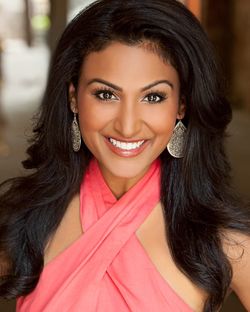
MissAmericaA woman of Indian origin, Nina Davuluri of New York, is the new Miss America. In the first wave of news about her winning this arguably outdated concourse, there was an almighty collision between two American cultural strains. The first celebrated her ascent to tiarahood, seeing hers as a triumph of diversity and assimilation (values that have not always marched in lockstep in this land). The Girl Next Door can be a dark-skinned daughter of immigrants from Andhra Pradesh, a state in the southeast of India whose inhabitants speak Telugu, 13th in the list of the most-spoken languages worldwide. Take a bow, America. (Compare this country with mostly dark-skinned Brazil, which has had not a single nonwhite Miss Brazil.)

The second cultural strain revealed itself in a torrent of abuse on Twitter and other forums. Some disenchanted Americans gave vent to a racial displeasure over this incomprehensibly exotic Miss America. “And the Arab wins Miss America. Classic,” someone tweeted. (Dude, the Arab won Miss America in 2010. She’s called Rima Fakih.) The most frequent complaint was of the “This is America, not India” variety. The critics of Davuluri’s selection were, one can be sure, the kind of people who wouldn’t want our young Indian beauty queen as a neighbor, let alone as Miss America, so their views need not detain us.

More here.

Overpopulation Is Not the Problem

Erle C. Ellis in the New York Times:

0914OPEDstreeter-articleInlineMany scientists believe that by transforming the earth’s natural landscapes, we are undermining the very life support systems that sustain us. Like bacteria in a petri dish, our exploding numbers are reaching the limits of a finite planet, with dire consequences. Disaster looms as humans exceed the earth’s natural carrying capacity. Clearly, this could not be sustainable.

This is nonsense. Even today, I hear some of my scientific colleagues repeat these and similar claims — often unchallenged. And once, I too believed them. Yet these claims demonstrate a profound misunderstanding of the ecology of human systems. The conditions that sustain humanity are not natural and never have been. Since prehistory, human populations have used technologies and engineered ecosystems to sustain populations well beyond the capabilities of unaltered “natural” ecosystems.

The evidence from archaeology is clear. Our predecessors in the genus Homo used social hunting strategies and tools of stone and fire to extract more sustenance from landscapes than would otherwise be possible.

More here.

Preface to Lissa Wolsak

Henry Gould in The Critical Flame:

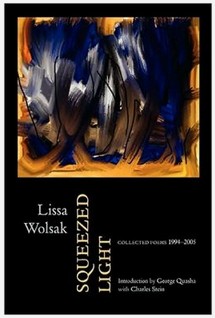
ScreenHunter_328 Sep. 17 16.45Lissa Wolsak is a major American poet, living in Vancouver; Squeezed Light is a comprehensive gathering of her published work, which includes seven poem-sequences, a prose piece titled “An Heuristic Prolusion”, an interview, and an extended introduction by George Quasha (with Charles Stein).

“Major” is a weighty word, not to be trifled with; yet I feel confident in this case. It has become a commonplace to note that American poetry is various, fractured, “balkanized”—but if we think of the distinctive American stream in English writing, we must reckon with a single, branching river. That is, we are dealing on the one hand with the brilliant, idiosyncratic, metaphysically-ambitious, transcendental Emerson, Whitman, Dickinson—and on the other with a darker channel: the melancholic, skeptical, ironic “power of blackness” (Harry Levin’s term) represented primarily by Poe and Melville. Lissa Wolsak floats her boat where both streams merge. She is an heir to their astringent, challenging, and problematic greatness.

put me on the dune
oval
sloping
this is,
she, made, undertaken…

T.S. Eliot once famously wrote, “poetry in our civilization, as it exists today, must be difficult.” In this regard, Lissa Wolsak demands the reader Walt Whitman required: an athlete—alert, engaged, willing to wrestle both angels and devils in order to grasp the poem.

More here. [Thanks to Daniel Pritchard.]

Chinese Takeout

From Conservative Magazine:

The Chinese probably eat the world’s greatest diversity of wild beasts. As their national appetite grows, American biologists are wondering, where have all the turtles gone?

There is an often repeated Chinese joke that says, “In southern China people eat everything on four legs except tables, everything that flies except planes, and everything in the water except boats.” I had heard the saying before and already knew that China is arguably the world’s most adventurous culinary destination. Over the decade I had lived in China, I had learned that almost everything that moves is considered edible. I had been served snake soups and tiny pigeons roasted on long skewers. At a banquet in Sichuan province, the host had placed a heaping mound of fried bees in front of me. I once reluctantly joined two friends for a boiling hot pot meal that included the genitals of various animals. I had passed countless restaurants displaying a wide array of unusual food: in backwater towns, restaurants commonly displayed the skinned carcasses of cats and dogs, their muzzles frozen in permanent snarls; in wealthier cities, seafood was more common—giant shark fins, sometimes tied in red bows and always bearing outlandish price tags, held prominent space in front windows; turtles and fish peered with dull expressions from dirty glass tanks.

And I had seen more exotic fare. At the edge of a national park in Hunan province, a restaurant owner had shown me a thick black snake that she said was called the “three-step”: one bite, and the victim would take three steps before collapsing. Boiled, it cost a few hundred yuan. Outside a wildlife sanctuary in Sichuan province, an official happy to be hosting an American guest presented me with a plate of what he said was a wild local deer. He told me it had been killed in the park and was healthier than farm-raised animals. To maintain our friendship, I took a few bites of the tough, gamey meat. A Chinese friend described being served meat from wild pangolins and monkeys at an expensive restaurant in southern China.

More here.

On the Edge of Slander

Greenblatt_1-092613_jpg_470x633_q85

Stephen Greenblatt on Joss Whedon's Much Ado About Nothing, in the NYRB:

In a curious way the central figure in the splendid new film of Much Ado About Nothing, directed by Joss Whedon (Buffy the Vampire Slayer, The Avengers), is the house in which the events unfold. Not that the house—Whedon’s own—is particularly remarkable. It is a comfortable, sprawling Santa Monica McMansion, no doubt very expensive, with more than a touch of a suburb about it. But that is the point: we are not in faraway Sicily, where Shakespeare set the story, or in glorious, technicolor Tuscany, where Kenneth Branagh set his admirable film adaptation twenty years ago. We are rather on familiar ground, and, as if to conjure up the ordinary accoutrements of modern American upper-middle-class life, the camera dwells lovingly on the kitchen counter and the wine glasses and the piles of dishes and the stairs that lead up to the pleasant patio and, discreetly hidden, the video screens scanned by the bumbling employees of a security company—Whedon’s clever incarnation of Messina’s night watchmen.

All of this familiarity makes the circumstances that set the story in motion in Shakespeare and in his sources seem particularly discordant and weird. They were strange enough to begin with. Shakespeare followed his principal source, a story by the Italian monk Matteo Bandello, in having a Spanish army commander, Prince Don Pedro of Aragon, and several of his officers arrive in Messina, in the wake of a successful military campaign, for a month’s stay as the guests of the town’s governor, Leonato. The awkwardness such a stay would inevitably entail is heightened by the fact that Don Pedro brings with him his disgraced bastard brother, Don John, who is under a kind of uneasy house arrest. The situation calls for an elaborate exercise of courtesy: everyone knows that there is no choice about the visit, but everyone has to behave as if they were witnessing an act of unconstrained hospitality.

More here.

DNA Double Take

Carl Zimmer in The New York Times:

DnaFrom biology class to “C.S.I.,” we are told again and again that our genome is at the heart of our identity. Read the sequences in the chromosomes of a single cell, and learn everything about a person’s genetic information — or, as 23andme, a prominent genetic testing company, says on its Web site, “The more you know about your DNA, the more you know about yourself.” But scientists are discovering that — to a surprising degree — we contain genetic multitudes. Not long ago, researchers had thought it was rare for the cells in a single healthy person to differ genetically in a significant way. But scientists are finding that it’s quite common for an individual to have multiple genomes. Some people, for example, have groups of cells with mutations that are not found in the rest of the body. Some have genomes that came from other people. “There have been whispers in the matrix about this for years, even decades, but only in a very hypothetical sense,” said Alexander Urban, a geneticist at Stanford University. Even three years ago, suggesting that there was widespread genetic variation in a single body would have been met with skepticism, he said. “You would have just run against the wall.”

But a series of recent papers by Dr. Urban and others has demonstrated that those whispers were not just hypothetical. The variation in the genomes found in a single person is too large to be ignored. “We now know it’s there,” Dr. Urban said. “Now we’re mapping this new continent.” Dr. James R. Lupski, a leading expert on the human genome at Baylor College of Medicine, wrote in a recent review in the journal Science that the existence of multiple genomes in an individual could have a tremendous impact on the practice of medicine. “It’s changed the way I think,” he said in an interview. Scientists are finding links from multiple genomes to certain rare diseases, and now they’re beginning to investigate genetic variations to shed light on more common disorders.

More here.

This Insect Has The Only Mechanical Gears Ever Found in Nature

Joseph Stromberg in Smithsonian Magazine:

Burrows5HRTo the best of our knowledge, the mechanical gear—evenly-sized teeth cut into two different rotating surfaces to lock them together as they turn—was invented sometime around 300 B.C.E. by Greek mechanics who lived in Alexandria. In the centuries since, the simple concept has become a keystone of modern technology, enabling all sorts of machinery and vehicles, including cars and bicycles.

As it turns out, though, a three-millimeter long hopping insect known as Issus coleoptratus beat us to this invention. Malcolm Burrows and Gregory Sutton, a pair of biologists from the University of Cambridge in the U.K., discovered that juveniles of the species have an intricate gearing system that locks their back legs together, allowing both appendages to rotate at the exact same instant, causing the tiny creatures jump forward.

The finding, which was published today in Science, is believed to be the first functional gearing system ever discovered in nature. Insects from the Issus genus, which are commonly called “planthoppers,” are found throughout Europe and North Africa. Burrows and Sutton used electron microscopes and high-speed video capture to discover the existence of the gearing and figure out its exact function.

More here.

Monday, September 16, 2013

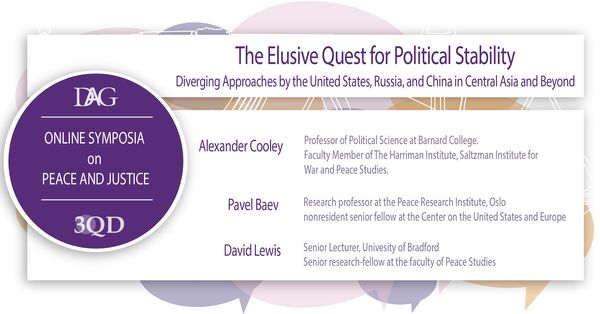
The Quarterly DAG-3QD Peace and Justice Symposium: The Elusive Quest for Political Stability in Central Asia and Beyond

Online symposium 5 Cooley-09

Dear Reader,

We are very pleased to collaborate with the Amsterdam-based Dialogue Advisory Group (DAG) to bring to you quarterly online symposia on topics of international peace and justice. This is the fifth in this series of symposia; the first four can be seen here.

DAG is an organization which discreetly assists government, inter-government and other actors to confidentially manage national and international mediation efforts. Among their publicly known activities is DAG’s involvement in verifying the ETA ceasefire in Basque Country and the decommissioning of the weapons of INLA, a dissident Republican armed group in Northern Ireland.

DAG is directed by Ram Manikkalingam who also teaches politics at the University of Amsterdam. He advised the previous President of Sri Lanka during the peace process with the Tamil Tigers and prior to that advised the Rockefeller Foundation’s program in international peace and security.

In the DAG-3QD Peace and Justice Symposia internationally recognized figures will debate challenges in conflict resolution and human rights. One (or more) author(s) will present a thesis in the form of a short essay and then the others will present critiques of that point of view. Finally, the initial author(s) will also have an opportunity to present a rebuttal to the critiques.

The topic this time is “The Elusive Quest for Political Stability: Diverging Approaches by the United States, Russia, and China in Central Asia and Beyond”.

The distinguished participants in this symposium:

  • Pavel Baev is a Norwegian political scientist and security scholar. He is currently a research professor at the Peace Research Institute Oslo (PRIO) and a senior nonresident fellow at the Brookings Institution (Washington, DC). Baev graduated from Moscow State University (M.A. in economic and political geography, 1979) and worked in a research institute in the USSR Ministry of Defence. He received his PhD in international relations from the Institute for US and Canadian Studies in Moscow in 1988, then worked in the newly created Institute of Europe in Moscow until 1992, when he moved to Oslo, Norway and joined PRIO. In 1994-1996, he held a ‘Democratic Institutions Fellowship” from NATO. From 1995-2001, Baev was co-editor of the academic journal Security Dialogue, and From 1999-2005 he was a member of the PRIO board. Baev’s current research includes the transformation of the Russian military, Russia – European Union relations, Russia’s energy policy, Russia’s policy in the Arctic, terrorism and conflicts in theCaucasus. Baev is the author of several books.
  • David Lewis is senior lecturer at the University of Bradford in the Department of Peace Studies. He has research interests in the areas of peacebuilding, security, political change and conflict, and has considerable field experience in Central Asia, the Caucasus and South Asia. Before working in Bradford, David worked at the International Crisis Group in Central Asia and in Sri Lanka. His publications have focused on political change and the dynamics of authoritarian regimes in Central Asia. His recent book The Temptations of Tyranny in Central Asia (Hurst/Columbia University Press, 2008) examined the impact of Western policy on the region in the aftermath of 9/11. David is also an active adviser and consultant on political engagement and programming in the Caucasus and Central Asia. David has also been working on the impact of global geopolitical change on peace and conflict norms and practices. Within the same research framework, David has been awarded a British Academy grant to study shifting international norms within the OSCE and the Shanghai Cooperation Organisation. 

I would like to thank the participants as well as Ram Manikkalingam, Fleur Ravensbergen, Daniël Grütters, Michelle Gehrig, and the indefatigable Amanda Beugeling of the Dialogue Advisory Group for working closely with me in organizing these symposia. The logo for the symposium has also been designed by Amanda Beugeling.

We look forward to your comments and feedback.

Yours,

S. Abbas Raza


NOTE: DAG and 3QD wish to acknowledge the generous contribution of the Dutch Stichting Democratie en Media toward these symposia, as well as the support of our readers.


THE SYMPOSIUM

[Click the links below to read the essays.]


  1. The Elusive Quest for Political Stability: Diverging Approaches by the United States, Russia, and China in Central Asia and Beyond by Alexander Cooley
  2. The Stability Paradox in Central Asia by Pavel Baev
  3. Caveats to Cooley’s Argument by David Lewis
  4. A Response to Baev and Lewis by Alexander Cooley


***********************

***********

******

*


Please leave comments about any of the essays in the symposium in the comments area of this post. Thank you.

The Elusive Quest for Political Stability: Diverging Approaches by the United States, Russia, and China in Central Asia and Beyond

by Alexander Cooley

The post-Soviet region of Central Asia is frequently viewed as an arena of Great Power competition and contemporary geopolitical maneuvering. But officials from the United States, Russia and China publicly deny any rivalry, citing their shared interest in promoting regional prosperity and “stability.” The latter has become a scripted trope, trotted out alongside periodic warnings that the region has the potential to become “failed,” “ungoverned” or run over by militants from surrounding regions. Whatever their exact regional strategies, surely all external powers share the common goal of maintaining a stable “Central Asia.”

Yet, what exactly do we mean by “political stability”? Do the regional actions of the “big three” actually match such a shared vision? And what lessons might this maneuvering among external patrons hold for other regions such as the post-Arab Spring Middle East, Africa and Southeast Asia?

My basic argument in this essay is that the public emphasis on “political stability” masks a more fundamental debate that we are reluctant to have about the underlying factors that might promote political order and responsive governance in an increasingly multipolar world. This is all the more pressing in areas such as Central Asia where local strongmen agendas increasingly intersect with the security cooperation of multiple external patrons.

The most frequently used definition of stability, drawing upon Samuel Huntington's still influential concept of “political order,” is the absence of political violence. But throughout the region, the term has also been used as a synonym for political loyalty, regime longevity, the durability of informal political institutions, and the need to clamp down on all forms of political opposition.

The region's “stability” has also varied by state. In small Kyrgyzstan, host to both US and Russian military facilities, has witnessed two revolutions (in 2005 and 2010) and a violent conflict among ethnic Uzbeks and Kyrgyz in the south of the country in 2010. On the other end, Turkmenistan, outwardly, at least appears the most depoliticized, having seamlessly transitioned from the repressive personality cult of President Saparmurat Niyazov to the equally indulgent Gurbanguly Berdhimuhamedow. Uzbekistan, Tajikistan and Kazakhstan have all experienced bouts of political violence, mostly because of internal grievances, though their governments have been keen to blame such outbreaks on subversive and destabilizing foreign influences. Cumulatively, external engagement has contributed to the region's “securitization” and the consolidation of power by ruling authoritarians.

Read more »

The Stability Paradox in Central Asia

by Pavel Baev

In the 22 years long post-Soviet period, Central Asia has remained far more stable than standard risk analysis would predict, given the intensity of internal tensions and disagreement between external impacts. Alex Cooley demonstrates convincingly the deep differences between the US, Russia and China in defining what “stability” in this geographically land-locked and politically anti-modern region is about; he is also absolutely right in arguing that these differences do not amount to direct competition, for which the cliché “New Great Game” has long been coined – and never made any sense. He may be not quite correct, however, reducing the emphasis on “stability” to a “convenient rhetorical exercise”. What is really odd about these three policies is that each of them is based on a particular definition of “stability” – and is executed in a way that is not compatible with it. This incompatibility of the proclaimed aims and employed means constitutes a “stability paradox”, which is set to acquire a dramatic character as the interplay between various conflicts in the region escalates, while the regimes are fast approaching their respective expiration dates.

Starting with the US, we can see that this paradox cuts deeper than just sacrificing the compromised “democracy promotion” for the access to the infrastructure supporting the Northern Distribution Network. The fundamental premise of the US strategic assessment is that stability in Central Asia could only be achieved through the transformation of the corrupt authoritarian regimes towards what Cooley calls “responsive governance”, as well as through building a regional security system with the support of the European NATO allies and the EU. In reality, all efforts at fostering cooperation between Central Asian states have long been abandoned as useless, while the joint work with the allies is centered on securing safe withdrawal from Afghanistan. The EU has lost whatever “soft power” it tried to project and accepted its inability to play even a supportive role in Central Asia. The pragmatic approach of the Obama administration to doing security business with Uzbekistan and Tajikistan directly contributes to consolidation of the despotic regimes (Cooley’s term “normative regression” appears rather academic for this ugly process). This is completely at cross-purposes with the proposition for encouraging democratic reforms, moderating corruption and curtailing narco-trafficking.

Russia has no doubt about identifying stability in Central Asia with continuation of the ruling regimes, obviously reflecting on the domestic ideological dogma that only the “verticality of power” created by President Vladimir Putin holds the country from collapsing into anarchy and disintegration. Contrary to this article of faith, Moscow orchestrated the coup against the Bakiyev regime in Kyrgyzstan in April 2010, stopped abruptly importing gas from Turkmenistan in April 2009, thus putting in peril Berdymuhammedov’s regime, and picked quite a few quarrels with Karimov’s regime in Uzbekistan, which constitutes the key link in the chain of despotic regimes in the region. Russia also puts a strong emphasis on the strengthening of regional security system structured first of all by the Collective Security Treaty Organization (CSTO) and other institutions, including the Shanghai Cooperation Organization (SCO). This institution-building falls far short of “an almost demonstrative obsession with projecting influence” (as Cooley argues). It has provided for plenty of high-level networking but for very little hard substance. Russia has never put serious resources behind this political aim and is not building sufficient military muscle for performing convincingly the role of “stability provider”. Its failure to intervene into the Osh riots in summer 2010, was caused by the shortage of projectable power, and no “rapid deployment corps” will spring to life in the course of badly mismanaged military reform.

Read more »