rereading henry james

BarryShane Berry at the Dublin Review of Books:

In his surprisingly thoughtful bagatelle How to Talk About Books You Haven’t Read, Pierre Bayard challenges the binary division of books into those we have read and those we haven’t. He suggests a more nuanced approach, reflecting how we really experience literature. To buttress his argument, Bayard throws out the concept of the collective library, “the larger set of books on which our culture depends at that moment”. Anyone acquainted with the collective library is granted a degree of latitude:

To a cultivated or curious person, even the slightest glance at a book’s title or cover calls up a series of images and impressions quick to coalesce into an initial opinion. […] For the non-reader, therefore, even the most fleeting encounter with a book may be the beginning of an authentic personal appropriation.

The work of Henry James would seem to merit at least a shelf in Bayard’s hypothetical repository.

more here.

The robot cars are here

ImageDaniel Albert at n+1:

The American “love affair” with the automobile is often mistaken for a love affair with driving. We think driver distraction arose with the smartphone, but truth be told most Americans never liked driving much. When Oldsmobile debuted Motoring’s Magic Carpet on the eve of World War II, it lamented the struggles of the little lady with a standard transmission: “After nineteen distinct manual operations, she’s finally ready to drive.” Relief came from the Hydra-Matic drive, the original automatic transmission. Times have changed but the dream has not. Today, Mercedes promises a “flying carpet” ride from its laser-guided Magic Body Control active suspension system. Let them wrestle with their overtaxed motors among the dark satanic mills of Europe. Americans invented power steering. Come to think of it, flying carpets don’t even need steering wheels, do they?4

Those who read robot news may think I’m on about the Google Car, the result of Pentagon funding, Stanford computer genius Sebastian Thrun, and of course money from all those little internet adverts. The origin of Google’s small self-driving fleet—each with sixty-four spinning laser beams mounted to its roof and hacker wires running down to the wheels—dates to the 2005 DARPA Grand Challenge, where Stanley, Stanford’s VW SUV (now on display at the Smithsonian), beat twenty-three other teams in a race through the desert.

more here.

The science interview: Jared Diamond

Gillian Tett in FT Magazine:

DiamondBorn in Boston to a Bessarabian Jewish family, Diamond toiled in relative obscurity in the first few decades of his career as a physiologist at Cambridge university and UCLA. “For decades I was the world’s expert on the gall bladder,” he explains matter-of-factly, without any hint of modesty. “The gall bladder is a simple organ that absorbs salt and water – and that means you can study it with a minimum of equipment, which I like.” But even as he obsessively observed gall­bladders, Diamond developed a second passion: birds. In his twenties he started to visit Papua New Guinea and used the material gathered to write academic papers in the field of ornithology. That led him into yet more – seemingly unlikely – areas of intellectual inquiry such as environmental geography, followed by physical and cultural anthropology (or the study of human evolution and culture). “My study of New Guinea was initially motivated by birds but you cannot do anything there without dealing with local people,” he explains. “And once you have spent time dealing with local people, you realise that humans are similar all around the world in some respects – but different in others.”

This led Diamond to produce his first bestseller, Guns, Germs, and Steel, which endeavoured to explain why the Eurasian people of North America and Europe displaced other native Indian American and Asian cultures by highlighting differences in ecology. It was a controversial thesis. But it turned him into something of a cult hero: 16 years after the book, when I tell friends that I am interviewing Diamond, one remarks that “Guns, Germs, and Steel changed how I thought.” In 2002, Diamond abandoned gall bladders, ending his career in physiology, to devote himself to writing. In 2005 he published another sweeping analysis, Collapse, which explained why some societies fail and others flourish. Then last year he published The World Until Yesterday , which describes how humans live in societies which are not “WEIRD”, or “Western, Educated, Industrialised, Rich and Democratic”. This is a fun, lively read that sets out to illustrate two simple points: humans can live their lives in numerous, different ways; and the WEIRD approach is not always best. On the contrary, America and Europe could sometimes improve their own cultures and lives by looking at how other, more traditional cultures live.

More here.

An American Shutdown Reaches the Earth’s End

John Schwartz in The New York Times:

ANTARCTIC-3-popupJoseph Levy was preparing for a season of scientific research in Antarctica last week when he got the call: Stand down. Dr. Levy,a research associate at the University of Texas at Austin’s Institute for Geophysics, is studying the climate history of the dry valleys of Antarctica by analyzing buried ice sheets that have been frozen since the last ice age and are beginning to thaw. The research season in Antarctica typically starts around now, when things warm up enough to be merely frigid and scientists from around the world flock far south to conduct studies that affect our understanding of climate change, volcanoes, the family life of Weddell seals and much more. But with the United States government partly shut down, federally financed research has come to a halt for Dr. Levy and hundreds of other Americans. Even if a budget deal is struck, these scientists will have less time on the ice, and some will lose a full year’s worth of work as the narrow window of productive time closes. “It’s like a biography of the earth with a couple of pages in the middle torn out,” Dr. Levy said. “Nature will have taken its course, and we will have not been there to see it.”

The shutdown in Washington is being felt acutely at the ends of the earth. Some 3,000 Americans work through the Antarctic summer, including scientists and support staff from the private sector and from federal agencies like the Defense and Energy Departments, NASA and the United States Geological Survey. Amid the battle over the country’s spending and debt limit, the National Science Foundation, which coordinates the Antarctic program, has ordered it into “caretaker status,” which means skeleton staffing. “All field and research activities not essential to human safety and preservation of property will be suspended,” the agency said in a statement last week.

More here.

Monday, October 14, 2013

Sunday, October 13, 2013

A Tribute to Stanley Kauffmann

Stanley-kauffmann-1_0_0

Dorothy Wickenden in TNR:

I started working with Stanley at The New Republic in 1978, when I was twenty-four and he was sixty-two. The best part of my job was proofreading his reviews. It involved no work, since we both regarded him as editorially infallible. We spent a few moments each week on the phone correcting the typesetter’s errors, then moved on to an art he relished as much as film: conversation. That is, he entertained, and I listened. There were stories about meeting Marilyn Monroe in her hotel room, about discovering Walker Percy’s The Moviegoer in the slush pile at Knopf, and about the rigor of Meryl Streep, who attended the Yale School of Drama, but was not, he admitted ruefully, one of his students there. Eventually I was invited to his apartment in the Village for drinks, with my friend and fellow editor, Ann Hulbert. Courtly and mocking, he greeted me with the sentence, “I imagined you as a little old lady with a pencil in her bun.”

Over the years, I learned more. Stanley said he had to work hard to convince Alfred Knopf to publish The Moviegoer, and to give Percy a decent advance. Knopf fired him soon afterward. Meanwhile, A.J. Liebling had just finished The Earl of Louisiana, and happened to read a review of the Percy novel, whose protagonist lived and breathed New Orleans. Liebling bought the book, and recommended it to Jean Stafford–his wife and a National Book Award judge that year. Stanley couldn’t resist gloating when it won the fiction prize. Over countless dinners he gave urbane accounts about these interactions with many of the major writers, directors, playwrights, and actors of the 20th century. He corresponded with T.S. Eliot, and George Bernard Shaw, among others. But he also loved hearing about the lives of his friends, and boasting to others about their more modest accomplishments.

More here.

A Symposium on the Gender Gap in Academia

Citationsnetwork-300x279

Over at the Washington Post's The Monkey Cage, Erik Voeten introduces the symposium (via bookforum's omnivore):

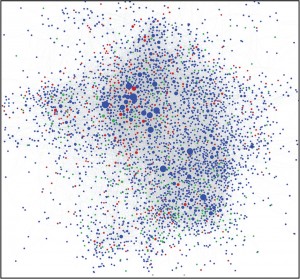
Despite substantial progress, it is irrefutable that a gender gap persists in academia – as it does in many other professions. By 2010, women constituted 40 percent of assistant professors and 30 percent of associate professors but only 19 percent of full professors in the political science profession (source). These figures have gone up steadily but slowly (see here) and it would be tempting to believe that the disappearance of the gender gap is merely a matter of time.

Yet, there are still structural obstacles that stand in the way of full equality. Those range from overt sexism to (more commonly) implicit biases and the fact that men on average still do less than 50 percent of childcare and household tasks. The intense discussions surrounding Anne-Marie’s Slaughter‘s article on work-life balance, Sheryl Sandberg‘s Lean In, and the New York Times article on gender issues at the Harvard Business school illustrate that concerns about gender equality in universities and workplaces are alive and well.

And for good reasons. Women are still more likely to consider dropping out of graduate school. There is ample evidence of persistent implicit biases. For example,psychologists have found that women are described in more communal terms in letters of recommendation and that such communal characteristics negatively affect hiring decisions in academia.

More here. In the symposium:

Explaining the gender gap Jane Mansbridge

How to reduce the gender gap in one (relatively) easy step B.F. Walter

Closing the gender citation gap: Introducing RADS Daniel Maliniak and Ryan Powers

Why it matters that more women present at conferences Sara McLaughlin Mitchell

Student evaluations of teaching are probably biased. Does it matter? Lisa Martin

The gender gap from the gatekeeper’s perspective Rick Wilson

Editors and the gender gap Marijke Breuning

Why is work by women systematically devalued? Brett Ashley Leeds

Gender bias in professional networks and citations David Lake

The gender citations gap: A glass half-full perspective Beth Simmons

Jonathan Franzen’s Love Letter to the Doyen of Jewish Intellectual Vienna

Karl_kraus_100113_620px80

Adam Kirsch in Tablet:

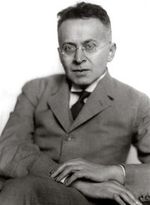
For all its variety, Vienna’s Jewish intelligentsia had one thing in common: They all read Karl Kraus. In his autobiography, Elias Canetti describes how he moved to Vienna as a young man and was immediately told that he had to start reading Kraus’ magazine Die Fackel (“The Torch”) if he wanted to be au courant. Die Fackel was not just edited by Karl Kraus; after a few years, he was its sole contributor, and it became a decades-long virtuoso performance. The best English-language book about Kraus is titled The Anti-Journalist, by Paul Reitter, and Die Fackel can best be considered anti-journalism: journalism that attacked and criticized everyone, including other journalists.

In its pages, Kraus held up for mockery everything he hated about Viennese and Austrian society, which was everything: the government, the military, the law, business, advertising, consumer culture, the theater, literature, and above all, the press. His greatest target was Vienna’s main newspaper, the Neue Freie Presse, which was as authoritative in Austria then as the New York Times is in America today. To Kraus, however, the paper was both linguistically and politically corrupt, and he never tired of pointing out everything from clichéd language to actual cases of influence-peddling. In response, the editor of the Neue Freie Presse made a rule that Kraus’ name was never to be mentioned in its columns.

Kraus was such an influential figure, in such an influential time and place, that his name has come down to us through many channels. Canetti writes about him, as do Walter Benjamin and Gershom Scholem; he figures in a small way in the life of Freud, whom he predictably despised. But the actual substance of Kraus’ work remains curiously ghostly in the English-speaking world. While the whole run of Die Fackel is available online in the original German, only small selections have been translated. And even those are hard to appreciate, because of the intensely topical and critical nature of Kraus’ writing. His work took the form of commentary on local figures, passing scandals, the latest books and newspapers—none of which have even the slightest resonance for a 21st-century American reader. That Kraus exercised an enormous moral and literary authority is beyond doubt, but it’s impossible for us to really feel that authority; we have to take it largely on trust.

That situation is not changed by the appearance of The Kraus Project, the admirable and deeply eccentric new book by Jonathan Franzen.

More here.

Love & Death: Bollywood tackles assisted suicide

Jennifer Hancock in The Humanist:

Hancock2-300x240Suicide is a complex issue. To fully understand the implications of any assisted-suicide policy, we ideally should weigh the pros and cons. The problem is that most of our discussions about it are polarized. We choose a side based on personal or partisan preferences and argue without really engaging in the proper give-and-take that’s required for critical thinking. Likewise, one of the reasons it’s so hard to have a rational conversation about a person seeking help to end their life is that we all have a tendency to want to impose our ideas and our preferences on the actions and decisions of others. Do any of us have the right to second-guess another person’s decision about something as intimate as whether to continue living or not? And yet second-guessing is what we all do.

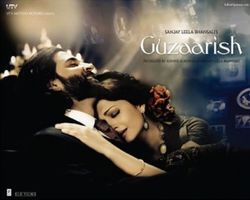
This brings us to Guzaarish (which in English means “request”). Ethan Mascarenhas (played by Hrithik) is a former magician paralyzed from the neck down as a result of a stage accident. He’s made a new career for himself as a motivational disc jockey, encouraging his listeners not to give up hope. It doesn’t matter your situation, he tells them, live life to the fullest and live life joyously. Indeed, Ethan is a very humanistic character. But on the fourteenth anniversary of his accident, when he calls his lawyer and friend Devyani to request her assistance in obtaining the right to commit suicide, his message comes into question. After a judge rejects Ethan’s petition, Devyani urges him to garner public support through his radio show. His campaign, which he dubs “Project Euthanasia,” becomes a big story. People are shocked and everyone in the country thinks they have the right to weigh in on whether Ethan should be allowed to die or not.

More here.

Delayed aging is better investment than cancer, heart disease research

From KurzweilAI:

SeniorsA new multi-university study shows that research to delay aging and the infirmities of old age would have better population health and economic returns than advances in individual fatal diseases such as cancer or heart disease. With even modest gains in our scientific understanding of how to slow the aging process, an additional 5 percent of adults over the age of 65 would be healthy rather than disabled every year from 2030 to 2060, revealed the study in the October issue of Health Affairs.

Put another way, an investment in delayed aging would mean 11.7 million more healthy adults over the age of 65 in 2060. The analysis, from top scientists at the University of Southern California (USC), Harvard University, Columbia University, the University of Illinois at Chicago and other institutions, assumes research investment leading to a 1.25 percent reduction in the likelihood of age-related diseases. In the U.S., the number of people aged 65 and over is expected to more than double in the next 50 years, from 43 million in 2010 to 106 million in 2060. About 28 percent of the current population over 65 is disabled. “In the last half-century, major life expectancy gains were driven by finding ways to reduce mortality from fatal diseases,” said lead author Dana Goldman, holder of the Leonard D. Schaeffer Director’s Chair at the USC Schaeffer Center for Health Policy and Economics. “But now disabled life expectancy is rising faster than total life expectancy, leaving the number of years that one can expect to live in good health unchanged or diminished. If we can age more slowly, we can delay the onset and progression of many disabling diseases simultaneously.”

More here.

Sunday Poem

Not the Heaven of Raccoons

philosophically and logistically speaking
there are some problems with my theory
of separate heavens for separate people
as my sister pointed out the other night
when we met for coffee after going to
the funeral home

wouldn't it be lonely she wondered

my response involves advanced theories of quantum physics in which the universe is expanding so fast that there are infinite alternate universes created which are almost identical to other universes except that in one universe there might be raccoons up in trees while hound dogs bark underneath them and in another universe the raccoons are in the cornfield feasting while in heaven right next door somebody has plugged a radio into a long extension cord and music from the local radio station has scared the raccoons away and bushels of corn are picked by a woman who loves the feel of the perfect ears in her hands because this is her heaven you see not the heaven of raccoons

by Julie Berry
from The Walnut Cracking Machine

Saturday, October 12, 2013

This Is the Average Man’s Body

James Hamblin in The Atlantic:

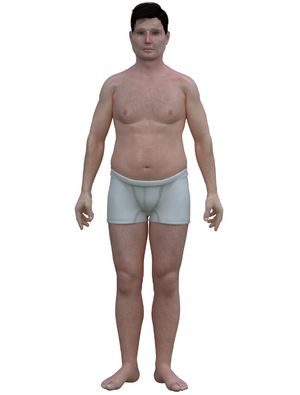
USA-Frontmanmain_jpgTodd is the most typical of American men. His proportions are based on averages from CDC anthropometric data. As a U.S. male age 30 to 39, his body mass index (BMI) is 29; just one shy of the medical definition of obese. At five-feet-nine-inches tall, his waist is 39 inches. Don't let the hyperrealistic toes fool you; Todd is an avatar. I gave Todd his name, and gave his life a narrative arc, but he is actually the child of graphic artist Nickolay Lamm as part of his Body Measurement Project.

Todd would prefer perfection—or at least something superlative, even if it's bad—to being average. But Todd is perfect only in being average. With this perfection comes the privilege of radical singularity, which is visible in his eyes. Though in his face this reads lonesome, Todd does have three international guyfriends. They met at a convention for people with perfectly average bodies, where each won the award for most average body in their respective country: U.S., Japan, Netherlands, and France. The others' BMIs, based on data from each country's national health centers, are 23.7, 25.2, and 25.6. I named them all Todd, actually, even though it could be confusing, because not everyone's name is a testament to their cultural heritage.

More here.

The Evolutionary Ethics of E. O. Wilson

Whitley Kaufman in The New Atlantis:

Dr_-E_O_-Wilson--006In his new book The Social Conquest of Earth (2012), naturalist E. O. Wilson argues that our best chance at understanding and advancing morality will come when we “explain the origin of religion and morality as special events in the evolutionary history of humanity driven by natural selection.” This is a bold claim, yet a familiar one for Wilson, who has been advocating something like this approach to human morality ever since his landmark 1975 work Sociobiology.

In that book, Wilson provocatively argued that “scientists and humanists should consider together the possibility that the time has come for ethics to be removed temporarily from the hands of the philosophers” and that ethics should instead be “biologicized”: questions once debated seemingly without end by philosophers will be settled by biologists using the same methods by which they have explained digestion, reproduction, and all of the other evolved drives and functions of the body. The unification of science and morality, on Wilson’s count, would be a much-needed revolution for ethics. ut it has also long been one of the desiderata of the Enlightenment project — which has been so successful in fulfilling its promise of advancing our scientific knowledge and our material wellbeing, yet seems to have made so little progress in settling debates over ethics. The consilience of the human and natural sciences that Wilson’s sociobiological project promises would carry on the scientific method’s “unrelenting application of reason” to the field of ethics, and finally begin to establish a stable, wise, and enduring ethical code for the future.

More here.

Jonathan Franzen’s ‘Kraus Project’

13SUBFAWCETT-articleInlineEdmund Fawcett at the NY Times:

Placing Kraus was never easy, least of all for Kraus. Like many educated West European Jews, he favored assimilation, not Zionism. In 1899 he abandoned Judaism and in 1911 joined the Catholic Church, only to abandon that in 1923. His great love was the aristocrat Sidonie Nadherny; when she ended their long liaison, some guessed it was because he was “still a Jew” — a phrase Kraus himself had used satirically to mock veiled hostility to assimilated Jews. More probably she saw too little room for a second person in Kraus’s one-man show.

In making a present-day case for Kraus, Franzen has avoided the easy choice. Rather than a tasty serving of epigrams, he and two scholarly Germanists have chosen a pair of essays from the early 1900s that, Franzen believes, speak powerfully to us now. The first is on Heinrich Heine (1797-1856), who along with Goethe was one of Germany’s most famous 19th-century poets. Kraus aimed to knock Heine off the perch where “progressive” middle-class taste had placed the poet as a domesticated house radical. The second essay championed the sparkling musical farces and unpreachy social comedies of an Austrian actor-playwright, Johann Nestroy (1801-62). In both pieces Kraus attacks cultural pretension, false sentiment, cheap irony and reckless faith in progress, especially the economic and technological kinds.

more here.