Cord Jefferson in Gawker on plausibly deniable racism:

Read more here.

Cord Jefferson in Gawker on plausibly deniable racism:
Read more here.
Kamila Shamsie in The Guardian:
It is dangerous to write openings as compelling as Donna Tartt's. In The Secret History, the one-page prologue gives us a murder and a narrator who has helped to commit it. The Little Friend starts with the death of a child who, by page 15, is found hanging by a piece of rope from a tree branch, his red hair “the only thing about him that was the right colour any more”. And now, in The Goldfinch, Tartt has a 50‑page two-part opening. In the first section, the narrator, Theo Decker, is holed up in an Amsterdam hotel, looking at newspapers written in Dutch, which he can't understand; he is searching for his name in articles illustrated with pictures of police cars and crime scene tapes. Before any of this is explained, the story moves back 14 years to the day Theo's mother dies, when he is on the cusp of adolescence. Her death takes place in New York's Metropolitan Museum, as a consequence of an exploding bomb – mother and son are in separate rooms when the bomb blast occurs, and the descriptions of Theo regaining consciousness in the wreckage, and trying to find his way out of the ripped-apart museum before returning home, expecting to find his mother there, are written in astonishingly gripping prose. This is, of course, where the danger comes in: if, at the end of the kind of set piece to which the word “climactic” should emphatically apply, you still have 700 pages to go, aren't you setting your readers up for disappointment? Astonishingly, the answer is no.
…Plot and character and fine prose can take you far – but a novel this good makes you want to go even further. The last few pages of the novel take all the serious, big, complicated ideas beneath the surface and hold them up to the light. Not for Tartt the kind of clever riffs, halfway between standup comedy and op-ed columns, which are too commonly found in contemporary fiction. Instead, when plot comes to an end, she leads us to a place just beyond it – a place of meaning, or, as she refers to it, “a rainbow edge … where all art exists, and all magic. And … all love.”
More here.
From Science:
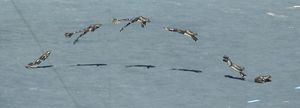
…In 2009, Henry Astley, then a Ph.D. student at Brown University, and colleagues brought a video camera in hopes of learning more about how far frogs can jump. The frogs perform their hops on the floor of a stadium, one at a time, through days of qualifying rounds. “Fortunately, it turns out we were able to measure the frog jumps without getting in anyone's way, by videotaping the arena from a seat in the stands,” Astley says. During the contest, an announcer says the name of each frog. “Quite a few Kermits,” Astley says. “Mr. Slimy, things like that.” Then it's time for the “frog jockey” to motivate his or her amphibian. “They literally will lunge their whole body after the frogs, imitating a predator—reaching for it and yelling and everything, trying to scare it.” (The local agricultural association has a frog welfare policy.) When the researchers got back to the lab with more than 20 hours of high-definition video, they measured the length of each jump. Fifty-eight percent of the 3124 jumps they recorded were longer than 1.295 meters, the longest jump reported in the scientific literature. One athletic bullfrog covered 2.2 meters in a single bound. Unsurprisingly, frogs jumped by professionals—those committed entrants who catch their own frogs every year and screen them for jumping ability ahead of time—managed longer jumps.
More here.
Leland de la Durantaye in the Boston Review:

Italo Calvino’s most famous novel, If on a Winter’s Night a Traveler (1979), includes just such a formula in its title but does not begin with it. Its first lines are: “You’re beginning to read Italo Calvino’s new novel If on a Winter’s Night a Traveler. Relax. Take it in. Dispel every other thought. Let the world around you fade.” A few pages later the voice addressing you walks you back through how you came to find yourself in this position: “You went to the bookstore and bought it. You did the right thing.” This voice then turns back the clock still earlier, telling you of your past experience with books, of the other books in the bookstore and the many categories into which they fall, “Books You Haven’t Read, which were frowning at you from the tables and shelves, trying to intimidate you,” and which are not to get you down because
you know you must never allow yourself to be awed, that among them there extend for acres and acres the Books You Needn’t Read, the Books Made For Purposes Other Than Reading, Books Read Even Before You Open Them Since They Belong To The Category Of Books Read Before Being Written.
This voice soon returns you to your home—or, at least, a home—sees to it that you are—or a character with whom you are to identify is—comfortable and ready to begin doing what you have been doing: reading. “You prepare to recognize the unmistakable tone of the author. No. You don’t recognize it at all.” After a moment of uncertainty, you are told that “you prefer it this way, encountering something and not yet quite knowing what it is.”
More here.
Joseph Brownstein in Al Jazeera:

The study, — a collaboration of researchers in the U.S., Canada and Iraq appearing in the journal PLoS Medicine — included a survey of 2,000 Iraqi households in 100 geographic regions in Iraq. Researchers used two surveys, one involving the household and another asking residents about their siblings, in an attempt to demonstrate the accuracy of the data they were collecting. Using data from these surveys, researchers estimated 405,000 deaths, with another 55,800 projected deaths from the extensive migration in and emigration from Iraq occurring as a result of the war.
The researchers estimated that 60 percent of the deaths were violent, with the remaining 40 percent occurring because of the health-infrastructure issues that arose as a result of the invasion — a point they emphasized in discussing their research, since the figure is higher than those found in previous studies.
More here.
Justin E. H. Smith in his own blog:

It is with respect to animals, in particular, that these folk commitments might be thought at once to carry with them significant moral implications. Ordinarily, animals are taken as individual beings par excellence, and this at least since Aristotle said, in the Categories, that what he means by 'substance' is really just 'this particular horse or man' (to paraphrase).
Animals lose their substantial unity in slaughter and preparation, yet even there they frequently maintain their conceptual unity: for Thanksgiving, e.g., a family has a turkey, and that is as much a single, individual entity as the living, strutting tom that preceded it. The further we move down the scale of ritual importance, it seems, the more likely the creature, following its slaughter, is going to be treated as a mass, or, ironically, as a 'substance' not in the Aristotelian sense but in the decidedly modern sense (of which the dreaded 'pink slime' is arguably a limit case, much like prime matter in Aristotle's scheme).
More here.
Gwynn Guilford in Quartz:

En masse, jellyfish are a bigger problem. “The [moon jellyfish swarm] phenomenon…occurs at regular intervals on Sweden’s three nuclear power plants,” says Torbjörn Larsson, a spokesperson for E.ON, which owns Oskarshamn. Larsson wouldn’t say how much revenue the shutdown cost his company, but noted that jellyfish also caused a shutdown in 2005.
Coastal areas around the world have struggled with similar jellyfish blooms, as these population explosions are known. These blooms are increasing in intensity, frequency, or duration, says Lucas Brotz, a jellyfish expert at the University of British Columbia.
Brotz’s research of 45 major marine ecosystems shows that 62% saw an uptick in blooms (pdf) since 1950. In those areas, surging jellyfish numbers have caused power plant outages, destroyed fisheries and cluttered the beaches of holiday destinations. (Scientists can’t be certain that blooms are rising because historical data are too few.)
More here. [Thanks to Tunku Varadarajan.]
Usha Alexander in Shunya's Notes:

Days later, another neighbor introduced us to her cleaning woman, newly arrived from West Bengal. ‘Does she speak Hindi?’ I asked. ‘No, she doesn’t speak Hindi or English or any language!’ the neighbor blurted with vague, exasperated disgust, while the short Bangla woman stood smiling shyly behind her; she was aware we were speaking of her but not of what we said.
I had heard such comments before in other middle-class Indian living rooms, when the workers whom we invite daily into our homes were cast by their employers as a mysterious band of them, their collective virtues and vices debated or condemned: they steal; they are lazy and don’t work; they are careless and clumsy, prone to breaking things; they’ve become ‘too smart’ and know how to play you. When our maid returned to work after being out just 3 or 4 days due to a slipped disk in her back, my neighbor remarked that ‘they recover quickly’ from illness and injury.
More here.
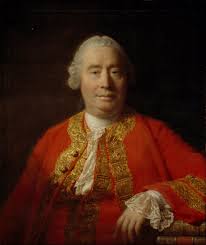
From James Fieser's ([email protected]) Hume Archives, over at Brad DeLong's blog:
Dear Sir,
It is with a real, though a very melancholy, pleasure that l sit down to give you some account of the behaviour of our late excellent friend, Mr. Hume, during his last illness.
Though, in his own judgment, his disease was mortal and incurable, yet he allowed himself to be prevailed upon, by the entreaty of his friends, to try what might be the effects of a long journey. A few days before he set out, he wrote that account of his own life, which, together with his other papers, he has left to your care. My account, therefore, shall begin where his ends.
He set out for London towards the end of April, and at Morpeth met with Mr. John Home and myself, who had both come down from London on purpose to see him, expecting to have found him at Edinburgh. Mr. Home returned with him, and attended him during the whole of his stay in England, with that care and attention which might be expected from a temper so perfectly friendly and affectionate. As I had written to my mother that she might expect me in Scotland, I was under the necessity of continuing my journey.
More here.
Jennifer L. Roberts in Harvard Magazine:

I want to focus today on the slow end of this tempo spectrum, on creating opportunities for students to engage in deceleration, patience, and immersive attention. I would argue that these are the kind of practices that now most need to be actively engineered by faculty, because they simply are no longer available “in nature,” as it were. Every external pressure, social and technological, is pushing students in the other direction, toward immediacy, rapidity, and spontaneity—and against this other kind of opportunity. I want to give them the permission and the structures to slow down.
More here.
Erika Check Hayden in Nature:
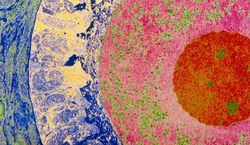
The FDA was asked to look into the issue by developmental biologist Shoukhrat Mitalipov at Oregon Health and Science University in Beaverton, who last year created early human embryos with the technique (see Nature http://doi.org/n76; 2012). When the manipulated eggs were fertilized, genetic abnormalities were detected in half of them — but seemingly normal embryonic stem-cell lines could be extracted from 38% of the rest. Trying to obtain stem cells from unmanipulated eggs results in a similar success rate. Mitalipov had used the same technique in 2009 to create apparently healthy rhesus monkeys. Now he wants to begin a clinical trial in humans.
More here.
The Nut of Knowledge
—Tao te Ching, V. 14
it won’t be seen when you look
won’t be grasped when you reach
won’t be heard when you turn an ear
it’s not bright above nor dark below
seamless and un-namable
it is from and goes to no-thing
the no-form form-source
subtle and without image
preceding conception
passing beyond
trace it to its no-beginning
track it to its no-end
it can’t be known
only lived as ease in your own life
to understand where you’re from
is the nut of knowledge
.
from the Tao te Ching or Lao Tzu
Adam Mann in Wired:

How do you objectively measure creativity in movies? Though there’s probably no perfect way, the recent research mined keywords generated by users of the website the Internet Movie Database(IMDb), which contains descriptions of more than 2 million films. When summarizing plots, people on the site are prompted to use keywords that have been used to describe previous movies, yielding tags that characterize particular genres (cult-film), locations (manhattan-new-york), or story elements (tied-to-a-chair).
Each keyword was given a score based on its rarity when compared to previous work. If some particular plot point – like, say, beautiful-woman – had appeared in many movies that preceded a particular film, it was given a low novelty value. But a new element – perhaps martial-arts, which appeared infrequently in films before the ’60s – was given a high novelty score when it first showed up. The scores ranged from zero to one, with the least novel being zero. Lining up the scores chronologically showed the evolution of film culture and plots over time. The results appeared Sept. 26 in Nature Scientific Reports.
More here.
Michael P. Lynch in the New York Times:
Even if the immediate crises — the partial shutdown and the looming debt default — are resolved, we will still be living in a dangerous political moment. The danger in question is because of the recent emergence of a political philosophy — and I mean that in the loosest sense — which threatens to unravel our joint commitment to a common democratic enterprise.
What is the “political philosophy” I have in mind? The conservative writer John Tamny at Forbes.computs it this way: “It quite simply must be asked,” he writes, “what the point of the Republican Party is if it’s not regularly shutting down the federal government?” No point at all, Tamny seems to think, suggesting that “shutdown should be a part of the G.O.P.’s readily unsheathed arsenal of weapons meant to always be shrinking the size and scope of our economy-asphyxiating federal government.”
It is tempting to call this “crazy talk” and unserious bluster. But it isserious, and it shows that some people are thinking about what happens next. It is a plan that represents the logical limit of the views now being entertained on the radical right, not just in the dark corners of the Internet, but in the sunlight of mainstream forums.
More here.
Jess Cotton in Prospect:
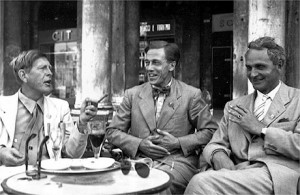
Auden has always seemed ripe for quotation. One of Lyndon Johnson’s 1964 campaign ads included the signature line “We must love one another or die” from Auden’s poem “September I, 1939.” Two decades later, Auden’s lyric “Stop all the clocks” became the signature elegy of the AIDS era, and later made a cameo appearance in the 1994 romcom Four Weddings and a Funeral. Faber and Faber immediately cashed in withTell me the truth about love, a pamphlet which sold a reputed 275,000 copies. Auden’s lines are quoted, misquoted, appropriated, parodied, often without any attribution to the poet himself. Our language is peppered with his neologisms, not least the “Age of Anxiety,” defined in the OED as “a catch-phrase of any period characterised by anxiety or danger.”
More here.
Robert Kuttner in the Huffington Post:
I know it looks just terrible for us right now. Our caucus is badly split, we are getting killed in the polls, we have had to drop the demand to defund Obamacare, all the corporate leadership is mad at us for playing roulette with the debt, and there are even some likely primary challenges from mainstream business Republicans to our Tea Party incumbents.
But fear not. We may lose a battle, but we will win this war. Why? Barack Obama will save us. He always does.
In the end game, we will agree to reopen with government with a continuing resolution and we will allow an extension of the debt for several months. But in return, President Obama will finally put on the table a version of the Grand Bargain for deeper cuts in social spending.
That means cuts in Social Security and Medicare and in other domestic programs. Obama has already put the so-called chain-weighted CPI, a disguised cut in Social Security, in his own budget. So that is the starting point for our negotiations. And of course we will steadfastly refuse to raise taxes.
On domestic discretionary spending, the current spending budget that Obama has acceptedis already below the level of the Paul Ryan budget!
With these negotiations, the next budget will be even lower.
For now, we are getting something of a black eye in the press, but our long-term strategy is working.
More here.

The cockroaches in Tel Aviv are nuclear-apocalypse huge. How adorable, how terribly petite the roaches of New York seem to me now. In a million years, the spacemen who descend to this place will find only styrofoam cups and the hard-shelled family living under my sink. I am a coward. Afraid to get close, I kill them with a chemical spray. They fall from the wall or garbage bin, thud. They heave madly in tortured circles, stopped by convulsions that come at smaller and smaller increments, cramming themselves into the ground as if to disappear. Their stomachs bulge and seep out. After they die — or as they are dying — their feelers twitch, twitch, twitch.
This was the month for gas masks in Israel. Fearing that Assad might use his sarin-bearing rockets on Israel next, those who did not yet have gas masks picked one up at the post office. Every outlet reported it, and every lede was the same: “Long lines and high tensions in Israel today as civilians obtain gas masks from local distribution centers…” I don’t have a gas mask. I’m not a citizen, and therefore not eligible for a free gas mask from the post office. I can buy one for — 400 sheckels — a bit over $100 from a war profiteer.
more here.