Zadie Smith manages to shrink the novel

Louise Doughty in The Guardian:

Deft--Zadie-Smith-at-the-009Those who love short-form fiction have had reason to cheer recently: the success of high profile competitions such as the BBC Short Story award, Sunday Times EFG Short Story award and the new Costa Short Story award; and now Alice Munro winning the Nobel after several decades of producing quietly brilliant volumes. A literary form declared dead on the slab a few years ago has proved to have a soft but resolutely pumping pulse.

At first glance, Zadie Smith's new volume might seem part of that resurgence. Numbering 69 small pages with a lot of white space, it's an extended story that first appeared in the New Yorker earlier this year and is now being published simultaneously as an ebook, audio book read by Smith herself and handy, pocket-sized hardback. The Embassy of Cambodia isn't a short story, though. It's a novel in miniature, divided into 21 tiny “chapters”, each of which is a brief scene that encapsulates what many writers would take several thousand words to say. Reading it is a bit like having a starter in a restaurant that is so good you wish you had ordered a big portion as a main course, only to realise, as you finish it, that it was exactly the right amount. It begins in a somewhat disconcerting manner – in the narrative form of the fourth person, or first person plural: “we”. “Who would expect the Embassy of Cambodia? Nobody. Nobody could have expected it, or be expecting it. It's a surprise to us, that's all… we, the people of Willesden.” At this stage, the reader might suspect Smith of having an in-joke at the expense of those who have stereotyped her as a poster girl for tales of cheery multiculturalism in a particular corner of north-west London.

Later this “we” turns out to be an elderly lady standing on a balcony of an old people's home, “barely covered” in her dressing gown: the kind of distressed yet omniscient figure who appears to command and control many an inner-city street.

More here.

The Pills of Last Resort: How Dying Patients Get Access to Experimental Drugs

Darshak M. Sanghavi in The New York Times:

DrugIt was shortly after the breadbasket arrived last year at the Temple Bar near Harvard Square that Sarah Broom first told me about the last-ditch plan to save her own life. Broom’s mere presence that evening was something of a miracle. Several years earlier, in 2008, while pregnant with her third child, she received a harrowing diagnosis. A 35-year-old English lecturer and poet living in New Zealand, Broom developed a persistent cough. She saw doctors in Auckland repeatedly over the course of a few months, but they didn’t want to do an X-ray on a pregnant woman. Finally, her shortness of breath became so severe that they relented, and 29 weeks into her pregnancy, she was found to have a large mass on her lung. She underwent a cesarean section — her daughter was born almost three months early — and a biopsy. Broom had advanced-stage lung cancer. “I was told nothing could be done to cure the cancer, but that various treatments could give me time,” she recalled. Less than 1 percent of patients live more than five years. She endured chemotherapy for weeks but then developed severe pelvic pain. To her horror, tests showed there was a new plum-size tumor on her ovary that wasn’t present at her C-section. The cancer was spreading relentlessly. Broom’s doctors predicted she had only a few months to live. She worried about her two sons, Daniel and Christopher, ages 5 and 2; her husband, Michael, whom she’d been with since they were teenagers; and her premature baby, Amelia, who was still hospitalized in the newborn unit. “My determination was to live, to live a long time — what else could I do, with three little kids depending on me — but at this time, it was clear that the situation looked pretty dire indeed,” Broom told me.

In desperation, she called friends around the world, including Meghan O’Sullivan, a former deputy national security adviser in the Bush administration, who contacted Bruce Chabner, the director of clinical research at Massachusetts General Hospital Cancer Center in Boston. Chabner asked Broom to send him her biopsy, so he could analyze its DNA. Her tumor had a mutation in a gene called anaplastic lymphoma kinase, or ALK, which occurs in about 5 percent of lung cancers. A Japanese group discovered it only a year earlier. Chabner knew that the drug company Pfizer was developing a new compound called crizotinib that might treat this mutation. The trouble was, it had been given to only two ALK-positive people before, and one died anyway. Still, it was Broom’s only hope, and Pfizer agreed to enroll her in a trial in Australia. Incredibly, the tumors shrank by half, and Broom led an almost normal life for two years.

More here.

Is Glenn Greenwald the Future of News?

Bill Keller in the New York Times:

Keller_New-articleInline-v2Much of the speculation about the future of news focuses on the business model: How will we generate the revenues to pay the people who gather and disseminate the news? But the disruptive power of the Internet raises other profound questions about what journalism is becoming, about its essential character and values. This week’s column is a conversation — a (mostly) civil argument — between two very different views of how journalism fulfills its mission.

Glenn Greenwald broke what is probably the year’s biggest news story, Edward Snowden’s revelations of the vast surveillance apparatus constructed by the National Security Agency. He has also been an outspoken critic of the kind of journalism practiced at places like The New York Times, and an advocate of a more activist, more partisan kind of journalism. Earlier this month he announced he was joining a new journalistic venture, backed by eBay billionaire Pierre Omidyar, who has promised to invest $250 million and to “throw out all the old rules.” I invited Greenwald to join me in an online exchange about what, exactly, that means.

Dear Glenn,

We come at journalism from different traditions. I’ve spent a life working at newspapers that put a premium on aggressive but impartial reporting, that expect reporters and editors to keep their opinions to themselves unless they relocate (as I have done) to the pages clearly identified as the home of opinion. You come from a more activist tradition — first as a lawyer, then as a blogger and columnist, and soon as part of a new, independent journalistic venture financed by the eBay founder Pierre Omidyar. Your writing proceeds from a clearly stated point of view.

More here.

Tuesday Poem

Poem
.
.
Form in the woods: the beast,
a bobcat padding through red sumac,
the pheasant in break or goldenrod
that he stalks – both rise to the flush,
the brief low flutter and catch in air;
and trees, rich green, the moving of boughs
and the separate leaf, yield
to conclusions they do not care about
or watch – the dead, frayed bird,
the beautiful plumage,
the spoor of feathers
and slight, pink bones.
.

by Jim Harrison
from The Shape of the Journey
Copper Canyon Press, 1998

Monday, November 4, 2013

Sunday, November 3, 2013

IBM’s Watson is better at diagnosing cancer than human doctors

Ian Steadman in Wired:

IbmwatsonAccording to Sloan-Kettering, only around 20 percent of the knowledge that human doctors use when diagnosing patients and deciding on treatments relies on trial-based evidence. It would take at least 160 hours of reading a week just to keep up with new medical knowledge as it's published, let alone consider its relevance or apply it practically. Watson's ability to absorb this information faster than any human should, in theory, fix a flaw in the current healthcare model. Wellpoint's Samuel Nessbaum has claimed that, in tests, Watson's successful diagnosis rate for lung cancer is 90 percent, compared to 50 percent for human doctors.

More here.

Bird!

Shatz_1-110713_jpg_250x1274_q85

Adam Shatz reviews Stanley Crouch's Kansas City Lightning: The Rise and Times of Charlie Parker, in the NYRB:

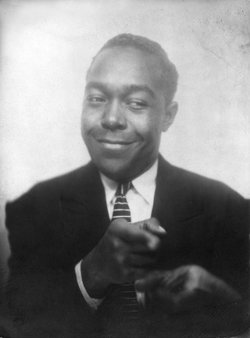
“Bird was kind of like the sun, giving off the energy we drew from him,” Max Roach said of the alto saxophonist Charlie Parker. The sun set early for Parker, who died at thirty-four of pneumonia on March 12, 1955. He spent his last few days in a suite at the Stanhope Hotel owned by the Baronness Nica de Koenigswarter, a Rothschild heiress who was well known for her patronage of jazz musicians. He’d been watching a juggler on the Tommy Dorsey show when he collapsed. A baseless rumor spread that the baroness’s lover, the drummer Art Blakey, either shot or knocked him out in the middle of a quarrel, but Parker, who had been shooting heroin since he was seventeen, hardly needed help killing himself. He was a world-class musician, but he was also a world-class addict. His body was so haggard that the doctor who examined him estimated his age at fifty-three.

Kansas City Lightning, the first volume of Stanley Crouch’s Parker biography, never gets to the Stanhope. It covers only the first twenty-one years of Parker’s life. But each page is haunted by the demons that brought down the man known as Bird. In the richly evocative set piece that opens the book, Parker turns up late for a gig at the Savoy Ballroom with the Jay McShann Orchestra. Crouch imagines the musicians on stage asking themselves, “Why did this guy have to be the guy with all the talent?… Why did his private life have to mess up everybody’s plans so often?” This is, of course, conjecture, but it’s not unreasonable to think that Parker’s bandmates might have wished that he was more like the courtly and punctual Duke Ellington. Parker often nodded off during concerts, or vanished midway through a set. When he wasn’t playing, he was copping for heroin. He stole from his family and friends. His most lasting relationship was with his horn, which he often pawned when he was in need of a fix. Miles Davis, who worshiped Parker, called him “one of the slimiest and greediest mother fuckers who ever lived.”

More here.

The Reluctant Giant: Why Germany Shuns Its Global Role

Image-538062-breitwandaufmacher-ustn

Ullrich Fichtner in Spiegel Online:

Today, 68 years after the end of the war and 24 years after the fall of the Berlin Wall, we Germans are respected, admired and sometimes even loved. The fact that we generally don't know what to do with all this admiration, because we collectively still seem to assume that we are not likeable and therefore must be unpopular, is a problem that very quickly becomes political. It's obvious that Germans' perception of themselves and the way we are perceived by others differ dramatically.

Even if some would not consider a travel guide to be the most credible basis for political reflections, it's easy to find other sources of praise for Germany and the Germans. The BBC conducts an annual poll to name the “most popular country in the world.” Germany came in a clear first in the latest poll, and it wasn't the first time. Some 59 percent of 26,000 respondents in 25 countries said that the Germans exert a “positive influence” in the world (and not surprisingly, the only country in which the view of Germany is overwhelmingly negative at the moment is Greece).

In the “Nation Brands Index” prepared by the American market research company GfK, which surveys more than 20,000 people in 20 countries about the image of various nations, Germany is currently in second place, behind the United States. This index is not some idle exercise, but is used as a decision-making tool by corporate strategists and other investors. GfK asks questions in six categories, including the quality of the administration and the condition of the export economy, and Germany is at the top of each category. But when Germans do acknowledge their current standing in the world, they always seem to be somewhat coy or even amused.

The rest of the world doesn't understand this (anymore). The rest of the world is waiting for Germany. But instead of feeling pleased about Polish Foreign Minister Radoslaw Sikorski's historic statement that he fears Germany's power less than its inactivity, we cringe anxiously over such sentiments. When US President Barack Obama calls Germany a leading global power, we hope that he doesn't really mean it. And when politicians in Israel say that Germany should wield its power more actively, we don't interpret it as a mandate to become more committed, but are puzzled instead.

We Germans? Exercise power? Take action? Lead?

More here.

The American Mommy Wars

Beja_feminism_468w

Alice Béja in Eurozine:

Reading Hanna Rosin's End of Men, one would think Friedan completely obsolete. For Rosin, women are very close to taking over the world: they do better than men at school, and will benefit from the end of blue-collar jobs and the rise of the service industry. For Sheryl Sandberg, Facebook's chief operating officer, women have to “lean in” in order to make it in the workplace; they can succeed without giving up on having a family. The success of the few will benefit all; for Sandberg, the “trickle down” theory of wealth is applicable to the cause of women. In fact, according to Kate Bolick, women should relish the independence they gain through work, and enjoy their lives without succumbing to the fetters of marriage and children.

The debate about the place of women in the professional world has gained momentum in the United States mainstream media over the past two years, and has reignited the 1980s “mommy wars”, which, at the time, pitted housewives against working women, and were one of the legacy of the feminist movement led by Betty Friedan. Should women be more confident? Have they already won the struggle for professional emancipation? Or is it time to question the focus on work and career, and to reappraise the value of family life?

These issues are particularly sensitive in the United States, where women's social protection largely depends on their employer. For a while, they were sidelined by the struggle for reproductive rights, especially the fight to defend women's right to choose, Roe v. Wade being under threat in many states. The media's focus in this debate on women who are white, rich and have high-profile jobs has had two consequences on the national conversation around women and feminism: on the one hand, it has revived the language of “responsibility”, the “when there's a will there's a way” logic which is also applied to the poor and the unemployed, on the principle that if they're not making it, it means they don't want it enough. In this perspective, individual initiative alone is the key to success and if women are to make it in the professional world, they should simply “lean in”. On the other hand however, there has been a reaction against this paternalistic approach to women's place in society. Dissent published an issue on “the new feminism”, that stressed social issues and the fact that women, far from “having it all”, seldom have a choice between work and family; most of them have to work in order to be able to support their family.

More here.

You Can’t Learn About Morality from Brain Scans

Article_inset_nagel

Thomas Nagel in TNR:

Joshua Greene… asks how our moral beliefs and attitudes should be affected by these psychological findings. Greene began his training and research as a doctoral student in philosophy, so he is familiar from the inside with the enterprise of ethical theory conceived not as a part of empirical psychology but as a direct first-order investigation of moral questions, and a quest for systematic answers to them. His book is intended as a radical challenge to the assumptions of that philosophical enterprise. It benefits from his familiarity with the field, even if his grasp of the views that he discusses is not always accurate.

The book is framed as the search for a solution to a global problem that cannot be solved by the kinds of moral standards that command intuitive assent and work well within particular communities. Greene calls this problem the “tragedy of commonsense morality.” In a nutshell, it is the tragedy that moralities that help members of particular communities to cooperate peacefully do not foster a comparable harmony among members of different communities.

Morality evolved to enable cooperation, but this conclusion comes with an important caveat. Biologically speaking, humans were designed for cooperation, but only with some people. Our moral brains evolved for cooperation within groups, and perhaps only within the context of personal relationships. Our moral brains did not evolve for cooperation between groups (at least not all groups)…. As with the evolution of faster carnivores, competition is essential for the evolution of cooperation.

The tragedy of commonsense morality is conceived by analogy with the familiar tragedy of the commons, to which commonsense morality does provide a solution. In the tragedy of the commons, the pursuit of private self-interest leads a collection of individuals to a result that is contrary to the interest of all of them (like over-grazing the commons or over-fishing the ocean). If they learn to limit their individual self-interest by agreeing to follow certain rules and sticking to them, the commons will not be destroyed and they will all do well. As Greene puts it, commonsense morality requires that we sometimes put Us ahead of Me; but the same disposition also leads us to put Us ahead of Them.

More here.

Evolution: In Action

From lensculture:

EvoSix months of daily shooting of over 250 skeletons at the Museum of Natural History in Paris as well as 4 other locations in France. From the smallest to the biggest vertebrate, isolated in front of a black background, Patrick Gries presents these skeletons as sculptures. This series of stark black-and-white photographs offers an atypical approach to viewing natural science and forces us to reconsider the boundaries between artistic and scientific objects. Spectacular, mysterious, elegant, or grotesque, vertebrate skeletons are objects of art, while they carry within them the traces of several billion years of evolution.

The book Evolution from Editions Xavier Barral/Paris, in which more than two hundred fifty of Patrick Gries' photographs are accompanied with text written by scientist and documentarian Dr Jean-Baptiste de Panafieu. The result is a powerful pairing that profoundly illustrates how we came to be what we are. Evolution steps beyond the debate and presents the undeniable truth of Darwin's theory, showing through skeletons both obscure and commonplace, but always intriguing, the process by which life has transformed itself, again and again.

More here.

Amy Tan: a life that’s stranger than fiction

Jane Mulkerrins in The Telegraph:

At-home_2719522bIn her airy, elegant apartment, slap-bang in the centre of SoHo in New York, Amy Tan is explaining the squirm-inducing difficulty of writing sex scenes. “I was so worried people would think they were corny, or a reflection of my own sex life,” the author confesses with a slightly bashful smile. “And I started this book long before that Fifty Shades of Grey came out.” She shakes her head in horror at the notion of her novels being compared with that “mummy porn” hit. But Tan’s latest book, The Valley of Amazement, is set partly in a courtesan house in early-20th-century Shanghai – where women were working as prostitutes and mistresses – so the novel inevitably involves a fair amount of bedroom hoopla, and she deliberated, not simply over the deeds but over the language used to describe them. “I was determined to put certain words in there, words that I thought courtesans really would have used,” she tells me, in her soft, slightly sultry voice. “I didn’t want to be too coy, and I thought words like 'enter’ were a little pedestrian, but I was worried that 'f—’ and 'c—’ might be repulsive to some people.”

It’s more than a little incongruous to hear Tan, a poised, polite 61-year-old author of intelligent popular fiction, talking like a trucker. Her first novel, The Joy Luck Club, comprising 16 interlocking stories about four Chinese immigrant women and their American-born daughters, was on The New York Times bestseller list for 77 weeks and has been made into a Hollywood film. Her five subsequent novels, including The Kitchen God’s Wife and The Bonesetter’s Daughter, have been wildly successful too, translated into more than 35 languages, and she’s also written children’s books and non-fiction. The American-born daughter of Chinese immigrant parents, Tan is credited with sparking the trend for fiction that explores ethnic identity. Her books are set against sweeping historical backdrops; part of the difficulty with her latest work, she says, was that no one had conducted any serious research into courtesan houses of that era.

More here.

Saturday, November 2, 2013

Gambling with Civilization

Paul Krugman reviews The Climate Casino: Risk, Uncertainty, and Economics for a Warming World, by William D. Nordhaus, in the New York Review of Books:

Krugman_1-110713_jpg_250x1413_q85Forty years ago a brilliant young Yale economist named William Nordhaus published a landmark paper, “The Allocation of Energy Resources,” that opened new frontiers in economic analysis.1 Nordhaus argued that to think clearly about the economics of exhaustible resources like oil and coal, it was necessary to look far into the future, to assess their value as they become more scarce—and that this look into the future necessarily involved considering not just available resources and expected future economic growth, but likely future technologies as well. Moreover, he developed a method for incorporating all of this information—resource estimates, long-run economic forecasts, and engineers’ best guesses about the costs of future technologies—into a quantitative model of energy prices over the long term.

The resource and engineering data for Nordhaus’s paper were for the most part compiled by his research assistant, a twenty-year-old undergraduate, who spent long hours immured in Yale’s Geology Library, poring over Bureau of Mines circulars and the like. It was an invaluable apprenticeship. My reasons for bringing up this bit of intellectual history, however, go beyond personal disclosure—although readers of this review should know that Bill Nordhaus was my first professional mentor. For if one looks back at “The Allocation of Energy Resources,” one learns two crucial lessons. First, predictions are hard, especially about the distant future. Second, sometimes such predictions must be made nonetheless.

More here.

Do You Say “Amongst” Instead of “Among”? Here’s Why

Ben Yagoda in Slate:

ScreenHunter_382 Nov. 02 22.54In the first episode of the Showtime series Masters of Sex, William Masters is talking to a prostitute named Betty, and notes that she faked an orgasm during sex. “Is that a common practice among prostitutes?” he asks her. “It’s a common practice amongst anyone with a twat,” replies Betty.

Clearly, two words contribute to the humor of Betty’s comeback, and the second isamongst. The show takes place in America in the 1950s, which is relevant because in that time and place virtually nobody said amongst. For the past few centuries,amongst has been a distinctly British word, though even there among is more popular. In the United States, according to the Google Books database, the last timeamongst was about as common as among was in 1720.

Curiously, however, amongst appears to be on the upswing.

More here.

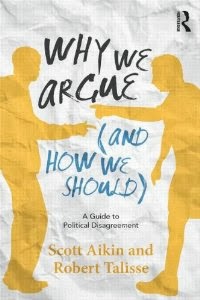
Why Why We Argue?

Our own Scott Aikin and Robert Talisse at the website of their book Why We Argue (And How We Should):

BookcoverWhy We Argue (And How We Should) is a book about logic and politics. The jokes write themselves. As one person put it to us, “The book's about logic and politics? It'll be a mighty short book!” We appreciate the humor. Nevertheless, there's something disconcerting about the underlying premise that it's ridiculous to expect our politics to be logical. In fact, those who joke about the irrationality in our politics most often exempt themselves and their political allies from the charge. That is, the jokes are driven not by the claim that we humans are fundamentally lacking in logical ability; rather the claim is that politics is illogical because only some of usare properly rational. Conveniently, in most cases, the logical/illogical divide tracks the joker's own political views: it is those with whom she politically disagrees that are failing at logic. Accordingly, for many of those who joke in this way, the task of making politics more logical is the task of removing from politics all opposition to their own favored political views. And that thought is no joke.

In Why We Argue, we affirm the idea that politics ought to be rational. Indeed, we hold that our current politics reflects the aspiration to have our collective lives governed by reason. Why We Argue is a book about logic and politics because our politics already attempts to be logical. The trouble, of course, is that it is so difficult to make good on our shared aspiration.

More here.