Sunday Poem

A Barred Owl

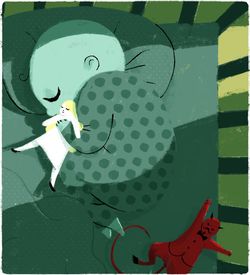
The warping night air having brought the boom
Of an owls voice into her darkened room,
We tell the wakened child that all she heard
Was an odd question from a forest bird,
Asking of us, if rightly listened to,
“Who cooks for you?” and then “Who cooks for you?”

Words, which can make our terrors bravely clear,
Can also thus domesticate a fear,
And send a small child back to sleep at night
Not listening for the sound of stealthy flight
Or dream of some small thing in a claw
Borne up to some dark branch and eaten raw.

by Richard Wilbur
from Collected Poems, 1943 – 2004

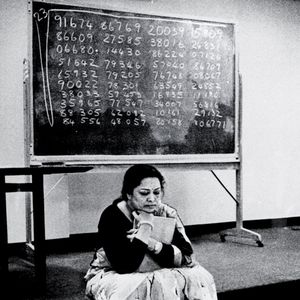
Feats of mathematical greatness: Shakuntala Devi (1929-2013)

Maggie Jones in The New York Times:

DeviIn retrospect, it seems inevitable that the 3-year-old girl with pigtail braids would end up on the stage. Her father was a traveling magician, and for seven generations before him, the men of the family were performers of a different sort: Brahmin priests and astrologers. So when the tiny, preschool-age girl named Shakuntala Devi effortlessly memorized an entire shuffled deck of cards at one of her father’s shows, he lifted her onto a table for her debut. In another time, in another place, in another family, the child prodigy might have honed her skills with tutors and math classes. But this was the 1930s in Bangalore, India, and Devi’s family was impoverished. Stage money was fast money; education, on the other hand, was a long-term investment her parents couldn’t afford. Every morning, Devi and her father headed out on foot to display her talents at schools and businesses. At 5, when other kids were learning to count to 100, she was extracting cube roots in her head and was the family’s sole money earner. Soon she started appearing at universities throughout southern India. By her teens, she had moved to bigger stages in England, saving just enough money to pay for her room and board and sending the rest home.

By adulthood, the duty to perform and travel had become a muscle that she couldn’t rest. For more than six decades, Devi packed her suitcase, often every several weeks, for England, the United States, Hong Kong, Japan, Sri Lanka, Italy, Canada, Russia, France, Spain, Mauritius, Indonesia and Malaysia. Before each performance, she needed an hour of silence. Then as soon as Devi stepped onstage in her flowing saris, her gold jewels and her pink lipstick, she was at ease and chatty. She asked for the birth years and dates of members of the audience: In one second or so, she pinpointed the day of the week on which they were born. Or she would rattle off the dates of, say, every Monday in a given year. “Is that correct?” she would ask. Yes, it was correct. Again and again, she was correct. She wowed the magician Ricky Jay on a CBS special, “Learned Pigs and Fireproof Women,” as she extracted roots from nine- and 10-digit numbers. She liked to see the numbers on a chalkboard, without commas, which interrupted their natural flow. The cube root of 849278123? The cube root of 2186875592? Then: Click. With a small shrug of her shoulders, she had the answer. On the BBC, she teased the host, David Frost, about the simplicity of her calculations. “You’ve got it?” she said, knowing full well he didn’t. “How do you do it?” TV hosts often asked. The question bored Devi, but she didn’t show it. “It’s a very automatic reaction. . . . I was born with this gift.”

More here.

Michele Bachmann as William F. Buckley’s spawn: How right-wing media spiraled out of control

Jeffrey M. Berry and Sarah Sobieraj in Salon:

Buckley_bachmann-620x412Michele Bachmann kicked off her 2012 presidential campaign in Waterloo, Iowa, where she was born and spent most of her childhood. During the speech announcing her candidacy, Bachmann emphasized her connections to the community, a theme she continued in subsequent interviews. In one interview with Fox News, Bachmann suggested that she shared the spirit embodied by John Wayne, Waterloo’s other native son. Unfortunately, the candidate’s facts were incorrect; John Wayne hailed from Winterset, Iowa, not Waterloo. This would have been a small detail, except that another nationally known John Wayne, John Wayne Gacy—who raped and murdered 33 boys in the 1970s—did, for a time, live in Waterloo. This left some in the media assuming that she had confused the two men. In an information environment rife with outrage outlets, it was more than a gaffe. It was political pornography. If you are an outrage-based liberal blog, headlines such as Wonkette’s “Michele Bachmann Launches 2012 Presidential Campaign by Praising ‘Killer Clown’ John Wayne Gacy,” are great for traffic, even if they are patently inaccurate. The video clip of Bachmann’s blunder hit YouTube and was posted on several liberal blogs including the Huffington Post and the Daily Kos, and reappeared on the left-leaning cable news analysis shows. After Keith Olbermann aired it on “Countdown,” he quipped (in response to Bachmann’s reference to her “spirit”), “The kind of spirit that mixes fact, fantasy, and often sheer stupidity in a potent blend that is really all her own.”

…Like Sarah Palin’s “refudiate” or Anthony Weiner’s repeated sexting faux pas, Bachmann’s serial killer faux pas was tantalizing click-bait—a snarky jab at a favorite target—too good to pass up. Indeed, according to the Project for Excellence in Journalism’s New Media Index, a full third of the newslinks on blogs from the week of the John Wayne Gacy error were about Michelle Bachmann, with her candidacy and the John Wayne Gacy gaffe noted as sharing the spotlight. This political mudslinging is not new, but over the last 25 years outrage as a genre has grown exponentially. In this chapter we dispel the myth that the outrage we see today has always been present—an unfortunate but unavoidable side effect of American democracy—showing that while outrage as a rhetorical style was not recently invented, its emergence as a genre is new.

More here.

Saturday, December 28, 2013

A Calm Look at the Most Hyped Concept in Neuroscience – Mirror Neurons

Monkey-mirror

Christian Jarrett in Wired, via Andrew Sullivan:

[A] pair of neuroscientists in London have published a welcome review in the respected journal Current Biology entitled “What we know currently about mirror neurons.” In contrast to the hype that usually surrounds these cells, James Kilner and Roger Lemon at UCL have taken a calm, objective look at the literature.

They acknowledge that it is difficult to interpret mirror neuron activity in humans (using brain imaging) and so they focus on the 25 papers that have involved the direct recording of individual brain cells in monkeys. This research reveals that motor cells with mirror-like properties are found in parts of the front of the brain involved in motor control (so-called premotor regions and in the primary motor cortex) and also in the parietal lobe near the crown of the head.

Reading their paper it soon becomes clear that the term “mirror neurons” conceals a complex mix of cell types. Some motor cells only show mirror-like responses when a monkey sees a live performer in front of them; other cells are also responsive to movements seen on video. Some mirror neurons appear to be fussy – they only respond to a very specific type of action; others are less specific and respond to a far broader range of observed movements. There are even some mirror neurons that are activated by the sound of a particular movement. Others show mirror suppression – that is their activity is reduced during action observation. Another study found evidence in monkeys of touch-sensitive neurons that respond to the sight of another animal being touched in the same location (Ramachandran calls these “Gandhi cells” because he says they dissolve the barriers between human beings).

Importantly, Kilner and Lemon also highlight findings from monkeys showing how the activity of mirror neurons is modulated by such factors as the angle of view, the reward value of the observed movement, and the overall goal of a movement, such as whether it is intended to grasp an object or place it in the mouth. These findings are significant because they show how mirror neurons are not merely activated by incoming sensory information, but also by formulations developed elsewhere in the brain about the meaning of what is being observed.

More here.

Danger Close: The Iraq War in American Fiction

FireWar-243x366

Ryan Bubalo in the LA Review of Books:

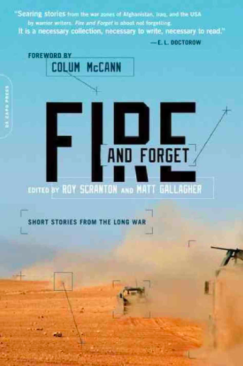
SOLDIER TALES produce their own tropes and metaphors, the unique hells of each war. World War I led us into the trenches. World War II carried us along for D-Day and dogfights. Vietnam was choppers, paddy field recons, and the smell of napalm in the morning. And now, while most of the country tries to forget the Iraq War ever happened, American Iraq fiction slams the doors on its underprotected Humvees and compels readers to take a perilous ride.

Fiction is, of course, serving rearguard here; the last decade has seen Iraq War films, poetry collections, documentaries, and non-fiction books too numerous to list, but part of what’s appealing about examining American Iraq War fiction now is that there isn’t that much yet. A common perspective unites this early wave of American Iraq War storytellers.“The war tried to kill us in the spring,” Kevin Powers writes in the elegant, elegiac opening of The Yellow Birds. Powers’ “us” could just as well include Ben Fountain’s Billy Lynn, David Abrams’ Gooding and Shrinkle, Lea Carpenter’s SEAL operators, and most of the protagonists in Fire and Forget, a collection of “short stories from the long war.” That “us” is the wife of Siobhan Fallon’s Meg in You Know When the Men Are Gone and the son of Lea Carpenter’s Sara. Because the texts that comprise the current corps of American fictions about Iraq are not just war stories, they are soldier tales.

David Simon’s Generation Kill and other early American works explored the halcyon invasion days of the war when the enemy and objectives were clear: topple Saddam, free Iraq. American fiction, though, focuses primarily on the occupation, and for American soldiers in occupied Iraq, there was driving and there were IEDs.

More here.

Peter Singer on Being a Utilitarian in the Real World

Petersinger

Over at the Rationally Speaking podcast, Massimo Pigliucci and Julia Galef:

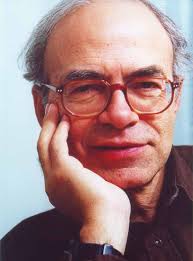
Few philosophers have as wide of an impact on the general public as ethicist Peter Singer, this week's guest on Rationally Speaking podcast. Singer's utilitarian arguments about how we should treat animals, why we have a moral obligation to give to charity, whether infants should count as “people,” and more have won him widespread fame — and notoriety — over the last few decades, and launched multiple movements. Tune in to hear his discussion with Massimo and Julia about why he's a utilitarian, and how his views of utilitarianism have recently changed (and find out how he influenced Massimo's life years ago).

More here.

bambi, so jewish

Reitter1Paul Reitter at Jewish Review of Books:

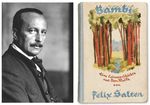
The years before the First World War mark the highpoint of Salten’s career as a Zionist speaker. He was invited back by Bar Kochba’s leaders, and when, in 1911, he made another appearance in the festive evening series, he shone just as brightly as he had the first time. But even after Zionist lecturing was mostly behind him, Salten continued to write as a Zionist. In 1924, for example, he travelled to Palestine and published a largely admiring book about what he saw there. This was soon after Salten had produced the work that would win him international fame: Bambi.

Bambi first appeared in serialized form in Vienna’s stately paper of record, the Neue Freie Presse. The book version appeared in 1923, and by then the story had established itself as one that appealed to adults and children alike. The American edition was so hotly anticipated that the fledgling Book of the Month Club ordered 50,000 copies before it had even appeared. Translated into English by Whittaker Chambers, of all people, and published in the United States in 1928, the novel was both a critical and commercial success.

more here.

Literature of the 1940s: War, Postwar and ‘Peace’

Final-eadeaoinÉadaoín Lynch at Dublin Review of Books:

Gill Plain’s first line, “There are many ‘1940s’”, is an illustration of not only the complexities of the decade, but of the difficulty of dividing history into arbitrary digestible ten-year periods. Despite this difficulty, Plain’s study offers an accessible, engaging overview of the decade’s literature. By placing texts parallel to historical settings, she allows for a greater understanding of the ways in which they overlap, and offers succinct insights that could be subjects for further studies in their own right. Take for example this observation: “The horror of 1945 is both anticipated and avoided by literature.” This paradoxical viewpoint, which many authors of the 1940s adopted, is a useful starting point in understanding the tensions apparent in the literature of this decade, when combatants and non-combatants were facing a Second World War within the great shadow of the First.

The general preface to the book, written by series editor Randall Stevenson, advises that, “history in the twentieth-century perhaps pressed harder and more variously on literary imagination than ever before, requiring a literary history correspondingly meticulous, flexible and multifocal”. It was because of this felt need that Edinburgh University Press began its History of Twentieth-Century Literature in Britain.

more here.

ON THE NOVELS OF JAMES PURDY

PurdyDaniel Green at The Quarterly Conversation:

Purdy’s alienation from the dominant literary culture as represented by both publishers and reviewers ultimately became quite profound, prompted, no doubt, by his acknowledgment of the perceived irrelevance of his books, although publishers had demonstrated indifference, if not outright hostility, to his earliest fiction as well. (His first important work, 63: Dream Palace, was published in Great Britain after it could find no publisher in the United States.) Yet it is also the case that Purdy did very little on his part to ameliorate the situation. He gave few friendly interviews, did not participate in any efforts to better “position” his work in the literary marketplace, and above all never tried to write differently in order to make his fiction more amenable to conventional expectations of “literary fiction.” For readers, journalists, or critics who are more interested in writers than writing, more concerned about business than literature, Purdy’s attitude might have understandably been frustrating. Similarly, some readers and critics might rightly have found Purdy’s fiction stubbornly idiosyncratic, but dismissing it as idiosyncratic before determining if those idiosyncrasies actually amount to a sustained artistic vision hardly seems a very serious response.

Indeed, those of us who have read deeply into Purdy’s fiction quickly enough realize that what could be called its idiosyncrasies are in fact its greatest strengths and that Purdy didn’t merely write one or two individually adventurous, original stories or novels but instead created a comprehensively original body of work, each separate work providing a variation on Purdy’s themes and methods but also exemplifying his larger achievement.

more here.

The Delhi Durbar and the Indian Diplomat

Rafia Zakaria in Chapati Mystery:

DelhiA ripe 110 years ago, in the year 1903, the Second Imperial Durbar was held in Delhi, to celebrate the coronation of King Edward the VII and Queen Alexandria as Emperor and Empress of India. Neither could attend, but Lord Curzon, then Viceroy of the Indian colony, decided that it would be a great opportunity to appropriate the spectacle as homage to the British rule of India. To insure that the spectacle would be appropriately, spectacular he ordered all the minion Maharajas of the Empire to arrive in their traditional garb, with large retinues, silks and elephants and punkahs; so they would look like Maharajas. In this neat directive, the Indian love of protocol was thus successfully employed in the service of Empire. That the arriving “rulers’ were not “rulers” but vassals of Empire, that their retinues and turbans and everything else meant nothing at all in relation to their ability to rule themselves, was the farce behind it all. The British left and Pakistan and India exchanged their misgivings against the British Empire with petty barbs and nuclear weapons directed at each other. It is a consuming concern; and has occupied millions on either side with its continuing pettiness and puffery for a near century. On either side; the love of pomp and protocol has remained; flagellated into democratic norms on one side and military machinations on the other. Indians and Pakistani leaders are united in their love of appropriating the discriminatory racism that was once heaped on them on the lesser others of their respective countries. Importance, value, worth on either side of the border equals never being mistaken for those ordinary hordes; And nowhere is this most visible than in the constellations of power, the subcontinent elected office means command over convoys of cars, flashing lights, security details and never, ever, the ignominy of being treated “just like everyone else”

…The case of the Indian diplomat accused of victimizing her Indian maid in the United States could not end that way. After a few days of passion and petulance; the U/S Secretary of State, John Kerry, said he regretted the treatment of the diplomat. Indians happily declared victory They had won! The Americans would not be able to treat their diplomats poorly even when they happened to abuse their maids, diplomatic courtesy demanded delicacy (and perhaps even oversight, after all what’s a harried diplomat with kids to do without good help of the Indian kind!) In the fog of jubilation; they may have missed, like the decked up Maharajas of the Delhi Durbar; the ultimate irony of their fervently fought cause. Abusing a maid, lying on documents, foisting the inequalities of status operative at home on their servants abroad is none of it, worthy of serious punishment, of detention least of all the strip search required of everyone. What is more important is the South Asian love of protocol, of an affirmation by a superpower of the importance of an Indian diplomat, a vindication of the belief that those that get special treatment are somehow, in some special way inherently deserving of it.

More here.

‘Just Babies: The Origins of Good and Evil

Simon Baron-Cohen in The New York Times:

BabyIs morality innate? In his new book, “Just Babies,” the psychologist Paul Bloom draws from his research at the Yale Infant Cognition Center to argue that “certain moral foundations are not acquired through learning. . . . They are instead the products of biological evolution.” Infants may be notoriously difficult to study (rats and pigeons “can at least run mazes or peck at levers”), but according to Bloom, they are, in fact, “moral creatures.” He describes a study in which 1-year-olds watched a puppet show where a ball is passed to a “nice” puppet (who passes it back) or to a “naughty” puppet (who steals it). Invited to reward or punish the puppets, children took treats away from the “naughty” one. These 1-year-olds seem to be making moral judgments, but is this an inborn ability?

…He also describes remarkable classic experiments, some of which left this reader stunned. One study by the psychologists Kenneth and Mamie Clark involved presenting black children with black and white dolls. In the segregated South, a ­majority of children preferred the white dolls and used negative attributes to describe the black dolls. Bloom says this study, referred to in the Brown v. Board of Education decision to end school segregation, “might well be the most important developmental psychology finding in American history.” But how it fits into his theory of morality is less clear, since the experiment only really shows that, without exposure to people from different backgrounds, we have a tendency to judge others based on stereotypes.

More here.

Saturday Poem

Parade

Peter says if you’re going to talk about suffering
you have to mention pleasure too.

Like the way, on the day of the parade, on Forbes Avenue,
one hundred parking tickets flutter
under the windshield wipers of one hundred parked cars.

The accordion band will be along soon,
and the famous Flying Pittsburgettes,
and it’s summer and the sun is shining on the inevitable flags—

Something weird to admire this week on TV:
the handsome face of the white supremacist on trial.
How he looks right back at the lawyers, day after day
—never objecting, never making an apology.

I look at his calm, untroubled face
and think, That motherfucker is going to die white and right,
disappointing everyone like me
who thinks that punishment should be a kind of education.

My attitude is like what God says in the Bible:
Love your brother, or be destroyed.

Then Moses or somebody says back to God,
If I love you,
will you destroy my enemies?
and God says—this is in translation—, No Problemo.

Here, everyone is talking about the price of freedom,
and about how we as a people are united in our down payment.
about how we will fight to the very bottom of our bank account.

And the sky is so blue it looks like it may last forever
and the skinny tuba player goes oompahpah
and everybody cheers.

In the big store window of the travel agency downtown,
a ten-foot sign says, WE WILL NEVER FORGET.

The letters have been cut with scissors out of blue construction paper
and pasted carefully to the sign by someone’s hand.

What I want to know is, who will issue the ticket
for improper use of the collective pronoun?
What I want to know is, who will find and punish the maker
of these impossible promises?

by Tony Hoagland
from What Narcissism Means To me
Greywolf Press, 2003

Friday, December 27, 2013

Peace and Pessimism in the Promised Land

1386697998mortshavitreviewoperationdannylyddarefugees1948bw666

Jo-Ann Mort in Dissent:

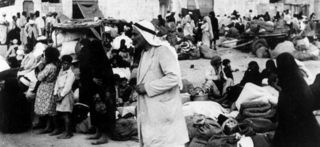
The most excruciating and important chapter in the book, recently excerpted in the New Yorker, is on Lydda. With new research and reporting, Shavit brings light to the “black box” of Israel’s creation, examining the 1948 campaign to expel Arabs from Lydda (now Lod). The story is almost never told, exemplifying the myth that many Jews grew up with—that Israel was “a land without people for a people without a land.” Today, Lod is a profoundly dysfunctional city ridden with crime and drugs, especially in its poor Arab neighborhoods.

Confronting both the past and the present of the Arab population inside Israel (the 20 percent of Israeli citizens who are of Palestinian, Bedouin, Circassian, or Druze origin and live within the “Green Line,” acknowledged internationally as Israel’s border) is one of the major issues facing the contemporary state. And today, a sea change regarding their treatment is underway. Instead of approaching Arab Israelis as a security risk, the government spends billions of shekels on education and employment in order to raise living standards and better integrate the Arab minority into the workforce. But ultimately, the only way to address underlying historical grievances is to find a solution to the occupation on the other side of the 1949 armistice line.

Shavit humanizes the major historical campaigns for peace with well-crafted reporting on key players, along with a short history of the dispute between the Zionist movement and Palestinians. He rightly says that “the real, mainstream Zionist peace movement was born only after the wars of 1967 and 1973”—as was the ideological and fervid movement to further colonize the West Bank and, until 2005, Gaza. Shavit interviews and profiles leaders of the peace camp like former Meretz leader and education minister Yossi Sarid and former justice minister Yossi Beilin, the architect of the Oslo Accords. In all of these interviews, Shavit searches for explanations for why the peace camp failed. He tells Sarid that the doves were “always against. . . . There was not enough love, not enough compassion. And there was too much judgment.” He castigates Sarid at length for not considering the deep animosity that Palestinians felt (and still feel, according to Shavit) toward Israel as a result of the state’s creation:

You were blind to the chilling consequences of Zionism and the partial dispossession of another people that is at the core of the Zionist enterprise. You also failed to realize the gravity of the religious conflict and identity clash between the Western Jewish democratic Israel and the Arab world. You didn’t take into consideration the fact that given our history and our geography, peace is hardly likely.

Yet when he argues with Sarid, he is arguing with himself. “The peace story is also my story.” When Shavit was active in Peace Now in high school and as a student at Hebrew University, the peace for which he yearned was “bogged down by a systematic denial of the brutal reality we live in.” He later came to the conclusion that the Zionist left made a mistake to promise peace, rather than just to end the occupation.

More here.

The Emotions That Prosecutors Elicit to Make Jurors Vote Guilty

Jury-prosecutor

Lauren Kirchner in Pacific Standard:

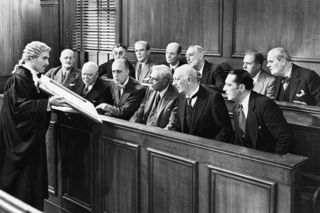
Recently, two psychologists teamed up to analyze and identify the emotions that have the most impact on the outcome of jury trials. They had participants in mock trials read scenarios and look at crime-scene evidence, and keep track of their feelings throughout the experiment. The researchers found that anger paired with disgust makes up the powerful mix of emotions that we often call “moral outrage.” The authors also concluded that this particular response—more than sadness, more than the desire for vengeance, more than any other emotion—is the one that most often brings jurors to vote to convict, and to be confident in those convictions.

“Humans intuitively understand what moral outrage is,” said Jessica M. Salernoo, co-author of the study, published in the journal Psychological Science. “However, researchers debate its emotional components. We wanted to investigate the relationships between anger and disgust since emotions tend to co-occur with each other.” Salerno and her co-author, Liana C. Peter-Hagene, note that this mix of emotions is entirely involuntary, and the jurors can often be unaware that they are feeling it—which makes it that much more effective.

After the study concluded, Salerno also suggested that the increasing ubiquity of cameras may mean that this factor will be an increasingly important one in jury trials to come. Personal cameras are cheaper, lighter, and used more frequently than ever; public and private surveillance cameras capture more everyday action than ever before, as well. That means that future prosecutors will be that much more likely to have visual evidence available to them when planning their cases.

More here.

Mournful Creatures

AnimalmourningNEW

Virginia Morell in Lapham's Quarterly:

Animals have a great advantage over man: they never hear the clock strike, however intelligent they may be; they die without any idea of death; they have no theologians to instruct them…Their last moments are not disturbed by unwelcome and often objectionable ceremonies; it costs them nothing to be buried; no one starts lawsuits over their wills.

—Voltaire
Who can say what cows feel, when they surround and stare intently on a dying or dead companion?
—Charles Darwin

It is often said that our understanding and knowledge of death separates the human animal from all other animals. We alone know that we will die—that one day, suddenly or slowly, our life, our loves, our dreams will end. Surely this awareness sets us apart from the rest of the animal kingdom, we say, pointing to some of our greatest art, music, and literature—all inspired by what we know: that death awaits every living being. And yet, how very odd it is that we should be the only animal to know what life ultimately has in store for us. We share biological histories and physiologies DNA, eyes, muscles, nerves, neurons, hormones—with other animals, and these may lead to similar behaviors, thought processes, and emotions—even about death.

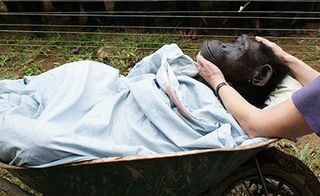
Take the case of Thomas, a nine-year-old chimpanzee who died in 2010 at the Chimfunshi Wildlife Orphanage Trust in Zambia, home to more than one hundred chimps. Research scientists filmed the reactions of one community of forty-three chimpanzees to Thomas’ corpse; thirty-eight of them gathered around and stayed by his side for almost twenty minutes. During that time, some of the chimps gently touched his body, smelled and studied him closely. One of those visitors was Masya, a mother carrying her dead infant (at the time, there was an outbreak of a respiratory illness among the chimps). A few days earlier, Masya had been seen placing her dead child in a grassy, sunlit patch and retreating to the shade, where she sat watching, her eyes rarely straying from her infant. Every few minutes, she strode back to the clearing to inspect her baby’s body. At times she did so hurriedly, jumping up and rushing forward as if she thought she’d detected a stirring. She studied her child’s face intently, peered into her gaping mouth and wide eyes, and brushed away the flies. Finally, she placed her knuckles softly against her infant’s neck—hoping, it seems, for any sign of life.

More here.

At year’s end, Egypt maintains little tolerance for dissent

Ashraf Khalil at Al Jazeera:

ScreenHunter_473 Dec. 27 16.15Twenty-one schoolgirls from Alexandria, in northwest Egypt, were sentenced to 11 years in prison last month for demonstrating in favor of deposed President Mohammed Morsi and handing out balloons bearing the Muslim Brotherhood's yellow four-fingers symbol. The symbol commemorates the bloody August clearing of a Brotherhood sit-in outside Cairo's Rabaa el-Adaweya Mosque.

“These women and girls should have never been arrested,” said Hassiba Hadj Sahraoui, deputy director for the Middle East and North Africa at Amnesty International, in a postverdict statement. “They are now prisoners of conscience and must be released immediately and unconditionally.”

Though the women's sentences were quickly reduced on appeal in early December — the seven minors received three months' probation, the rest suspended one-year sentences — the incident is perhaps the most disturbing example of a crackdown being carried out against supporters of the former president and his organization, the Muslim Brotherhood.

With much of the Brotherhood's leadership, including Morsi, locked up or in exile, authorities have in recent months rounded up thousands of alleged members in mass arrests.

More here.

on prison and the cold

Winter-cityHoward Tharsing at Threepenny Review:

When I got out of County Jail following my second arrest, one of the friends I wanted to get in touch with right away was HG. When I texted him the news that I was walking out of the jail at 850 Bryant Street, breathing freely for the first time in ten days, he said the strangest thing in reply: “I don’t know what I should say to you,” he said.

I have been often struck by the fact that HG constantly describes himself as driven first and foremost by Jewish guilt. He complains all the time about his mother and her oppressive concern with propriety. (Indeed, as someone whose mother is no longer living, I have found his denigration of her and the bitter feelings he expresses about her make me uncomfortable.)

So at first I took his remark to mean that he felt he needed some formal or conventional words to use on the occasion, that he was searching his mind for something his mother would say to a friend just released from jail. But his mother, no doubt, would not have a friend who had been released from jail because she would not have a friend who was in jail in the first place.

more here.

Modernity, enchantment, and Fictionalism

Footbridge-between-worldsMichael Saler at The Immanent Frame:

The stern visage of Max Weber looms over discussions of modernity and enchantment, as does the sunnier countenance of Charles Taylor. Perhaps they should be joined by the open faced, bluntly spoken, and allegedly poker wielding Ludwig Wittgenstein. This choice might seem counter-intuitive. Wittgenstein did not write much about enchantment, and is more often considered a disenchanter who used the tools of philosophy to dispel illusions brought about by linguistic misuse. As he wrote, “Philosophy is a battle against the bewitchment of our intelligence by means of language.”

Nevertheless, enchantment was central to Wittgenstein’s outlook on life. By enchantment he meant a sense of wonder regarding the world. He described wonder as his “experience par excellence…when I have it I wonder at the existence of the world. And I am then inclined to use such phrases as ‘how extraordinary that anything should exist’ or ‘how extraordinary that the world should exist.’” Plato and Aristotle claimed that philosophy begins in wonder, and Wittgenstein’s famous last words—“Tell them I’ve had a wonderful life”—suggests it ends there as well. His later philosophy aimed at re-enchanting the world by re-describing it in new and unexpected ways. In so doing, the world does not change—things remain as they are—but our fundamental orientation to the world changes: “We see, not change of aspect, but change of interpretation.” As a result, one becomes aware of how rich, contingent and variable the world is.

more here.

People and Homes of Aligarh

Meher Ali in Himal Southasian:

AftabI have always had a fascination with old homes. I grew up in one – Abid Manzil in Aligarh, built in 1935. Well-known as the home of Aligarh Muslim University, the town in western Uttar Pradesh saw many Indian Muslims migrate there in the early 1900s from different parts of the erstwhile United Provinces. This included the Muslim zamindar elites who came from neighbouring principalities as well as working-class and middle-class families from eastern Uttar Pradesh. Many wanted to give their children the chance of a good education at the university. These people brought their cultures and histories with them, blending with the Islamic yet liberal intellectual philosophy propagated by AMU and spearheaded by its founder, Sir Syed Ahmed Khan. The homes of these people, mostly built in the 1930s, are evidence of this syncretic tradition. On my most recent visit to Aligarh I realised that these pre-Partition houses were gradually disappearing. I met with some of the remaining families, who wanted to talk about the rich history of their homes, the culture and ways of life they embodied, and the measures they were currently taking to secure a future for their homes and themselves. This photo essay tells the story of these homes and the people who live in them.

Sir Syed Ahmed Khan, the founder of Aligarh Muslim University (AMU) was Scheherazade Alim’s paternal great, great-grandfather. She spent her childhood in Aftab Manzil, named after her maternal great-grandfather Aftab Ahmed Khan, who built the house in 1904. Scheherazade Begum studied law at Oxford and became a barrister and has taught law at AMU. After two decades of living and working in Dubai, Scheherazade Begum and her husband Abdul Alim Khan returned to Aligarh and to Aftab Manzil in 1997, and have lived there since. Aftab Manzil saw the comings and goings of influential men and women. One of them was E M Forster. Scheherazade Alim’s grandfather Sir Ross Masood was a close friend of the writer, who dedicated A Passage to India to him. Masood became the Vice Chancellor of AMU in 1929, a position he held for three years. The photograph on the right was taken in Italy in 1911. The photograph on the left shows Scheherazade Begum with Forster. It was taken in England in 1962. She herself cultivated a deep bond with the writer, calling him “Forster Chacha”.

More here. (Note: In memory of our mother, Begum Ali Raza, who grew up in Aligarh, the hub of activity for nineteenth and early twentieth century enlightened Muslims dedicated to modernizing and making higher education available to the common Muslims for the first time)