
Peter Woit at Not Even Wrong:
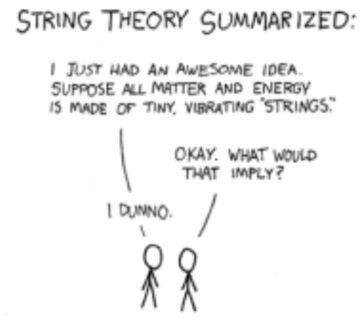 One lesson of the development of our best fundamental theory is that the new ideas that went into it were much the same ideas that mathematicians had been discovering as they worked at things from an independent direction. Our currently fundamental classical notion of spacetime is based on Riemannian geometry, which mathematicians first discovered decades before physicists found out the significance for physics of this geometry. If the new idea is that the concept of a “space” needs to be replaced by something deeper, mathematicians have by now a long history of investigating more and more sophisticated ways of thinking about what a “space” is. That theorists are on the road to a better replacement for “space” would be more plausible if they were going down one of the directions mathematicians have found fruitful, but I don’t see that happening at all.
To get more specific, the basic mathematical constructions that go into the Standard Model (connections, curvature, spinors, the Dirac operator, quantization) involve some of the deepest and most powerful concepts in modern mathematics. Progress should more likely come from a deeper understanding of these than from throwing them all out and starting with crude arguments about holograms, tensor networks, or some such.
More here.
Enjoying the content on 3QD? Help keep us going by donating now.
 The
The  Canonized by a team of Spotify editors, including Lizzy Szabo in the summer of 2019, ‘Hyperpop’ was a term taken from Szabo’s data science colleague Glenn McDonald, in an attempt to contextualize the growing traction surrounding an internet infected duo named 100 gecs, and the scene of like minded musicians who seemed to be forming around them. Artists operating under the Hyperpop rubric — from established stars like Charli XCX to Gen Z newcomers like osquinn and ericdoa — have concurrently played a hand in boosting it from a niche internet scene to a viral talking point, having received unexpected cosigns from the likes of YouTuber pewpiedie and and EDM superproducer Skrillex. Practitioners seek to accelerate and exaggerate pop music to the point of abrasion and absurdity. And while no formal genre conventions truly exist across its spectrum — much like Spotify’s playlist, Hyperpop is scene-led rather than genre-led — a prototypical song will usually sound like the meeting point between experimental sound design and EDM influenced pop from the 2010s.
 In 2013, a mysterious producer named Sophie released “Bipp,” a minimalist club track that sounded like it had been formed on another planet and squeezed through hyperdrive before arriving on ours. “Bipp” was black space latticed with radically strange objects: a rubbery squelch of a bass beat, a melodic line like a laser coated in latex, percussive punctuation marks that seemed to morph from plasma into steel. Sophie continued releasing singles, each one accompanied by a 3-D rendering of a ladderless slide. The objects looked the way the songs sounded, like uncanny candy—slick, chemical, jaw-breakingly hard.
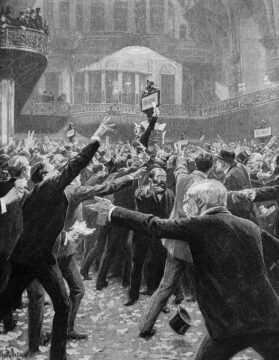 In the chilling speech he gives at the end of the film Margin Call, Jeremy Irons says that no one should say they believe in equality, because no one really thinks it exists: The very idea camouflages the endurance of hierarchy in an essentially unchanging form. “It’s certainly no different today than it’s ever been,” he explains to an underling. “There have always been and there always will be the same percentage of winners and losers….Yeah, there may be more of us than there’s ever been, but the percentages? They stay exactly the same.”
 Both of us understand the powerful effects that food has on your health and longevity. A poor diet may lead to
  People volunteer at organizations that fail to advance the causes to which they are supposedly devoted. They donate to their local cat shelter even though there are already enough organizations caring for stray pets in their affluent neighborhood. They buy their alma mater a fancy new gym even though the campus already has state-of-the-art facilities.
 J.D. Vance looks annoyed. It’s a Tuesday afternoon in August, and we’re sitting near the front of his campaign plane, flying from a rally in Michigan to a fundraiser in Tennessee. Across the aisle is his mother Bev, whose role in Vance’s traumatic and disruptive childhood he chronicled in his best-selling memoir, Hillbilly Elegy. As flight attendants serve Chick-fil-A, Vance gripes about the ongoing controversy over his three-year-old comments complaining that the U.S. is being run by Democrats, corporate oligarchs, and “childless cat ladies” who “don’t really have a direct stake” in the country’s future. As with his boss, Vance’s instincts are to punch back. “I think it’s a ridiculous thing to focus on,” he says, “instead of the underlying argument I was trying to make.”
 There’s a bar in Baltimore, Maryland, that very few people get to enter. It has a cocktail station, beer taps and shelves stacked with spirits. But only scientists or drug-trial volunteers ever visit, because this bar is actually a research laboratory. Here, in a small room at the US National Institutes of Health (NIH), scientists are harnessing the taproom ambience to study whether blockbuster anti-obesity drugs might also curb alcohol cravings.
 F
F The monomyth, otherwise known as the “hero’s journey,” attempts to set structure to story. First developed by folklorist Joseph Campbell, the monomyth is the type of concept you are quizzed on in a college literature survey course—a multi-stage narrative journey that includes an archetypal hero, a departure from a homeland, a period of trial often necessitating a descent into an underworld, and a triumphant return with newfound power and experience. It is an attractive formula, in part because it monumentalizes many well-loved works of literature—turning anything from the Odyssey to Star Wars to The Lord of the Rings into a simple series of steps. The monomyth is helpful insofar as it illuminates patterns, but, like all theoretical frameworks, it is capable of obscuring distinctive aspects of any given work.
 Entomologist Erica McAlister, the Curator of Diptera at the Natural History Museum, London (NHM), has previously written two popular science books on flies,