The 10 Greatest Documentaries of All Time According to 340 Filmmakers and Critics

Over at Open Culture:

Earlier this year we featured the aesthetically radical 1929 documentary A Man with a Movie Camera. In it, director Dziga Vertov and his editor-wifeElizaveta Svilova, as Jonathan Crow put it, gleefully use “jump cuts, superimpositions, split screens and every other trick in a filmmaker’s arsenal” to craft a “dizzying, impressionistic, propulsive portrait of the newly industrializing Soviet Union.” He mentioned then that no less authoritative a cinephilic institution than Sight and Sound named A Man with a Movie Camera, in their 2012 poll, “the 8th best movie ever made,” But now, in their new poll in search of the greatest documentary of all time, they gave Vertov’s film an even higher honor, naming it, well, the greatest documentary of all time. A Man with a Movie Camera, writes Brian Winston, “signposts nothing less than how documentary can survive the digital destruction of photographic image integrity and yet still, as Vertov wanted, ‘show us life.’ Vertov is, in fact, the key to documentary’s future.”

High praise indeed, though Sight and Sound‘s critics make strong claims (with supporting clips) for the other 55 documentaries on the list as well. In the top ten alone, we have the following:

1. A Man with a Movie Camera (Dziga Vertov, 1929)

2. Shoah (Claude Lanzmann, France 1985). Lanzmann’s “550-minute examination of the Jewish Holocaust falls within the documentary tradition of investigative journalism, but what he does with that form is so confrontational and relentless that it demands to be described in philosophical/spiritual terms rather than simply cinematically.”

3. Sans soleil (Chris Marker, 1982). “It’s a cliché to say about a movie [ … ] that its true shape or texture is in the eye of the beholder – but it’s true of Sans soleil, which not only withstands multiple viewings, but never seems to be the same film twice. It addresses memory even as its different threads seem to forget themselves; it parses geopolitics without betraying any affiliation; it might be Marker’s most elaborately self-effacing film, or his most plangently personal.”

4. Night and Fog (Alain Resnais, 1955). “In 1945 moviegoers worldwide became familiar through weekly newsreels in their local cinemas with the unspeakable conditions in the recently liberated Nazi extermination camps. [ … ] Not, however, until Night and Fog (Nuit et brouillard), commissioned to mark the tenth anniversary of the Allied liberation of the most notorious camp, at Auschwitz, did film producers truly confront and define the moral and aesthetic parameters involved in treating such an intractable subject.”

More here.
Heaven is for neuroscience: How the brain creates visions of God

Joan-of-Arc-Eugene-Thirion-web

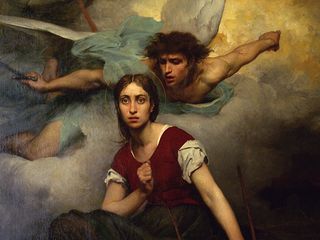
Sam Kean in Salon (image: Eugene Thirion's “Jeanne d’Arc” (1876)):

[S]ome physicians had always had a different perspective on where the mind came from. They’d simply seen too many patients get beaned in the head and lose some higher faculty to think it all a coincidence. Doctors therefore began to promote a brain-centric view of human nature. And despite some heated debates over the centuries—especially about whether the brain had specialized regions or not—by the 1600s most learned men had enthroned the mind within the brain. A few brave scientists even began to search for that anatomical El Dorado: the exact seat of the soul within the brain.

One such explorer was Swedish philosopher Emanuel Swedenborg, one of the oddest ducks to ever waddle across the stage of history. Swedenborg’s family had made a fortune in mining in the late 1600s, and although he was raised in a pious household — his father wrote hymns for his daily bread and later became a bishop — Swedenborg devoted his life to physics, astronomy, and geology. He was the first person to suggest that the solar system formed when a giant cloud of space dust collapsed in upon itself, and much like Leonardo he sketched out plans for airplanes, submarines, and machine guns in his diaries. Contemporaries called him “the Swedish Aristotle.”

In the 1730s, just after turning forty, Swedenborg took up neuroanatomy. Instead of actually dissecting brains, though, he got himself a comfy armchair and began leafing through a mountain of books. Based solely on this inquiry, he developed some remarkably prescient ideas. His theory about the brain containing millions of small, independent bits connected by fibers anticipated the neuron doctrine; he correctly deduced that the corpus callosum allows the left and right hemispheres to communicate; and he determined that the pituitary gland serves as “a chymical laboratory.” In each case Swedenborg claimed that he’d merely drawn some obvious conclusions from other people’s research. In reality, he radically reinterpreted the neuroscience of the time, and most everyone he cited would have condemned him as a luna- and/or heretic.

More here.

Read the Letter at the Center of the New Reagan Book “Plagiarism” Controversy

Download (2)

David Weigel in Slate:

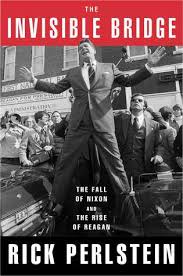
If you click around Slate, you will find a review of Rick Perlstein's long-awaited 1970s history, The Invisible Bridge, and you'll find a podcast interview with the author. Both of these items were finished before the New York Times published a storyabout author/political strategist Craig Shirley, who has insisted that Perlstein plagiarized his 2005 book about Ronald Reagan's near-miss presidential primary run against Gerald Ford.

The Times' story is not quite definitive; it takes a teach-the-controversy, he said/she said approach to the story. “Mr. Shirley said he has since tallied close to 50 instances where his work was used without credit,” reports Alexandra Alter, who quotes Perlstein describing the instances as paraphrases.

But how did it start? Shirley told me yesterday that Perlstein contacted him when he (Shirley) was at a meeting of Reagan scholars, and wanted to run 10 citations by him, stories that had appeared in Shirley's book that he was trying to confirm independently. By the time Shirley got back to him, Perlstein had found the sources.

“He apologized and asked me if I would review his book,” said Shirley. “I asked my research assistant to get a review copy. I get it, I sit down, I start looking, I see my own writing in his book, not cited or credited to me.”

It did not matter to Shirley that Perlstein had put citations online, or that at the end of the book Perlstein thanked the conservative for saving him “3.76 months” of research.

“My name is only mentioned in passing, and then almost dismissively,” said Shirley. “What does he mean by 3.76 months? I don’t even know what the fuck that means. He didn’t interview Dick Cheney. I did. He didn’t interview Jim Baker. I did.”

More here.

A New Report Argues Inequality Is Causing Slower Growth. Here’s Why It Matters.

06up-inequality-articleLarge

Neil Irwin in the NYT's Upshot on the new report by 3QD friend and former writer Beth Ann Bovino (photo: Greg Gibson/Bipartisan Policy Center):

Is income inequality holding back the United States economy? A new report argues that it is, that an unequal distribution in incomes is making it harder for the nation to recover from the recession and achieve the kind of growth that was commonplace in decades past.

The report is interesting not because it offers some novel analytical approach or crunches previously unknown data. Rather, it has to do with who produced it, which says a lot about how the discussion over inequality is evolving.

Economists at Standard & Poor’s Ratings Services are the authors of the straightforwardly titled “How Increasing Inequality is Dampening U.S. Economic Growth, and Possible Ways to Change the Tide.” The fact that S&P, an apolitical organization that aims to produce reliable research for bond investors and others, is raising alarms about the risks that emerge from income inequality is a small but important sign of how a debate that has been largely confined to the academic world and left-of-center political circles is becoming more mainstream.

More here. From the report:

Though the share of income from labor and capital, excluding capital gains, has decreased, the share coming from capital gains and business income has increased over time. In particular, inherited wealth has increased since the World Wars and the Great Depression, as Thomas Piketty has shown (14), and with it the earnings from that wealth. This trend is important because labor income tends to be distributed across income levels more evenly than capital gains–so a shift in income composition can significantly affect inequality.

While labor income accounted for nearly three-fourths of market income from 1979-2007, that figure had dropped to two-thirds by 2007. Capital income (excluding capital gains) is the next largest source, but even at its 1981 peak, it represented only 14% of market income before falling to about 10% of total income in 2007. Conversely, income from capital gains rose, doubling to approximately 8% of market income in 2007 from about 4% in 1979. Business income and income from other sources (primarily private pensions) each accounted for about 7% of total income in 2007, up from about 4% each.

In addition, capital income has become increasingly concentrated since the early 1990s–and, despite declines in 2001 and 2002, concentration spiked from 2003 through 2007, with more than 80% of the capital gains realized by the top 5% of earners going to the top 1% alone (15). Capital gains also have become increasingly concentrated and are tied with business income as the most concentrated income source.

More here.

Humanity’s cultural history captured in 5-minute film

Alison Abbott:

StoryAll roads lead from Rome, according to a visual history of human culture built entirely from the birth and death places of notable people. The 5-minute animation provides a fresh view of the movements of humanity over the last 2,600 years.

Maximilian Schich, an art historian at the University of Texas at Dallas, and his colleagues used the Google-owned knowledge base, Freebase, to find 120,000 individuals who were notable enough in their life-times that the dates and locations of their births and deaths were recorded. The list includes people ranging from Solon, the Greek lawmaker and poet, who was born in 637 bc in Athens, and died in 557 bc in Cyprus, to Jett Travolta — son of the actor John Travolta — who was born in 1992 in Los Angeles, California, and died in 2009 in the Bahamas. The team used those data to create a movie that starts in 600 bc and ends in 2012. Each person’s birth place appears on a map of the world as a blue dot and their death as a red dot. The result is a way to visualize cultural history — as a city becomes more important, more notable people die there. The work that the animated map is basedon was reported on 31 July in Science1. The animation reflects some of what was known already. Rome gave way to Paris as a cultural centre, which was eventually overtaken by Los Angeles and New York. But it also puts figures and dates on these shifts — and allows for precise comparisons. For example, the data suggest that Paris overtook Rome as a cultural hub in 1789.

More here.

Working in the Medium of Science

Jascha Hoffman in The New York Times:

BookScientists are logical, making observations and running experiments, then building theories that explain the data. Artists are emotional, working in solitude and by intuition. Or so we are told. In “Colliding Worlds,” the historian and philosopher Arthur I. Miller argues that artists and scientists have always had the same mission: to “fathom the reality beyond appearances, the world invisible to our eyes.” And he argues that after drifting apart during the Enlightenment, the twin branches of understanding have been coming back together over the last century, a reunification that is accelerating in the digital age.

Dr. Miller’s encyclopedic survey begins at the dawn of the 20th century, when physicists as well as painters were testing radical new models of space and time. In the vein of his previous book “Einstein, Picasso,” Dr. Miller shows how the discovery of quantum mechanics inspired a generation of avant-garde artists, including Picasso, Kandinsky and Dalí, who said, “It is with pi-mesons and the most gelatinous and indeterminate neutrinos that I want to paint the beauty of the angels and of reality.” Starting in the 1980s, Dr. Miller began to spend time with artists who have found their muse in science, and has watched as the scene grew. He knows the field like few others, interviewing many of the artists for hours at a stretch and visiting museums, galleries, media labs, and corporate behemoths like Pixar and Google. Inventors and engineers make up a large share of his subjects, among them Neri Oxman, who is using her knowledge of bone formation to design better buildings from concrete, and David Edwards, the founder of Le Laboratoire in Paris, who has come up with methods for inhaling food and beverages and transmitting odors using cellphones.

More here.

Monday, August 4, 2014

Sunday, August 3, 2014

Hamas’s Chances

Nathan Thrall in the London Review of Books:

ScreenHunter_735 Aug. 03 21.13The current war in Gaza was not one Israel or Hamas sought. But both had no doubt that a new confrontation would come. The 21 November 2012 ceasefire that ended an eight-day-long exchange of Gazan rocket fire and Israeli aerial bombardment was never implemented. It stipulated that all Palestinian factions in Gaza would stop hostilities against Israel, that Israel would end attacks against Gaza by land, sea and air – including the ‘targeting of individuals’ (assassinations, typically by drone-fired missile) – and that the closure of Gaza would essentially end as a result of Israel’s ‘opening the crossings and facilitating the movements of people and transfer of goods, and refraining from restricting residents’ free movements and targeting residents in border areas’. An additional clause noted that ‘other matters as may be requested shall be addressed,’ a reference to private commitments by Egypt and the US to help thwart weapons smuggling into Gaza, though Hamas has denied this interpretation of the clause.

During the three months that followed the ceasefire, Shin Bet recorded only a single attack: two mortar shells fired from Gaza in December 2012. Israeli officials were impressed. But they convinced themselves that the quiet on Gaza’s border was primarily the result of Israeli deterrence and Palestinian self-interest. Israel therefore saw little incentive in upholding its end of the deal. In the three months following the ceasefire, its forces made regular incursions into Gaza, strafed Palestinian farmers and those collecting scrap and rubble across the border, and fired at boats, preventing fishermen from accessing the majority of Gaza’s waters.

The end of the closure never came. Crossings were repeatedly shut. So-called buffer zones – agricultural lands that Gazan farmers couldn’t enter without being fired on – were reinstated. Imports declined, exports were blocked, and fewer Gazans were given exit permits to Israel and the West Bank.

More here.

Pirzada Qasim – Zakham Dabay Tu Phir Naya Teer Chala Diya Karo

There is a tradition in Urdu poetry of poets singing their own poems a capella in melodies of their own devising. This is a good example of a contemporary poet doing just that. Pirzada Qasim is an accomplished scientist and educator in addition to being a poet. He has served as Vice Chancellor of Karachi University.

This post is dedicated to Robert Pinsky for whom I sang the first two couplets of this poem recently. He seemed to like it. Well, at least he was polite enough not to say otherwise! Enjoy. 🙂

Democracy Causes Economic Development?

Daron

Daron Acemoglu, Suresh Naidu, James A Robinson and Pascual Restrepo in Vox EU:

A belief that democracy is bad for economic growth is common in both academic political economy as well as the popular press. Robert Barro’s seminal research in this area concluded that “More political rights do not have an effect on growth…The first lesson is that democracy is not the key to economic growth” (Barro 1997, pp. 1 and 11). Meanwhile, reacting to the rise of China, New York Times columnist Tom Friedman argues:

“One-party nondemocracy certainly has its drawbacks. But when it is led by a reasonably enlightened group of people, as China is today, it can also have great advantages. That one party can just impose the politically difficult but critically important policies needed to move a society forward in the 21st century []

In “Democracy Does Cause Growth”, we present evidence from a panel of countries between 1960 and 2010 challenging this view. Our results show a robust and sizable effect of democracy on economic growth. Our central estimates suggest that a country that switches from nondemocracy to democracy achieves about 20% higher GDP per capita in the long run (over roughly the next 30 years). These are large but not implausible effects, and suggest that the global rise in democracy over the past 50 years (of over 30 percentage points) has yielded roughly 6% higher world GDP.

There are several challenges in estimating the impact of democracy on growth. First, existing democracy indices are typically subject to considerable measurement error, leading to spurious changes in the democracy score of a country even though its democratic institutions do not truly change.

More here.

On Joyce and Syphilis

0076-GettyImages-Harpers-1407-390 (1)

Kevin Birmingham in Harper's blog (James Joyce © Photo Researchers/Getty Images):

In 1917, while walking down a street in Zurich, James Joyce suffered an “eye attack” and remained frozen in agony for twenty minutes. Lingering pain left him unable to read or write for weeks. Joyce had endured at least two previous attacks, and after the third he allowed a surgeon to cut away a piece of his right iris in order to relieve ocular pressure. Nora Barnacle, Joyce’s partner, wrote to Ezra Pound that following the procedure Joyce’s right eye bled for days.

Joyce was suffering from a case of glaucoma brought on by acute anterior uveitis, an inflammation of his iris. It was, unfortunately, nothing new. Joyce’s first recorded bout of uveitis was in 1907, when he was twenty-five years old, and the attacks recurred for more than twenty years. To save his vision, Joyce had about a dozen eye surgeries (iridectomies, sphincterectomies, capsulectomies) — every one of them performed without general anesthetic. He lay in dark rooms for days or weeks at a time, and his post-surgical eye patches became his trademark. Doctors applied leeches to siphon blood from his eyes. They gave him atropine and scopolamine, which cause hallucinations and anxiety, to dilate his pupils. They administered vapor baths, sweating powders, cold and hot compresses, endocrine treatment and iodine injections. They prescribed special diets (oatmeal and leafy vegetables) and warmer climates. They disinfected his eyes with silver nitrate, salicylic acid, and boric acid; instilled them with dionine to dissipate nebulae; and doused them with cocaine to numb the pain. Nothing really helped.

More here.

On Octavia Butler’s “Unexpected Stories” and Margaret Mitchell’s “Gone With the Wind “

9781497601376_custom-9804f2ef49a1f2e61e32d2d56952e55b10ac3375-s6-c30-243x366

Noah Berlatsky in The LA Review of Books:

The utopia in Gone With the Wind is predicated on the insistence that black people in the South found slavery to be a pretty good life. In the voice of its heroine, the novel asserts that “slaves were neither miserable nor unfortunate. The negroes were far better off under slavery than they were now under freedom, and if she didn’t believe it, just look about […]!” — as if looking around would offer reassurance.

Mitchell takes care to make her black characters — or at least her “good” black characters — constantly express their enthusiasm for the antebellum hierarchy. Mammy, Scarlett’s longtime nurse and companion, may be “black, but her code of conduct and her sense of pride were as high as or higher than those of her owners.” Mitchell means that Mammy looks down on poor whites and field slaves alike; she is fiercely protective of the social standing of the O’Haras’. In the world of this novel, Mammy sees herself as a member of the family, and her service is based on love and affection, rather than on fear that she might be whipped, raped, or shot at will. Blacks in Gone With the Wind identify so closely with their white families that when Atlanta is invaded, the slaves are panic-stricken, actually afraid of freedom, as if they’re children about to be robbed of their parents. In Mitchell’s portrayal of Reconstruction, “good” black people, like Scarlett’s former foreman, Big Sam, express as much horror at the new, fallen world as the whites do. A group of Yankees “ast me ter set down wid dem, lak Ah wuz jes’ as good as dey wuz,” Sam says, with mixed indignation and confusion. Visions of utopia in Gone With the Wind become forces for imperialism in themselves. In this case, the prey is actively enthusiastic about being fed on by the mosquitoes. For Mitchell, happiness legitimizes, and enables, slavery.

Octavia Butler’s final book, the vampire novel Fledgling,explicitly draws the links between blood, slavery, and happiness. The narrator is an “Ina” — a young, black female vampire — named Shori. Shori uses her bite, which is physically and emotionally addictive, to surround herself with a number of dependent “symbionts” who love and serve her, sexually and otherwise. The novel, which is told from Shori’s point of view, encourages the reader to sympathize with her as she builds a small, utopian community ruled by herself as benevolent mistress. However, as Isaac Butler points out on my website, the Hooded Utilitarian, if you read against the novel just a little bit, the subtext is disturbing.

More here.

The Argentina Debt Case

Cristina_Fernandez_Comandante_en_Jefe

Jayati Ghosh in Naked Capitalism (image from wikimedia commons):

Ever since it bought Argentine bonds at around 20 per cent of the face value in 2008, it has been pursuing the case both legally and physically. In 2012, it hired mercenaries to detain and try to seize an Argentine ship where it was docked off the coast of Ghana; at another time it even attempted to grab the Argentina Presidential plane from an airport—as “collateral” for its supposed holding of debt. Legally, NML Capital and another vulture fund, Aurelius Capital Management LP, have been pursuing a case in a New York district court, demanding full payment on their debt, of the value of around $1.5 billion. It has been estimated by the Argentine government that this could amount to a return of more than 1600 per cent on the initial investment made by these vulture funds.

In 2012, U.S. District Judge in New York Thomas Griesa ruled in favour of the hedge funds, which was both extraordinary in law and devastating in its potential implications not just for Argentina but for finance in general. The Argentine government appealed against it, but this appeal has now been dismissed by the U.S. Supreme Court.

Consider just some elements of this U.S. court decision. First, it is based on a peculiar and unprecedented interpretation of the pari passu (equal treatment) clause, which holds that all bond holders must be treated alike. The courts have interpreted this to mean that a sovereign debtor must make full payment on a defaulted claim if it makes any payments on restructured bonds. So if the bondholders who agreed to restructure 93 per cent of the Argentine debt are being paid according to their agreement, then the other resisting bond holders must also be paid the full value of their debts!

The immediate effect of this would be to disable Argentina from repaying $832 million of debt to other bondholders (who have already received around 90 per cent of their debt) unless it also pays the holdouts in full, thereby forcing the country into technical default. Economy Minister Alex Kicilloff noted in a speech to the United Nations that this contradicts Argentina’s own laws and its clear agreements with creditors in the restructuring process that it would not treat other creditors differently. An official statement from the Argentine government called this judgement “senseless and unheard of”, and pointed out that by attempting to block the payment, the judge “has abused his power and gone outside of his jurisdiction because the holders of restructured bonds are not the object of this litigation.”

This is effectively leaving the country no choice but default on its other legal obligations. “Not paying while having the resources and forcing a voluntary default is something that is not contemplated in Argentine law. It would be a clear violation of the debt prospects.”

This absurd interpretation of the pari passu clause does indeed have systemic implications. It effectively makes a mockery of all debt renegotiation agreements, since there would be no incentive for any creditor to accept less than full value of the debt if some other creditor will be paid in full. It is therefore also in contradiction to the United States’ own bankruptcy laws under Chapter 9 and Chapter 11. Indeed, bankruptcy laws are in place in most market economies precisely to ensure that there can be an orderly workout when debts cannot be repaid in full.

There is a reason for this. No credit system can function or has ever functioned with zero default. This possibility of default is embedded into credit contracts through the interest rate, with interest rate spreads operating as the market estimate of the probability of a default.

More here.

Sunday Poem

“Before the beginning is the end of another beginning.” —R.Bob

History of the Future

Again a new era has been promised. It’s
already here, curled like a fetus. About to be born.
They say it’s a new world. But here is the history of its future:

Somewhere at some point in time
documents and papers will be required.
There will be a receptionist at a government office
or a security screener at an airport, but
in every era somewhere in the world
a gendarme is liable to demand papers.

This means: Somewhere in the world a passport will be forged.

And someday an army will invade a city, called
Prague or Baghdad
or New York. Any name is possible.
Many things will happen under cover of night.
Knocks on the door.
Arbitrary arrest.
A father torn from the arms of his child,
His disappearance.

Many things will happen in broad daylight.
Looting
rape
slaughter.
In the marketplace and the stock market, trade will continue as usual. So will
the pogrom.

Very soon the mob will join in:
Spraying slogans against one minority or another
for one reason or another. A demand
will be made to prohibit entry to the continent, the country
or the grocery store.
At its door a puppy will wait for its master.
Someone will leave behind books and photos,
an old blanket, a magnificent armchair of happiness.
And someone he loves.
But he will not forget to take a coat.
With pockets. As long as he leaves in time
with his face. And with cash.
Many will flee on foot.
Some will escape by train.

There is no escapee without a pursuer.
There is no shelter without a storm.
The world is a rifle butt
The night — flashing police cars.

At least one person — perhaps even you? — will lose
the way, pray it ends. There he is, look,
leaning on the parapet of the dark;
boats going by downriver
and cars on the bridge
grab him
for a fraction of a second.
He jumps.
Or stays. But manages to fall away
like a view through a window.

Your window, perhaps?
.

by Shachar Mario Mordechai
from Toldot ha atid
publisher: Even Hoshen, Raanana, 2010

it is not anti-Semitic to say: not in my name

Laurie Penny in New Statesman:

BoyPeople of Jewish descent have every reason to be hyper-vigilant about anti-Semitic language and it is stupid to pretend that there’s none of it in the global movement for Palestinian freedom. It’s stupid to pretend that nobody ever conflates Jews with Zionists, or labels the Jewish people bloodthirsty and barbarous. And it hurts like hell to hear hoary old words of hate trickling through a movement that is about justice, about freedom, about protecting some of the world’s most persecuted people. It hurts just as much, however, to hear right-wing Israelis tell Jews around the world that the violence is for us, for our ancestors, for our children.

It is not anti-Semitic to suggest that Israel doesn’t get a free pass to kill whoever it likes in order to feel “safe”. It is not anti-Semitic to point out that if what Israel needs to feel “safe” is to pen the Palestinian people in an open prison under military occupation, the state’s definition of safety might warrant some unpacking. And it is not anti-Semitic to say that this so-called war is one in which only one side actually has an army. It is not hate speech to reiterate the wild disparity in casualties. More than 600 Palestinians have been killed this past week, most of them civilians. Fewer than 30 Israelis have died, and most of them were soldiers. To speak of proportionality is not to call, as at least one silverback columnist has claimed, for “more dead Jews”.

More here.

On the Slaughter: A political poem’s ironic new life

Peter Cole in The Paris Review:

And cursed be he who cries out: Revenge!
Vengeance like this, for the blood of a child,
Satan has yet to devise.
Let the blood fill the abyss!
Let it pierce the blackest depths
and devour the darkness
and eat away and reach
the rotting foundations of the earth.

Bialik_parisreview-001Political poems lead strange lives—they often wither on the vines of the events they’re tied to. Old news gives way to new, and the whole undertaking starts to seem, well, an expense of spirit in a waste of shame. For many and maybe most American readers, “poetry and politics just don’t mix.” But sometimes they do. Quite violently. On June 12, three Israeli teenagers were kidnapped while hitchhiking home together from their West Bank yeshivas. They were murdered—most likely within hours of being taken—and, eighteen days later, after an extensive search, their bodies were discovered under some rocks in a field near Hebron. Israel mourned, and raged. Emerging from a cabinet meeting convened just after the corpses were found, Prime Minister Benjamin Netanyahu expressed his condolences to the families and quoted the great modernist Hebrew poet Hayim Nahman Bialik: “Vengeance … for the blood of a small child, / Satan has not yet created.” He went on in his own words: “Hamas is responsible—and Hamas will pay.” For good measure, the Prime Minister’s office tweeted the lines as well.

…Several days before Israel deployed its Protective Edge, a New York Times article quoted Netanyahu quoting Bialik; a few days later, the paper’s editorial deplored the metastasizing racist rhetoric. “Even Mr. Netanyahu,” the paper wrote, “referenced an Israeli poem that reads: ‘Vengeance for the blood of a small child … ’ ” Then it carefully weighted the paragraph for the usual pantomime of equal time, noting that Israelis have long had to live with Hamas’s violent ways and put up with hateful speech from Palestinians. Never mind that the poem intoned by Mr. Netanyahu wasn’t Israeli: it was written long before the state was founded and very far from it. “On the Slaughter” was the thirty-year-old Odessan Hayim Nahman Bialik’s immediate response to the April 1903 pogroms in the Bessarabian town of Kishinev, where some forty-nine Jews were slashed, hacked, and cudgeled to death, or drowned in outhouse feces, and hundreds were wounded over the course of several days. Women and girls were raped repeatedly. The Jewish part of town was decimated. Netanyahu quoted just two lines, carefully avoiding the one preceding them: “Cursed be he who cries out: Revenge!”

More here. (Thanks to C.M. Naim).

Saturday, August 2, 2014

Laughter in Ancient Rome

Gregory Hays in the New York Review of Books:

Hays_1-071014_png_250x938_q85In 1984 the American satirist Veronica Geng was asked to introduce a reprint of Dwight Macdonald’s Parodies: An Anthology from Chaucer to Beerbohm—and After. Rather than writing a conventional preface, she decided to depict the authors in the anthology as characters from the Travis McGee mysteries of John D. MacDonald—or rather, from their jacket blurbs: “Cyril Connolly—whose bait box harbored a poisonous cargo”; “Robert Benchley—the Vietnam vet who drifted freely between the glittering cabanas of the Fun Coast and the oil-stained walkways of a derelict marina”; “Jane Austen—bright, petite, blonde, suntanned—she couldn’t get a license to open her health spa, but she didn’t need a license to kill.”

Why is this piece funny? The answer, according to one popular theory, is that humor is grounded in incongruity. Certainly a good part of the fun here lies in encountering familiar figures in an unfamiliar light: H.L. Mencken as ill-fated condo salesman, or Ring Lardner as “human flotsam” churned up by the “Colombia drug-smuggling underground.” And of course the whole piece rests on a basic crossing of verbal wires (what if Dwight Macdonald were John D. MacDonald?).

A rival explanation holds that laughter springs from a feeling of superiority—a “suddaine Conception of some Eminency in our selves,” as Hobbes put it, “by Comparison with the Infirmityes of others.” Geng’s squib might seem to offer less support for this theory. But look again. Obviously the piece requires some generic familiarity with hard-boiled detective novels and their blurbs. But it also helps to know something about the individual authors. For the descriptions are not as arbitrary as they may appear. “Petite, blonde” Jane Austen’s unlicensed “health spa” is Bath transported to the Gulf Coast. The real Cyril Connolly’s bait box really did harbor a poisonous cargo. Benchley was adrift in his later years, his talent drained by Hollywood (“the Fun Coast”) and the bottle (the “derelict marina”).

More here.