
Category: Recommended Reading
A ferocious biological struggle between mother and baby belies any sentimental ideas we might have about pregnancy
Suzanne Sadedin in Aeon:

To see this spirit of maternal generosity carried to its logical extreme, consider Diaea ergandros, a species of Australian spider. All summer long, the mother fattens herself on insects so that when winter comes her little ones may suckle the blood from her leg joints. As they drink, she weakens, until the babies swarm over her, inject her with venom and devour her like any other prey.
You might suppose such ruthlessness to be unheard-of among mammalian children. You would be wrong. It isn’t that our babies are less ruthless than Diaea ergandros, but that our mothers are less generous. The mammal mother works hard to stop her children from taking more than she is willing to give. The children fight back with manipulation, blackmail and violence. Their ferocity is nowhere more evident than in the womb.
This fact sits uncomfortably with some enduring cultural ideas about motherhood. Even today, it is common to hear doctors talking about the uterine lining as the ‘optimal environment’ for nurturing the embryo. But physiology has long cast doubt on this romantic view.
More here.
The Steven Salaita Affair: Denial of Job to Harsh Critic of Israel Divides Advocates of Academic Freedom
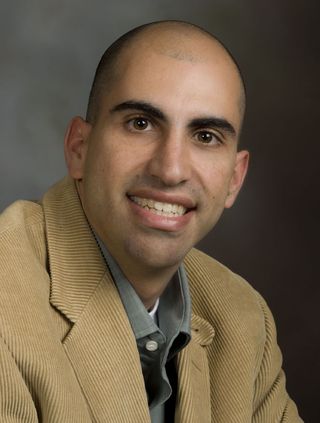
Peter Schmidt details the Steven Salaita controversy over at the Chronicle of Higher Education:
Leading proponents of academic freedom are divided over a last-minute decision by the University of Illinois at Urbana-Champaign to revoke a job offer to a professor accused of incivility in his criticisms of Israel.
Phyllis M. Wise, the campus’s chancellor, and Christophe Pierre, the University of Illinois system’s vice president for academic affairs, informed the job candidate, Steven G. Salaita, on Friday that they were effectively revoking a written offer of a tenured professorship made to him last year by refusing to submit it to the system’s Board of Trustees next month for confirmation.
The two administrators’ letter to Mr. Salaita did not offer an explanation for their decision other than to say they believed the board’s approval of his appointment was unlikely. But they sent their letter just weeks after Mr. Salaita first came under fire on the popular conservative blog The Daily Caller for his incendiary criticisms of Israel, and many faculty members on the campus suspect the rare job-offer revocation was in response to that controversy.
Mr. Salaita did not return emails on Wednesday requesting comment. He had already resigned a position as an associate professor of English at Virginia Tech to take the new position as a tenured professor of American Indian studies at Urbana-Champaign, starting next week.
More here. Corey Robin has a post with links to pieces relating to the affair.
Genocide Watch: the Iraqi Communities Most Endangered by the Rise of ISIL
Bobby Ghosh in Quartz magazine:
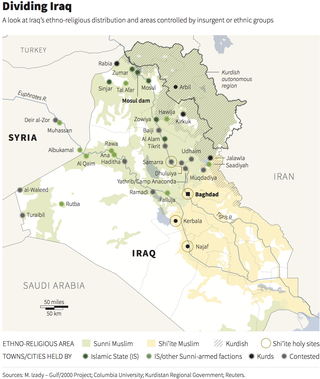
Many Shi’ites can flee—some already have—southward, and find refuge among family and those of their own sect; many of my Shi’ite friends in Baghdad are currently sheltering northerners sent to them by religious organizations. Kurds, likewise, have been streaming into the Kurdish-dominated areas to the north and west of ISIL-controlled territory. Yet another minority, the Assyrians, most whom are Christians, have also fled south, and now await succor from the West, especially from groups of well-established Iraqi Christians in the US, who themselves fled previous spasms of persecution.
But other minorities, just as vulnerable to the wrath of ISIL, have neither international support nor nearby refuge. And ISIL seems to have identified them for special persecution.
The Yazidis: Numbering roughly 500,000, and concentrated around Sinjar, this group is ethnically Kurdish and adheres to a faith that has some aspects of ancient Zoroastrianism. Many Iraqi Muslims refer to Yazidis as “devil-worshipers,” because one of the faith’s foundational narratives of a fallen angel is similar to that ofshaitan (or Satan) in Islam. When I traveled to Sinjar in 2003, my Iraqi colleagues, Sunni and Shi’ite alike, used the term “devil-worshipers” as a joke, even a term of endearment. ISIL, however, is taking the false claim of satanism as deadly serious. Hundreds, possibly thousands, of Yazidis have already been killed and tens of thousands have been driven into the mountains around Sinjar, where they are exposed to the elements as well as ISIL execution squads.
The Shabak: Also concentrated around Sinjar, the Shabak are about one-tenth as numerous as the Yazidis, and even more vulnerable. Their faith doesn’t lend itself to easy definitions, since it is comprised of several micro-sects with elements of several religions, including Islam, Christianity and the Yazidi faith. Some Shabak identify as Shi’ite; that makes them double-heretics for ISIL, which has taken to kidnapping Shabaks from their villages and neighborhoods in Mosul.
More here.
Ant colony ‘personalities’ shaped by environment
Jonathan Webb in BBC News:

As such, there is nothing to stop a colony of insects from having a personality – as Ms Bengston found when she tracked how colonies behaved up and down the western US, both in the wild and when she bundled them up and watched them in the lab. Once back in the lab, whole colonies of 200-600 ants could be filmed inside transparent containers, and the videos analysed to measure things like the level of physical activity and aggressive behaviour. But some measurements, such as how far the ants would go foraging for food, had to be done in the field.
More here.
The Green Vision of Saul Bellow
Andrew Furman in The Chronicle of Higher Education:

…Critics have generally paid short shrift to such moments of heightened perception, moments that don’t directly involve the people in Herzog’s life, or his big ideas. But now it seems wrong to separate Herzog’s receptivity to the external world from his insights about his impoverished upbringing, his failures as a father, husband, and son, and his scholarly views. It seems worthwhile, instead, to examine whether he finds, through nature, the exalted state of human perception envisioned by another Massachusetts resident, Ralph Waldo Emerson.
More here.
Wednesday, August 6, 2014
Voter impersonation: Study finds 31 credible incidents out of one billion ballots

Justin Levitt in the Washington Post's Wonkblog (AP Photo/Rogelio V. Solis):
Requirements to show ID at the polls are designed for pretty much one thing: people showing up at the polls pretending to be somebody else in order to each cast one incremental fake ballot. This is a slow, clunky way to steal an election. Which is why it rarely happens.
I’ve been tracking allegations of fraud for years now, including the fraud ID laws are designed to stop. In 2008, when the Supreme Court weighed in on voter ID, I looked at every single allegation put before the Court. And since then, I’ve been following reports wherever they crop up.
To be clear, I’m not just talking about prosecutions. I track any specific, credible allegation that someone may have pretended to be someone else at the polls, in any way that an ID law could fix.
So far, I’ve found about 31 different incidents (some of which involve multiple ballots) since 2000, anywhere in the country. If you want to check my work, you can read a comprehensive list of the incidents below.
To put this in perspective, the 31 incidents below come in the context of general, primary, special, and municipal elections from 2000 through 2014. In general and primary elections alone, more than 1 billion ballots were cast in that period.
Some of these 31 incidents have been thoroughly investigated (including some prosecutions). But many have not. Based on how other claims have turned out, I’d bet that some of the 31 will end up debunked: a problem with matching people from one big computer list to another, or a data entry error, or confusion between two different people with the same name, or someone signing in on the wrong line of a pollbook.
More here.
Slaves of Happiness Island
Molly Crabapple in Vice:
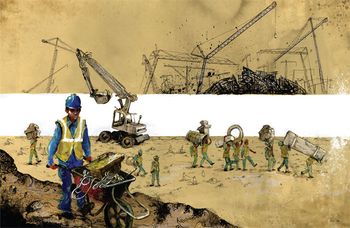
While there are no official statistics, there may be as many as 1 million migrant construction workers in the UAE today. Like Tariq, the men I talked to have had their passports confiscated and earn between $150 and $300 a month. They will have to spend years working off debts to recruiters who have gotten them their jobs.
Reports about the conditions of workers in the Gulf have been wide and probing. Articles contrast the glittering skyscrapers they build and the scant wages they receive. In May, the New York Times published a scathing exposé of labor abuses at NYU Abu Dhabi.
But what’s often lost in much of the reporting about foreign labor in the United Arab Emirates—and Abu Dhabi specifically—is the agency of the workers themselves. The men I met in the Gulf are brave and ambitious—heroes to their families back home. They dared to chase better prospects and were met with repression instead. In a country where the faintest whisper of dissent can get you deported, more than a hundred strikes have rocked the construction industry in the past three years. While workers may be lied to and forced to live and work in brutal conditions, they also—improbably—are fighting back…
The most simplistic accusation against Abu Dhabi is that by building branches of the Louvre or Guggenheim, the city is buying culture. This logic pretends that Cleopatra’s Needle ended up in Paris through the goodness of Egyptian hearts, or that Lord Elgin didn’t just pillage the marbles that bear his name.
Those accusations also perpetuate another myth: The UAE has no culture of its own.
Two generations ago, the Emiratis were Bedouins, nomadic desert people whose main economic activity was pearl diving. They built wind towers, trained falcons, and composed swashbuckling poetry. Emirati culture was rich, but Emiratis were poor. Now they are wealthy. From the lens of European dominance, Emiratis can seem like improper overlords.
Or perhaps Europeans are just jealous. The UAE’s oil money could have disappeared in the coffers of Western energy companies or corrupt leaders. Instead, Sheikh Zayed bin Sultan al Nahyan, the founding father of the UAE, built a munificent welfare state. Emirati citizens get free education, health care, and electricity, as well as generous wages subsidized by the government. They pay no taxes. But the foreigners who compose 90 percent of the population don’t share in this largesse…
Vijay works seven days a week. His company withholds salaries for months at a time, especially if workers visit home. He believes that his company is cheating workers on overtime, denying them access to the ledgers in which their hours are marked.
“I don’t know how much longer I can go on like this. My body is on the verge of giving up, but I cannot leave my job because I am responsible for my sisters,” he told me.
Vijay dreams of getting married in India and returning to his family’s modest farm near Chennai. But first, he wants to get a license to drive a minibus. Drivers are paid better and can work out of the sun, sitting down.
They say Sheikh Zayed built Abu Dhabi, just like Louis XIV built the Louvre. But this is a myth. Vijay built Abu Dhabi more than Sheikh Zayed did. He built it growing deeper in debt each day, his feet sinking into the lunar sand.
Read the rest here.
Why isn’t anyone talking about the nightmare in northern Iraq?
Brendan O'Neill in Sp!ked:

There are reports of awful attacks and events in northern Iraq over the past two days. Having already conquered huge swathes of territory in eastern Syria and western Iraq, and declared the establishment of the Islamic State, ISIS has now made serious inroads into northern Iraqi regions that were being protected by Kurdish military forces, getting closer to the semi-autonomous Kurdish state in northern Iraq. They have taken Kurdish-protected towns in the Dohuk province, the most significant being the ancient town of Sinjar. This is not only home to some Kurds but is also the ancestral home of the Yazidi religious group. ISIS denounced the Yazidi people as ‘apostates’ and ‘devil worshippers’, and according to the United Nations 200,000 Yazidi have fled their homes in 48 hours. (Question for the West’s anti-Israel obsessives currently refusing to talk about anything other than Gaza: why haven’t you commented on this act of what you might call ‘ethnic cleansing’?) Alongside conquering Sinjar, ISIS has taken other economically and strategically key towns that were being protected by Kurdish forces, including Zumar, which has some of Iraq’s most important oilfields, and Wana, a town close to the Mosul Dam that supplies electricity and water to Iraq. So ISIS is not only controlling greater amounts of Iraqi territory – it is close to controlling Iraq’s resources, too. Wana is 30 miles from Mosul, Iraq’s second-largest city, which ISIS captured in June and is already governing severely.
More here.
p-zombies are inconceivable
Massimo Pigliucci in Scientia Salon:

In this essay I propose to do the following: we are first going to take a look at Chalmers’ zombie argument (one of a number of instances of zombification in philosophy of mind) to see exactly what it says and why I find it utterly unconvincing. Next, we’ll use p-zombies to broaden the discussion to parse the differences among different types of possibilities, especially logical, metaphysical and physical/nomological (with a nod toward two other types: epistemic and temporal/historical/contingent). Finally, we’ll use whatever we think we have learned in the process to talk even more broadly about the very nature of philosophical inquiry — or at the least the sort of analytic-type [4] metaphysics that Chalmers and his supporters indulge in.
What, if anything, are p-zombies?
The first thing to be aware of when we talk about p-zombies is that the concept has a long history and has been used in different ways for different purposes. It can be traced back to Saul Kripke’s arguments in the 1970s against type-identity theory in philosophy of mind as presented in his Naming and Necessity [5]. Versions of it were elaborated upon during the same decade by both Thomas Nagel and Robert Kirk. But we won’t go into any of that, focusing instead on the more famous Chalmers’ version of 1996.
More here.
U.S. Must Help Deal Directly With Hamas
Scott Atran in the New York Times:
Nevertheless, as the Hamas vice chairman Abu Musa Marzouk acknowledged to me in Cairo, Hamas believes the right of Palestinians to return to homes in Israel is sacred and it will never abandon hope of a sovereign Palestine from the Jordan River to the Mediterranean Sea.
Still, wars truly end when one side is obliterated or when enemies become nonenemies. For the latter, enemies first must talk. After spleens are vented, over years if necessary, as happened in Northern Ireland, enough grudging accommodation can emerge to stop the killing even if dreams of triumph endure. To succeed, such a process requires persistence, with strong international backing and policing.
More here.
Neuroscience vs. Philosophy
mysticism and the first world war

In the first few weeks of World War I, Evelyn Underhill published a little book about mysticism. Practical Mysticism: A Little Book for Normal People was written during the last months of peace. But was a book about mysticism for the common man really necessary when the whole world was collapsing? Underhill decided it was, more than ever.
The contemplative life, wrote Underhill, is not some dreamy, silly pursuit; “a game fit only for idle women and inferior poets.” Neither is it a pious “special career, involving abstraction from the world of things.” Mysticism is a call to arms. It is a challenge to engage with true reality, to see things are they really are. “The mystical consciousness,” Underhill wrote in her Preface, “has the power of lifting those who possess it to a plane of reality which no struggle, no cruelty, can disturb: of conferring a certitude which no catastrophe can wreck. Yet it does not wrap its initiates in a selfish and otherworldly calm, isolate them from the pain and effort of the common life. Rather, it gives them renewed vitality; administering to the human spirit not – as some suppose – a soothing draught, but the most powerful of stimulants.”
more here.
Confronting Reality By Reading Fantasy
Joe Fassler in The Atlantic:
Author Lev Grossman says C.S. Lewis taught him that in fiction, stepping into magical realms means encountering earthly concerns in transfigured form.
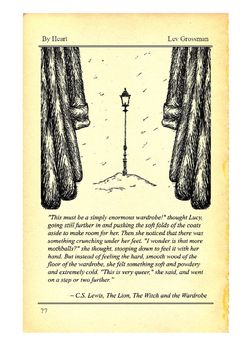
…Why is Lewis so important to me? In part, it’s because—technically, from the point of view of craft—he tells the story with truly exemplary economy. By the time we’re only six or seven pages into The Lion, the Witch, and the Wardrobe, we already know all four Pevensies, we know how each child feels about the other three, and he’s gotten Lucy through the wardrobe and into Narnia. With incredible speed, he acquaints us with the characters—just one or two well-placed details, and we’re able to know each one—and delves right away into the adventure. Even more than that, it’s the way he uses language—which is nothing like the way fantasists used language before him. There’s no sense of nostalgia. There’s no medieval floridness. There’s no fairy tale condescension to the child reader. It’s very straight, and very clean—there’s no Vaseline on the lens. You see everything clearly, not with sparkles or a flowery sense of wonderment, but with very specific physical details.
More here.
the life of Camilo Torres Restrepo

Nineteen hundred and sixty-six years after the birth of Jesus Christ and one year prior to the execution of Che Guevara, a thirty-seven-year-old Colombian Catholic priest and sociologist named Camilo Torres Restrepo was killed while taking part in a botched ambush of government troops. He had joined a band of guerrillas only a few months before. “I have taken off my cassock,” he said, “to be a truer priest.”
Born into an upper-class secular family—his mother was furious about his decision to be ordained—Torres served as a college chaplain, a parish priest, and a founding leader of the opposition United Front before conflict with his ecclesiastical superiors and a growing conviction that, in his country at least, “the Catholic who is not a revolutionary is living in mortal sin” led him to apply for release from his priesthood. Shortly after laicization was granted, he left for the jungle.
more here.
thoughts on iago
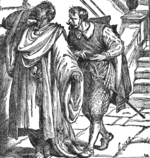
Othello is clearly the protagonist of Shakespeare’s most problematic tragedy, yet it is Iago who incites the tragic action and pushes it through to conclusion. He has more lines than Othello, including more soliloquies. Othello’s murder of Desdemona is appalling, but his jealous motivation for it is clear enough; even though his jealousy has been triggered by Iago’s lies and innuendos, they do not mitigate Othello’s guilt, although they do raise the question as to why he is so gullible. (“This may be a lesson to Husbands, that before their Jealousie be Tragical, the proofs may be Mathematical,” wrote a late seventeenth-century wag.) It is Iago’s motivation that is troublesome. Even if he hates the Moor, why does he go to so much trouble to destroy him? Why not just kill him and be done with it? And why does Iago also have to wound Cassio, bring on the deaths of Roderigo and Desdemona, and kill his own wife? What have they ever done to him?
It is not that Iago gives no reasons for what he does. In fact, he gives several: he resents Othello promoting Cassio over him; he loves Desdemona himself; he fears that “the lusty Moor” (II.ii.292) has cuckolded him with his wife Emilia; he even fears that hapless Cassio has cuckolded him as well.
more here.
Wednesday Poem
The Chinese micro-carver Chen Zhongen
can inscribe poems on a single strand of hair
The Stylist
I asked for a headful of sonnets
(Petrarchan) from scalp to split end.
Short-haired one, said he,
the most I can do for you
is a crop of haiku.
A bit miffed, I looked round the room
at enormous close-ups of women
with sestinas twirled through their ringlets,
thousands of Möbius strips
curled round recidivist words.
A man with a brylled-black mullet
sported tercets over his ears,
and a thicket of octets ending in knots:
floccinaucinihilipilification,
sesquipedalian,
hyperfecund,
the days of the week in Old Norse.
Poems with upbeat conclusions
on the flick-ups of nymphet models.
Bawdy love-lyrics from the 1700s
hidden inside dense dark shag perms,
and rhyming couplets at the outer tips
of a blonde boy’s barely-there eyebrows.
No fair, I thought; oh, to be Rapunzel
with space for the lost Latin epics
of Valerius Flaccus cascading
down past my backside.
But no; I got Ezra Pound’s petals
above my wet and blackening brow.
Some highlights from Japanese wisdom.
And one of the stylist’s own:
What hard work this is,
blinded by flurries of snow:
your psoriasis.
by Mary O'Donoghue
from Among These Winters
publishe, Dedalus Press, Dublin, 2007
Tuesday, August 5, 2014
The New-Wave classic ‘Band of Outsiders’ turns 50

It’s as if a French poet took an ordinary banal American crime novel and told it to us in terms of the romance and beauty he read between the lines; that is to say, Godard gives it his imagination, recreating the gangsters and the moll with his world of associations—seeing them as people in a Paris cafe, mixing them with Rimbaud, Kafka, Alice in Wonderland. Silly? But we know how alien to our lives were those movies that fed our imaginations and have now become part of us. And don’t we—as children and perhaps even later—romanticize cheap movie stereotypes, endowing them with the attributes of those figures in the other arts who touch us imaginatively? Don’t all our experiences in the arts and popular arts that have more intensity than our ordinary lives, tend to merge in another imaginative world? And movies, because they are such an encompassing, eclectic art, are an ideal medium for combining our experiences and fantasies from life, from all the arts, and from our jumbled memories of both. The men who made the stereotypes drew them from their own scrambled experience of history and art—as Howard Hawks and Ben Hecht drew Scarfacefrom the Capone family “as if they were the Borgias set down in Chicago.”
more here.
The enduring appeal of “Weird Al” Yankovic

Do people enjoy “Weird Al” Yankovic because he’s funny or because he’s not that funny? The comedian, who specializes in song parodies, just released his fourteenth studio album, “Mandatory Fun,” which features his class-clown mangling of hits by Lorde, Iggy Azalea, and Pharrell Williams, among others. It débuted at No. 1, selling more than a hundred thousand copies in its first week. Considering the post-digital slump in music sales—a hit album a decade ago could sell as many as a million copies in a week; this year, Sia’s “1000 Forms of Fear” entered the charts at No. 1 by selling only fifty-two thousand copies—this might be the biggest first week for a comedy album ever. But what is it that Weird Al actually does? I don’t laugh at his songs, yet I’m delighted by his presence in the world of pop culture. With his parodic versions of hit songs, this somehow ageless fifty-four-year-old has become popular not because he is immensely clever—though he can be—but because he embodies how many people feel when confronted with pop music: slightly too old and slightly too square. That feeling never goes away, and neither has Al, who has sold more than twelve million albums since 1979.
more here.
Europe Has a Serious Anti-Semitism Problem, and It’s Not All About Israel

Joshua Keating in Slate (photo: Photo by MIGUEL MEDINA/AFP/Getty Images):
When European government ministers talk about anti-Semitism, they tend to focus on the continent’s growing Muslim community—see French President Francois Hollande expressing concern about the Israeli-Palestinian conflict being “imported” to his country. This may accurately describe many of the incidents of the past few weeks—the Sarcelles riots, in particular, do appear to have been carried out by young Muslims—but the problem may be more widespread.
A recent Anti-Defamation League survey found that 24 percent of the French population and 21 percent of the German population harbor some anti-Semitic attitudes. A recent study of anti-Semitic letters received by Germany’s main Jewish organization found that 60 percent of the hate mail came from well-educated Germans. So this isn’t just a problem with young, disaffected Muslim men.
After all, the two worst recent incidents of violence against Jews in Europe—the killing of three children and a teacher in a 2012 attack on a Jewish school in Toulouse and the shooting of three people at a Jewish museum in Brussels in May—took place during times when there wasn’t much news coming out of Israel. Continentwide statistics on anti-Semitic incidents leading up to the most recent uptick don’t show much of an overall trend—in Britain, anti-Semitic violence is becoming less common while online abuse is becoming more frequent—or a correlation with events in Israel and Palestine.
More here.