An Orangutan Learns to Fish

Ferris Jabr in The New Yorker:

Jabr-Orangutans-690In 1990, while visiting a research camp in central Borneo, the primatologist Anne Russon saw an orangutan nicknamed Supinah attempt to make fire. Supinah sauntered toward an ashy fire pit, picked up a stick glowing with embers, and dipped it into a nearby cup full of liquid. Russon thought that the cup contained water, but it in fact held kerosene. Fortunately, that bath did little more than dampen the wood. Yet Supinah persisted: she got a second glowing stick, blew on it, fanned it with her hands, and rubbed it against other sticks. She never got the right steps in the right order to start a fire, but what foiled her was not her innate intelligence. She had a clear goal in mind and the right kind of brain to achieve it. She just needed a little more practice.

At the time, Russon was visiting Camp Leakey, which the anthropologist Biruté Galdikas established, in 1971, to study orangutans, just as Jane Goodall and Dian Fossey had done, in Africa, to observe chimpanzees and gorillas, respectively. Since then, Galdikas, Russon, and a handful of other orangutan specialists have learned firsthand just how intelligent and resourceful the animals really are. Some of their mental skills may exceed those of their great-ape brethren. Michelle Desilets, executive director of the Orangutan Land Trust, has summarized the unique intellect of orangutans like this: “They say that if you give a chimpanzee a screwdriver, he’ll break it; if you give a gorilla a screwdriver, he’ll toss it over his shoulder; but if you give an orangutan a screwdriver, he’ll open up his cage and walk away.”

Compared with chimpanzees, which are highly excitable, orangutans seem far more sober and considerate. They move deliberately and often spend a good deal of time silently watching before deciding how to act. At Camp Leakey, the orangutans had plenty of opportunity to observe and imitate people. They soon developed a habit of stealing canoes, paddling them downriver, and abandoning them at their destinations.

More here.

Human Ingenuity Can Fix Past Mistakes and Shape the Future

Simon Warrall in National Geographic:

In her new book, The Human Age, Diane Ackerman, best-selling author of The Zookeeper's Wife and A Natural History of the Senses, takes us on a journey into the Anthropocene: the era in which humans have both mastered and degraded the natural world. Ranging across the globe, she shows how our unique talent for self-awareness and our technological prowess can help us overcome today's global challenges. Speaking a few days before what may be the largest ever climate change demonstration, in New York, she talked about the Frozen Ark, where the DNA of vanishing species is being collected, introduced us to an orangutan with an iPad and a group of Alaskan Inuits threatened by rising sea levels, and expressed her optimism about the future.

Book-talk-human-age-01_83925_600x450You call our era the Anthropocene age. Can you explain?

Human beings have been on the planet for about 200,000 years, but if you think about it, most of the wonders we identify with contemporary life came about in the past 200 years. And in the past 20 years, they've been advancing at a mind-boggling pace. We've now changed the course of rivers, we've changed the outline of continents, we've created giant megacities, and we've even played golf on the moon. We've so dominated our landscape that the coalition of scientists believes we have to change the name of the era in which we're living. We're in the Holocene, a geologic era like the Jurassic for the dinosaurs. But [scientists would] like to change it to something that conveys more of our imprint on the planet, the Anthropocene, which translates as the human age. And I think it's a very good idea.

More here.

On/off switch for aging cells discovered, may hold the key to ‘healthy aging’

From KurzweilAI:

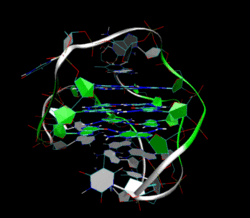
Telomer-structureScientists at the Salk Institute have discovered an on-and-off “switch” in cells that points to a way to encourage healthy cells to keep dividing and generating, for example, new lung or liver tissue — even in old age — and may hold the key to healthy aging. In our bodies, newly divided cells constantly replenish lungs, skin, liver and other organs. However, most human cells cannot divide indefinitely — with each division, a telomere (a cellular timekeeper at the ends of chromosomes) shortens. When this timekeeper becomes too short, cells can no longer divide, causing organs and tissues to degenerate, as often happens in old age. But there is a way around this countdown: some cells produce an enzyme called telomerase, which rebuilds telomeres and allows cells to divide indefinitely.

However, in a new study published September 19 in the journal Genes and Development, scientists at the Salk Institute have discovered that telomerase, even when present, can be turned off. “Previous studies had suggested that once assembled, telomerase is available whenever it is needed,” says senior author Vicki Lundblad, professor and holder of Salk’s Ralph S. and Becky O’Connor Chair. “We were surprised to discover instead that telomerase has what is in essence an ‘off’ switch, whereby it disassembles.” Understanding how this “off” switch can be manipulated, thereby slowing down the telomere shortening process, could lead to treatments for diseases of aging (for example, regenerating vital organs later in life).

More here.

Wednesday Poem

.
The Last Chapter is The Longest
Speaker 2

Every door opened and walked through recalls
all other doors —that first glimpse of the next room
its bric-a-brac reflecting what you knew and
how old you were and
what style shirt hung over a chair and
which program was on TV and
who else lay on the couch the night you met her and
when your first kiss led to which ceremony and
what gifts from then survived so many years and
why another door shut behind you that last time together and
how empty rooms seemed then without her to share those memories
of all the doors you opened together and
what color you decided to paint those walls after she had gone and
which car you drove to drop off the child at her place and
when you watched her door close and
how much time it took to find another door and
knock expectantly like you had before
.

by Michael Chrisman
from Little Stories, New Poems by Michael Chrisman

Tuesday, September 23, 2014

The Peculiar Journey of “Orange”

Ben Zimmer in the Visual Thesaurus:

OrangesAs has become the custom for the LinguaFile series on Lexicon Valley, I presented the hosts Mike Vuolo and Bob Garfield with a mystery word. This time, I had them guess the word that Eminem discussed in a 2010 interview on “60 Minutes” with Anderson Cooper: “People say that the word ___ doesn't rhyme with anything, and that kind of pisses me off, because I can think of a lot of things that rhyme with ___.” Bob figured out right away that it was orange, that eminently unrhymable word. Or not so unrhymable for Eminem, as he freestyles: “I put my orange four-inch door hinge in storage, and ate porridge with George.” I was amused to find out that Eminem's quasi-rhyming of orange has its roots in versifying going back to Walter William Skeat in an 1865 issue of Notes and Queries (not to mention a couple of dirty limericks collected by the great folklorist Gershon Legman).

The question that immediately came up had a less-than-obvious answer: Which came first, the color orange or the fruit orange? Many people are tempted to say the color, because it seems so basic to our vocabulary, but its “basicness” is relatively recent in the history of English. In the 1969 book Basic Color Terms, Brent Berlin and Paul Kay posited a kind of evolutionary sequence of terms in a language. The sequence starts with white and black, then proceeds to red, then green and yellow, then blue, then brown, and eventually to orange and purple (both unrhymable in English, as it turns out). The earliest evidence for the use of orange as a color term in English comes from 1512, several centuries after the other terms had been established. In Old English, you would need to say “yellow-red” (ġeolu-rēad) to describe something orange-colored.

More here.

tinkering around the edges of the third world war

Int-syria-1206Giles Fraser at The Guardian:

But despite my considerable reservations, it is still useful to invoke one aspect of the just war tradition and apply it to the current conflict in the Middle East: just wars require not only proportionality but also a reasonable chance of success. And the problem with so much of the west’s military involvement in Iraq, in particular, is that it has precious little conception of what success actually looks like. Bombing Islamic State is no more than a tinkering around the edges of a massive conflagration that is now increasingly being compared in scale to the thirty years war.

The sectarian conflict between Sunni and Shia, ignited first by the Iranian revolution and then deepened by the ill-advised western invasion of Iraq, is of a much greater order of magnitude than that acknowledged by Obama’s hands-off drone and air-strike approach.

We are witnessing a shift in the political tectonic plates throughout the whole of the Middle East and beyond into Africa, and the west’s apparently surgical involvement will probably do little more than generate some short-term satisfaction that we are doing something.

more here.

ben lerner’s 10:04

Cover00Christian Lorentzen at Bookforum:

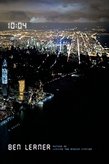
So 10:04 is a novel of intensities, an unfolding present. Some of this present is personal. At the start, Ben is diagnosed with “an entirely asymptomatic and potentially aneurysmal dilation of my aortic root” that could turn the artery into “a whipping hose spraying blood into my blood.” He’s also trying to impregnate his best friend Alex by artificial insemination (“fucking you would be bizarre,” she tells him). And he’s casually dating a conceptual painter named Alena with a taste for autoerotic asphyxiation. Other strands of the novel put Ben into contact with aspects of the city. He tutors an eight-year-old boy named Roberto, a well-drawn character but also a surrogate-son figure and an emissary from the immigrant class—Ben is constantly aware of being served by people who speak Spanish. Politics enters in the form of an Occupy protester who uses Ben’s shower and eats a meal he cooks, and an Adderall-addled student fixated on environmental apocalypse. Ben sits at the bed of a hospitalized mentor, who represents a connection with a vanishing avant-garde. He publishes a story in the New Yorker, fretting over whether he’ll let its editors “standardize” his work. After he signs his book deal, there’s an interlude in Marfa, Texas, where he sees the specter of Robert Creeley.

more here.

the mysterious Elena Ferrante’s Neapolitan novels

ID_POPKIN_FERRANTE_AP_001Nathaniel Popkin at The Smart Set:

Since the English publication last year of the second novel in the series, Story of a New Name (Europa Editions, 2013), critics have lauded the mysterious Ferrante, whose true identity is unknown. They’ve praised her particularly for her skill in rendering the fraught relationship between Elena and her childhood friend Lina (alternatively called Lila). Indeed, she draws the lines of the deepest love and of momentary hate, of jealousy and manipulation, guilt and fear, with spectacular control and insight. Give Ferrante a paragraph, and she’ll burnish the page with brilliant, fiery life.

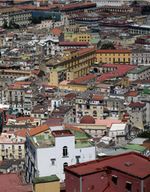
But underlying every nuance of personality here, every desire, every awakening, is the neighborhood, Naples, and the broad landscape of Italian cities, all in tension. This is “the infinite and the parochial,” as I attempted to conceptualize the opposite poles of urban life in Song of the City, my first book on Philadelphia. “It’s easy to become trapped in the parochial city,” I wrote, describing the neighborhood’s power of “exclusion and denial, stratification and fear.” On the other hand, “the infinite city is like the world itself. It is flat and wide and vast and in it everyone, everything can be known and explored.” For most of us and certainly for Elena and Natalie, “our relationship with the city stretches somewhere between the parochial and the infinite. Take away the parochial and the remains are cold, commodified spaces where personal, local connections do not exist. There are no neighborhoods, no neighbors, just glances. Dismiss the infinite from the city and what’s left is a village. The expectations are already known, the outcomes understood. The only way out is to leave.”

more here.

Too Much of a Good Thing: Carbon Dioxide, Building Block of Life, Best in Moderation

Natalie Angier in The New York Times:

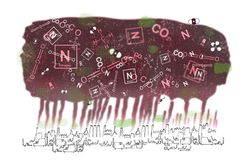
AngierA typical American car, Dr. Alley said, belches a pound of carbon dioxide through its tailpipe for every mile driven. A typical American power plant that burns coal to generate the electricity that lights up your home, your computer and your vibrating toothbrush releases more than 20 million pounds of carbon dioxide into the sky each day, said Donald J. Wuebbles, a professor of atmospheric sciences at the University of Illinois.

And too bad, when you pick up your luggage after your flight from Chicago to Salt Lake City, that you can’t also collect the 2,000 pounds that is your portion of the CO2 exhaust expelled en route by the burning of jet fuel. But it’s too late. The buoyant, odorless, colorless carbon dioxide molecules have dispersed into their surroundings, where wind and currents will stir them more or less evenly through the nitrogen and oxygen gases of which our atmosphere is overwhelmingly composed, and where the bouncing triplets will remain, on average, for 1,000 years. Researchers emphasize the importance of understanding the basic character of carbon dioxide and related greenhouse gases, and the fundamental role such gases have played in making our planet a Goldilocks haven, fit for life. But just as a pinch of salt can bring out the flavor in food but a fistful will ruin it, so too can excess CO2 transform our world into a two-thumbs-down stew.

More here.

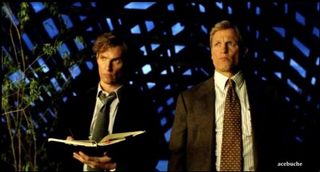
The Ethics of True Detective: Resignation or Compassion?

True-Detective-Ethics-Picture-500x268

Sandra Shapshay in The Critique:

The profundity of “True Detective”, in my view, is to be found in the series’ handling of the theme of pessimism and possible responses to this doctrine. By pessimism I mean the view adumbrated by Schopenhauer that life (that is, conscious life whether it be non-human animal or human life) involves a tremendous amount of suffering that is pretty much built into the structure of the world and is, further, unredeemed. By focusing on the character arc of Rust, one may empathetically appreciate the challenge posed by Schopenhauerian pessimism [1], and possible ethical responses to it.

Before we are introduced to the character, Rust had already experienced a terrible loss of his 4-year old daughter and the painful dissolution of his marriage. Further, his employment confronts him daily with the horrors of human conduct, where the “law of the stronger” reigns and the strong and sadistic exploit the weak. Throughout Season One, we see Rust struggling to find the best, truest response to all this seemingly endemic and unredeemed suffering. When we meet him, he declares to Marty, upon the latter’s insistent questioning, that he is “in philosophical terms, a pessimist,” and holds that human consciousness is a “tragic misstep in nature.” For Rust, it is our “programming” (in Schopenhauer’s terms, the will-to-life) that “gets us out of bed in the morning”, but that it would be better, all things considered to “deny our programming” and “walk ourselves hand in hand into extinction.” The only reason he has not committed suicide, he claims, is that he “lacks the constitution” to complete the act.

Despite his stated embrace of pessimism and his resignationist tendencies as evidenced by his rather ascetic lifestyle and in principle embrace of suicide, Rust does not actually resign himself from life. He is, after all, the eponymous “true detective” and throws himself assiduously into the task of solving the ritualistic rape/murders and bringing the perpetrators to justice.

So what really motivates Rust to spend most of his waking life (and he doesn’t seem to sleep all that much) attempting to solve these crimes? Is it the intellectual puzzle? Is it compassion for the victims and potential new victims? Is it a thirst for justice?

More here.

The Barbarians Within Our Gates

140918_melham_isil_ap

Hisham Melhem in Politico:

There is no one single overarching explanation for that tapestry of horrors in Syria and Iraq, where in the last five years more than a quarter of a million people perished, where famed cities like Aleppo, Homs and Mosul were visited by the modern terror of Assad’s chemical weapons and the brutal violence of the Islamic State. How could Syria tear itself apart and become—like Spain in the 1930s—the arena for Arabs and Muslims to re-fight their old civil wars? The war waged by the Syrian regime against civilians in opposition areas combined the use of Scud missiles, anti-personnel barrel bombs as well as medieval tactics against towns and neighborhoods such as siege and starvation. For the first time since the First World War, Syrians were dying of malnutrition and hunger.

Iraq’s story in the last few decades is a chronicle of a death foretold. The slow death began with Saddam Hussein’s fateful decision to invade Iran in September 1980. Iraqis have been living in purgatory ever since with each war giving birth to another. In the midst of this suspended chaos, the U.S. invasion in 2003 was merely a catalyst that allowed the violent chaos to resume in full force.

The polarizations in Syria and Iraq—political, sectarian and ethnic—are so deep that it is difficult to see how these once-important countries could be restored as unitary states. In Libya, Muammar al-Qaddafi’s 42-year reign of terror rendered the country politically desolate and fractured its already tenuous unity. The armed factions that inherited the exhausted country have set it on the course of breaking up—again, unsurprisingly—along tribal and regional fissures. Yemen has all the ingredients of a failed state: political, sectarian, tribal, north-south divisions, against the background of economic deterioration and a depleted water table that could turn it into the first country in the world to run out of drinking water.

More here.

Who’s On Trial, Eichmann or Arendt?

21stone1-blog480

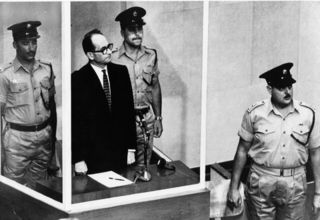
Seyla Benhabib in the NYT's the Stone (Adolf Eichmann during his 1961 trial. Credit Associated Press):

The Emory University historian Deborah E. Lipstadt told The Times this month that Stangneth “shatters” Arendt’s portrait of Eichmann. In The Jewish Review of Books, the intellectual historian Richard Wolin writes: “Arendt had her own intellectual agenda, and perhaps out of her misplaced loyalty to her former mentor and lover, Martin Heidegger, insisted on applying the Freiburg philosopher’s concept of ‘thoughtlessness’ (Gedankenlosigkeit) to Eichmann. In doing so, she drastically underestimated the fanatical conviction that infused his actions.”

This sort of dismissal of Arendt’s work — essentially a rejection of the “banality of evil” argument — is by no means new, but it does not hold up when one truly understands the meaning of her phrase. Couldn’t Eichmann have been a fanatical Nazi and banal? What precisely did Arendt mean then when she wrote that Eichmann “was not stupid. It was sheer thoughtlessness — something by no means identical with stupidity — that predisposed him to become one of the greatest criminals of that period.”? Arendt certainly did not think that ordinary human beings were all potential Eichmanns; nor did she diminish the crime Eichmann committed against the Jewish people. In fact, she accused him of “crimes against humanity,” and approved his death sentence, with which many, including the Jewish philosopher Martin Buber, disagreed.

More here.

Monday, September 22, 2014

The Winners of the 3QD Science Prize 2014

Science 2014 StrangeScience2014 Scienic 160 Charme Quark 2014 neu

Frans de Waal has picked the three winners from the nine finalists:

  1. Top Quark, $500: Eric Michael Johnson, Promiscuity Is Pragmatic
  2. Strange Quark, $200: Christie Wilcox, Did Allergies Evolve To Save Your Life?
  3. Charm Quark, $100: Carl Zimmer, The Wisdom of (Little) Crowds

Here is what Frans had to say about them:

Eric Michael Johnson knows how to grab the reader’s attention, and does so in “Promiscuity is pragmatic.” In Biology 101, we all have learned that females are the picky sex, and that males roam the field. This view is made to sound logical, and moreover comfortably fits accepted gender roles. Explaining what kind of resistance there has been, and there still is, to violations of this Victorian scenario, Johnson – who is getting a PhD in science history – delves into its history. He portrays anthropology as dominated by white male morality, hence its hostility to theories explaining female “promiscuity” (the term alone is morally loaded!). And not just hostility to the theories: data in support of a more complex view of sexuality are quickly dismissed or simply ignored.

The reason I give this essay top ranking is partly since it is so compellingly written, capable of keeping our attention, but also because the topic is provocative, as attested by the 500+ comments it has elicited. Johnson’s blend of history, primatology, and anthropology works very well in convincing us to pay heed to evolutionary explanations of human behavior. His take is not nearly as narrow as the one common in evolutionary psychology, partly because of his ability and desire to look beyond our own species. He is also not shy to explore science that is at the fringes. Here I don’t mean science at the fringes for being obscure or questionable, but rather because it is subversive.

Johnson has a heretical streak, which makes him pay attention to serious scientists with unconventional ideas. As a result, his writing is more exciting than that of those so seeking to present all sides of an issue as to end up somewhere in the middle. Also, even though Johnson starts out with a primate story, his essay is relevant to all of animal and human science, as attesetd by the ground breaking study on fruit flies that challenged the Bateman hypothesis and the implications for human anthropology.

I found all of the entries very much worth reading, and so it was not easy to pick the two other two Quark Prizes. My second choice is Christie Wilcox’s piece on the toxin hypothesis of allergies. It is well written and the recent mouse work she describes supports the view that allergies reflect a protective mechanism.

My third choice is Carl Zimmer’s essay about small crowds being superior in decision-making compared to big crowds. This essay, too, is a pleasure to read, and systematically explores the idea why crowds make better decisions than single individuals, and why this advantage is not necessarily a linear function of crowd size.

In fact, all three essays explore unusual ideas that seem to go against the mainstream, which makes for exciting reading, leaving one to wonder what other established ideas we may have wrong. As such, these authors promote the healthy skepticism that is the bedrock of science, and show that science is always in flux, always keeping us at the edge of our seat. In a society that sometimes turns away from science, or views it as a boring mass of facts, this is a most important message to convey.

Congratulations also from 3QD to the winners (remember, you must claim the money within one month from today–just send me an email). And feel free, in fact we encourage you, to leave your acceptance speech as a comment here! And thanks to everyone who participated. Many thanks also, of course, to Frans de Waal for doing the final judging.

The three prize logos at the top of this post were designed by Sughra Raza, me, and Carla Goller. I hope the winners will display them with pride on their own blogs!

Details about the prize here.

Sunday, September 21, 2014

One of the most amazing feats in chess history just happened, and no one noticed

Seth Stevenson in Slate:

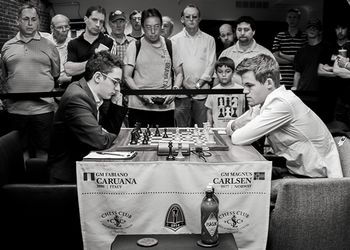
140917_SNUT_CaruanaCarlsen.jpg.CROP.original-originalBefore any of the six entrants in the 2014 Sinquefield Cup had nudged a white pawn to e4, they’d already been hailed as the strongest collection of chess talent ever assembled. The tournament, held in St. Louis, featured the top three players in the game. The weakest competitor in the field was the ninth best chess player on the planet.

The favorite was current world No. 1 and reigning world champion Magnus Carlsen. The young Norwegian—who is among the best players in the history of chess—strolled into the lounge of the St. Louis Chess Club as the most alluring grandmaster ever, a brilliant, handsome 23-year-old with a modeling contract for the clothing company G-Star Raw. Forget about his overmatched foes. If anything could stop Carlsen, his fans reckoned, it would be the swirl of distractions occupying the parts of his brain not given over to memorizing Nimzo-Indian variations.

As the tournament began on Aug. 27, Carlsen was mired in an ongoing faceoff withFIDE, the international governing body of chess. There are a few things you should probably know about FIDE—or the Federation Internationale des Echecs, if you’re feeling continental. FIDE is, by all accounts, comically corrupt, in the vein of other fishy global sporting bodies like FIFA and the IOC. Its Russian president, Kirsan Ilyumzhinov, who has hunkered in office for nearly two decades now, was once abducted by a group of space aliens dressed in yellow costumes who transported him to a faraway star. Though I am relying here on Ilyumzhinov’s personal attestations, I have no reason to doubt him, as this is something about which he has spoken quite extensively. He is of the firm belief that chess was invented by extraterrestrials, and further “insists that there is ‘some kind of code’ in chess, evidence for which he finds in the fact that there are 64 squares on the chessboard and 64 codons in human DNA.”

More here.

Murder ‘comes naturally’ to chimpanzees

Jonathan Webb at the BBC:

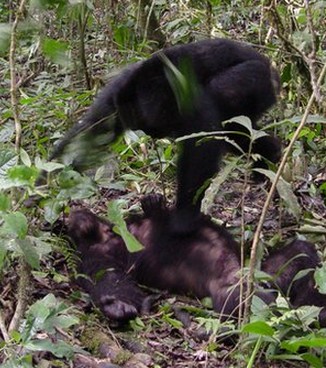
ScreenHunter_805 Sep. 21 17.10A major study suggests that killing among chimpanzees results from normal competition, not human interference.

Apart from humans, chimpanzees are the only primates known to gang up on their neighbours with lethal results – but primatologists have long disagreed about the underlying reasons.

One proposal was that human activity, including destroying habitats and providing food, increased aggression.

But the new findings, published in Nature, suggest this is not the case.

Instead, murder rates in different chimp communities simply reflect the numerical make-up of the local population.

The international study was co-written by more than 30 scientists and gathers data from some 426 combined years of observation, across 18 different chimp communities.

A total of 152 killings were reported. This includes 58 that were directly observed by researchers; the rest were counted based on detective work – tell-tale injuries or other circumstances surrounding an animal's death or disappearance.

Interestingly, the team also compiled the figures for bonobos, with strikingly different results: just a single suspected killing from 92 combined years of observation at four different sites. This is consistent with the established view of bonobos as a less violent species of ape.

More here.

Battle Ground: A look at the tangled political history of modern Gaza

Hussein Ibish in Bookforum:

Cover00As this review was going to press, the latest bout of hostilities between Hamas and other Gaza-based militants and Israel had become even more bloody and destructive than 2009’s brutally named Israeli incursion into Gaza, Operation Cast Lead. An estimated 1,700 people have been killed. Between 70 and 80 percent of them were Palestinian civilians, and at least 200 were children. Israel has so far attacked seven UN schools serving as refugee shelters, provoking harsh condemnation even from the United States. Meanwhile, Hamas has drawn criticism from the global community for using abandoned schools to store ordnance. Sixty-four Israeli troops have been killed, along with three civilians—a stark contrast to Operation Cast Lead, which claimed the lives of just nine Israeli soldiers, four of them killed by friendly fire. The cost reckoned in damage to infrastructure and property in Gaza remains all but impossible to calculate. The war has reportedly displaced some 460,000 people—nearly a quarter of Gaza’s entire population. The present conflict appears unlikely to come to a complete stop—and if it does, there’s no reason why it wouldn’t flare up again at any moment.

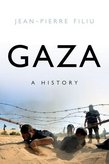
With so much international attention focused on Gaza, it’s finally occurring to many Americans and other Westerners that the region has its own history, and that this history is key to sorting out the present conflict. So in this sense, Jean-Pierre Filiu’s Gaza: A History arrives at a propitious moment; if anything, Filiu’s book—“the first comprehensive history of Gaza in any language,” the publisher claims, probably correctly—is long overdue. Gaza isn’t exactly exhaustive; it dashes through the area’s lengthy and complex ancient, classical, and Islamic imperial histories in a mere thirty pages or so.

More here.