
When Illness Is Cure
Moonmen gush over the blue: all noticed Earth
looked more alive and tenuous, more startling
and alone than could have been guessed.
On TV last week, one of them got stuck
repeating “fragile,” as if the word’s gentle alarm
would wake us. After he spoke, shots of fires
and floods. When they returned to his face
he seemed older, sadder: I imagined him
in the capsule reaching back
putting a hand under the world
as if supporting the head of a child.
Comfort is the cause of climate change.
That we can create it to a degree
rats and giraffes can’t. Comfort and ease.
Fridge of beer in the basement
to save walking upstairs.
Taking the car to get the paper
at the bottom of a long driveway
when it’s raining. Clicking pictures of desires
until they abracadabra into our hands.
And pain will be the thing that saves us.
When New York becomes Atlantis. When only angels
are allowed to fly. When we have to shoot
our cars in the head. Push has come to shove
for us: we’re quick to notice
when the kitchen’s on fire but not
when our way of life is burning down.
It’s our nature: how many explorers
did the dishes, painted the living room:
the point was to leave home, not take care of it.
It’s easier to ask what’s out there
than in here, but the new moonshot’s
internal: can we discover we love life
enough to save it from ourselves?
I won’t be here to find out is why I ask.
by Bob Hicok
Enjoying the content on 3QD? Help keep us going by donating now.
 You can want different things from a university—superlative basketball, an arts center, competent instruction in philosophy or physics, even a cure for cancer. No wonder these institutions struggle to keep everyone happy. And everyone isn’t happy. The Trump Administration has effectively declared open war on higher education, targeting it with deep cuts to federal grant funding. University presidents are alarmed, as are faculty members, and anyone who cares about the university’s broader role.
 A century ago, one of the richest men in the world decided to wade into the public sphere by throwing his weight behind a series of cuts that would reach into every corner of American life. The president of the day, sensing early support for these reforms and not wishing to be left behind, jumped on board with impulsive zeal, demanding that all federal offices implement the cutbacks with immediate effect.
 The legal doctrine of “habeas corpus,” a Latin phrase that has its
 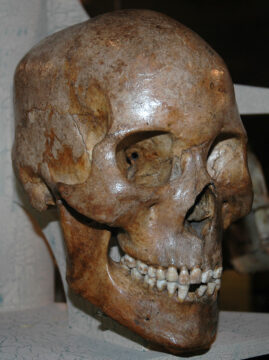 What’s distinctive about humans is that homo sapiens domesticated themselves. We are self-domesticated apes. Anthropologist Brian Hare characterizes recent human evolution (Late Pleistocene) as “Survival of the Friendliest”, arguing that in our self-domestication we favored prosociality — the tendency to be friendly, cooperative, and empathetic. We chose the most cooperative, the least aggressive, the less bullying types, and that trust in others resulted in greater prosperity, which in turn spread neoteny genes, and other domestication traits, into our populations.
 Against the backdrop of a cold white room, Iris Apfel’s yellow outfit, which she wore on the occasion of her hundredth birthday, sings its own joyous song. Both here and elsewhere, Apfel, an artist and fashion designer, often paired gorgeous things sensually by color and texture, rather than by invoking some obvious theory or idea. She was not afraid to wear a yellow tulle coat with yellow silk pants (which she designed herself in collaboration with H&M). She celebrated yellow vivaciously; she took up space with yellow. With her arms raised in this picture, she looks like some sort of bishop or religious figure. Her open palms throw spectral glitter upon us. A spiritual icon. Just by looking at her, I feel her upturned palms manifesting my dreams.
 T
T What Rina Green calls her “living hell” began with an innocuous backache. By late 2022, two years later,
  L
L Parenting teenagers