Culture: A scientific idea “ready for retirement”?

Bk_423_pascal__boyer

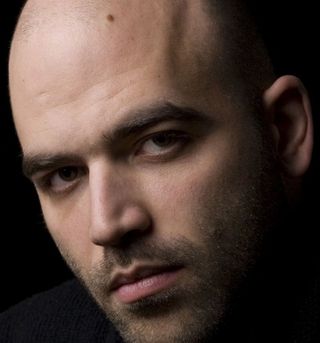
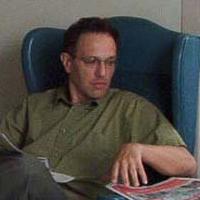
Alberto Acerbi over at the LSE's International Cognition and Culture Instiute, with comments in the comment section by Pascal Boyer (pictured), Dan Sperber and others:

Every year the website edge.org asks their panel a general question on science and/or society. The 2014 question was: What scientific idea is ready for retirement? I did not read (yet) all the answers, but I was surprised to see that two of them, from Pascal Boyer and John Tooby, were one and the same: culture. One could take the answers as a provocation of two evolutionary psychology-minded scholars against mainstream cultural anthropology (which I’d subscribe to). However, knowing Boyer and Tooby's work, and since, when people ask me what my research is about, I tend to answer “human culture” or “cultural evolution”, I think I have to take this challenge quite seriously.

On one level, I agree completely with the answer: “culture” cannot be considered as an unproblematic explanation of any phenomenon. I was recently reflecting on the fact that, while I consider myself an atheist, I find it often unpleasant to hear – let alone pronounce – profanities. Rationally, I know that they are simply a series of sounds, but still I cannot avoid being annoyed. The imaginary naive anthropologist would say: of course, it is your culture! (I am Italian, and I received a then standard Catholic education). But this is exactly what we want to explain: why is this specific “cultural stuff” (being bothered by profanities) and not others (say going to church or pray) still present?

I think that every reader of this blog would agree that it is not useful to use culture as an explanation: we can not explain X (my problematic relationship with profanities, the readiness to perceive interpersonal threats in Southern USA, etc.) with “culture”. As Boyer writes in his answer, “that such processes could lead to roughly stable representations across large numbers of people is a wonderful, anti-entropic process that cries out for explanation”. However I feel like this is a starting point. I would be interested in X as a “cultural stuff”, and then try to explain it. Boyer and Tooby do not seem to agree: “culture”, in their view, is not just mistakenly used as an explanation. It is not a scientific concept at all…

[Dan Sperber in the comments] Culture is a property. What property? Take all practices, artefacts, mental states in a population over time that have some informational content. Ask how are their contents related? Well, they are all links in many causal chains where for an item to be a link in such a chain is to owe some of its content to having been at least partly caused by previous links in the chain. So in a chain of perfect copying, as exists now on the internet, each new token of, say, a given youtube video owes its whole content to the token that has been copied in producing it. In most cases however, in particular before the internet, items having informational content have a more complex informational aetiology, owing some of their content to one causal chain, some to another causal chain, and some to the more or less idiosyncratic process of their production in the mind or through the behaviour of one or several individuals. Take a very idiosyncratic item: someone’s original dream. Even that item owes quite a bit of its content to being a causal descendent of conversations, stories, images, and so on. It is cultural too. You get my point. The more an item gets its informational content from the causal chains in which it occurs, the more cultural it is. Note that to be 100% cultural in this way, it should typically owe all of its content to a single chain, otherwise the recombination itself is likely to involve some idiosyncratic construction.

More here.

Being Johnny Rotten

D195876c-9bf5-11e4_1122352hWesley Stace at The Times Literary Supplement:

Lydon the narrator is endlessly self-contradictory – there is no use criticizing the book on the basis of this essential component of his character. He is also abrasive, immodest, given to outlandish claims, prone to speaking about himself in the third person (“poor old Johnny Rotten”), and either very funny or mesmerizingly humourless. He seems to will misunderstanding, purely so he can complain about it, and is equally happy to speak ill of the dead and the living in his eternal battle over the soul of the Pistols. Occasionally, as the book goes on, he picks a fight with himself just to pass the time.

The tone changes when he writes tenderly, and uxoriously, of his wife, Nora, and extended family. Libraries have been another kind of saviour and there are paeans to Dickens, Wilde, Ted Hughes, Muriel Spark and John Keats. Punk did not brush away the musical past as its publicists have claimed, and Lydon emphasizes the musical continuum, praising influential musical acts from Can and Hawkwind, through Kool & the Gang, to Duran Duran and Depeche Mode. Of the Edgar Broughton Band, he wisely notes: “I don’t expect the music would bear up too much today, but that isn’t the be-all-and-end-all”.

It’s perhaps fitting that the career of Lydon, who undoubtedly sees himself as a force of nature, took a left turn when he became the presenter of “extreme” nature programmes, including John Lydon’s Megabugs and John Lydon Goes Ape. During the filming of the latter, he finally met his match: “You can not train [gorillas], they will not have it . . . But then I’m untrainable too”.

more here.

Jeff VanderMeer: The Weird Thoreau

Rothman-The-Weird-Thoreau-690Joshua Rothman at The New Yorker:

The three weirdest books I read last year were all by the same writer. His name is Jeff VanderMeer, he’s from Tallahassee, Florida, and he’s the King of Weird Fiction. He writes in the genre—his 2009 novel “Finch” is a detective story, reminiscent of “Blade Runner,” set in a city divided between normal people and mushroom people—and he champions it: with his wife, the influential sci-fi and fantasy editor Ann VanderMeer, he’s edited the anthologies “The Weird” and “The New Weird.” It’s self-defeating, of course, to try and define weirdness (although VanderMeer has offered definitions). A lot of fiction, moreover, merely pretends to it, invoking its atmosphere without being, in fact, all that weird.

Still, when you’re in the presence of the genuine, uncanny article, you know. Stephen King is tremendously imaginative, but H. P. Lovecraft is weird; Kafka is probably the ultimate weird writer. In VanderMeer’s “Finch,” the mushroom people (“gray caps”) are people-shaped, and they can seem like character in an ordinary detective novel. (“You stupid fucking mushroom” a cop says while interrogating one of them. “Answer the question.”) But, standing next to one, you feel its “humid weight.” You can torture a mushroom person by pouring water on its head, but if you cut it into pieces it stays cold and dry.

more here.

Richard Estes at the smithsonian

Klei01_3702_01August Kleinzahler at the London Review of Books:

Estes is identified with the photorealist school of painting. With their glossy, often hard finish, an almost enamelled quality, and photographic degree of verisimilitude, his work looks at home in that context. But it might be more useful to compare his pictures with those of the veduta painters of the 17th and 18th centuries, with Vermeer’s View of Delft and The Little Street, or the views of Venice by Canaletto and the Guardis. The Smithsonian exhibition includes two canvases of Venice from 1980, View towards La Salute, Venice and Accademia, Venice, that are reminiscent of 18th-century Venetian painters even if they show the buildings of the city reflected, multiplied and distorted by the glass windows of vaporetto stops. Piranesi’s detailed etchings of Rome – The Colosseum, for instance – seem a probable influence but Estes, who is most definite about his likes and especially his dislikes (Pop art is ‘silly’), regards drawings, etchings and lithographs as ‘incomplete’ because they are not coloured. As for his interest in reflection, it seems to have been ignited by the pictures he saw at the National Gallery during his travels as a young artist: small Turner watercolours ‘with distorted reflections in windows – or mirrors perhaps’, Van Eyck’s The Arnolfini Portrait, in which the mirror behind the couple reflects two figures at the door and The Rokeby Venus by Velásquez, in which she admires her own reflection in a mirror – all these pictures, Estes says, ‘seemed to open up a lot of possibilities for painting’.

more here.

Why a Generation of Adoptees Is Returning to South Korea

Maggie Jones in the New York Times Magazine:

18adoption_ss-slide-I1HM-master1050That night, Klunder and her friends passed plates of bibimbap (rice topped with meat and vegetables), soondubu jjigae (tofu stew) and pa jun (scallion pancake) around the table and ordered bottles of beer and soju. Everyone there was a member of Adoptee Solidarity Korea, or ASK. It was started as a reading group in 2004 by a handful of politically progressive Korean female adoptees (and one man) in their 30s, who began to discuss why Korean single mothers felt pressure to give away their children — 90 percent of those who place their children for adoption are not married. They talked about a culture in which single mothers are often ostracized, one in which employers typically ask women about their marital status in job interviews; parents sometimes reject daughters who raise their children alone; and the children of single mothers are often bullied in school. They also questioned why the government offered little aid to mothers to help keep their families intact. At an adoption conference organized a year after the group was created, members handed out fliers that read, in part, “ASK stands in opposition to international adoption.” They sold T-shirts, designed by Kimura Byol-Nathalie Lemoine, an early adoptee activist, that depicted a wailing baby with a large stamp on its rear end: “Made in Korea.”

Over time, ASK backed away from its message of ending adoption. It was too polarizing, adoptees said, and “hard for people to hear anything we said after the word ‘stop,' ” Jenny Na, one of the group’s founders, wrote in a history of ASK. But in recent years, members — along with other Korean adoptee activists — have built an improbable political campaign, lobbying for legislation that has helped reduce the flow of Korean children overseas. In the process, they have emerged as leaders in a movement to question the very concept of international adoption, one that has galvanized other adoptees around the world.

Read the rest here.

Roberto Saviano: My life under armed guard

From The Guardian:

ScreenHunter_947 Jan. 16 14.18As a young writer growing up in Caserta, a suburb of Naples, I felt myself getting more and more angry. There was a war going on between two mafia clans for control of the territory, and violence between them spilled into the streets. I wanted to tell the world what this war zone was like: the victims’ families tearing their clothes, the stink of piss from a man who knew he was going to die and couldn’t control his fear, people shot in the street because they looked like the intended victim. I got to know the workers in industries run by the Camorra. I got to know the messengers, the look-outs who worked for the clan. I read court records, news reports, trial transcripts. I pulled their stories together, the stories of my neighbourhood, and published a book called Gomorrah. Something about it touched a nerve. It became an instant bestseller – so many people bought it that the Camorra couldn’t ignore it.

Not long after the book came out in 2006, someone left a leaflet in my mother’s postbox. I was living in Naples, but she was still in Caserta. It showed a photograph of me, with a pistol to my head, and the word “Condemned”. Soon afterwards, I was invited to give an address at a gala to inaugurate the new school year in the town of Casal di Principe, home of the most powerful Camorra clan, with one of the highest murder rates in Italy. I singled out the Camorra bosses from the stage, naming them publicly, which local people had been too intimidated to do. I told them they should leave. The then-speaker of the Italian parliament was there with his bodyguards. After the event, they told me it would be too dangerous to go back to Naples on public transport, so they took me with them. The following day the local paper denounced my intervention as an insult to the Camorra. A few days later, someone followed me on the street in Naples and got on the bus behind me. He said: “You know that they are going to make you pay for what you did in Casale [Casal di Principe], right?”

Less than a month after that, returning to Naples from a literary festival, I was met at the railway station by two carabinieri. As we drove away in an armoured car, they said they had been assigned to me for my protection.

More here.

Looking for the roots of terrorism

Sara Reardon in Nature:

ScreenHunter_946 Jan. 16 14.10In the wake of terrorist attacks last week on the French satirical magazine Charlie Hebdo and a Paris supermarket, the world has struggled to understand the combination of religion, European culture and influence from terrorist organizations that drove the gunmen. Scott Atran, an anthropologist at the University of Michigan in Ann Arbor and the Centre National de la Recherche Scientifique in Paris, studies such questions by interviewing would-be and convicted terrorists about their extreme commitment to their organizations and ideals. Atran recently returned from Paris, where he talked with members of the shooters’ communities. He spoke with Nature about what he discovered.

What sociological and cultural factors are behind the Paris attacks?

Unlike the United States, where immigrants achieve average socioeconomic status and education within a generation, in Europe even after three generations, depending on the country, they’re 5–19 times more likely to be poor or less educated. France has about 7.5% Muslims and [they make] up to 60–75% of the prison population. It’s a very similar situation to black youth in the United States.

The difference is here’s an ideology that appeals to them, it’s something that’s very attractive to more people than you might think. In France, a poll by [ICM Research] showed that 27% of young French people, not just Muslims, between 18 and 24 had a favourable attitude toward the Islamic State. The jihad is the only systemic cultural ideology that’s effective, that’s growing, that’s attractive, that's glorious — that basically says to these young people, “Look, you're on the outs, nobody cares about you, but look what we can do. We can change the world.”

And of course they are. These three lowlifes, they managed to capture the entire world’s attention for the better part of a week. They mobilized all of French society. That’s a pretty good cost–benefit for the bad guys.

More here.

Love in the Time of Military Courts

Fawzia Naqvi in Kafila:

Fawzia-1Pakistan has become a euphemism for insanity. Doing the same thing over and over again and hoping for a different outcome. There are though some incredibly brave, thoughtful, humane and patriotic Pakistani men and women who have decided enough is enough and they are determined to chart a different future for the country. After speaking with one of these activist leaders I was reminded of the Russian author Ivan Turganev’s heroes Bazarov, the young Nihilist from Fathers and Sons or Insarov, the Bulgarian revolutionary from On the Eve. Youthful, galvanized, resolute, compelled by the rightness of the cause and their destiny, dreaming of a new country and their place within it, they were the first glimpse of “the new men,” lonely and ultimately tragic. In 1860 Turganev’s heroes were ahead of their time, pulling along a people unwilling to change tradition and unwilling to cede privilege. In 2015 Pakistan, there is a huge obstacle in the way of these courageous souls. They are outnumbered by the rest of us.

The time has come for each of us to recall what it was we were doing when our children were being executed in Peshawar. Is there even a word which encompasses the horror when 135 children are executed? Make no mistake it was our collective shrug which has tipped Pakistan over the edge and into this very dark abyss. It was our collective indifference which let these children be stalked by death at the hands of cold blooded murderers who went from child to child executing them that December 16 morning in Peshawar. We let our children die alone and scared, with no one to comfort them except other wounded and dying children.

More here.

Friday Poem

Bloodlines

I.

Even in the dark, I’m ashamed of my lemon breasts,
my peach-fuzzed midsection. I want to go back
home to my father. To my bed with the threadbare
blanket, the hand-carved cross over the headboard.
I want a God-fearing man, hands roughed by fields.

Augusto is a pretty boy with a new blue bicycle.
He rides into the next town, buys all the things
my mother assures me will make for a good life.
But the patch of blood on the bed sheets promises
different, promises thorns no bread or gold can dull.

II.

In America, I’m a maid at the Ramada , I
rent an apartment on Market Street. Broken English
and bad fruit. Pigeons as pets. My two children
in a one-bedroom. A Technicolor TV with antennas
sky-high. Double-locked doors. Barred windows.

An ironbound city, the unfamiliar cacophony: honks
of trailer horns, the bloody spur of factory smoke,
the brandied laughter of construction workers. I try
to sing the lullaby I’d hum to my brothers in the dark
over the news anchor’s Más lluvia para mañana!

III.

Tonight, my granddaughter sits in my kitchen
and considers the importance of bloodlines, waits
for the words to pop like champagne grapes.
Blood from my veins into her veins
until we are both blue with life. Outside, the song

gulls sing as they look for food separates the wind
from the hymn of pine needles. She writes a poem
to remember me, to remember it all— sweat and tears,
Portuguese ancestry, and of course, blood, to run roots
through my future great-granddaughter’s bones.
.

by Maria Carreira
from Acentos Review
November 2014

Thursday, January 15, 2015

LAWRENCE OSBORNE’S THE BALLAD OF A SMALL PLAYER

Paul French in the Los Angeles Review of Books:

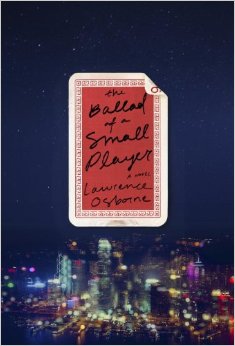
51H7BgDh9fL._SY344_BO1,204,203,200_Every so often, a novel that captures the essence and flavors of the modern China experience is published — yet seemingly totally escapes the attentions of the devoted China reading crowd. They praise and discuss, absorb and dissect other, often distinctly inferior, novels, while Lawrence Osborne’s The Ballad of a Small Player has attracted no attention and fallen through the cracks of the Sinology drain. Yet Osborne has written an acutely observed novel detailing one part of the contemporary China experience and he deserves to be widely read. In fact, I’m going to just go right on and out and say it — Osborne’s novel is the best on contemporary China since Malraux’s Man’s Fate (which, rather depressingly, means we might have to wait another 80 years for the next one!)

Macau, the former Portuguese colony off the coast of southern China, is a distinctly little written-about place. It deserves more. In the 1930s, Macau gained a reputation for sin and wickedness, epithets that have long lingered over the place. The American noir writer Sherwood King wrote If I Die Before I Wake in 1938. The book became the basis for the Orson Welles-Rita Hayworth film The LadyFrom Shanghai in 1947. In the novel, Elsa Bannister, a White Russian of dubious reputation, born of refugees in Chefoo, on the China coast, explains her past: “Chefoo is the second wickedest city of earth.” The first? “Macau,” she exclaims, without a moment’s hesitation.

More here.

The golden ratio has spawned a beautiful new curve: the Harriss spiral

Alex Bellos in The Guardian:

HarrisHarriss was overjoyed when he first saw the spiral because it was aesthetically appealing – one of his primary aims was to draw branching spirals like you might find in Islamic art or the work of Gustav Klimt. But he was particularly delighted because he arrived at the spiral using a very simple mathematical process.

“It’s not hard to make something that no one has seen before,” he said. “It’s more difficult to make something mathematically satisfying that people haven’t seen before.”

His first concern was that maybe someone else had had, in fact, drawn the spiral “One thing about mathematical discoveries and mathematical art is that even if the process is completely new there is no guarantee that someone else has not already explored it.”

It turned out that the ratio 1.325, which gives you the rectangle that creates the Harriss spiral has been written about – it is known as the “plastic number” – but Harriss could find no previous drawings of the spiral. (In fact, the ratio is a number that begins 1.32472… and carries on forever).

More here.

The Palestinians’ decision to join the ICC deserves support

Ken Roth in the Los Angeles Times:

ScreenHunter_945 Jan. 15 16.26The Israel exception to Western governments' human rights principles has been starkly on display in the reaction to the Palestinian Authority's decision to join the International Criminal Court. In Washington, Ottawa, Paris and London, as well as Tel Aviv, the response has ranged from discouraging to condemnatory. The Palestinian move has been seen as “counterproductive,” “deeply troubl[ing],” “a concerning and dangerous development” that could make a “return to negotiations impossible.” Before accepting these howls of protest, we should ask why, exactly, the Palestinian move is supposed to be bad.

Given the outcry, one would think this move targets only Israel, but the ICC doesn't work that way. Rather, the court will be empowered to prosecute war crimes committed in or from Palestinian territory — that is, crimes committed by Israelis or Palestinians. The court's prosecutor is not dependent on formal complaints by ICC members but can now initiate cases on her own.

Many of the Western objections are based on the argument that having the Palestinians in the ICC will somehow undermine Israeli-Palestinian peace negotiations — moribund as they have been. The U.S. State Department opined that it would “damage the atmosphere” for peace.

But the broad parameters for peace have been known for years. What has been lacking is the trust between the two sides to make the painful decisions necessary for a peace accord. Nothing undermines that trust more than impunity for the war crimes that Human Rights Watch has found continue to characterize the conflict, whether settlement expansion, Hamas rocket strikes or Israel's lax attitude toward civilian casualties in Gaza. By helping to deter these crimes, the ICC could discourage these major impediments to peace.

More here.

why john updike loved cartoons

6a00d8341c630a53ef013484409f0d970c-piJeet Heer at The Paris Review:

“I can’t remember the moment when I fell in love with cartoons, I was so young,” John Updike once recalled in Hogan’s Alley magazine. “I still have a Donald Duck book, on oilclothy paper in big-print format, and remember a smaller, cardboard-covered book based on the animated cartoon Three Little Pigs. It was the intense stylization of those images, with their finely brushed outlines and their rounded and buttony furniture and their faces so curiously amalgamated of human and animal elements, that drew me in, into a world where I, child though I was, loomed as a king, and where my parents and other grownups were strangers.”

This is one of many passages where Updike talks about his childhood love of comics, a theme that recurs not just in essays but also in poems and short stories. What deserves attention in this passage is not only what Updike is saying but the textured and sensual language he’s using when he recalls the “oilclothy paper” and the “buttony furniture.” His tingling prose, where every idea and emotion is rooted in sensory experience, owes much to such modern masters as Joyce, Proust, and Nabokov, but it was also sparked by the cartoon images he saw in childhood, which trained his eyes to see visual forms as aesthetically pleasing. Indeed, the comparison with Nabokov is instructive since the Russian-born author of Lolita was also a cartoon fan.

more here.

HOLLYWOOD’S MEXICAN WAVE

Birdman HeadTom Shone at More Intelligent Life:

Iñárritu is not the only Mexican searching out flesh tones amid the steel of the Hollywood blockbuster. In “Gravity” Alfonso Cuarón signed George Clooney and Sandra Bullock, cast them adrift in outer space, took all the technical resources that pummel us in the summer months and bent them to a stripped-down tale of survival, with explosions ripping soundlessly across the screen and the audience holding their breath while Bullock struggled for hers. Then there is Guillermo del Toro, more of a genre fiend than his compatriots, but on such intimate terms with the gnarled old souls of his monsters—in films like “Pan’s Labyrinth”, “Hellboy” and “Pacific Rim”—that the whole notion of heroism, let alone super-heroism, is left outclassed.

The three directors are friends and run a production company together. But unlike earlier South American directors, who defined themselves in vocal opposition to the Hollywood machine, the three amigos are the children of globalism, as conversant in franchise formulas as they are in Mexico’s indigenous cinema. Working away at the fault-line that separates north from south, blockbuster export from indie import, they are bilingual, speaking Hollywoodese but making up their own grammar and syntax.

It had to happen. Hollywood’s global supremacy over the last 30 years was always going to bring its own form of blowback.

more here.

‘Sympathy for the Devil: Four Decades of Friendship with Gore Vidal’

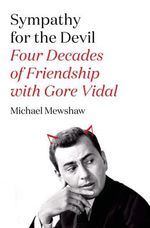
9780374280482_p0_v1_s260x420Michael Dirda at The Washington Post:

Vidal (1925-2012) was for more than half a century the wittiest gadfly on the American scene, almost a latter-day Mark Twain — but without the lovability of that white-suited curmudgeon. Like Twain, Vidal published best-selling books (“Burr,” “Lincoln”), experimented with literary forms (the gender-shifting comedy “Myra Breckinridge”), produced scores of cultural and political pieces (the collected essays, titled “United States,” run to a thousand pages) and was a charismatic storyteller and performer.

But where Twain cultivated his plain-folks image, Vidal was clearly a patrician, a scion of the American aristocracy. His immediate family included a grandfather who was a distinguished senator, a gold-digger mother (who once slept with Clark Gable) and a father who had starred on the gridiron at West Point, competed in the Olympics and helped build the American airline industry. During one of his mother’s marriages, Jacqueline Bouvier (later Mrs. John F. Kennedy) became a kind of stepsister.

more here.

As a Muslim, I’m fed up with the hypocrisy of the free speech fundamentalists

Mehdi Hasan in New Statesman:

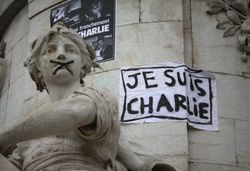
CharlieIn the midst of all the post-Paris grief, hypocrisy and hyperbole abounds. Yes, the attack was an act of unquantifiable evil; an inexcusable and merciless murder of innocents. But was it really a “bid to assassinate” free speech (ITV’s Mark Austin), to “desecrate” our ideas of “free thought” (Stephen Fry)? It was a crime – not an act of war – perpetrated by disaffected young men; radicalised not by drawings of the Prophet in Europe in 2006 or 2011, as it turns out, but by images of US torture in Iraq in 2004. Please get a grip. None of us believes in an untrammelled right to free speech. We all agree there are always going to be lines that, for the purposes of law and order, cannot be crossed; or for the purposes of taste and decency, should not be crossed. We differ only on where those lines should be drawn.

Has your publication, for example, run cartoons mocking the Holocaust? No? How about caricatures of the 9/11 victims falling from the twin towers? I didn’t think so (and I am glad it hasn’t). Consider also the “thought experiment” offered by the Oxford philosopher Brian Klug. Imagine, he writes, if a man had joined the “unity rally” in Paris on 11 January “wearing a badge that said ‘Je suis Chérif’” – the first name of one of the Charlie Hebdo gunmen. Suppose, Klug adds, he carried a placard with a cartoon mocking the murdered journalists. “How would the crowd have reacted? . . . Would they have seen this lone individual as a hero, standing up for liberty and freedom of speech? Or would they have been profoundly offended?” Do you disagree with Klug’s conclusion that the man “would have been lucky to get away with his life”?

More here.

Making History: First Free Climb of Yosemite’s Dawn Wall

Andrew Bisharat in National Geographic:

Elcapitan-finish-03_adapt_1190_1Nineteen days after they set out to achieve one of climbing's most difficult challenges, Tommy Caldwell and Kevin Jorgeson reached the summit of the 3,000-foot rock known as El Capitan in Yosemite National Park on Wednesday, marking the first free ascent of a notoriously difficult section called the Dawn Wall. Caldwell and Jorgeson reached the summit just after 6:00 p.m. EST, where a contingent of 40 friends and family members, plus a group of reporters, stood ready to greet them, having arrived via an eight-mile (13-kilometer) hike around the backside of the mountain. The crowd had already begun toasting the duo's accomplishment with champagne. (See pictures from the photographer who is documenting Caldwell's and Jorgeson's attempt to make history.) The ascent represents the realization of Caldwell's vision to find a way to free climb the Dawn Wall—widely considered too steep and too difficult for free climbing—a dream that began seven years ago, when Caldwell began exploring this historic granite face.

…Free climbing means using one's hands and feet to ascend a rock's natural features, employing ropes and other gear only to stop a fall. At roughly 3,000 feet (915 meters) tall, the Dawn Wall comprises 32 “pitches”—or 32 rope-lengths—of climbing. Caldwell's and Jorgeson's goal was to free climb all 32 pitches—without falling and without returning to the ground in between. If one of them fell while attempting a pitch, he would have to try that individual pitch from its beginning again. (Read about Jorgeson's attempts to catch up to Caldwell.) They began their ascent on December 27, and committed to living up on the side of El Cap for as long as it took each of them to free climb every pitch in succession. Their base camp consisted of three portaledges—each one a six-foot by four-foot (2-meter by 1-meter) platform with tent fly, suspended by nylon straps and hanging from bolts in the sheer granite wall. For breakfast they ate whole-wheat bagels topped with cream cheese, red bell pepper, cucumber, and salami or salmon. At night, they sipped whiskey. Every few days, one of the friends waiting on the ground ascended 1,200 feet (366 meters) of rope to bring the team a new cache of supplies and water.

More here.

Thursday Poem

Expect Nothing

Expect nothing. Live frugally
On surprise.
become a stranger
To need of pity
Or, if compassion be freely
Given out
Take only enough
Stop short of urge to plead
Then purge away the need.

Wish for nothing larger
Than your own small heart
Or greater than a star;
Tame wild disappointment
With caress unmoved and cold
Make of it a parka
For your soul.

Discover the reason why
So tiny human midget
Exists at all
So scared unwise
But expect nothing. Live frugally
On surprise.
.

by Alice Walker

Another take on
expecting nothing