Using sound waves to detect rare circulating cancer cells

From KurzweilAI:

Cancel-cell-detectionA team of engineers from MIT, Penn State University, and Carnegie Mellon University is developing a novel way to isolate cancer cells that circulate in the bloodstream: using sound waves to separate them from blood cells. Cancer cells often break free from their original locations and circulate through the bloodstream, allowing them to form new tumors elsewhere in the body. Detecting these cells could give doctors a new way to predict whether patients’ tumors will metastasize, or monitor how they are responding to treatment, but finding these extremely rare cells has proven challenging because there might be only one to 10 such cells in a 1-milliliter sample of a patient’s blood.

…KurzweilAI has reported on several cancer-cell-sorting techniques. Most existing cell-sorting technologies require tagging cells with chemicals or exposing them to strong mechanical forces that may damage them, according to the MIT/Penn State/Carnegie team. To sort cells using sound waves, which offer a gentler alternative, the researchers built microfluidic devices with two acoustic transducers, which produce sound waves, on either side of a microchannel. When the two waves meet, they combine to form a standing wave (a wave that remains in constant position). This wave produces pressure nodes, or lines of low pressure. Because the sound waves are tilted so they run across the microchannel at an angle, each cell encounters several pressure nodes as it flows through the channel. As cells encounter each node, they are pushed further to the side of the channel; the distance of cell movement depends on their size and other properties, such as compressibility. In the previous study, the researchers were able to separate cancer cells from red and white blood cells, but the sample flow rate through the device was only 1 to 2 microliters per minute. At that rate, it would take more than 50 hours to process a typical patient sample of about 6 milliliters. The new version of the device has a working flow rate about 20 times faster, allowing it to process a patient sample in about five hours.

More here.

Resistance Is Fertile!

Gfc.2014.14.4.69-f02

Anne Meneley in Gastronomica (Image courtesy of Sharaka – Community Supported Agriculture):

The practices of everyday commensality—producing, provisioning, and consuming food and drink in the West Bank of Palestine—are radically affected by the Israeli occupation. I discuss two very different Palestinian initiatives that envision production and consumption of food and drink as a nonviolent means of resisting the occupation: a craft beer called Taybeh brewed in the predominantly Christian Taybeh village close to Ramallah, and a local agriculture movement based in the Ramallah district known as Sharaka (“partnership” in Arabic). Theories of resistance in anthropology, from James Scott’s (1985) conception of resistance tactics as “weapons of the weak” to Lila Abu-Lughod’s (1990) idea of resistance as a “diagnostic of power,” still resonate in Palestine as the Palestinians are so clearly in a position of gross inequality in relation to their Israeli occupiers, whose power is hardly disguised enough to need a diagnostic. I have found Julia Elyachar’s discussion of how agency is embedded in infrastructure and infrastructure is implicated in resistance activities insightful. This is particularly salient given the peculiar status of infrastructure in the West Bank where, instead of facilitating connectivity, infrastructure is designed to impede and exclude flows—in this case, commodities of sustenance (Elyachar 2014: 460). I am primarily concerned with both Christian and Muslim Palestinians in the West Bank; while I did not have the opportunity to travel to Gaza, conditions in Gaza, including the shocking 2014 Israeli military offensive, affect political sentiments and actions in the West Bank, including resistance practices involving food, a topic I will return to briefly in the postscript of this article.

Local food and drink production and consumption have become sites of “agro-resistance.” Vivien Sansour, a journalist and activist, describes 78-year-old Abu Adnan as one of Palestine’s farmer revolutionaries, who “understand on an experiential level that healing for us as a community suffering from oppression and occupation requires the restoration of our sense of self—a self that is defiant but not defined by its oppressor” (Sansour 2010: 2). Dinaa Hadid cites a Palestinian farmer who, like Abu Adnan, envisions agricultural practice itself as a fertile resistance: “‘I don’t throw rocks,’ says farmer Khader, referring to young men who frequently hurl stones during demonstrations. He pointed to his rock-built terraces. ‘I use them to build our future’” (Hadid 2012: 3). I borrow my title from that of a recent article published in Al-Jazeera, “Resistance Is Fertile: Palestine’s Eco-War” (Brownsell 2011), itself a spinoff from the classic line by the Borg inStar Trek: The Next Generation, “Resistance is futile.” Describing Palestinian “guerilla gardeners of the occupied West Bank,” the author quotes Baha Hilo, then of the Joint Advocacy Initiative, responsible for planting olive trees on land that is in danger of being confiscated: “We’re not a militia, our weapons are our pickaxes and shovels, our hands and our olive trees” (ibid.: 3). Baha Hilo was my guide during my five years as an intermittent “guerilla gardener” myself, as we picked olives on Palestinian land threatened by Israeli military or settlers. Here, I examine how guerrilla gardeners are part of contemporary Palestine agricultural movements and, moreover, are deployed as a new form of nonviolent resistance to the Israeli occupation.

More here.

Literature and Politics

Calvino

Yong Jie in 3:AM Magazine:

In considering how the chief necessity of literature to politics resides in the representation of the politically excluded, it is perhaps necessary to first explore the reasons for which literature is able to acknowledge those whom politics often overlooks.

I. a) The individual at the heart of literature

The first reason is the greater focus of literature on the individual. One notes how Calvino refers quite instructively in his quotation to the way literature may serve the individual: it gives “a voice to the one who does not have a voice”, “a name to the one who does not have a name”. The insight here is that the individual lays at the heart of literature, though his or her voice may be lost to the ear of politics.

For if politics purports – at least in democratic polities – to be in the service of individual citizens, it tends to perceive these citizens as finally a part of a collectivity, its vision attuned to the broad sweep. And thus one is either a part of the Democrats or Republicans in the United States, belonging perhaps to the Jewish-American bloc, or the African-American demographic; in Malaysia, one may be seen by politicians as simply a member of the Chinese, Indian or Malay community. The individual derives significance from being a part of a whole. Indeed, in the perspective of politics, strength is gained in numbers: the collective counts for more, possesses a weightier presence than the individual, by dint of its size and thus ability to influence political outcomes in elections. The significance of a group within politics is commensurate with size, and the single individual is the smallest grouping of all.

And even in exceptional instances whereby particular individuals are taken into account within politics, these invariably possess power of some sort, economic or political, rendering them therefore significant. The ear of politics thus registers the roar of the gathered masses, and is sensitive to the whispers of the privileged; the lone voice of an ordinary individual belonging to no politically significant grouping often remains unheard.

Yet it is the individual around which literature revolves. A work of literature is by its nature the work of a single consciousness. And we are often drawn to works of singularity – works in which a consciousness speaks and expresses its experience of the world in an individual, inimitable manner. We love best, as Salman Rushdie points out, those writers whose “voices are fully and undisguisably their own” , who, in William Gass’ unforgettable phrase, “sign every word they write”.

More here.

Wednesday, April 8, 2015

How to do history (and how not to)

Philip Ball in Pandaemonium:

ScreenHunter_1125 Apr. 08 17.45In a recent short review in Prospect of Steven Weinberg’s book To Explain the World, I took exception to his narrow and presentist view of the history of science. That perspective remains unchanged in Weinberg’s recent article in the Guardian, in which he gives us his take on both the history of science and popular science writing. In both respects his remarks are useful, insofar as they encapsulate the worst of what drives me to despair when some (most definitely not all) scientists talk about these things.

Weinberg’s view of the history of science is not down to ignorance. It’s important to say this because that’s what it looks like. But Weinberg does not write Whiggish history because he doesn’t know what historians of science do these days, but specifically because he does know and disapproves of it. Yes, this theoretical physicist believes that historians don’t really know how to write history. It is hard to know why he nonetheless expresses ‘enormous respect for professional historians of science, from whom I have learned so much’ – unless he means (as I suspect) that he is grateful to them for having dug all the facts out of the archives, but that he doesn’t believe they can be trusted to know what to do with them. Because Weinberg seems to have learned nothing from historians of science about how to be a historian.

If your view is that science was just blundering around and dragging its feet until Newton’s Principia, then it’s perhaps not surprising if you conclude that the use of mathematics in science by ancients such as Plato and the Pythagoreans was ‘childish’. Again we have to understand that, while a remark like this coming from an undergraduate would simply indicate ignorance, from Weinberg it connotes something else. I am quite sure that he knows how incendiary such a claim is. But I fear that, in making it, he comes across like James Watson, evidently thinking that by saying the ‘outrageous’ he is revealing himself as a bold and outspoken thinker, whereas in fact he just sounds silly.

More here.

Defending Rojava

Rojava-383x321

A. M. Gittlitz in The New Inquiry:

The time is right to redraw the map, former US lieutenant colonel and Fox News talking head Ralph Peters argues, with a Free Kurdistan as the New Middle East’s crown. “Stretching from Diyarbakir through Tabriz, it will be the most pro-Western state between Bulgaria and Japan,” he says, continuing a century-long tradition of treating the Kurdish people as a talking point in negotiating borders, disciplining Turkey or invading Syria or Iraq. As the most effective fighting force against ISIS and the faction most likely to set up a stable secular democracy, Western hawks like Peters are once again championing the Kurdish cause, so long as it fits the daily agenda.

Often equally instrumentalizing, the Western left has taken a newfound interest in the allegedly revolutionary situation in the Kurdish-majority region of Rojava in northern Syria. There, a new system of stateless governance has formed and their rhetoric against patriarchy, neo-liberalism, and the nation-state quickly lead to both enthusiasm from those who see the embattled Kobane as the new Catalonia, and scorn from those who see it breeding short-sighted and faux-revolutionary nationalism.

In both cases, the voices of revolutionary Kurds are seldom heard, and Combustion Books’ collection of essays, A Small Key Can Open a Large Door: The Rojava Revolution, tries to fix this lack. Perhaps the first English language book on the subject, it includes an eclectic assortment of first hand accounts, including a letter from a 19 year old woman sent to her mother from the Kobane frontlines, a description of the situation on the border of Turkey by activists facing down Erdogan’s military police and newly translated essays from Turkish anarchist groups. Other selections compile a series of letters sent between Syrian and Iraqi Kurds and analyze the importance and mechanics of Kobane’s successful defense against ISIS.

The book reads as a primer for the situation in Rojava that the editors unhesitatingly refer to as a “revolution” in a 30 page introduction on the history of Kurdish resistance and the results of the PKK’s “libertarian turn”. In 2004, influenced by the works of Murray Bookchin, imprisoned PKK leader Abdullah Öcalan determined that the authoritarian nature of Marxism-Leninism was behind the times and out of touch with Kurdish society, and the anarchistic model of governance by small councils of workers, youth, women, and neighbors would be a more pragmatic and truly communistic solution. Around this time Kurds in Syria attempted to enact the program, but were quickly and violently repressed by Assad.

More here.

American Orientalism

Vivek Bald in Dissent:

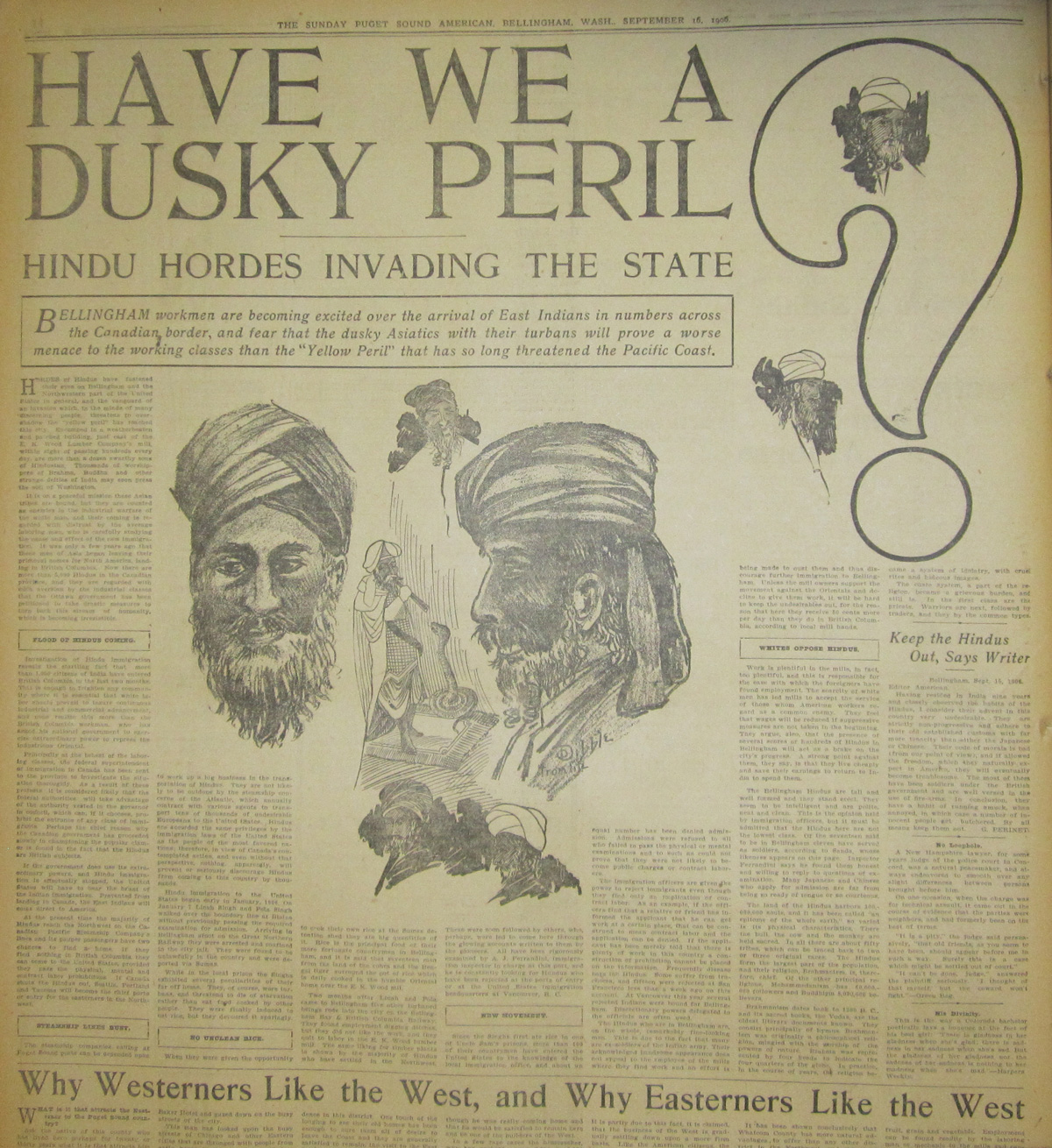
On an early September night in 1907, fifteen hundred white lumber mill workers set off on a rampage against Indian immigrants in the coastal town of Bellingham, Washington. The Indians, also mill workers, were predominantly from Punjab; most were turbaned Sikh men. The rioters saw the Indians as aliens, outsiders, and racial inferiors who were taking away American jobs, jobs that should go to white men. As they made their way across Bellingham, the mob, according to historian Joan Jensen,

swept down to the waterfront . . . where many of the Indians lived. Battering down the doors, the mob . . . pocketed money and jewelry, and dragged Indians from their beds . . . Those who did not move fast enough were beaten . . . Fifty men stormed the surrounding mills, pulled Indians from their bunks and began to burn the bunkhouses.

By the end of the night, two hundred Indian men, beaten and bruised, had been rounded up like cattle into Bellingham’s City Hall. Over the next days, most of the Indians chose to leave Bellingham, and the United States, in search of work in British Columbia. Local white residents cheered as their train rolled out of the station.
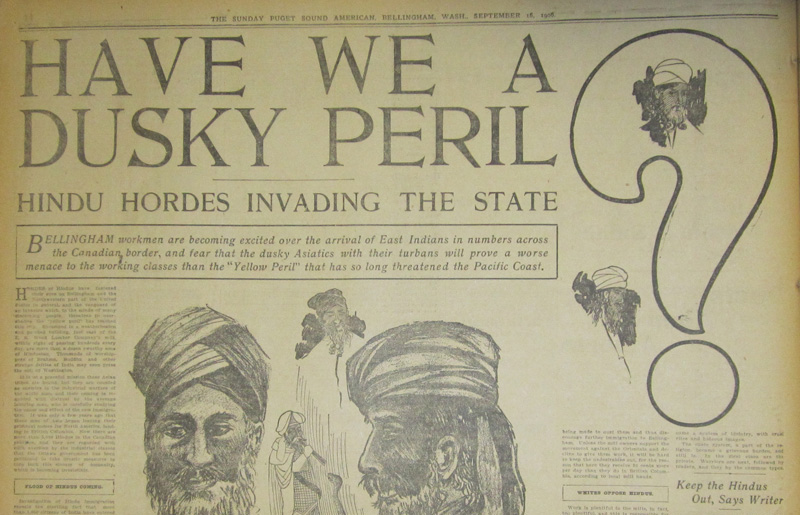
An article from the September 16, 1906 Puget Sound American describing recent “Hindu” immigration to Bellingham, Washington. Courtesy of the South Asian American Digital Archive.

It is not well known among Americans today that immigrants from British colonial “India”—that is, from present-day India, Pakistan, and Bangladesh—were entering the United States alongside the Irish, Italians, Greeks, Germans, Poles, Russians, and other Europeans during the “golden age” of immigration between the 1890s and 1920s. It is also not well known that, though their numbers were small, these Indian or “Hindu” migrants (“Hindu” being a racial term applied to all South Asians) figured prominently in the public outcry for restrictions on immigration. Members and supporters of the West Coast-based Asiatic Exclusion League were the first to promote the idea that a nefarious horde of “Hindus” was about to swamp the United States. But their discourse became national in scope, and came to include claims that thousands of Indian and Chinese seamen (the former, primarily Muslims from present-day Bangladesh) were jumping ship, smuggling drugs, and engaging in human trafficking through northeastern ports. In the opening decades of the twentieth century, in newspapers, public speeches, and congressional testimony, Indian immigrants were portrayed as a looming threat to the United States. Alongside other Asian laborers, Indians were viewed in much the same way that immigrants from Mexico, Central America, Haiti, and elsewhere south of the U.S. border have been in recent years.

At the same time, as historian Seema Sohi has argued, Indians occupied a unique place in the broader anti-Asian rhetoric of the early twentieth century. Because Indian nationalist exiles had been using what they believed to be the safety of U.S. soil to plan and coordinate anti-colonial activities against the British, they became a focus of the state’s broad efforts to quell political radicalism in the 1910s. While West Coast labor leaders warned of a “Tide of Turbans” sweeping in from the Pacific to take away American workers’ jobs, congressional advocates for exclusion warned that Indian immigrants were promoting subversion, Bolshevism, and anarchism, and were a threat to national security.

More here.

The “Food Babe” Blogger Is Full of Sh*t

Lh6dpf6ihthiuqnlqogx

Yvette d'Entremont in Gawker:

Hari's campaign last year against the Starbucks Pumpkin Spice Latte drove me to launch my site (don't fuck with a Bostonian's Pumpkin-Spice Anything). She alleged that the PSL has a “toxic” dose of sugar and two (TWO!!) doses of caramel color level IV in carcinogen class 2b.

The word “toxic” has a meaning, and that is “having the effect of a poison.” Anything can be poisonous depending on the dose. Enough water can even be poisonous in the right quantity (and can cause a condition called hyponatremia).

But then, the Food Babe has gone on record to say, ” There is just no acceptable level of any chemical to ingest, ever.” I wonder if anybody's warned her about good old dihydrogen monoxide?

(AKA water.)

It's a goddamn stretch to say that sugar has deleterious effects, other than making your Lululemons stretch a little farther if you don't “namaste” your cheeks off. However, I implore you to look at the Safety Data Sheet for sugar. The average adult would need to ingest about fifty PSLs in one sitting to get a lethal dose of sugar. By that point, you would already have hyponatremia from an overdose of water in the lattes.

And almost enough caffeine for me.

And what about that “carcinogenic” caramel color? Well, it turns out that it's not the only thing in your PSL that's in carcinogen class 2b.

There's also coffee.

Coffee is class 2b because of the acrylamide accumulated during the roasting process. Coffee, before Starbucks turns it into a milkshake, is pretty healthy for you. Class 2b means that all possible carcinogenic effects haven't been ruled out (because we haven't tested drinking it while tightrope walking across the Grand Canyon and simultaneously attempting to eat fire… yet), but that it hasn't been shown to cause a single case of cancer.

This is a blatant attempt at getting you to look to her for answers by making you unnecessarily afraid. The goal of Hari's campaign was to… well, we're still not sure. Remove the caramel color? Smear Starbucks? After that campaign failed, she launched a failed attempt to get them to use only organic milk, which would have made their lattes far more expensive and no healthier.

More here.

NASA is planning to deflect an asteroid in 2022 — to learn how to protect Earth

Joseph Stromberg in Vox:

ScreenHunter_1124 Apr. 08 15.31This is all part of a joint mission NASA's planning with the European Space Agency called Asteroid Impact & Deflection Assessment (AIDA). It will start with the launch of a European craft in 2020 to study and map the asteroid first. ESA entered the preliminary design phase of that initial reconnaissance mission earlier this week.

The goal is to develop the technology and expertise that might be necessary to nudge an asteroid out of its orbit if we ever discovered one heading for Earth. It might sound far-fetched, but the truth is that asteroids are apotentially serious threat — and foresighted missions like this could theoretically be the difference between a closely averted disaster and catastrophe.

In 2020, the European Space Agency plans to launch its Asteroid Impact Mission, or AIM probe. It'll travel to an asteroid named Didymos, which is orbited by a relatively small (about 550 feet wide) asteroid called Didymoon.

Over the course of a year or so, AIM will orbit Didymoon, mapping its surface and collecting data on its mass and overall structure. Current plans also call for it to send out a pair of smaller satellites to collect more data, as well as a lander that would touch down on Didymoon itself — becoming just the fourth craft (if Japan's current Hayabusa-2 mission is a success) to make a controlled landing on an asteroid.

More here.

You can’t love a whole planet

Liam Barrington-Bush in openDemocracy:

Liam2In most discussions, the answers to the questions above follow an understandable logic: if the problems are big, the solutions must be too. The allure of a ‘Big Solution’ is it represents the silver bullet we all so desperately wish we could find; the single answer to countless massive, complex and interrelated problems. It is the desperate hope that climate change can be boiled down to the text of one binding agreement. Progressive NGOs think we can negotiate the deal we need, many activists on the street think we can pressure it into being, but the push for a Big Solution is largely agreed. It’s hard to argue against it when we think about average global temperature increases, sea level rises and greenhouse gasses measured by the tonne!

With awareness of the scale of the problems we face – if we can avoid utter despair – comes a great weight; a sense of responsibility for something we can’t truly comprehend in more than an abstract way. Many of us who actively try to help have become the loving-but-overstretched adoptive parents of seven billion children.

We spread ourselves so thin that each of the children becomes an abstraction. Love becomes care, becomes like, becomes duty. We desperately attempt to find generalised solutions to apply to the infinite smaller problems we see the family struggling with, glossing over the specifics of each to give ourselves the sense that if we just find The Answer, we can make everyone’s lives better in one fell swoop.

Maybe this is what Naomi Klein was getting at when I interviewed her last summer. “I don’t think you can love a whole planet,” she said almost apologetically.

It’s a phrase that has been swirling around in my head ever since, and would probably have felt incredibly depressing, had she not followed it up with the counterpoint: “I think what’s driving the most powerful resistance movements is love of particular places.” This resonated with me in such a deep way, and turned the initial statement from one of despair, into one of possibility.

Trade summits, climate negotiations, the UN, the WTO, the IMF, are all such abstractions in the lives of anyone who doesn’t go to work for them. Even the protests outside the meetings become part of the same abstraction, debating in equally removed terms about which Big Solutions should be pursued and applied across the vastness of the planet. Whether these Big Solutions are broadly more or less progressive is secondary; the processes themselves are out of touch.

The expectation that coordination at scale can or must be organised through a single entity or institution lies at the core of Carne Ross’ criticisms of schizophrenic intergovernmental structures and processes. In essence, even a single national government is constantly working against parts of itself, as different policy priorities perpetually butt up against one another. This ‘left hand working against the right hand’ dilemma grows exponentially when you try to bring multiple governments together under a single banner.

Read the rest here.

God’s Bankers: the catholic church and indulgences

From Delancey Place:

PopeToday's selection — from God's Bankers by Gerald Posner. One of the scandalous practices of the Catholic church was the sale of “indulgences” to raise money. Indulgences allowed Catholics to buy forgiveness for their sins with cold, hard cash. Most remember that indulgences were one of the primary reasons Martin Luther made the cataclysmic decision to leave the Catholic church and start the “Protestant” movement. However, few realize that indulgences were used by the Catholic church as a primary source of revenue for over a thousand years, and that the practice did not end as a result of Luther's protests: “The cost of running the church's kingdom while maintaining the profligate lifestyle of one of Europe's grandest courts pressured the Vatican always to look for ways to bring in more money. Taxes and fees levied on the Papal States paid most of the empire's basic expenses. The sales of produce from its agriculturally rich northern land as well as rents collected from its properties throughout Europe brought in extra cash. But over time that was not enough to fuel the lavish lifestyles of the Pope and his top clerics. The church found the money it needed in the selling of so-called indulgences, a sixth-century invention whereby the faithful paid for a piece of paper that promised that God would forgo any earthly punishment for the buyer's sins. The early church's penances were often severe, including flogging, imprisonment, or even death. Although some indulgences were free, the best ones — promising the most redemption for the gravest sins — were expensive. The Vatican set prices according to the severity of the sin and they were initially available only to those who made a pilgrimage to Rome.

…”The licentious lifestyle of the Papal Court and the widespread abuses in selling indulgences became a rallying cry for Martin Luther and the Reformation. Pope Leo responded by excommunicating Luther. One of the few benefits from the schism was that since Protestants condemned indulgences, the Holy See remained unopposed when it came to selling forgiveness to believers in Christ. “The steady flow of cash became ever more important as the Vatican suffered from the repercussions of the liberal political and social upheaval that swept Western Europe in the late eighteenth century, climaxing in the 1789 French Revolution.”

More here.

Tumour mutations harnessed to build cancer vaccine

Heidi Ledford in Nature:

TumorCancer is a genetic disease, driven by mutations that lift the brakes on cell proliferation. But the mutated proteins produced by cancerous cells can serve as a siren call to immune cells, signalling the presence of a cell that has become, in a sense, ‘foreign’. Unfortunately, many of these calls are never heard. Some tumours suppress nearby immune responses, and mutated tumour proteins may not be expressed at high enough levels to rally immune cells. Researchers have long dreamed of using those mutated proteins to generate a vaccine, says immunologist Beatriz Carreno of Washington University in St. Louis, Missouri, but lacked the technological wherewithal to do so.

The advent of cancer-genome sequencing and an improved understanding of the immune system have converged to make that approach possible. Last year, two groups2, 3 showed that such vaccines can work in mice. Carreno and her colleagues have now taken the approach into humans. The researchers sequenced the tumour genomes in samples taken from three people with melanoma and catalogued the mutated proteins in each sample. They then chose seven protein fragments per patient for use in the vaccine. White blood cells were taken from each patient and cultured in the laboratory to generate immune cells called dendritic cells. These cells were then exposed to the protein fragments, allowed to mature in the laboratory and then infused into the patients. By then, the dendritic cells had taken up the protein fragments, and were able to present them to immune cells in the body. The result: immune cells trained to target the mutated proteins produced by the tumour1. Such immune cells were evident in the patients' blood two weeks after vaccination.

More here.

Wednesday Poem

At a Happiness Symposium in Wales
.

A psychologist said
Graveyards may help you feel happier,
visit a graveyard when you are depressed

There is a thin line between life and death, my friend
and I am a graveyard

I am happy to be alive, my friend
After Halabja and Anfal
I am happy to become the voice
of a land
that contains the mass graves of our brothers

There is a thin line between life and death, my friend
There is a thin line between life and death
.

by Nazand Begikhani
from Bells of Speech
Ambit Books, London, 2006

*******

Halabja
Anfal

Tuesday, April 7, 2015

Sven Birkerts Interviews Sven Birkerts

Sven Birkerts in the Los Angeles Review of Books:

There-Is-Simply-Too-Much-to-Think-About-243x366SVEN BIRKERTS: Why did you decide to write about Bellow’s essays in the form of a self-interview? Isn’t that displacing the focus just a bit?

SVEN BIRKERTS: Maybe so, yes. But the idea came to me as a kind of default after I had been beating my head against the standard, familiar thing — you know: hook, overview, bits of excerpt, some wrangling, some praise, followed by the larger pronouncement … I felt I just could not do it one more time. Then I remembered that Bellow had conducted a self-interview (included in this very collection) and something clicked. The form offers certain advantages, the main one being that you can break against the prescribed structure and meander to the things that are more interesting, as happens in good conversation.

But what about fulfilling your reviewer’s responsibility?

I own that there is a certain shirking of the task going on. Which would normally be unconscionable. But this seemed an exception. And here’s my reasoning: first, there’s no need to be arguing for Bellow’s literary status — he is one of our confirmed greats, a Nobelist, admired by his fellow writers the world over. The essays in this book have been published and published again; not only in their original journals like Partisan Review, The Atlantic Monthly, The American Scholar, and The New Yorker, but in previous books. They’ve been reviewed and discussed and —

It sounds like you’re saying “what’s the point?”

I guess I am. On the other hand, there’s always a point in writing about a great writer. That’s what being a great writer means — that he or she can (and ought to) always be written about. Which leads me around to my other rationale for these proceedings: reading the essays had me dropping in on some of the novels — and as I did, my brain started getting revved up in the unique way that it does when I get near that side of Bellow, as if there reallyis simply too much to think about. (I was, it seemed, living out the feeling of the title of the collection.) I was being overrun — like in those old movies when the attacking multitudes finally put their crude ladders up against the castle walls and swarm over everything. (Well, that’s a bit dramatic …)

More here.

How Europeans evolved white skin

Ann Gibbons in Science:

Sn-europeansH_0Most of us think of Europe as the ancestral home of white people. But a new study shows that pale skin, as well as other traits such as tallness and the ability to digest milk as adults, arrived in most of the continent relatively recently. The work, presented here last week at the 84th annual meeting of the American Association of Physical Anthropologists, offers dramatic evidence of recent evolution in Europe and shows that most modern Europeans don’t look much like those of 8000 years ago.

The origins of Europeans have come into sharp focus in the past year as researchers have sequenced the genomes of ancient populations, rather than only a few individuals. By comparing key parts of the DNA across the genomes of 83 ancient individuals from archaeological sites throughout Europe, the international team of researchers reported earlier this year that Europeans today are a mix of the blending of at least three ancient populations of hunter-gatherers and farmers who moved into Europe in separate migrations over the past 8000 years. The study revealed that a massive migration of Yamnaya herders from the steppes north of the Black Sea may have brought Indo-European languages to Europe about 4500 years ago.

Now, a new study from the same team drills down further into that remarkable data to search for genes that were under strong natural selection—including traits so favorable that they spread rapidly throughout Europe in the past 8000 years. By comparing the ancient European genomes with those of recent ones from the 1000 Genomes Project, population geneticist Iain Mathieson, a postdoc in the Harvard University lab of population geneticist David Reich, found five genes associated with changes in diet and skin pigmentation that underwent strong natural selection.

More here.

the legacy of The New republic

Suter-Columns-ScialabbaGeorge Scialabba at The Baffler:

“Twentieth-century liberalism has won.” So ran the first sentence of The New Republic’s eightieth-anniversary anthology back in 1994. Liberalism “inspired democratic revolutions from the Soviet Union to South Africa,” according to the anthology’s editor, Dorothy Wickenden, and finally “disabused this country of its prolonged infatuation with conservatism.” Occupying the White House were two men with “intellectual edge and moral intuition,” the magazine’s editors enthused, who offered “the best chance in a generation to bring reform and renewal to a country that desperately needs both.”

How accurate you think this judgment is depends on what you understand by that perennially disputed word, “liberalism.” Originally it meant the opposite of mercantilism, the close government regulation of commercial policy to benefit domestic merchants by means of tariffs and restrictions on the movement of capital and technology. Mercantilism, protectionism, and industrial policy all name various aspects of the impulse to limit competition from abroad. As Britain and the United States became the world’s leading economic powers in the nineteenth and twentieth centuries, respectively, each decided that other countries’ efforts to favor the home team were no longer cricket and that unregulated (i.e., “free”) competition—which, by the merest coincidence, they were most likely to win—was in everyone’s best interest. “Liberalism,” from the Latin word for “free,” is the name of this ideology. Even now, European political parties that call themselves “liberal” mean by it “pro-business.” The leading voice of nineteenth-century liberalism was The Economist, which famously argued that to provide famine aid to Ireland would be to interfere with the necessarily benign workings of the free market.

more here.

Is ISIS Islamic? Why it matters for the study of Islam

Faqih_and_studentsAnver Emon at The Immanent Frame:

For instance, suppose instead of asking whether ISIS is Islamic, we were to say that ISIS is as much Islamic as it is a product of broken promises at the end of the British and French mandates; ISIS is as much Islamic as it is a product of the American interventions in Iraq; ISIS’s brutality is as Islamic as the Ku Klux Klan’s lynching of Black Americans was Christian, both Islam and Christianity having been used to justify violent brutality. To baldly pose these claims is to reveal the parochialisms that frame debates on Islam and Muslims, that inform certain politics of belonging and difference (read, Fox News), and that bolster the state policies that flow therefrom (e.g. Shari’a legislative bans).

To reveal these parochialisms illuminates how the arguments for and against moral panic artificially reduce the debate on ISIS to an unhelpful zero-sum game of Islamic/unIslamic. The label of “Islam(ic)” in the case of ISIS might be better appreciated as what James Scott in Domination and the Arts of Resistance would call a “hidden transcript” that is now made public. Scott writes about how the oppressed hew to “public transcripts” that might appear as their contented resignation to the status quo. But when they are able to avoid detection, the dominated employ “hidden transcripts” (like dragging one’s feet) to quietly subvert that same status quo.

But what happens when the dominated no longer want their hidden transcript to remain hidden?

more here.

The Master Writer of the City

Malcolm_2-042315_jpg_600x763_q85Janet Malcolm at The New York Review of Books:

Images that “stand for something” recur throughout Mitchell’s writing and reinforce the sense that we are reading a single metaphoric work about the city. That the author was a southerner only heightens its authority. As Robert Frank’s European sensibility permitted him to see things as he traveled around America that had been invisible to the rest of us, so Mitchell’s outsiderness gave him his own X-ray vision.

Thomas Kunkel’s biography adds some telling details to what Mitchell’s readers already know about his childhood as the eldest son of a prosperous cotton and tobacco grower in North Carolina.* Perhaps the most striking of these is Mitchell’s trouble with arithmetic—he couldn’t add, subtract, or multiply to save his soul—to which handicap we may owe the fact that he became a writer rather than a farmer. As Mitchell recalled late in life:

You know you have to be extremely good at arithmetic. You have to be able to figure, as my father said, to deal with cotton futures, and to buy cotton. You’re in competition with a group of men who will cut your throat at any moment, if they can see the value of a bale of cotton closer than you. I couldn’t do it, so I had to leave.

Mitchell studied at the University of North Carolina without graduating and came to New York in 1929, at the age of twenty-one. Kunkel traces the young exile’s rapid rise from copy boy on the New York World to reporter on the Herald Tribune and feature writer on The World Telegram.

more here.

The Jim Crow Soft-Shoe Segregationists of St. George

Tom Gogola in The Baffler (via Bookforum):

Located Imagein the suburban settlement of St. George, the Mall of Louisiana—and most particularly, the millions in tax revenue it generates—was, until recently, ground zero in a fiercely pitched battle over the economic, political, and racial makeup of Baton Rouge, Louisiana’s capital city. This May, the Baton Rouge city council voted to annex the mall firmly within the city’s borders—thus claiming for the majority-black city one of the key economic prizes that had been in the sights of a new cohort of affluent (and mostly white) would-be municipal secessionists. But that setback for the region’s secessionist forces is unlikely to slow the momentum of their movement, which thrives on a powerful compound of free-market development stratagems, movement-conservative swagger, and new-millennial racial animus…

Throughout the South, rich municipalities have begun to raise the specter of secession—despite the associations that carry over from the last big push by a privileged white Southern elite to carve out a brave new civic destiny for itself, during the years 1861 to 1865. Similar movements to inaugurate breakaway townships and school districts have lately taken off in Georgia, Tennessee, and Alabama.

But the St. George effort is different. For starters, it furnishes a detailed case study in how the unvarnished rhetoric of white reaction has been repackaged as a sunny faith in the mystical healing powers of school choice. And it has drawn a corps of politically prominent supporters who are long-standing entrepreneurs of far-right reaction.

Read the rest here.

How the subconscious mind shapes creative writing

Charlotte Seager in The Guardian:

BrainDo you remember those plastic slide puzzles you used to get in party bags? They were made up of a three by three grid with eight tiles and a blank square – the missing tile allowing you to move the others around. This nine-grid puzzle was the central image behind the story of Mark Haddon’s The Red House – although, bizarrely, he didn’t know it when he wrote the book. “I was being interviewed by Claire Armitstead at the Edinburgh Books Festival when she said that when she read the book she kept thinking about those tile puzzles,” wrote Haddon on his blog after the interview.

“I felt a lurch, because before writing The Red House I’d given up on a novel called The Missing Square, the central image of which was one of those tile puzzles, and whose organising conceit was that certain absences may make a world imperfect, but they enable that world to change and generate new meanings. I suddenly realised this image had remained a model for the central structure of The Red House, which is a story about the eight remaining members of a family and a ninth member – a stillborn daughter – who is still having a profound effect on the family despite, or because of, her absence.” This hidden structure enabled Haddon to plot and plan his novel around a central theme without even realising it. Unusual, but perhaps not unheard of, this got me thinking: how many other novelists have plotted their books subconsciously? Perhaps another subconscious plotter is John Boyne, who wrote the first draft of The Boy in the Striped Pyjamas in just three days and is known for writing without planning. I caught up with him to see how much of his writing he puts down to hidden thoughts.

More here.