The Radical Vision of Toni Morrison

12morrison1-superJumbo-v3

Rachel Kaadzi Ghanash in The NYT Magazine (Katy Grannan for The New York Times):

[W]hen the poet Henry Dumas went to his death, the way so many black boys and men do, it was Morrison, who never had a chance to meet him and published his work posthumously, who sent around a book-party announcement that was part invitation, part consolation, which read: “In 1968, a young black man, Henry Dumas, went through a turnstile at a New York City subway station. A transit cop shot him in the chest and killed him. Circumstances surrounding his death remain unclear. Before that happened, however, he had written some of the most beautiful, moving and profound poetry and fiction that I have ever in my life read.”

Two years after Dumas’s death, Morrison published her first novel, at 39. In many ways, she had prepared the world for her voice and heralded her arrival with her own editorial work. And yet the story of Pecola Breedlove, a broken black girl who wants blue eyes, was a novel that no one saw coming. Morrison relished unexpectedness. The first edition of “The Bluest Eye” starts Pecola’s story on the cover: “Quiet as it’s kept, there were no marigolds in the fall of 1941. We thought, at the time, that it was because Pecola was having her father’s baby that the marigolds did not grow.”

Morrison’s work, since she published that first novel, has always delivered a heavy load. Her books are populated by both history and the people who are left out of history: a jealous, mentally ill hairdresser with a sharp knife (“Jazz,” 1992); a man who as a child suckled at his mother’s breast until those in the community found it odd (“Song of Solomon,” 1977); an enslaved woman, who would rather slice her own daughter's neck than let captivity happen to her (“Beloved,” 1987); and a destitute little girl, belly swollen with her father’s child, holding a Shirley Temple cup, desperate to have Temple’s bright blue eyes (“The Bluest Eye,” 1970).

On one level, Morrison’s project is obvious: It is a history that stretches across 11 novels and just as many geographies and eras to tell a story that is hardly chronological but is thematically chained and somewhat continuous. This is the project most readily understood and accepted by even her least generous critics. But then there is the other mission, the less obvious one, the one in which Morrison often does the unthinkable as a minority, as a woman, as a former member of the working class: She democratically opens the door to all of her books only to say, “You can come in and you can sit, and you can tell me what you think, and I’m glad you are here, but you should know that this house isn’t built for you or by you.” Here, blackness isn’t a commodity; it isn’t inherently political; it is the race of a people who are varied and complicated. This is where her works become less of a history and more of a liturgy, still stretching across geographies and time, but now more pointedly, to capture and historicize: This is how we pray, this is how we escape, this is how we hurt, this is how we repent, this is how we move on.

More here.
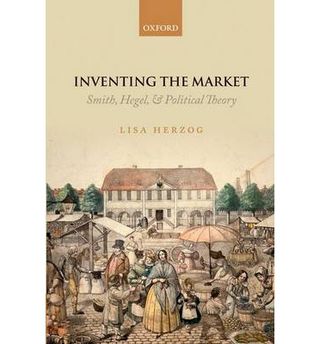
Philosophy of Markets

9780199674176

Richard Marshall interviews Liza Herzog in 3:AM Magazine:

3:AM: When you discuss the philosophy of markets you begin by pointing out that economists theorizing and modeling markets are inadequate. What’s the problem?

LH: Economic models make simplifying assumptions about human agency and about social interaction. If one only used these models to answer the questions they are supposed to answer, taking into account their methodological limitations, there wouldn’t be any problem. But often they are used to make much wider claims. For example, predications are based on a theoretical model, but with insufficient discussion of whether the assumptions of the model also hold in reality. Along the way, one often finds that normative judgments sneak in, but without being made explicit. Thus, one cannot even ask critical questions, for example whether certain theories serve the interests of certain social groups – whether they are ideologies in the classical sense.

3:AM: You also suggest that philosophers like Rawls’s on justice and others discussing social and political issues like Elizabeth Anderson tend to discuss the market as something to be tamed from the outside rather than be the central subject. Can you say something about this?

LH: Markets are often treated as “black boxes” in normative theorizing, maybe because of an implicit assumption that they are the economists’ business, not ours. Thinking about the boundaries of markets, and about their place in society, is very important, but it is not the only question we can, and should, ask about them. We also need to think about the internal structures of markets: what is their ontology, what kinds of social relations do they create between individuals, what internal distributive features do they have? Some might say that by treating markets from a philosophical perspective, we bestow too much honor to them, replicating the dominance that the economic sphere already has on our lives. But I think we can best resists the tendencies of markets to colonize the life world, as Habermas put it, if we get a better understanding of what they are, and what is problematic about them.

More here.

Friday, April 10, 2015

Sam Harris and Johann Hari discuss the “war on drugs”

From Sam Harris's blog:

DrugsS. Harris: Thanks for taking the time to speak with me, Johann. You’ve written a wonderful book about the war on drugs—about its history and injustice—and I hope everyone will read it. The practice of making certain psychoactive compounds illegal raises some deep and difficult questions about how to create societies worth living in. I strongly suspect that you and I will agree about the ethics here: The drug war has been a travesty and a tragedy. But you’re much more knowledgeable about the history of this war, so I’d like to ask you a few questions before we begin staking out common ground.

The drug war started almost exactly 100 years ago. That means our great-grandparents could wander into any pharmacy and buy cocaine or heroin. Why did the drug war begin, and who started it?

J. Hari: It’s really fascinating, because when I realized we were coming up to this centenary, I thought of myself as someone who knew a good deal about the drug war. I’d written about it quite a lot, as you know, and I had drug addiction in my family. One of my earliest memories is of trying to wake up one of my relatives and not being able to.

And yet I just realized there were many basic questions I didn’t know the answer to, including exactly the one you’re asking: Why were drugs banned 100 years ago? Why do we continue banning them? What are the actual alternatives in practice? And what really causes drug use and drug addiction?

To find the answers, I went on this long journey—across nine countries, 30,000 miles—and I learned that almost everything I thought at the start was basically wrong. Drugs aren’t what we think they are. The drug war isn’t what we think it is. Drug addiction isn’t what we think it is. And the alternatives aren’t what we think they are.

If you had said to me, “Why were drugs banned?” I would have guessed that most people, if you stopped them in the street, would say, “We don’t want people to become addicted, we don’t want kids to use drugs,” that kind of thing.

What is fascinating when you go back and read the archives from the time is that that stuff barely comes up.

More here.

lagos must prosper

Marina-at-DuskAlexis Okeowo at Granta:

The city of Lagos takes the form of an awkwardly shaped octopus, with tentacles reaching east and west, plucking up land that was once outside of its edges or part of neighbouring states. The metropolis, the commercial capital of Nigeria, is inundated with water, a fact never more obvious than during the rainy season – about half the year. Pushed up against a lagoon, riddled with creeks and canals and lacking drains, the city sinks under the rain and roads disappear. Lagosians pull up their trousers to wade through the water and cars slow to a near-halt as they tentatively plow through rapidly forming lakes. Most residents live on what is called the mainland, the body of the octopus, where quarters continue to become denser as migrants pour into the city. Settlers build precariously on the wetlands, and the homes, constructed quickly and cheaply, routinely fall in on their residents. At least one hundred and thirty-five buildings in Lagos have collapsed over the last seven years, some of them of considerable scale and some of which were schools.

Every morning, more than 60 per cent of the mainland’s inhabitants, from the upper-class neighbourhoods to the poorest shanty towns, cross three choked bridges, leaving the mainland to work on a series of islands. The original downtown of the city is a tight grid of markets, parks and commercial and government buildings called Lagos Island. Today, the city center includes Victoria Island, Lagos’s financial centre, and its adjacent residential area, Ikoyi.

more here.

Enjoying the Low Life?

Nicholas Kristof in the New York Times:

ScreenHunter_1129 Apr. 10 15.44The United States is the most powerful colossus in the history of the world: Our nuclear warheads could wipe out the globe, our enemies tweet on iPhones, and kids worldwide bop to Beyoncé.

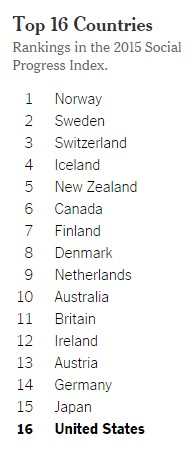
Yet let’s get real. All this hasn’t benefited all Americans. A newly released global index finds that America falls short, along with other powerful countries, on what matters most: assuring a high quality of life for ordinary citizens.

The Social Progress Index for 2015 ranks the United States 16th in the world. We may thump our chests and boast that we’re No. 1, and in some ways we are. But, in important ways, we lag.

The index ranks the United States 30th in life expectancy, 38th in saving children’s lives, and a humiliating 55th in women surviving childbirth. O.K., we know that we have a high homicide rate, but we’re at risk in other ways as well. We have higher traffic fatality rates than 37 other countries, and higher suicide rates than 80.

We also rank 32nd in preventing early marriage, 38th in the equality of our education system, 49th in high school enrollment rates and 87th in cellphone use.

Ouch. “We’re No. 87!” doesn’t have much of a ring to it, does it?

Michael E. Porter, the Harvard Business School professor who helped devise the Social Progress Index, says that it’s important to have conventional economic measures such as G.D.P. growth. But social progress is also a critical measure, he notes, of how a country is serving its people.

More here.

Fear in the Cockpit

Jeff Wise in Nautilus:

5813_069090145d54bf4aa3894133f7e89873For any pilot, losing engine power is a nerve-wracking experience. Engine failure in a plane like the ATR-72-600 is not in itself a catastrophe. It’s an eventuality that the planes are designed for—it’s why they have multiple engines—and pilots train for. But Liao had to take the right steps immediately. His heart pounding, he knew that he had to throttle back the stricken engine and turn it off to reduce the risk of fire. Once that was done, he’d have enough power from the remaining engine to maintain altitude and maneuver back to the airport for a safe landing.

The plane’s black boxes recorded what happened next. Liao reached forward and pulled back on one of the engine throttle levers. But he pulled back on the left one—the one for the good engine. Now the plane was 1,000 feet over one of the most densely populated cities in the world, 25 tons of metal, fuel, and human flesh, with no engines to keep it in the air. A worrisome but manageable problem had suddenly become an imminent and severe one.

More here.

Did natural selection make the Dutch the tallest people on the planet?

Martin Enserink in Science:

TallInsecure about your height? You may want to avoid this tiny country by the North Sea, whose population has gained an impressive 20 centimeters in the past 150 years and is now officially the tallest on the planet. Scientists chalk up most of that increase to rising wealth, a rich diet, and good health care, but a new study suggests something else is going on as well: The Dutch growth spurt may be an example of human evolution in action. The study, published online today in the Proceedings of the Royal Society B, shows that tall Dutch men on average have more children than their shorter counterparts, and that more of their children survive. That suggests genes that help make people tall are becoming more frequent among the Dutch, says behavioral biologist and lead author Gert Stulp of the London School of Hygiene & Tropical Medicine. “This study drives home the message that the human population is still subject to natural selection,” says Stephen Stearns, an evolutionary biologist at Yale University who wasn't involved in the study. “It strikes at the core of our understanding of human nature, and how malleable it is.” It also confirms what Stearns knows from personal experience about the population in the northern Netherlands, where the study took place: “Boy, they are tall.” For many years, the U.S. population was the tallest in the world. In the 18th century, American men were 5 to 8 centimeters taller than those in the Netherlands. Today, Americans are the fattest, but they lost the race for height to northern Europeans—including Danes, Norwegians, Swedes, and Estonians—sometime in the 20th century. Just how these peoples became so tall isn't clear, however. Genetics has an important effect on body height: Scientists have found at least 180 genes that influence how tall you become. Each one has only a small effect, but together, they may explain up to 80% of the variation in height within a population. Yet environmental factors play a huge role as well. The children of Japanese immigrants to Hawaii, for instance, grew much taller than their parents. Scientists assume that a diet rich in milk and meat played a major role.

The Dutch have become so much taller in such a short period that scientists chalk most of it up to their changing environment. As the Netherlands developed, it became one of the world's largest producers and consumers of cheese and milk. An increasingly egalitarian distribution of wealth and universal access to health care may also have helped. Still, scientists wonder whether natural selection has played a role as well.

More here.

Neverending story

Kaelen Wilson-Goldie in Bookforum:

Article04In the months that have passed since three young men, two of them ex-convicts, gunned down the staff of a satirical magazine and patrons of a kosher grocery in Paris, killing seventeen people, including several artists—during which time another young man, also an ex-con, shot up a café and a synagogue in Copenhagen, killing two more, including a filmmaker—much has been written to put these events in context. With each new text, the narrative has thickened with nuance, anger, digression, and distraction, as writers, in accordance with their nature, have tied themselves in knots to make sense of the killings in terms of terrorism, religious intolerance, ideological indoctrination, postcolonial injustice, racial prejudice, economic depravation, government neglect, bad schools, terrible prisons, dangerous clerics, and the potential for radicalization among disaffected young men prone to messianic delusion.

In one way or another, all of these texts belong to what Adam Phillips, describing Freud, has termed “a long spiritual, religious tradition of crisis writing.” Perhaps that ever-expanding mass of storytelling, messy and oversensitive and argumentative as it may be, is truer to the experience of these events around the world, where reactions have been everywhere mixed, and nowhere the same, not even in the mind of a single person, to say nothing of the popular imagination of a single place.

In Europe and the United States, a story of the attacks has settled into a moment of much-needed but still dubious repose, as responsibility is passed to “moderate Muslims” around the globe to deal with religious extremism, reform their faith, and thicken their skin. “What is entirely out of the government’s control—out of anyone’s control,” argues Mark Lilla, writing about France in the New York Review of Books, “is what happens next in the larger Muslim world.”

This is true enough. But there are a great many cities out there in the not-so-distant, not-so-frightful Muslim world. In those cities, one might listen for the subtleties of a self-reflexive criticism and hear a brash and lively satire in return. One might discover a rich history of progressive ideas that have developed in close proximity to Islam over hundreds of years. Beirut, Cairo, and Istanbul are three such cities. Others are just as relevant, but in these three, artists have established a particularly strong tradition of pushing public discourse. And in these three, regular people are dealing all the time with the kinds of dangers and ideological distortions that ripped through France and Denmark this winter.

Read the rest here.

Return of the King: “Mad Men” and the Greatest Story Ever Sold

Madmen-243x366

Kathy Knapp in LA Review of Books:

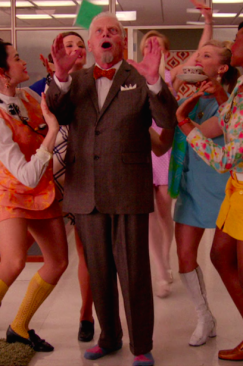
Mad Men still has a half-season to go, but Don Draper’s obituary has already been written. We don’t know exactly how it will end for Don, but the critical consensus is that his fate is sealed: for the past seven years, we’ve watched him follow the same downward trajectory his silhouetted likeness traces in the opening credits, so that all that’s left is for him to land. In a piece lamenting the “death of adulthood in American culture,” A. O. Scott says that Mad Men is one of several recent pop cultural narratives — among them The Sopranos and Breaking Bad — that chart the “final, exhausted collapse” of white men and their regimes, but I’m not convinced. Don has a way of bouncing back. Where one episode opens with him on an examination table, lying to his doctor about how much he drinks and smokes as if his bloodshot eyes and smoker’s cough didn’t give him away (even bets on cirrhosis and emphysema), another finds him swimming laps, cutting down on his drinking, and keeping a journal in an effort to “gain a modicum of control.” Over the course of the past six and a half seasons, Don has been on the brink of personal and professional destruction too many times to count, and yet when we last saw him at the conclusion of “Waterloo,” the final episode of the last half-season, which aired last May, he was fresh-faced and back on top. The truth is that Mad Men has something far more unsettling (and historically accurate) to tell us about the way that white male power works to protect its own interests, precisely by staging and restaging its own death.

In fact, a closer look at “Waterloo” in particular makes clear that the show does not chronicle the last gasp of the white male, as Scott would have it, but outlines the way that a wily old guard has followed the advice of E. Digby Baltzell (who coined the acronym WASP in 1964) by “absorbing talented and distinguished members of minority groups into its privileged ranks” in order to maintain its grip on power. After several episodes of unrelenting humiliation for Don, this installment was so thoroughly upbeat that it had critics wondering just whose Waterloo it was, anyway. Unlike Napoleon, Don doesn’t defiantly march into a futile, fatal battle to save his job, but instead surprises everyone by stepping graciously aside, handing a big pitch for Burger Chef to his protégé, Peggy Olson. Peggy protests she can’t, because she’s a woman; it seems a clear sign that the times are indeed a-changing that Don concludes, “Maybe that’s better.

More here.

Being There: Heidegger on Why Our Presence Matters

30StoneWeb-blog480-v3

Lawrence Berger in the NYT's The Stone:

A cognitive scientist and a German philosopher walk into the woods and come upon a tree in bloom: What does each one see? And why does it matter?

While that may sound like the set-up to a joke making the rounds at a philosophy conference, I pose it here sincerely, as a way to explore the implications of two distinct strains of thought — that of cognitive science and that of phenomenology, in particular, the thought of Martin Heidegger, who offers a most compelling vision of the ultimate significance of our being here, and what it means to be fully human.

It can be argued that cognitive scientists tend to ignore the importance of what many consider to be essential features of human existence, preferring to see us as information processors rather than full-blooded human beings immersed in worlds of significance. In general, their intent is to explain human activity and life as we experience it on the basis of physical and physiological processes, the implicit assumption being that this is the domain of what is ultimately real. Since virtually everything that matters to us as human beings can be traced back to life as it is experienced, such thinking is bound to be unsettling.

For instance, an article in The Times last year by Michael S. A. Graziano, a professor of psychology and neuroscience at Princeton, about whether we humans are “really conscious,” argued, among other things, that “we don’t actually have inner feelings in the way most of us think we do.”

One feature of this line of thought that may strike us as particularly strange is that rather than being in direct contact with people and things, we are said to process bits of information that go to form representations of the world that are the basis for any relations that we have with our fellows. That would appear to be quite different from the way we actually experience things, but we are told to trust that science is more reliable because experience is often misleading in this regard.

More here.

Contours of Macroeconomic Policy in the Future

Blanchard

Olivier Blanchard over at the IMF:

Seven years since the onset of the global financial crisis, we are still assessing how the crisis should change our views about macroeconomic policy. To take stock, the IMF organized two conferences, the first in 2011, the second in 2013, and published the proceedings in two books, titled “In the Wake of the Crisis” and “What Have We Learned?“.

The time seems right for a third assessment. Research has continued, policies have been tried, and the debates have been intense. But have we truly made much progress? Are we closer to a new framework? To address these questions, Raghuram Rajan, Ken Rogoff, Larry Summers and I are organizing a third conference, “Rethinking Macro Policy III: Progress or Confusion?” that will take place on April 15-16 at the IMF.

Much of the discussion in recent years has centered (rightly) on the policy issues of the day: What measures to take during a financial or sovereign crisis, what to do at the zero lower bound, how to design quantitative easing, at what rate should fiscal consolidation take place?

The focus of our conference will be instead on the architecture of policy when (hopefully) policy rates have become positive again, and most countries are growing and have stabilized debt-to-GDP ratios.

In other words, how will/should macro policy look once the crisis is finally over?

Here are some questions to start the discussion (I hope, in a later blog, to summarize the answers coming out of the conference).

It is now well understood that the financial crisis resulted from the interaction of excessive leverage in the financial system and extensive interconnectedness and complexity of balance sheets of both banks and non banks. In other words, the crisis revealed the presence of large, undetected, systemic risks. Since then, much effort has gone toward improving our understanding and assessment of systemic risk. Questions: Where do we stand? Are some dimensions of systemic risk easier to measure (e.g., leverage in the banking sector vs. interconnectedness of banks and non-banks or risks outside the banking sector)? How should we assess the experience with stress-tests? And have we made enough progress in reducing systemic risk since the crisis, e.g., with Dodd-Frank, the Vickers commission, the Financial Stability Board, etc?

More here.

Thursday, April 9, 2015

August Strindberg, in the maelstrom

C061661c-de05-11e4_1141466mSue Prideaux at the Times Literary Supplement:

In 1887–8, August Strindberg wrote the experimental autobiographical novel Le Plaidoyer d’un fou; but only now is it available in a translation taken directly from the author’s original manuscript, lost shortly after its first publication in Paris in 1895. The manuscript resurfaced in 1973 in the safe of the Anatomy department of Oslo University – a curious location rendered curiouser when you remember that Strindberg, a Swede, never visited Norway.

Throughout his life, Strindberg wrote a series of autobiographies that shared no common style or language, each aiming at “an analysis of the soul or psychological anatomy” that was truthful to himself at the particular moment of writing. The whole was deliberately designed to display the discontinuity of his “evolution as a human being” and as a writer. Plaidoyer was written as Strindberg was approaching forty. He wrote it in French, hoping Paris would be receptive to a new form of literature “more realistic than Flaubert, more experimental than Zola”. It was to be the opposite of the French tradition of the novelist-observer reporting elegantly on the human condition, the reverse of a neat encapsulation of experience. Written in the first person, it recorded his tortured ambivalence during the thirteen years of his adoring passion for his first wife, Siri von Essen.

more here.

The art of On Kawara

On_kawara_otu_imgBarry Schwabsky at The Nation:

Kawara’s art is not always quite so -rarefied. His most familiar work is his “Today” series, better known as “date paintings,” which he began producing in 1966 and continued making throughout his life: they are signlike works in acrylic on canvas showing the date on which the painting was made, inscribed in white sans serif letters and numerals, usually on a dark gray background (although there are some red and blue date paintings too). Because Kawara doesn’t space the numbers and letters of the date in the smooth way a typographer would, there is quirky rhythm to the inscriptions. The nearly 3,000 paintings are of various sizes, but most are quite modest in scale, often as small as eight by ten inches. It is thanks to these date paintings that “Kawara is a brand,” one of the many self-declared experts on the booming art market proclaimed a few years ago, “and his branding stands as a beacon for every contemporary dealer and every aspiring conceptual artist.”

Each painting is housed in (or, in the case of the larger paintings, merely accompanied by) a cardboard box that also contains a clipping from that day’s newspaper. At the Guggenheim, the boxes and clippings are mostly displayed in vitrines beneath the corresponding paintings. The selections are unpredictable. Beneath a painting from New Year’s Day, 1970, is the front page of The New York Times, with items on, for instance, the inauguration of John Lindsay for his second term as mayor and a dispute between the city and the transit workers’ union, which had turned down the offer of a 12 percent wage increase (how times have changed).

more here.

Researchers are on the trail of a mysterious connection between number theory, algebra and string theory

Erica Klarreich in Quanta:

ScreenHunter_1128 Apr. 09 16.02In 1978, the mathematician John McKay noticed what seemed like an odd coincidence. He had been studying the different ways of representing the structure of a mysterious entity called the monster group, a gargantuan algebraic object that, mathematicians believed, captured a new kind of symmetry. Mathematicians weren’t sure that the monster group actually existed, but they knew that if it did exist, it acted in special ways in particular dimensions, the first two of which were 1 and 196,883.

McKay, of Concordia University in Montreal, happened to pick up a mathematics paper in a completely different field, involving something called the j-function, one of the most fundamental objects in number theory. Strangely enough, this function’s first important coefficient is 196,884, which McKay instantly recognized as the sum of the monster’s first two special dimensions.

Most mathematicians dismissed the finding as a fluke, since there was no reason to expect the monster and the j-function to be even remotely related. However, the connection caught the attention of John Thompson, a Fields medalist now at the University of Florida in Gainesville, who made an additional discovery. The j-function’s second coefficient, 21,493,760, is the sum of the first three special dimensions of the monster: 1 + 196,883 + 21,296,876. It seemed as if the j-function was somehow controlling the structure of the elusive monster group.

Soon, two other mathematicians had demonstrated so many of these numerical relationships that it no longer seemed possible that they were mere coincidences. In a 1979 paper called “Monstrous Moonshine,” the pair — John Conway, now of Princeton University, and Simon Norton — conjectured that these relationships must result from some deep connection between the monster group and thej-function. “They called it moonshine because it appeared so far-fetched,” said Don Zagier, a director of the Max Planck Institute for Mathematics in Bonn, Germany.

More here.

The Genetics of the Earth and Moon

Sean Raymond in Nautilus:

MoonImagine that two very similar-looking neighbors undergo a genetic test. The exam shows that the pair’s genetic fingerprints are virtually identical. They feel a flash of shock and excitement. What does this mean? Could they be long-lost twins, separated in a hospital mixup? The Earth and Moon share a similar issue, one that poses a major scientific puzzle. At the isotopic level—the “genetic” level for rocks—the Earth and Moon are essentially identical. While they have different relative amounts of rock and iron, the Earth and Moon’s rocks share the same isotopic signatures in several different elements; oxygen is the most studied. This isotopic similarity has stumped scientists for decades. It must mean something about the Moon’s origin, but exactly what? Over the past century astronomers have come up with several theories for how the Moon formed. Perhaps the Moon was a wandering planet that was gravitationally captured by Earth (the capture theory). Perhaps the nascent Earth was spinning so fast that it barfed out the Moon (the fission theory). Or perhaps the young Earth was hit by another growing planet and this created the Moon (the giant impact theory). In recent years the third of these ideas has taken over as the preferred model.

The giant impact theory echoes what we know about the formation of the entire Solar System, which coalesced from a disk of gas and dust around the young Sun. The Earth and the other planets grew in a series of collisions, starting from dust particles and culminating in massive impacts between planet-sized bodies. The last giant impact involving the growing Earth may have spawned the Moon by creating a disk of rocky debris in orbit around the planet. The giant impact model has become so popular that the two bodies involved in the impact even have names: the proto-Earth (the progenitor of Earth) and Theia (the impacting body, named for the Greek goddess who was the mother of the Moon). To get a better understanding of these two bodies, we need to look at their genetics. Here, “genetic” information refers to exquisite geochemical measurements of different isotopes of certain elements.

More here.

Vladimir Nabokov’s Passionate Love Letters to Véra and His Affectionate Bestiary of Nicknames for Her

Whowhatwhen_rothman2

Maria Popova over at Brain Pickings (image Young Vladimir and Véra Nabokov by Thomas Doyle from 'The Who, the What, and the When: 65 Artists Illustrate the Secret Sidekicks of History.'):

After a charming aside professing that he had begun writing a poem for her on the page but a “very inconvenient little tail got left” and he had no other paper on which to start over, he continues in his characteristic spirit of earnest lyricism with a sprinkle of disarming irreverence:

Most of all I want you to be happy, and it seems to me that I could give you that happiness — a sunny, simple happiness — and not an altogether common one…

I am ready to give you all of my blood, if I had to — it’s hard to explain — sounds flat — but that’s how it is. here, I’ll tell you — with my love I could have filled ten centuries of fire, songs, and valor — ten whole centuries, enormous and winged, — full of knights riding up blazing hills — and legends about giants — and fierce Troys — and orange sails — and pirates — and poets. And this is not literature since if you reread carefully you will see that the knights have turned out to be fat.

But Nabokov makes clear that his feelings supersede the playful and expand into the profound:

I simply want to tell you that somehow I can’t imagine life without you…

I love you, I want you, I need you unbearably… Your eyes — which shine so wonder-struck when, with your head thrown back, you tell something funny — your eyes, your voice, lips, your shoulders — so light, sunny…

You came into my life — not as one comes to visit … but as one comes to a kingdom where all the rivers have been waiting for your reflection, all the roads, for your steps.

More here.

The Fierce Pressures Facing Pakistan

Ahmed Rashid in the New York Review of Books:

ScreenHunter_1127 Apr. 09 14.56The single worst legacy of military rule since the 1970s, the time of the loss of East Pakistan—now Bangladesh—has been a ruinous foreign policy that has made enemies out of most of Pakistan’s neighbors owing to the safe havens that Islamic extremists from these countries have carved out in Pakistan. It is well known that such havens exist in the Khyber Pakhtunkhwa Province and Balochistan, but they are also located in many other parts of the country, from Lahore near the Indian border to the Khyber Pass into Afghanistan.

Because of its fear of India, Pakistan has been turned into a garrison state with a persisting paranoia about being surrounded by hostile countries and dominated by a demanding, belligerent United States. Yet the Pakistani army is the seventh-largest in the world with some 642,000 soldiers, 500,000 reserves, and an arsenal of 120 nuclear weapons.

Still, since September 11, 2001, the army has often been ineffectual. Pakistani extremists have killed up to 30,000 Pakistani civilians and 15,000 members of the Pakistan military. Pakistan is living in the midst of a partially self-created bloodbath of terrorism that is more comparable to Iraq and Nigeria than to India or Bangladesh.

More here.

Here’s A News Report We’d Be Reading If Walter Scott’s Killing Wasn’t On Video

Ryan Grim and Nick Wing in the Huffington Post:

ScreenHunter_1126 Apr. 09 14.51This article is written as if the alleged murder of Walter Scott had not been captured on video that was made public Tuesday by The New York Times and other outlets.

A North Charleston police officer was forced to use his service weapon Saturday during a scuffle with a suspect who tried to overpower him and seize the officer's Taser, authorities said.

The man, who has a history of violence and a long arrest record, died on the scene as a result of the encounter, despite officers performing CPR and delivering first aid, according to police reports.

The shooting was the 11th this year by a South Carolina police officer. The State Law Enforcement Division has begun an investigation into the incident.

Police identified the officer involved as Patrolman 1st Class Michael Thomas Slager and the suspect as Walter Lamar Scott, 50, of Meadowlawn Drive in West Ashley. Slager, 33, served honorably in the military before joining the North Charleston Police Department more than five years ago. He has never been disciplined during his time on the force, his attorney said.

The incident occurred behind a pawn shop on Craig Street and Remount Road. Slager initially pulled Scott over for a broken taillight. During the stop, police and witnessessay Scott fled the vehicle on foot. When Slager caught up with him a short distance from the street, Scott reportedly attempted to overpower Slager. Police say that during the struggle, the man gained control of the Taser and attempted to use it against the officer.

It was during that scuffle that the officer fired his service weapon, fatally wounding Scott.

More here.