The medieval origins of mass surveillance

Innocent IIIAmanda Power at Lapham's Quarterly:

At its most essential level, the notion of an omniscient, omnipotent, interested, judging God was translated into our inherited forms of governance through the Roman Catholic interpretation of Christ’s words to Peter, in the Gospel According to Matthew. “Upon this rock I will build my church,” Christ says to his apostle, “and the gates of Hades shall not overpower it. I will give you the keys of the kingdom of heaven; and whatever you shall bind on earth shall be bound in heaven, and whatever you shall loose on earth shall be loosed in heaven.” The Church alleged that this authority had been transmitted through the succession of the bishops of Rome, and flowed from pope on down through the clerical hierarchy, so that every priest shared in the power to bind and loose on earth, in the knowledge that their decisions would be upheld by God.

Through the priests, God’s power to watch and judge had a human embodiment. They were not to shed blood, but there were circumstances in which they were to hand over obdurate individuals to secular authorities for execution. God’s dispersed authority was thus delegated even to laypeople whose individual jurisdiction extended no further than towns and villages. At the top of the secular hierarchy, monarchs were anointed by priests, thus symbolizing their religious legitimacy. As in John of Salisbury’s “ministers of God,” these monarchs’ worst abuses were sanctioned by the assertion of the elites that governments always operated with the backing of watchful divine will.

more here.

Hanya Yanagihara’s “A Little Life”

9780385539258 (1)Elif Batuman at The New Yorker:

When I first heard about Hanya Yanagihara’s “A Little Life”—a 720-page, four-friends-in-New-York novel that unexpectedly morphs into the saga of the self-loathing and self-harm of the disabled survivor of serial homosexual pedophilia—I didn’t plan on reading it. This decision was based on a belief I formed about myself as a child in the nineteen-eighties: some people, I saw, really liked to read novels about foster children who had flashbacks to terrible encounters with pedophiles or other abusers, but I usually preferred books that were about other things. I didn’t appreciate the ready-made importance or seriousness that seemed to be conferred by the subject matter. I thought it was great that books like that existed, and I knew they met a need, but they weren’t for me.

“A Little Life” became one of the most-talked-about books of 2015, a best-seller in the U.S. and the U.K., the subject of many enthusiastic reviews andreader testimonials, and a finalist for the Man Booker Prize and the National Book Award. (It has now begun to appear on end-of-the-year top-ten lists.) I read some of the positive reviews. Sooner or later, I would get to a sentence like “Jude was taught to cut himself by Brother Luke” and would be unable to imagine myself reading such a book. As for the negative reviews—which were less numerous but sometimes written by close friends with whom I often agreed about books—they seemed to be describing a genuinely problematic text.

more here.

Tuesday, December 15, 2015

3QD Philosophy Prize Semifinalists 2015

The voting round of our philosophy prize (details here) is over. Thanks to the nominators and the voters for participating.

So here they are, the top 20, in descending order from the most voted-for:

  1. SemiPhil2015Practical Ethics: Should we intervene in nature to help animals?
  2. Scientia Salon: Brontosaurus and the nature of philosophy
  3. Thinking Of Things: A False Sense of Insecurity
  4. The Philosopher's Beard: Children are special, but not particularly important
  5. Feminist Philosophers: On How We Talk About Passing
  6. Philosophical Percolations: Getting out of the philosophers’ rut
  7. Beauty Demands: Variations on a beauty theme: The uses of ‘normal’
  8. Imperfect Cognitions: Intellectual Humility: Interview with Duncan Pritchard
  9. Oxford University Press Blog: Does the meat industry harm animals?
  10. University of Birmingham: “Them and Us” no longer: mental health concerns us all
  11. What Is It Like To Be A Philosopher? Interview with Michael Ruse
  12. The Philosophers' Cocoon: Pink: The sweet spot of extended cognition
  13. Samuel C. Rickless: A History of Western Philosophy in 108 Limericks
  14. Sprachlogik: An Account of Necessity as an Attribute of Propositions
  15. Pacificklaus: Sardines, Death and Fear
  16. Quaeritur: Understanding Climate Change Denial through the Lens of Nietzsche
  17. The Forum: Are Delusions Bad for You?
  18. Jacob Archambault: On the future of research in the history of philosophy
  19. Orienteringsforsok: Slow corruption
  20. Vihvelin: Counterfactuals: The Short Course

The editors of 3 Quarks Daily will now pick the top six entries from these, and after possibly adding up to three “wildcard” entries, will send that list of finalists to John Collins for final judging. We will post the shortlist of finalists tomorrow.

Francis Bacon by rote

George Pendle in More Intelligent Life:

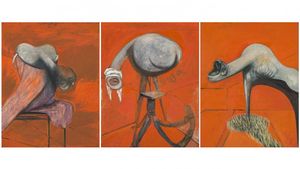
Bacon-figures--webYou’ve seen them before, those three eyeless monsters with their maws stretched taut in terrible screams. The unforgettable characters at the centre of Francis Bacon’s “Three Studies For Figures at the Base of a Crucifixion” (above) were so shocking when they were first revealed in 1944 that the critic John Russell declared, “We had no name for them, and no name for what we felt about them.” Yet the three figures which have been on show at the Gagosian Gallery in New York do not fill the viewer with the same sense of terror. In fact the effect is quite the opposite. Here are the same shrieking creatures, but this triptych is much larger and neater than the original, which was as small as a devotional painting and as raw as a chunk of meat. That’s because this is not the same picture but a copy entitled “Second Version of Triptych 1944”, a painting made almost half a century later when the Tate wouldn’t loan the original out for an exhibition of Bacon’s work.

Gagosian’s show of Bacon’s late paintings is full of such double-takes and do-overs. All the signifiers of his best known pictures are here – the bare rooms, the fleshy shadows, the sickly puces and vulgar violets – but they appear in lesser known works. As the wall text proudly states, “there has until now never been a show devoted solely to investigating the innovations and departures of his late paintings.” Judging from the evidence, that is because Bacon appears to have innovated and departed not very much at all. It’s true that in the last 15 years of his life he started using spray paint to add blossoming white lesions to his murky canvases. He also began imprinting them with strips of corduroy and developed a peculiar obsession with dressing his amorphous, fleshy lumps in cricket pads. But if there is one significant change it is that by the 1980s his once terrifying ghouls and gobbets had come to seem almost familiar. These are horrors drawn by rote. In his late paintings Bacon was no longer painting the void, he was decorating it.

More here.

Scientists Hope to Bring a Galápagos Tortoise Species Back to Life

Sandra Blakeslee in The New York Times:

TortThe dodo is dead. The passenger pigeon has passed on. But Lonesome George, the iconic Galápagos tortoise whose death marked the end of his species, is in post-mortem luck. A scientific expedition has discovered some of his close blood relations alive and well. With careful breeding, biologists now hope to revive George’s species and reintroduce the tortoises to the island on which they evolved. It would be a signal achievement in a place that gave rise to our understanding of evolution and speciation. Originally there were at least eight species of Galápagos tortoise, scientists now believe. (One was discovered only this year.) At least three species are now extinct, including tortoises on Pinta Island. The last one, George, was discovered wandering alone in 1972 and taken into loving custody. His death, in 2012 at more than 100 years old, was a powerful reminder of the havoc visited by humans on delicate ecosystems worldwide over the last two centuries.

There are two types of Galápagos tortoises: saddlebacked and domed. The sailors much preferred the smaller saddlebacks, which were easier to lug around and said to taste better. They were also easier to find: Domed tortoises live at higher elevations and can weigh 300 pounds. Saddlebacks evolved at lower elevations and feed on drier vegetation. Saddlebacked tortoises disappeared from Santa Fe Island and Floreana Island, a favorite hangout for sailors posting letters for other ships to carry home. With George’s death, the Pintas were gone, too. But now the story of extinct Galápagos tortoises has taken a strange, and hopeful, twist. More than a century ago, it turns out, sailors dumped saddlebacked tortoises they did not need into Banks Bay, near Wolf Volcano on Isabela Island. Luckily, tortoises can extend their necks above water and float on their backs. Many of them made it to shore, lumbered across the lava fields and interbred with Isabela’s native domed tortoises. In 2008, scientists tagged and collected blood samples from more than 1,600 tortoises living on the flanks of the volcano. Back in the laboratory, there was a genetic eureka: Eighty-nine of the animals were part Floreana, whose full genetic profile DNA had been obtained from museum samples.

More here.

Why conspiracy theories flourish on the right

Conspiracy-theorist.0

David Roberts in Vox:

A new study by political scientists Joanne Miller, Kyle Saunders, and Christina Farhart helps shed some light on these questions.

Endorsing conspiracy theories, they say, is a form of “motivated reasoning” — an effort to gather facts and construct frameworks that “protect or bolster one’s political worldview.” They set out to determine what sorts of people are most likely to be susceptible to that sort of thing.

They went into the study with two hypotheses:

1. All things being equal, knowledge — close engagement with partisan politics, consumption of political news — will tend to exacerbate the tendency to endorse conspiracy theories (CTs).

2. Trust in the political system will tend to mitigate this effect; those with high levels of trust will be less prone to accept CTs.

Putting those together, they expected to find CTs most common among high-information, low-trust people — those who are highly engaged and informed about politics but do not trust politicians, political elites, or mainstream institutions.

So do the hypotheses hold up?

The researchers found, after examining two large data sets (details in the paper), that the effect of trust is as expected, across the political spectrum. Lower-trust conservatives and liberals are both more likely to endorse ideologically congenial CTs (i.e., CTs that make the other side look bad).

But beyond that, there are interesting asymmetries. For liberals, more knowledge reduces endorsement of CTs, no matter the level of trust, and more trust reduces endorsement of CTs, no matter the level of knowledge — “knowledge and trust are both independently negatively related to liberals’ endorsement of liberal conspiracies.”

For conservatives, on the other hand, more knowledge increases endorsement of CTs among those with low trust; for high-trust conservatives, knowledge seems to have no effect — it neither increases nor decreases tendency to endorse CTs.

More here.

No Cheers For Anarchism

1444021964Anarchism15Msitin666

Sheri Berman in Dissent:

What are the uses of anarchism? The short answer is “not many.” Although anarchists have often been motivated by worthy aspirations and occasionally raised awareness of crucial issues, in general, anarchism is an ineffective way of improving the world. Anarchists are better dreamers than doers, and politics is the art of the possible. Although it may disappoint many on the left, a successful movement requires compromise, organization, and yes, even leadership, to actually get things done.

There are many variants and historical manifestations of anarchism, but characterizing all is a rejection of authority and hierarchy. Anarchists dream of a world without states, traditional political organizations, or any other structures that restrict individual freedom. Because they share such beliefs and goals with libertarians, anarchists are easily confused with them. In the American context, at least, the main distinction between the two concerns capitalism: anarchists view it as inherently coercive, while libertarians venerate it as the embodiment and guardian of individual rights. This has led the former to be viewed as left wing and the latter as right wing, but in reality, anarchists differ dramatically from other sectors of the modern left (just as libertarians differ dramatically from traditional conservatives and other factions of the modern right).

During the late nineteenth and early twentieth century anarchism’s rejection of traditional political organizations and activity led to its involvement in various uprisings and rebellions, the most important of which was the Paris Commune. Anarchists also became associated with “propaganda of the deed”—“spontaneous” and “voluntary” actions that reflected the power of the individual and were designed to inspire others. Although these actions need not necessarily be violent, they often were: during this period anarchists were responsible for a series of spectacular assassinations and bombings. A czar of Russia, presidents of Italy and France, kings of Portugal and Greece, and a president of the United States all met their ends at the hands of anarchists. Despite their often spectacular nature, anarchist activities were almost uniformly unsuccessful.

More here. See Marina Sitrin's counterargument here.

Benjamin in Jerusalem

Paul_Klee_-_Angelus_Novus_-_1920-750x375

David Kishik in Public Seminar:

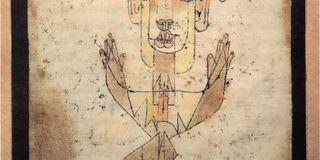
In his eighth thesis on the concept of history, Walter Benjamin alerts us of a rhetorical trap into which too many of us too often fall. First we see something: rights trampled, freedoms snatched, humans oppressed, laws overlooked, brutality unleashed. Amazed by these horrors, we then feel compelled to say something: how can this still be possible today?

Aristotle claimed that philosophy begins with wonder, but Benjamin assures us that no deep insight ever arose from the above knee-jerk reaction. Unless, that is, by lingering on it for a second, we will eventually be led to rethink a deeply-engrained conviction.

What stands behind this fake wonder? It is a simple assumption, hovering between the words still and today. Back in the day, we reckon, it was more common for such atrocities to happen. People probably didn’t even bother to bat an eyelash. But things changed. The world advanced. Progress rules, even though it remains an uphill battle.

And this battle is real. We know that an eyelash batted in America will not release a political prisoner in China. So petitions are signed, marches organized, boycotts enforced, legislations repealed, and yes, sometimes even force has to be used for the good cause. And look how far we have come!

But then, like a stock-exchange bubble, the situation blows up in our faces. And we can’t believe that this is even happening. Again. Still. Given all that we’ve already achieved. So we don’t hesitate. We barely stop to think, and spring back into action. We try to right the wrong. Bring the aberration back to a healthy state. Restore the peace. Reconcile the rift. This is just an exception to the rule, we surmise. The just rule can still rule.

Think of a real example of grave injustice, like the Israeli occupation of the Palestinian territories. How can this conflict remain unresolved for so many years? What part of “basic human rights” does the Israeli government fail to understand? How much suffering do the Palestinians have to endure before the world will really, truly wake up? How can this still be possible today? How can this misery continue on and on without concrete hope for a better future?

More here.

ISIS is a revolution

Header_ESSAY-00191358

Scott Atran in Aeon:

Treating the Islamic State as merely a form of terrorism or violent extremism masks the menace. All novel developments are ‘extremist’ compared with what was the norm before. What matters for history is whether these movements survive and thrive against the competition. For our singularly self-predatory species, success has depended on willingness to shed blood, including the sacrifice of one’s own, not merely for family and tribe, wealth or status, but for some greater cause. This has been especially true since the start of the Axial Age more than two millennia ago. At that time, large-scale civilisations arose under the watchful gaze of powerful divinities, who mercilessly punished moral transgressors – thus ensuring that even strangers in multiethnic empires would work and fight as one.

Call it ‘god’ or whatever secular ideology one prefers, including any of the great modern salvational -isms: colonialism, socialism, anarchism, communism, fascism and liberalism. In Leviathan (1651), Thomas Hobbes deemed sacrifice for a transcendent ideal ‘the privilege of absurdity to which no creature but man is subject’. Humans make their greatest commitments and exertions, for ill or good, for the sake of ideas that give a sense of significance. In an inherently chaotic universe, where humans alone recognise that death is unavoidable, there is an overwhelming psychological impetus to overcome this tragedy of cognition: to realise ‘why I am’ and ‘who we are’.

In The Descent of Man (1871), Charles Darwin cast this devotion as the virtue of ‘morality… the spirit of patriotism, fidelity, obedience, courage, and sympathy’ with which winning groups are better endowed in history’s spiralling competition for survival and dominance. It is the sacred values, immune to material tradeoffs, that bind us most. In any culture, an unwillingness to sell out one’s kin or religious and political brotherhoods and motherlands is the line we usually will not cross. Devotion to these values can drive successes which are out of all proportion to expected outcomes.

More here.

How Jessica Jones Won Over This Marvel Hater

Jessica_jones_850_593

Sady Doyle in In These Times:

I am proud to call myself a relentless and inflexible critic of the Marvel Cinematic Universe. For some time now, the unstoppable torrent of Marvel content—at least 23 movies between 2008 and 2019, plus at least seven TV shows (Agent Carter and Agents of S.H.I.E.L.D. on traditional broadcast, plus four separate Netflix shows for Iron Fist, Jessica Jones, Luke Cage and Daredevil, plus The Defenders, their inevitable team-up)—has been catastrophic not only for genre movies, but for entertainment as a whole.

Consider the effect Marvel has already had. Everything has to be a blockbuster, just to compete. Every blockbuster has to take place in “a universe” (which is to say, an endlessly prolonged and over-elaborated franchise) to command the largest possible share of consumer loyalty and income. Most of it, apparently, has to belong to Disney, one of the larger and more overtly evil media corporations in the world, which has now purchased Star Wars, Marvel, and (experts estimate) approximately 34 percent of your personal sense of childhood wonder.

It’s not just that we can’t get away from Marvel, or Disney: It’s that there are still genuinely great, beautiful, stand-alone sci-fi and horror and fantasy and action films being made, and Marvel is hurting their chances. This year, for example, we had Crimson Peak, Ex Machina and Mad Max: Fury Road. All of them were unique, thought-provoking, and progressive, particularly in their treatment of gender. And the first two struggled at the box office. Meanwhile, the relentlessly dull, surprisingly sexist, and borderline-nonsensical Marvel punchfest Age of Ultron made over $495 million (far outdoing Mad Max’s $300 million) despite the fact that I didn’t know a single person who walked out of the theater fully satisfied with the film.

So, yes: The Marvel Cinematic Universe is having the same effect on good genre fiction that Starbucks had on independent coffee shops. Not only are they brewing a worse product than the competition, they’re making it harder for anyone else to make a living by serving a decent cup. I have deep aesthetic and, dare I say, political objections to the entire enterprise. It would take a miracle, or a masterpiece, for me to ever unequivocally praise one of their products.

And Jessica Jones is either a miracle or a masterpiece, because I’ll be damned if it’s not a pretty good TV show.

More here.

The raunchy, brainy film writings of Boyd McDonald

Cover00Melissa Anderson at Bookforum:

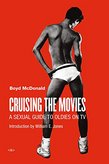
Nearly twenty years ago, Susan Sontag, in “The Decay of Cinema,” lamented, “No amount of mourning will revive the vanished rituals—erotic, ruminative—of the darkened theater.” But a decade before this dirge was written, Boyd McDonald, who had largely abandoned going out to the movies in 1969 (for reasons never explained), proved that some of the most ecstatic cinephilic—and carnal—delights could be found sitting alone at home. McDonald lustily, discursively wrote about the films that aired at all hours on television, which he viewed in his single-room apartment on the Upper West Side, often focusing on minor or supporting actors, as in this tribute to Steve Cochran, a second-billed performer inWhite Heat (1949): “But I have digressed from my topic, and digressed so far that it may be necessary to remind the reader what my topic is: the size of Cochran’s meat.” Between 1983 and 1985, his lubricious cultural criticism ran as a column in the gay magazine Christopher Street; those pieces, along with others written for New York Native, Connection, andPhiladelphia Gay News, were published in 1985 by the Gay Presses of New York as Cruising the Movies: A Sexual Guide to Oldies on TV. McDonald’s essential but under-recognized book, reissued by Semiotext(e) in an expanded edition with previously uncollected articles, offers, in its beautifully articulated bawdiness, perverse pleasures and a radical, though nondidactic, political view. It is, in other words, a model critical text.

The expansive introduction to Cruising the Movies, by experimental filmmaker William E. Jones, provides a helpful biographical sketch of McDonald and places this singular writer in a larger homo-cultural context.

more here.

Tuesday Poem

A Stonehold

she was the great baby sitter — tall dignified
rich warm brown

we’d scream her name pretend to be endangered
run and hide in mama’s clothes closet
she’d search house and yard
get angry and upset when she couldn’t find us
we’d pop out laughing while
she scolded us for wolfing

delicately she reported on our bursts into puberty
and experiments in sex

on visits to her home she made us family
after play with her nieces and nephews fed us
the best tuna sandwiches on the planet

love and love always for the only person
to ever comb my thick black kinks
without taking my hair out
in handfuls

i loved her coffee stained teeth flashing gold
her thick british honduras croon
how she always called her lover “Mr.”

so pretty inside
there was a joy about her i had to be a woman
to understand

by Wanda Coleman
from Mercurochrome, 2001

Ayn Rand was a melodramatist of the moral life

11-ayn-rand.w529.h529.2xCorey Robin at The Nation:

St. Petersburg in revolt gave us Vladimir Nabokov, Isaiah Berlin and Ayn Rand. The first was a novelist, the second a philosopher. The third was neither but thought she was both. Many other people have thought so too. In 1998 readers responding to a Modern Library poll identified Atlas Shrugged andThe Fountainhead as the two greatest novels of the twentieth century—surpassing Ulysses, To the Lighthouse and Invisible Man. In 1991 a survey by the Library of Congress and the Book-of-the-Month Club found that with the exception of the Bible, no book has influenced more American readers thanAtlas Shrugged.

One of those readers might well have been Farrah Fawcett. Not long before she died, the actress called Rand a “literary genius” whose refusal to make her art “like everyone else’s” inspired Fawcett’s experiments in painting and sculpture. The admiration, it seems, was mutual. Rand watched Charlie’s Angels each week and, according to Fawcett, “saw something” in the show “that the critics didn’t.”

She described the show as a “triumph of concept and casting.” Ayn said that while Angels was uniquely American, it was also the exception to American television in that it was the only show to capture true “romanticism”—it intentionally depicted the world not as it was, but as it should be. Aaron Spelling was probably the only other person to see Angels that way, although he referred to it as “comfort television.”

more here.

ON JOHN CAGE, MUZAK, NOISE, TORTURE, AND MORE

SpeakersMichael Fallon at Literary Hub:

At every moment we are bombarded by sound waves, light waves, gamma rays, x-rays, the solar wind. All around, through, and even inside of us is restless movement: the brain muses, nerve cells flare, hair grows, food becomes flesh, not to mention all that is going on at the subatomic level. Our senses can only register a narrow band of all this movement, but even what we can sense is far too much for us. To think, to function in the world, to survive, we have to ignore most of what we can see and hear. We need silence.

We need peace of mind to concentrate, which is not possible without silence. Music and poetry—without silence—impossible. Without silence, our dreams—sleeping or waking—are not possible. Without dreams, there can be nothing to imagine, nothing to hope for, no future. Even love is not possible without meaningful silences, and I would go so far as to say that, without silence, there is no freedom.

The composer John Cage was in search of silence when he entered an anechoic chamber at Harvard University in 1951.

more here.

Monday, December 14, 2015

Vote for one of the nominees for the 3QD Philosophy Prize 2015

Last day of voting!

Browse the nominees in the list below and then go to the bottom of the post to vote.

Alphabetical list of nominated blog names followed by the blog post title:

(Please report any problems with links in the comments section below.)

For prize details, click here.

  1. Beauty Demands: Variations on a beauty theme: The uses of ‘normal’
  2. Big Questions Online: Is Atheism Irrational?
  3. Experimental Philosophy: Can we have free will and lack it too?
  4. Feminist Philosophers: On How We Talk About Passing
  5. Flickers of Freedom: Punishing with a Compatibilist Heart
  6. Forbes: Why It's Unethical To Go Back In Time And Kill Baby Hitler
  7. Imperfect Cognitions: Intellectual Humility: Interview with Duncan Pritchard
  8. Jacob Archambault: On the future of research in the history of philosophy
  9. Justice Everywhere: (One of) Effective Altruism’s blind spot(s)
  10. Normlessness and Nihilism: How Metaethics Might Matter
  11. NPR Cosmos and Culture: Should We Care About The Preservation Of Our Species?
  12. NYT Opinionator: Can Moral Disputes Be Resolved?
  13. Orienteringsforsok: Slow corruption
  14. Oxford University Press Blog: Does the meat industry harm animals?
  15. Pacificklaus: Sardines, Death and Fear
  16. PBS Newshour, Making Sense: The case for employee-owned companies
  17. Philosophical Percolations: Getting out of the philosophers’ rut
  18. Practical Ethics: Should we intervene in nature to help animals?
  19. Proof I Never Want To Be President (Of Anything): Rights Are Often Wrong
  20. Quaeritur: Understanding Climate Change Denial through the Lens of Nietzsche
  21. Samuel C. Rickless: A History of Western Philosophy in 108 Limericks
  22. Scientia Salon: Brontosaurus and the nature of philosophy
  23. Scientia Salon: Yes, terminal patients still have moral obligations
  24. Slate Star Codex: Contra Caplan on Mental Illness
  25. Sprachlogik: An Account of Necessity as an Attribute of Propositions
  26. Step back, step forward: Hypocrisy in general, utilitarianism in particular
  27. The Electric Agora: That's Not Funny
  28. The Forum: Are Delusions Bad for You?
  29. The Mod Squad: Understanding Sentences: Port-Royal, Locke, and Berkeley
  30. The Philosopher's Beard: Children are special, but not particularly important
  31. The Philosophers' Cocoon: Pink: The sweet spot of extended cognition
  32. The Power of Language: Philosophy and Society: Some Arguments against Ethnocentrism
  33. The World Knot: On Philosophy, Philosophobia and Mysticism
  34. Thinking Of Things: A False Sense of Insecurity
  35. University of Birmingham: “Them and Us” no longer: mental health concerns us all
  36. Vihvelin: Counterfactuals: The Short Course
  37. What Is It Like To Be A Philosopher? Interview with Michael Ruse

If you are new to 3 Quarks Daily, we welcome you and invite you to look around the site after you vote. Learn more about who we are and what we do here, and do check out the full site here. Bookmark us and come back regularly, or sign up for the RSS feed. If you have a blog or website, and like what you see here, we would very much appreciate being mentioned there or added to your blogroll. Please don't forget!

Voting ends on December 14th at 11:59 pm NYC time.

Results of the voting round (the top twenty most-voted-for posts) will be posted on the main page on December 15th. The finalists will be announced soon after and winners of the contest will be announced on December 28th, 2015.

PLEASE BE AWARE: We have multiple ways of detecting fraud such as multiple votes being cast by the same person. We will disqualify anyone attempting to cheat.

Now click here to vote.

Thank you.

Strained Analogies Between Recently Released Films and Current Events: The Good Dinosaur and Donald Trump’s Incoherant Alternate History

by Matt McKenna

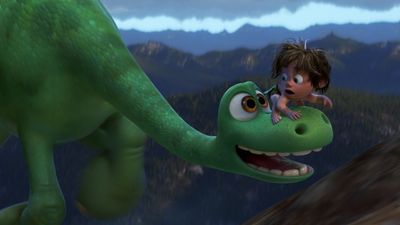
65428The Good Dinosaur is the latest Pixar film based on an alternate history timeline in which the famed meteor that struck Earth resulting in the extinction of the dinosaurs instead zooms past our planet striking nothing. In the film, dinosaurs have happily survived for millions of years post-meteor and somewhat surprisingly evolved to speak English, develop stone-age technology, and create a culture based on nuclear families. This premise provides for an emotionally engaging narrative, and the filmmakers take full advantage of the creative license the movie’s alternate history timeline affords. While this alternate history structure works well for The Good Dinosaur, it turns out to be a misused if popular technique for spinning other kinds of yarns, especially those generated by our politicians and pundits attempting to elicit a rise out of their audience.

The Good Dinosaur is a classic Disney tale in that it is beautiful, has talking animals, and incites children’s fears about their parents’ mortality. The story follows Arlo, an undersized adolescent apatosaurus who is separated from his family and must find his way back home. Over the course of his journey, Arlo reluctantly befriends an eager caveboy who is both a source of survival wisdom for Arlo and comedic relief for the children in the audience who are likely horrified by the scarier aspects of the film. One interesting note about The Good Dinosaur is that although dinosaurs can communicate with each other via language, the caveboy cannot. This is a humorous reversal from many other animated films in which the humans have adorable mute animal sidekicks. This switcheroo is narratively coherent due to the alternate history timeline in which the dinosaur-killing meteor never collided with Earth thus giving dinosaurs an evolutionary head start compared to their late-blooming human counterparts. I realize that’s not how evolution works, but it’s a fun idea for a children’s film anyway.

Read more »

Sunday, December 13, 2015

What Your Microbiome Wants for Dinner

David R. Montgomery & Anne Bikle in Nautilus:

ScreenHunter_1561 Dec. 13 20.04Let’s admit it. Few of us like to think, much less talk about our colons. But you might be surprised at the importance of what gets into your colon and what goes on inside it. This little-loved part of our bodies is actually less an onboard garbage can and more like the unlikeliest medicine chest.

There is abundant medical evidence that diet greatly influences health, and new science is showing us why this is so. It is also showing us that advocates of trendy paleo and vegan diets are missing the big picture of how our omnivorous digestive system works.

Your colon is the home for much of your microbiome—the community of microbial life that lives on and in you. In a nutshell, for better and worse, what you eat feeds your microbiome. And what they make from what you eat can help keep you healthy or foster chronic disease.

To gain an appreciation of the human colon and the role of microbes in the digestive tract as a whole, it helps to follow the metabolic fate of a meal. But, first, a word about terms. We’ll refer to the digestive tract as the stomach, small intestine, and colon. While the colon is indeed called the “large intestine,” this is a misnomer of sorts. It is no more a large version of the small intestine than a snake is a large earthworm.

More here.