
Rebekah Wallace at Aeon Magazine:
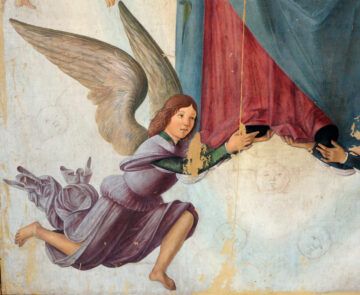 What do the angelic forces of the Heavenly Host have to do with orgasms? The answer, according to the 12th-century philosopher and theologian Maimonides, was simple. Some invisible forces that caused movement could be explained by God working through angels. Quoting a famous rabbi who talked about ‘the angel put in charge of lust’, Maimonides commented that ‘he means to say: the force of orgasm … Thus this force too is called … an angel.’
Before the discovery of gravity, energy or magnetism, it was unclear why the cosmos behaved in the way it did, and angels were one way of accounting for the movement of physical entities. Maimonides argued that the planets, for example, are angelic intelligences because they move in their celestial orbits. While most physicists would now baulk at angelic forces as an explanation of any natural phenomena, without the medieval belief in angels, physics today might look very different. Even when belief in angels later dissipated, modern physicists continued to posit incorporeal intelligences to help explain the inexplicable.
more here.
Enjoying the content on 3QD? Help keep us going by donating now.
 There is a phrase
 I recently copy-pasted
 As anyone who has had the job can attest, the enterprise of being chair of an English department—or, in my case, “head,” a term meant to designate a role still more managerial—comes with more than its share of these scenes of demoralized compliance and low-grade surrender. “A two-fisted engine of aggravation and despair” is how I recently described the gig to a friend, and it’s hard to find anyone who would disagree. So imagine my surprise, my wonder even, in having found for myself a nourishing antidote to all the in-built tedium, joylessness, and metastatic irritation. Yoga? Hypnosis? Ketamine? No. It has appeared in nothing so much as the revelation that my colleagues are, in ways and degrees I hadn’t quite grasped, extraordinarily good at what they do.
 We often study cognition in other species, in part to learn about modes of thinking that are different from our own. Today’s guest, psychologist/philosopher Alison Gopnik, argues that we needn’t look that far: human children aren’t simply undeveloped adults, they have a way of thinking that is importantly distinct from that of grownups. Children are explorers with ever-expanding neural connections; adults are exploiters who (they think) know how the world works. These studies have important implications for the training and use of artificial intelligence.
 As we observe our current world order becoming less cohesive, more volatile, socially fractured, politically polarized, and hence arguably less predictable, it becomes increasingly difficult to understand why.
 On the wall of his living room in Lier, Belgium, Werner van Beethoven keeps a family tree. Thirteen generations unfurl along its branches, including one that shows his best known relative, born in 1770: Ludwig van Beethoven, who forever redefined Western music with compositions such as the Fifth Symphony, Für Elise, and others. Yet that sprig held a hereditary, and potentially scandalous, secret.
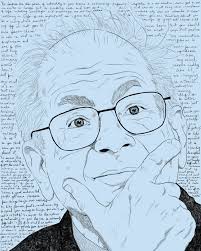 In mid-March 2024, Daniel Kahneman flew from New York to Paris with his partner, Barbara Tversky, to unite with his daughter and her family. They spent days walking around the city, going to museums and the ballet, and savoring soufflés and chocolate mousse. Around March 22, Kahneman, who had turned 90 that month, also started emailing a personal message to several dozen of the people he was closest to. On March 26, Kahneman left his family and flew to Switzerland. His email explained why:
 My wife Alma Gottlieb is an anthropologist, and for years we had lived in small villages in West Africa, among the Beng people of Côte d’Ivoire. In 1993, during our third extended stay, news of my father’s death back in the U.S. arrived in the village, too late for us to return for his funeral. Stunned, I couldn’t decide what to do, how to mourn, until village elders offered to give my American father the ceremonies of a traditional Beng funeral. After days of elaborate ritual, the village’s religious leader, Kokora Kouassi, confided to us that my father now visited him in his dreams—from Wurugbé, the Beng afterlife—with messages of farewell and comfort. The Beng believe the dead exist in an invisible social world beside the living, and Kouassi’s dreams were meant to assure me that my father wasn’t far away at all. Instead, he hovered invisibly beside me.
 Can you pass me the whatchamacallit? It’s right over there next to the thingamajig.
 T
T In January,
 Nobel Laureate and a psychologist, best known for his work on psychology of judgment and decision-making as well as behavioural economics,
  Covid was a privatized pandemic. It is this technocratic, privatized model that is its lasting legacy and that will define our approach to the next pandemic. It solves some problems, but on balance it’s a recipe for disaster. There are some public goods that should never be sold. Dr. Gounder checked off the basic mechanisms by which public health experts confront a pandemic: They create systems to understand and track its cause and spread; they identify the people most at risk; they deploy scalable mechanisms of protection, like air and water sanitation; they distribute necessary tools, such as vaccines and protective gear; they gather and communicate accurate information; and they try to balance individual freedoms and mass restrictions.