Dan Hendrycks and Eric Schmidt in Time:
 In the nuclear age that followed Oppenheimer’s creation of the atomic bomb, America’s technological monopoly lasted roughly four years before Soviet scientists achieved parity. This balance of terror, combined with the unprecedented destructive potential of these new weapons, gave rise to mutual assured destruction (MAD)—a deterrence framework that, despite its flaws, prevented catastrophic conflict for decades. The stakes of nuclear retaliation discourage each side from striking first, ultimately allowing for a tense but stable standoff.
Today’s AI competition has the potential to be even more complex than the nuclear era that preceded it, in part because AI is a broadly applicable technology that touches nearly every domain, from medicine to finance to defense. Powerful AI may even automate AI research itself, giving the first nation to possess it an expanding lead in both defensive and offensive power. A nation on the cusp of wielding superintelligent AI, an AI vastly smarter than humans in virtually every domain, would amount to a national security emergency for its rivals, who might turn to threatening sabotage rather than cede power. If we are heading towards a world with superintelligence, we must be clear-eyed about the potential for geopolitical instability.
More here.
Enjoying the content on 3QD? Help keep us going by donating now.
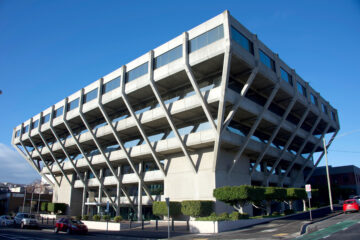 To enter the Rudolph retrospective at the Met is to be seduced. Enveloped in the museum’s 20th-century art galleries, the clean lines and daring spirit of Rudolph’s drawings place him comfortably in the company of the modern masters nearby. His geometric precision and imaginative forms echo Russian Constructivists like El Lissitzky. Exhibition photographs of Rudolph’s built works alluringly capture the interplay between light and shadow that animate the interiors and exteriors of his massive concrete structures. One featured building is a levitating layer cake improbably balanced on fluted columns; in another mock-up, a concrete snake of triangular apartment buildings slithers its way across Manhattan.
 It is safe to say that perceptions of migrants are contradictory. In their countries of origin, they are sometimes celebrated for having embarked on adventures and sometimes criticized as having abandoned their homes. In the countries of their arrival, they can appear as terrifying threats in another people’s history or be welcomed as fresh blood. If they face hostility and suspicion, migrants might feel the need to insert themselves into their new nation’s chronicles of conquest. The migrant’s heroism can then harmonize with their host nation’s self-image, as well as affirming that nation’s hospitality and generosity.
 They who in folly or mere greed
 Washington DC. Boston, Massachusetts. Denver, Colorado. Seattle, Washington. Trenton, New Jersey
 E
E
 Some of the microbes that rose from the ocean fell on land instead of water. Lying on the bare continents, they no longer had sea water to shield them from direct sunlight. Many likely died as the ultraviolet radiation ravaged their genes and proteins. Meanwhile, the atmosphere was sucking out the water from their interiors, causing their molecules to stick together and collapse into toxic shapes.