THE SUICIDE NOTE AS LITERARY GENRE

The-OuseDustin Illingworth at Literary Hub:

“Everything has gone for me but the certainty of your goodness. I can’t go on spoiling your life any longer. I don’t think two people could have been happier than we have been.” So ends Virginia Woolf’s poignant suicide note, addressed to her husband, Leonard Woolf. It is a throbbing document, hauntingly beautiful, in which a decision is made to part with a rote anguish. I’ve read it dozens of times over the years with fascination, even obsession. I picture her writing these final words in a thin ring of lamplight at a worn desk; walking deliberately down the road’s mellow dust; bending to fill her coat pockets with smooth river stones; the crisp blue cold of the Ouse biting at her ankles. But I always return to the contents of the note: the impossible task of a writer attempting to explain herself—to say goodbye to both a companion and an existence—with words grown suddenly insensate, rebellious. “You see I can’t even write this,” it reads at one point, a line that has always seemed, to me, the most tragic part of a tragic letter—that the mind capable of crafting To the Lighthouse should recoil at its own halting articulation.

This, then, is the morbid fascination of the literary suicide note: that it is, perforce, the final written work of the author in question. If we believe that writers possess a special relationship with language—one in which the incommunicable is somehow voiced—we might be forgiven our curiosity for what these moments of literary extremity are able to reveal of the inviolate mystery of death.

more here.
dance in detroit

635936669496960897-saloneMark Stryker at The Detroit Free Press:

At first glance, Eastman Johnson's large-scale painting “Negro Life at the South” (1859) looks like a sentimental genre picture of a large group of slaves enjoying themselves outdoors at their urban quarters in Washington D.C., during the antebellum period.

A close reading of the painting, a key work in the Detroit Institute of Arts' exhibition “Dance! American Art 1830-1960,” reveals a complex symphony of subtext and symbols. In the center, a dancing boy holds the hands of his mother while a banjo player nearby provides the soundtrack: markers of the centrality of music and dance within African-American culture. Up above a woman and child peer out the window of the dilapidated shack, while back on the ground, a young man makes time with a light-skinned girl who coyly keeps her eyes down on her domestic work. Way off to the side, a privileged white woman in a pretty dress enters the frame, eavesdropping.

These and others in the painting connect to each other through fleeting looks and enigmatic stares. Myriad subtle skin tones among the slaves allude to the reality of forced miscegenation — rape. A ladder from the master's house to the roof of the slave dwelling suggests a passageway; a rooster and hen add other symbolic clues. Southerners seized on the pleasantries in the painting, rendered in soft-focused brushwork, as confirmation of their view that the impact of slavery was benign. Abolitionists, however, interpreted a very different meaning, one affirming their belief that slavery was evil.

more here.

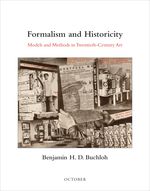
‘Formalism and Historicity’, by Benjamin H. D. Buchloh

9780262028523_0Graham Bader at Artforum:

ALMOST EXACTLY MIDWAY through his new collection of essays, Formalism and Historicity, Benjamin H. D. Buchloh quotes El Lissitzky’s late-1920s description of the revolutionary “demonstration rooms” for abstract art he’d designed earlier that decade in Dresden and Hannover, Germany:

Traditionally the viewer was lulled into passivity by the paintings on the walls. Our construction/design shall make the man active. . . . With each movement of the viewer in space the perception of the wall changes; what was white becomes black, and vice versa. Thus, as a result of human bodily motion, a perceptual dynamic is achieved. This play makes the viewer active.

Not just the literal midpoint of Buchloh’s book, Lissitzky’s passage can be understood to crystallize the volume’s analytical heart as well. For if the Russian describes a desire to awaken viewers’ critical capacities through his material reformulation of artistic work—moving from the production of discrete objects to integrated environments, following a paradigm not of static presentation but dynamic activation—so Buchloh has long sought to rouse his readers by articulating a model of historical inquiry driven by the twin engines of critical negativity and utopian anticipation, and motivated by a primary concern with the radically shifting conditions of possibility by which art in the modern period has been repeatedly redefined.

If the demonstration rooms proposed a fundamentally collaborative aesthetic model in which isolated authorship was rendered obsolete, so Formalism and Historicity departs from Buchloh’s 2000 essay collection, Neo-Avantgarde and Culture Industry: Essays on European and American Art from 1955 to 1975, in focusing not on individual makers but on historical repetitions (figuration, portraiture, the monochrome) and episodes (the development of Conceptual art and the interwar Soviet avant-garde, as well as the latter’s postwar reception) that cut across the span of twentieth-century art.

more here.

Controversial New Push to Tie Microbes to Alzheimer’s Disease

Melinda Wenner Moyer in Scientific American:

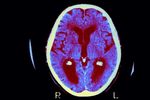
BrainScientists have long puzzled over the root causes of Alzheimer's disease, a devastating and typically fatal condition that currently denies more than five million Americans their cognition and memory. But in a provocative editorial soon to be published in the Journal of Alzheimer’s Disease, a cadre of scientists argue that the complex disease may have a surprisingly simple trigger: tiny brain-infecting microbes. This controversial view, which is not new, has long been dismissed as outlandish, but a growing body of work suggests it may be worth considering and further studying. If researchers can prove the theory and iron out the many argued-over details—both formidable tasks, as brain infections are difficult to study—Alzheimer's could become a preventable illness.

The editorial, signed by 31 scientists around the world, argues that in certain vulnerable individuals—such as those with the APOE ε4 gene variant, a known Alzheimer’s risk factor—common microbial infections can infect the aging brain and cause debilitating damage. These microbes may include herpes simplex virus 1 (HSV-1), the ubiquitous virus that causes cold sores as well as Chlamydophila pneumoniae and Borrelia burgdorferi, the bacteria that cause pneumonia and Lyme disease, respectively. The controversial idea butts heads with the long-standing theory that amyloid-beta proteins and tau tangles, both of which build up inside the brains of those with Alzheimer’s, are the main drivers of disease-induced cell death. Instead, supporters of the pathogen hypothesis, as it is called, posit that either pathogens induce brain cells to produce the amyloid proteins and tau tangles or that nerve cells that have been damaged by infection produce them as part of an immune response.

More here.

Tuesday, March 22, 2016

After Brussels: Once again thinking through terror

Kenan Malik in Pandaemonium:

Pierre-soulages‘Solidarity and anger. Those were my immediate emotions’. So I wrote last November after the Paris attacks: ‘Solidarity with the people of Paris, anger at the depraved, nihilistic savagery of the terrorists.’ My emotions are much the same after the savage attacks in Brussels this week. ‘But, beyond solidarity and anger,’, I observed in November, ‘we need also analysis.’ I have written much over the past few years about why conventional views about radicalization and the making of European jihadis are wrong. So here, some of the main themes of my articles on jihadism.

Terrorists often claim a political motive for their attacks. Commentators often try to rationalize such acts, suggesting that they are the inevitable result of a sense of injustice created by Western foreign policy or by anti-Muslim attitudes in the West. Yet most attacks have been not on political targets, but on cafes or trains or mosques. Such attacks are not about making a political point, or achieving a political goal – as were, for instance, IRA bombings in Britain in the 1970s and 1980s – but are expressions of nihilistic savagery, the aim of which is solely to create fear. This is not terrorism with a political aim, but terror as an end in itself.

More here.

LAWRENCE OSBORNE

Christopher Bollen in Interview:

ScreenHunter_1798 Mar. 22 22.25Once, when I was feeling disenchanted with contemporary fiction and complaining that no one ever writes great books set in exciting foreign locales anymore, a friend suggested Lawrence Osborne. I can't remember who that friend is, but I owe her tremendous thanks. I dove headfirst into Osborne's 2012 Moroccan novel The Forgiven and was blown away not only by the jarring, mysterious story of careless Western vacationers caught in circumstances from which that they can't buy or talk their way free, but also by Osborne's wizardry with descriptions. He is almost unrivaled among living novelists in his ability to reanimate weather and nature-transforming sunsets, deserts, parties, and even the hands of locals into rare and ferocious marvels. Osborne's novels are full atmospheres, they continue to engulf as you read, and the worlds he creates never feel like creaking painted backdrops rolled out to separate scenes. He's often compared to Graham Greene, but I find him holding his own with Patricia Highsmith—the morality of his books are more ominous and shifting.

His latest novel, Hunters in the Dark (Hogarth), which arrived in the U.S. earlier this year, concerns a young British traveler who journeys over the boarder from Thailand into Cambodia. Flush with a win at a casino, Robert Grieve quickly falls into the passing hands of a wily American ex-pat, corrupt police officers, a beautiful young Cambodian student, and an opportunity to strip himself of his own past. It isn't so much a simple game of cat-and-mouse, as a ruthless and gorgeous chessboard. The dark history and deep humidity of Cambodia practically warps the pages.

More here.

Earth to Economics: Welcome to Science 101

David Sloan Wilson in Evonomics:

ScreenHunter_1797 Mar. 22 22.19I welcome the attention that Noah Smith has drawn to two “big think” pieces,one by Nick Hanauer and Eric Liu and the other by myself, which are both cut from the same broad cloth of evolutionary and complexity theory. Smith comes across as an open-minded skeptic. He likes some aspects and is unimpressed by others. Most of all, he insists on empiricism. Here is how he ends his critique.

“But I think that more important than any of these theoretical changes – or the evolutionary theory suggested by Wilson – is the empirical revolution in econ. Ten million cool theories are of little use beyond the “gee whiz” factor if you can’t pick between them. Until recently, econ was fairly bad about agreeing on rigorous ways to test theories against reality, so paradigms came and went like fashions and fads. Now that’s changing. To me, that seems like a much bigger deal than any new theory fad, because it offers us a chance to find enduringly reliable theories that won’t simply disappear when people get bored or political ideologies change.

So the shift to empiricism away from philosophy supersedes all other real and potential shifts in economic theory. Would-be econ revolutionaries absolutely need to get on board with the new empiricism, or else risk being left behind.”

I can’t help but remark on the irony of this stance. By Smith’s own account, the field of economics is experiencing an empirical revolution. Unlike the past, it has become necessary to test theories against reality. That places the field of economics many decades behind the field of evolution and numerous fields in the human social sciences that have been rigorously evidence-based all along. Earth to the economics profession: Welcome to Science 101!

More here.

HUMEYSHA’S VIDEO FOR “FOR LOVE, FROM THE LAW” IS ODD IN ALL THE RIGHT WAYS

From Noisey:
Here's what we know about Humeysha: They're a quartet based in NYC (made up of Zain Alam, Dylan Bostick, Adrien DeFontaine, and John Snyder), they released their self-titled debut back in October, and their single is a marvelously mellow kind of psych-pop, but it's clean and sparkly like a diamond baguette, dappled with Bollywood-toned lilts, sung by Alam in both English and Hindi-Urdu (the project was initially conceived in India). Given the current trend for smothering recordings in reverb and lo-fi fuzz, this kind of high def clarity is a real palate cleanser.
“'For Love, From the Law' always felt like the song meant to open the album from the moment it was finished,” explains Alam. “Between the verse and chorus, the lyrics alternate from Hindi-Urdu to English and then back. The song distills my family’s stories of coming to the US from Pakistan, weaving in larger themes about promise, leaving for one’s love, and lost homelands.”
Premiering below is the video for said track, which luckily, is as languidly appealing as the track.

the erotic modernism of Rut Hillarp

Rut-hillarp-poet-och-erotiskt-geni-6939Saskia Vogel at Music and Literature:

When her debut novel Blood Eclipse arrived in the mail, I barely dared touch it. A slim, brittle volume from an antiquarian bookseller in Stockholm. One of two available for sale online. Self-published in 1951. Number 27 in an edition of 500, with one of 50 covers hand-painted by the author and signed to Nils Ferlin (the poet, I assume). It was love at first line. I let the sun burn my shoulders as I devoured her words on the balcony wearing white gloves, so as not to mar the stiff, yellowed pages.

The novel begins with a man’s reply to his female lover’s letter:

It’s true, I didn’t come. I never intended to.
And I can’t accept the discreet excuse you offered me in your letter.
I don’t believe you waited long enough for me . . . I asked for you to wait as a period of gestation during which your desires would consolidate, your emotions coagulate. Until now any man has been able to satisfy these desires in you, but after this waiting period, they will be devoted only to Man.
Because waiting shapes his story and gives him his reality . . .
Like hunger, waiting is creative. It rouses new senses and needs, and so it offers Man an infinitesimal keyboard and a palette with metaphysical resonance.
Waiting entices the desired man, and he comes more quickly when he is late than when he is on time.

It is tempting to make a case for Rut Hillarp as Sweden’s Anaïs Nin. In response to Anaïs Nin’s notoriety, she wondered in a 1951 letter if she too couldn’t do just as well. Indeed, they have a similar erotic project. Like Anaïs Nin, Rut Hillarp’s works trace a map of the psyche’s movements through love, lust, and desire.

more here.

A new critical biography of filmmaker David Lynch

David_lynchA. S. Hamrah at Bookforum:

A nicotine fiend and a coffee addict who mixes existential dread with sadomasochism in all-American settings, Lynch is that rare director who makes subversive films without a chip on his shoulder, seemingly without any will to provocation. He is at home with his neuroses and obsessions. His secret is that he proceeds as though he is acting from the most impossible condition of all: normalcy. While directors like David Fincher and Lars von Trier explore similar terrain with grim determination, only Lynch enters nightmare worlds like the Eagle Scout he was, as inquisitive about the depths of human psychology as he is about bugs and twigs.

“There is goodness in blue skies and flowers, but another force—a wild pain and decay—also accompanies everything,” Lynch has said. “There’s this beautiful world and you just look a little bit closer, and it’s all red ants.” Like the ones on the severed ear in Blue Velvet. Lim connects Lynch to the dark forces that drive the American psyche, the same ones D. H. Lawrence analyzed in his Studies in Classic American Literature, and there is more than a touch of “Young Goodman Brown” in Lynch’s homespun American surrealism. Like the character in Hawthorne’s story, Lynch is drawn to the woods at night, where ordinary people confront the demonic. The Black Lodge in Twin Peaks houses America’s violent soul.

This view was ingrained in Lynch from the start. His father, a research scientist with the US Forest Service, wrote a doctoral thesis called “Effects of Stocking on Site Measurement and Yield of Second-Growth Ponderosa Pine in the Inland Empire,” a title seeded with Lynchian allusion.

more here.

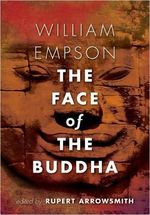
on Empson’s ‘The Face of the Buddha’

51cxHX5513L._SX346_BO1,204,203,200_Kevin Jackson in Literary Review:

The publication of this wonderful book is not far short of a miracle – a corny word that would have made Sir William Empson harrumph, irritable scientific rationalist that he was. Until about ten years ago, Empson’s admirers (our name is Legion, for we are many) had assumed that the only manuscript of The Face of the Buddha had vanished forever – it was often rumoured to have been destroyed in the Blitz, until the first volume of John Haffenden’s invaluable Empson biography (published in 2005) established that it was in fact the man of letters John Davenport who had left it in a taxi when very, very drunk, circa 1947.

Davenport was so embarrassed by his bungle that he did not confess to Empson until 1952. But his apology was far from accurate. Thanks to an inspired curator at the British Library (let his name be honoured: Jamie Andrews), we now know the full story. What actually happened is that Davenport, still three sheets to the wind, handed the manuscript and its photographic illustrations over to that most colourful figure of 1940s literary bohemia, the Tamil poet and editor ofPoetry London, Tambimuttu. Shortly afterwards, Tambimuttu quit London and returned to his native Ceylon, leaving The Face of the Buddha in the hands of his coeditor, Edward Marsh. And shortly after the handover, Marsh took ill and died. His papers remained unexamined until they were bought by the British Library in 2003. Andrews discovered Empson’s material two years later.

To Empsonians, this happy find was as exciting as, say, the discovery of an authenticated text of Cardenio would be to Shakespeareans.

more here.

the radical poverty of st. francis of assisi

From Delanceyplace:

Stfrancis_partSt. Francis of Assisi (1182-1226 CE), perhaps the most revered of all the Christian saints outside of the apostles themselves, took the practice of poverty to a new extreme. This was especially striking at a time when generally only the well-born entered these orders of monks, and in a world where the blind were laughed at and the weak scorned.

Francis also pioneered a type of classless equality unknown in his era: “Living according to the pattern provided in the gospels … meant practicing poverty at its most radical, both for Francis and for the brothers — 'lesser broth­ers' (fratres minores), as they called themselves (thus the Order of Friars Minor), or (to use Francis's word) fraticelli — who began to gather around him. … Francis went much further [than those before him]. For him and for his young brotherhood, Francis intended corporate destitution. Again, he states this emphatically, not gently, in the beginning of his first Rule: 'The broth­ers shall appropriate nothing to themselves, neither a place nor anything; but as pilgrims and strangers in this world, serving God in poverty and humility, they shall with confidence go seeking alms.' For a Benedictine, or even a Cistercian, living in stable residences and worshipping, often, in grand churches, 'poverty' had a different meaning.

More here.

Parrots Are a Lot More Than ‘Pretty Bird’

Natalie Angier in The New York Times:

ParrotParrot partisans say the birds easily rival the great apes and dolphins in all-around braininess and resourcefulness, and may be the only animals apart from humans capable of dancing to the beat. “We call them feathered primates,” said Irene Pepperberg, who studies animal cognition at Harvard and is renowned for her research with Alex and other African grey parrots.

…Dr. Pepperberg and her collaborators have shown that African grey parrots have exceptional number skills: Alex could deduce the proper order of numbers up to 8, add three small numbers together and even had a zerolike concept — “skills equivalent to those of a four-and-a-half-year-old child,” Dr. Pepperberg said. Dr. Auersperg and her co-workers have found that Goffin’s cockatoos are more geared toward solving technical tasks. Alternately using their bills and feet, the birds can systematically make their way through a lock with five different complex mechanisms on it. Should they discover that one of the steps can be skipped en route to opening a chamber with a nut inside, they skip it the next time around. And in an act of ingenuity that Dr. Auersperg called “sensational” for an animal not known to use tools in the wild, a cockatoo named Figaro one day started carefully chipping at the edge of a larch wood frame until he had formed a long, slender pole, which he then wielded in his bill like a hockey stick to knock out pebbles and nuts hidden under boxes. “It took him 20 minutes to make his first tool,” Dr. Auersperg said. “After that, he could do it in less than five minutes.”

More here.

Monday, March 21, 2016

Perceptions

Transparent Existence

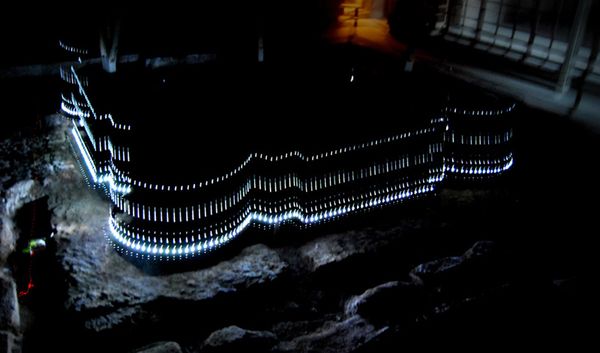
Magdi Mostafa. Transparent Existence. 2014.

“Transparent Existence is a site-specific sound and light installation created underneath the Mawlwian Museum in Islamic Cairo. The artist conducted research into the architectural history of the museum itself, which houses artifacts pertaining to Sufi rituals and a theatre for traditional Sufi dancing. In the course of his investigation, Mostafa found that the original building dates from over 650 years ago, and originally served as a school for husband- and father-less women and children; later, that structure became the foundation for a Sufi religious site, before finally being converted into a museum. Only recently did archaeologists discover the building’s historical foundations, and at the same time, discovered the burial site of five anonymous individuals at that lower, 15th century level.

Intrigued by these multiple and interpenetrating layers of history, as well as the contested identity of the forgotten dead, the artist conceived of a project that would call attention to the site’s invisible past. Mostafa created an interactive light sculpture beneath the museum, tracing the outline of a courtyard fountain that had been part of the original structure. A 16 channel sound system pervaded the entire underground chamber, emitting recordings of a Sufi vocal performance, digital sound elements, and ambient sounds recorded by the artist inside the museum and in the surrounding streets, including the creaks and thumps of dancing on the wooden theater floor that rests above the installation site. The lights responded to this sound, illuminating, flickering and disappearing according to the intensity of the noise, thus acting as a visual metaphor for the unstable, wavering mechanics of memory itself.”

More here, here, and here.

Sunday, March 20, 2016

Why I Bought Four Syrian Children Off a Beirut Street

Franklin Lamb in CounterPunch:

ScreenHunter_1793 Mar. 21 10.02I confess to having recently purchased four children near Ramlet el Baida beach from a stressed-out Syrian woman. I am not sure if she was what she said or if she was a member of one of the human trafficking gangs that operate widely these days in Lebanon selling Syrian children or vulnerable adult women. The vendor-woman claimed to have been a neighbor of the four children in Aleppo and that they lost their parents in the war. They appear in the photo above, sitting on this observer’s motorbike a few days after the sale: two five year old twin girls, a boy about one year and several months, and his eight-year old bigger brother.

She and the children had ended up in Lebanon but she explained to me that she was afraid to register with the UNHCR because she is an illegal and has no ID. The woman told me that she could no longer take care of the shivering children but did not want to just leave them on the street. She would give them all to me for $ 1000 (or I could pick and choose from among the siblings at $ 250 each).

More here.

Robots will take your job

Scott Santens in the Boston Globe:

ScreenHunter_1792 Mar. 21 09.58On Dec. 2, 1942, a team of scientists led by Enrico Fermi came back from lunch and watched as humanity created the first self-sustaining nuclear reaction inside a pile of bricks and wood underneath a football field at the University of Chicago. Known to history as Chicago Pile-1, it was celebrated in silence with a single bottle of Chianti, for those who were there understood exactly what it meant for humankind, without any need for words.

Now, something new has occurred that, again, quietly changed the world forever. Like a whispered word in a foreign language, you may have heard it but couldn’t fully understand.

The language is something called deep learning. And the whispered word was a computer’s use of it to defeat one of the world’s top players in a game called Go. Go is a board game so complex that it can be likened to playing 10 chess matches simultaneously on the same table.

This may sound like a small accomplishment, another feather in the cap of machines as they continue to prove themselves superior in parlor games that humans invented to fill their idle hours. But this feat is about far more than bragging rights. This was considered a “holy grail” level of achievement, and it’s a clear signal that advances in technology are now so exponential that milestones we once thought far away will start arriving rapidly.

More here.

Habermas, the Last European: A Philosopher’s Mission to Save the EU

Georg Diez in Der Spiegel:

ScreenHunter_1791 Mar. 21 09.53Jürgen Habermas is angry. He's really angry. He is nothing short of furious — because he takes it all personally.

He leans forward. He leans backward. He arranges his fidgety hands to illustrate his tirades before allowing them to fall back to his lap. He bangs on the table and yells: “Enough already!” He simply has no desire to see Europe consigned to the dustbin of world history.

“I'm speaking here as a citizen,” he says. “I would rather be sitting back home at my desk, believe me. But this is too important. Everyone has to understand that we have critical decisions facing us. That's why I'm so involved in this debate. TheEuropean project can no longer continue in elite modus.”

Enough already! Europe is his project. It is the project of his generation.

Jürgen Habermas, 82, wants to get the word out. He's sitting on stage at the Goethe Institute in Paris. Next to him sits a good-natured professor who asks six or seven questions in just under two hours — answers that take fewer than 15 minutes are not Habermas' style.

Usually he says clever things like: “In this crisis, functional and systematic imperatives collide” — referring to sovereign debts and the pressure of the markets.

Sometimes he shakes his head in consternation and says: “It's simply unacceptable, simply unacceptable” — referring to the EU diktat and Greece's loss of national sovereignty.

More here.