The Inherent Bias of Facial Recognition

Rose Eveleth in Motherboard:

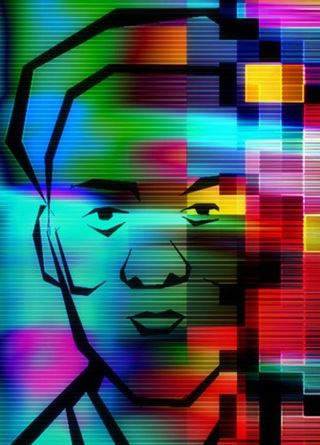
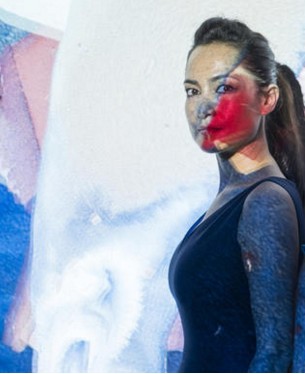
ScreenHunter_1813 Mar. 27 18.32Facial recognition systems are all over the place: Facebook, airports, shopping malls. And they’re poised to become nearly ubiquitous as everything from a security measure to a way to recognize frequent shoppers. For some people that will make certain interactions even more seamless. But because many facial recognition systems struggle with non-white faces, for others, facial recognition is a simple reminder: once again, this tech is not made for you.

There are plenty of anecdotes to start with here: We could talk about the time Google’s image tagging algorithm labeled a pair of black friends “gorillas,” or when Flickr’s system made the same mistake and tagged a black man with “animal” and “ape.” Or when Nikon’s cameras designed to detect whether someone blinked continually told at least one Asian user that her eyes were closed. Or when HP’s webcams easily tracked a white face, but couldn’t see a black one.

There are always technical explanations for these things. Computers are programmed to measure certain variables, and to trigger when enough of them are met. Algorithms are trained using a set of faces. If the computer has never seen anybody with thin eyes or darker skin, it doesn’t know to see them. It hasn’t been told how. More specifically: the people designing it haven’t told it how.

The fact that algorithms can contain latent biases is becoming clearer and clearer. And some people saw this coming.

More here.

Cast No Evil

Alia Ali in Lensculture.com:

WomanThroughout life we are presented with endless examples in which individuals and groups have been excluded from communities based on appearances, beliefs and actions. When this happens, there must always be two, those who impose standards, the decision makers, the 'included,' and those they exclude. Communication can be used to both connect and divide, evolve and regress, educate and destroy. Inclusion is, therefore, engaging someone in a dialogue, but not necessarily a verbal one.

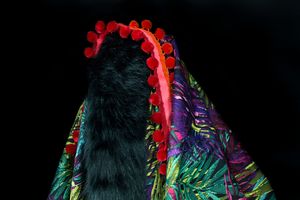
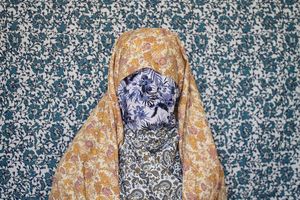
Girl4…The characters in the portraits, called —cludes, are wrapped in layers of fabric that shield them from interrelating with anything beyond the material. What are these fabricated barriers in society that inhibit the incorporation of others? Or are the obstacles just that: ideas, intuitions, fear, discriminations and ‘understandings’? Does inclusion mean acceptance? If so, does this definition lend itself to exclusion meaning rejection? Or do they both mean different points on the spectrum of tolerance? What side of the fabric are we on and can we be on both sides at once? When we exclude, does it come from the fear of being excluded ourselves? Isn’t exclusion a form of security, as well? If so, what is it that we fear from discovering that lies beneath the cloth and behind the curtain? By remaining indifferent, and incommunicative, do we become like one of them, dehumanized? Dummies? Or are we the ones enclosed and what we see is an illusive barrier that we have bestowed on them?

Who are the ‘includes’ and who are the ‘excludes’? How do we become secludes.

Does the material set a power dynamic? It certainly creates a boundary, but who holds the power; them, for their anonymity, or us, for their confinement?

More here.

American, Muslim, and under constant watch

Rose Hackman in The Guardian:

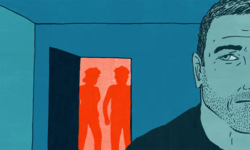
AhsanAhsan Samad sits on the sofa in the living room of his small family home in Brooklyn, New York. The 30-year-old plumber leans forward and carefully pours the coffee his mother has just brought in from the kitchen. His young niece and nephew are playing in a nearby room. “I know I have done nothing wrong. I am constantly thinking about it. Their visits made me terrified.” Samad looks up, bewildered and confused. He is trying to lay out the complexity of the mental hell the past four and a half years have been for him. Samad is an American citizen with no criminal record – no arrests, no felonies. But in the shifting eyes of the American law, he is something worthy of seeming extra attention. Samad is not just American – he is also Muslim.

Over the course of more than four years between September 2011 and 2015, he received at least five visits to his home by NYPD and then FBI officers. He says the visiting officers came with no warrant and used threatening and provocative language. During a visit in September 2011, they even forced themselves inside his home. Law enforcement agents presenting themselves to his residence were repeatedly and systematically told by him and his petrified family members to arrange for interviews in the presence of lawyers (who later followed up with agencies) – something law enforcement officials repeatedly declined to do. Followups by Samad’s lawyers – members of a free legal clinic named Clear, which is operated by the law school at City University of New York – have not revealed the existence of any kind of formal investigation tied to Samad and his family.

More here.

Sunday Poem

A Prism: Wet With Wars

this is the chapter of
devastation
this is our oasis
an angle where wars intersect
tyrants accumulate around our eyes
and in the shackle’s verandah
there is enough space for
applause
let us applaud

another evening climbs
the city’s candles
technological hoofs crush the night
a people is being slaughtered across short waves:
but local radio vomits raw statements
and urges us to
applaud

with a skeleton of a burning umbrella
we receive this rain
a god sleeps on our flag
but the horizon is prophetless
maybe they will come if we
applaud
let us applaud

we will baptize our infants with smoke
plough their tongues
with flagrant war songs
teach them the bray of slogans
and leave them beside burning nipples
in an imminent wreckage
and applaud

before we weave an autumn for tyrants
we must cross this galaxy of barbed wires
and keep on repeating
HAPPY NEW WAR!

Baghdad, March 1991
by Sinan Antoon
from Iraq Poetry Today
Zephyr Press, 2003
Translated from the Arabic by the poet

Saturday, March 26, 2016

How the surprising union between a fungus and an alga raises questions about the nature of identity

Elizabeth Lopatto in Bay Nature:

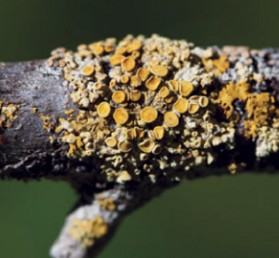
ScreenHunter_1812 Mar. 26 19.07In July, Governor Jerry Brown signed into law a bill declaring the lace lichen—found along the Pacific coast and throughout the coast ranges—the state lichen. As of January 1, 2016, California will be the first state ever to designate a lichen as a state symbol.

Lace lichen, Ramalina menziesii, is easily recognized. It is pale green and dangles in strips from trees. It’s sometimes confused with Old Man’s Beard (Usnea sp.), which is also pale green and dangly. Lace lichen’s range stretches from Alaska to Baja California. It’s an important food for deer; it also serves as material for birds’ nests. I see it once, in researching this story, when naturalist Morgan Evans, a former student naturalist aide at Tilden Nature Area in the East Bay hills, removes it from her backpack and spreads it out. Evans is a pleasant and patient woman, whose true love is fungi. Her interest in lichens is an extension of that, she says. Anyway, she found some lace lichen growing in Morgan Territory Regional Park. She figured I’d want to see it and there isn’t much growing in Tilden that she knows of. She hands me the lichen, which feels strangely plasticine. It’s pale green—she wetted it so it wouldn’t crumble when she transported it—and dangles impressively, at least six inches long. Lace lichen can grow as long as a meter, and it has a netted structure that looks, to me at least, more like fishnet stockings than lace. Perhaps fishnet-stocking lichen would be a little too racy a nickname.

Before I tell you more, though, a disclaimer: It turns out lichen identity is fraught with existential issues, not least of which is that lichens are a union between two separate organisms.

More here.

Haptics and Emotion: How Touch Communicates Feelings

Ajay Karpur at Somatic Labs:

ScreenHunter_1811 Mar. 26 18.53When we think about the content of a conversation, it’s easy to focus on just the verbal information exchanged through spoken words; however, there are many other factors that color our interpretation of conversations and, in turn, the information they communicate. One such consideration is the context provided by prosody—the intonation, stress, tempo, rhythm, and pauses in a person’s speech, all of which lend their voice a unique texture. The brain also employs detailed mappings that link different kinds of facial expressions and gestures with the emotions and nuances that they convey. In fact, up to 65% of the raw information in a conversation is exchanged nonverbally [1]. As we continue to investigate human communication, we uncover a highly complex, multi-modal system that comprises many of our senses—including our sense of touch.

Though modern messaging systems are efficient in transmitting visual information, they provide a limited channel for expressing emotions and fail to capture the nuances of face-to-face conversations. To express emotion, people often resort to using emoticons, emoji, or shorthand abbreviations (such as the ubiquitous ‘lol’). While grinning face, smiling face with open mouth, and face with tears of joy all convey different “happy” emotions, none of these pictographs can convey what it feels like to see a subtle smile creep across someone’s face and cascade into a joyous laugh.

More here.

Artist Shahzia Sikander on her multicultural past and our future

Shahzia Sikander in the Los Angeles Times:

ScreenHunter_1810 Mar. 26 18.47Human identity is mercurial. Like a human being, it is alive and liable to shift, evolve, challenge and surprise.

I was born in Lahore, Pakistan, to a family of storytellers. My father was an enthusiastic narrator, with oratory prowess. My first memory is of him reading to me Korney Chukovsky's book “Unusual Tales” translated into Urdu. His creative freedom in customizing the tales as he read out loud was infectious and entertaining. It signaled to me as a young child to be inventive. A couple of years later, encounters with Edgar Allan Poe, Lewis Carroll, Walter de la Mare alongside the stories of Miraj — the visionary night journey of Prophet Muhammad — felt like the Everest expedition in pursuit of wit, candor and irony. In high school the pendulum swung between Shakespeare and Salman Rushdie and a multitude of sources in between, allowing my imagination to inspect reality from different cultural consequences.

But growing up in Pakistan in the 1980s under a military regime that incessantly institutionalized religion was a deeply conflicting experience. The Hudood ordinances, which limited women's rights, loomed large. Art school was considered immoral. Co-education dissipated. Religious tolerance diminished.

More here.

Adam Hochschild’s ‘Spain in Our Hearts’

25BOOK-master180Dwight Garner at The New York Times:

The Spanish Civil War (1936-39) was not a splendid little war. It was an especially vicious one. Some 500,000 people died, most in combat or by political execution. A right-wing coup, led by Francisco Franco and backed by Hitler and Mussolini, toppled a democratically elected government.

It was, though, a strangely literary little war. We remember it today through classic accounts like Hemingway’s novel “For Whom the Bell Tolls” and Orwell’s memoir “Homage to Catalonia.” So many other significant writers and journalists poured into Spain, as observers or participants, it’s hard to keep track of them.

The French novelist André Malraux organized a squadron of volunteer pilots for the anti-Fascist resistance. The aviator and author Antoine de Saint-Exupéry reported for a Paris daily. Hemingway’s suite at the Hotel Floridain Madrid was a boozy hangout for a revolving rat pack of well-groomed foreign correspondents, including Martha Gellhorn, with whom he’d begun an affair. Dorothy Parker, Theodore Dreiser, Langston Hughes and W. H. Auden toured the fighting.

The war resonates visually as well. Robert Capa’s combat photographsare milestones; Picasso’s “Guernica,” painted after the carpet-bombing of that city, is among the most important artworks of our time.

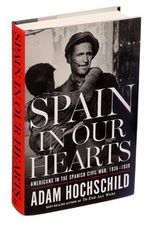
Adam Hochschild’s excellent and involving new book, “Spain in Our Hearts: Americans in the Spanish Civil War, 1936-1939,” is not primarily a literary or cultural history. It’s about the moral appeal of the war, about the anti-Fascist and frequently pro-Communist idealism that made so many volunteers from the United States and other countries flood into Spain.

more here.

the Easter Rising 100 years on

ImageColm Tóibín,Anne Enright, Roddy Doyle, etc., at The Guardian:

In the early hours of the Thursday of Easter week 1916 my grandfather came into the front bedroom of the small house in Enniscorthy. His sons woke and watched as he lifted some of the floorboards and removed a rifle. The Rising in Dublin had begun on Monday, but outside Dublin there was confusion. To get a clear idea of what was happening, a man called Paul Galligan had gone by bicycle the 75 miles from Enniscorthy to Dublin, arriving on Easter Sunday. The following day he met with three of the leaders of the Dublin Rebellion in the General Post Office. He was told to go back home to Enniscorthy and instruct the other members of the movement to take the town and hold the railway line, thus stopping British forces from getting from Rosslare to Dublin. He rode back to Enniscorthy by a circuitous route so he would not be detained, arriving on the Wednesday. The Rising in Enniscorthy began the following morning. Between 100 and 200 took part at the beginning, although more joined later. Compared to Dublin, the Enniscorthy Rising was small. No one was killed; two or three were wounded; no buildings were destroyed. “We had one day of blissful freedom,” one of the Enniscorthy leaders said. (The Rising lasted just a few days.) But perhaps its real importance came when the Rebellion ended. The British arrested almost 300 people in Enniscorthy and its environs. One of these – Séamus Doyle – was even sentenced to death. His sentence was commuted. In later years, he lived in a house close to ours and devoted himself to the growing of roses and grumbling about boys who kicked their football into his garden.

more here.

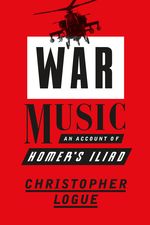
‘WAR MUSIC’ BY CHRISTOPHER LOGUE

War-musicAdam Kosan at The Quarterly Review:

For more than forty years the English poet Christopher Logue worked in fits and starts on his narrative poem War Music, subtitled An Account of Homer’s Iliad. The poem, which he was unable to complete before he died in 2011, was published in several sections titled War Music (1981), Kings (1991), The Husbands (1995), All Day Permanent Red (2003), and Cold Calls (2005), corresponding, respectively, to Books 16-19, 1-2, 3-4, 5-6, and 7-9 of The Iliad. These books have now been brought together in a single volume that tells the story of Logue’s fragmentary and highly original Trojan War. It benefits from the editorial care of Christopher Reid, who has appended excerpts from drafts for the work’s envisioned final section, Big Men Falling A Long Way, along with notes describing the source and contextual details for each draft. As the first volume since Logue’s death to take stock of his major poem, it is auspicious—in time we can expect Reid’s circumspection and restraint to be expanded on by critics working with Logue’s archives.

This is not to say that War Music is in pressing need of elucidation. Logue was vehemently responsive to his times, a rascal, a provocateur, irritating, incisive. His poetry looks out at the world without being topical. He was drawn to ballad forms and created “poster poems” that were sold and hung around London (these pieces were the subject of a recent retrospective at Rob Tufnell). He was a pacifist who protested against nuclear weapons, a satirist who wrote and edited pieces for Private Eye magazine, and, among other things, an actor, screenwriter, and playwright, who collaborated frequently with artists in various media. He was, in short, committed to a public presence for poetry, and this commitment was crucial to the very particular, undiminished energy that we find in Logue’s work. In fact, it might surprise people that he began War Music in 1959—so brilliant, so new, does it remain in a contemporary context.

more here.

Shock and Awe: The neverending end times

Lewis H. Lapham in Lapham's Quarterly:

’Tis not contrary to reason to prefer the destruction of the whole world to the scratching of my finger. —David Hume
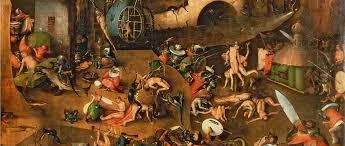
ShockNor is it contrary to reason to prefer the sight of a raging inferno or restless typhoon to the view of a worm in one’s apple or a fly in the soup. The spectacle of disaster—real and imagined, past, present, and imminent—is blockbuster box office, its magnitude measured by the number of dead and square miles of devastation, the cost of property, rates of insurance, long-term consequences, short-form shock and awe.

…Behold the world for what it is, a raging of beasts and a writhing of serpents, and know that the war on terror will be with us until the end of our days. Get used to it; harden thy resolve; America is everywhere besieged by monsters that must be destroyed—by any and all means necessary, no matter how costly or barbaric. And yes, Virginia, there is an answer to Adam Smith’s disturbing question—to prevent a paltry misfortune to oneself not only is it possible, it’s also prudent to sacrifice as many of our fellow human beings as circumstances require. The UN Security Council in 1990 imposed harsh economic sanctions on Iraq in order to send a stern message to Saddam Hussein. When Madeleine Albright, then U.S. ambassador to the United Nations, was asked in an interview on 60 Minutes whether she had considered the resulting death of over 500,000 Iraqi children (of malnutrition and disease for lack of medicine and baby food), she said, “We think the price is worth it.” Together with an estimated $2 trillion, President George W. Bush sacrificed the lives of nearly 5,000 American soldiers and 165,000 Iraqi civilians to prevent America from being harmed by Saddam Hussein’s nonexistent weapons of mass destruction. The cost–benefit analysis emerged from the administration’s doctrine of forward deterrence and preemptive strike, a policy predicated on the notion that if any nation anywhere in the world presumed even to begin to think of challenging America’s supremacy (moral, military, cultural, and socioeconomic) America reserved the right to strangle the impudence at birth—to bomb the peasants or the palace, block the flows of oil or bank credit.

Michael Ledeen, foreign-policy adviser to the Bush White House and Freedom Scholar at the Foundation for Defense of Democracies, put the policy in its clearest perspective: “Every ten years or so, the United States needs to pick up some crappy little country and throw it against the wall, just to show the world we mean business.”

More here.

‘Shuffle Along’ and the Lost History of Black Performance in America

John Jeremiah Sullivan in The New York Times:

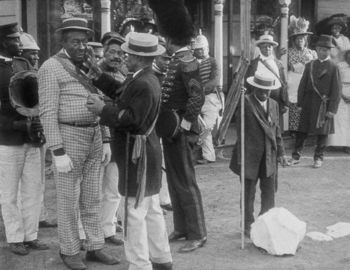
BlackThe blacks-­in-­blackface tradition, which lasted more than a century in this country, strikes most people, on first hearing of its existence, as deeply bizarre, and it was. But it emerged from a single crude reality: African-­American people were not allowed to perform onstage for much of the 19th century. They could not, that is, appear as themselves. The sight wasn’t tolerated by white audiences. There were anomalous instances, but as a rule, it didn’t happen. In front of the cabin, in the nursery, in a tavern, yes, white people might enjoy hearing them sing and seeing them dance, but the stage had power in it, and someone who appeared there couldn’t help partaking of that power, if only ever so slightly, momentarily. Part of it was the physical elevation. To be sitting below a black man or woman, looking up — that made many whites uncomfortable. But what those audiences would allow, would sit for — not easily at first, not without controversy and disdain, but gradually, and soon overwhelmingly — was the appearance of white men who had painted their faces to look black. That was an old custom of the stage, going back at least to “Othello.” They could live with that. And this created a space, a crack in the wall, through which blacks could enter, because blacks, too, could paint their faces. Blacks, too, could exist in this space that was neither-­nor. They could hide their blackness behind a darker blackness, a false one, a safe one. They wouldn’t be claiming power. By mocking themselves, their own race, they were giving it up. Except, never completely. There lay the charge. It was allowed, for actual black people to perform this way, starting around the 1840s — in a very few cases at first, and then increasingly — and there developed the genre, as it were, of blacks-­in-­blackface. A strange story, but this is a strange country.

Picture: Bert Williams having blackface applied in a production still from an uncompleted 1913 film that was identified in the MoMA archives in 2014.

More here.

Friday, March 25, 2016

The ethics of conspiracy theories

Patrick Stokes at ABC:

7251730-3x2-700x467Conspiracy theories weren't invented by the internet. They go back at least as far as the elite reaction to the French Revolution, with a grand Illuminati-Masonic conspiracy theory taking hold on both sides of the Atlantic before the start of the 19th century. Anti-Semitic conspiracy theories had tragic consequences during the last century, while today the Obama administration has had to contend with everything from demands for the president's birth certificate to state governments fuelling rumours of impending martial law. The consequences of conspiracy theories are, as they have always been, concrete and significant.

Most of us use the term 'conspiracy theory' to refer to beliefs we consider outlandish, paranoid, and almost certainly false. Yet strictly speaking this is unfair: on the simplest definition, a conspiracy theory is simply any explanation of observed events that posits two or more actors working in secret. Philosophers who have considered conspiracy theories as a class of explanation insist that there's nothing intrinsically irrational about conspiracy theory so defined. In fact, if we didn't accept the idea of a group of actors plotting in secret, we'd be unable to explain a host of historical events, from the assassination of Julius Caesar to Watergate. Conspiracies happen.

More here.

Is the cold fusion egg about to hatch?

Huw Price in Aeon:

ScreenHunter_1808 Mar. 25 20.05Three months ago I wrote an essay in Aeon about intriguing developments in low-energy nuclear reactions (LENR), a controversial field that traces its origins to the claims of ‘cold fusion’ by Martin Fleischmann and Stanley Pons in 1989. Cold fusion itself is widely regarded as discredited, yet there are several recent reports of LENR devices producing commercially useful amounts of heat. As David Bailey and Jonathan Borwein have pointed out in HuffPost Science, it seems increasingly improbable that all these findings are the result of fraud or error, as skeptics assert. But the only remaining alternative – that science simply made the wrong call when it dismissed cold fusion – is still almost invisible in serious scientific conversations and in the mainstream media.

Why is this possibility so broadly ignored? I suggested that it is because LENR is caught in what I called a ‘reputation trap’. Cold fusion has had such a bad name that scientists and journalists put their reputations at risk if they dare to express an interest in LENR. So a fascinating story goes largely unnoticed and unreported.

More importantly, the reputation trap has pushed to the margins an idea that, if it does work, might be just what we need right now: the ‘energy miracle’ that Bill Gates is so desperately seeking.

More here.

America’s Hands-On Hegelian

John Kaag in the Chronicle of Higher Education:

Photo_76003_landscape_650x433When the Republican presidential candidate Marco Rubio said that his country needed more welders and fewer philosophers, most listeners took him to be taking an anti-intellectual jab at academe, at the cultural and economic viability of high theory. Many of my philosophy colleagues came to the defense of our discipline, supplying statistics that demonstrated the economic payoff from pursuing the love of wisdom.

That response, however, sidesteps what might be most disturbing about Rubio’s comment: the suggestion that welders cannot be philosophers and philosophers cannot be welders. Theoreticians have always been mocked for being only loosely tethered to the world of human affairs (think of Aristophanes’ characterization, in The Clouds, of Socrates as hopelessly detached, flying solo in his balloon). And many philosophers, like Plato, have returned the favor by dismissing the rest of the world as cave dwellers. The advent of philosophy as an academic discipline in the 20th century has done nothing to ease this tension, and we have returned, once again, to the disturbing point where statesmen call for the end of theorizing.

More here.