Turkey’s Cyclical Coups

1471017568BaliTurkeyfailedcouptankJuly16Eser_Karadag666Aslı Bâli at Dissent:

Turkey has faced an unprecedented number of crises in the last year. The spillover from the war in Syria has undermined a peace process between the government and the country’s Kurdish community, with the success of Syrian Kurdish militias on the border with Turkey producing fears of separatism among Turkey’s Kurds and prompting the government to relaunch a counter-insurgency campaign (read: war) in the largely Kurdish southeastern provinces. Nationwide, the country has experienced at least five major Islamic State attacks since June 2015. Meanwhile, Turkey now hosts some 2.7 million Syrian refugees. Turkey has also experienced increasing political polarization since the 2013 protests against the government that began in Istanbul’s Gezi Park revealed a deep split in the country. All of these challenges have destabilized the country’s economy and unnerved its population.

Yet almost no one expected, one Friday night in mid-July, to turn on their televisions and see Turkish jets dropping bombs on the country’s own parliament building. Government reforms over more than a decade had civilianized control of Turkey’s military and the armed forces were already embroiled in a brutal war in the southeast. The attempted coup of July 15 and its aftermath has eclipsed the previous crises of the last few years in its magnitude and potential to radically transform the country.

more here.

How Meritocracy Went Wrong

Jefferson-1791Wilfred M. McClay at The Hedgehog Review:

From the very beginnings of American history, the concept of merit has enjoyed a certain pride of place. It found a welcoming home in a new republican nation that, from its inception, had sought to proscribe the titles of nobility and other hereditary distinctions of social and political rank, as well as practices such as primogeniture and entail that had long been characteristic of European aristocratic society. But even the most equality-affirming republic would need to generate a pool of talented and effective leaders, a leadership class recruited and empowered for public service. How to find appropriate means by which the members of such a class could be identified, trained, and elevated to that station? Who should lead, and how should the leaders be chosen?

In a republican America, these questions could no longer be answered by reliance upon bloodlines or skillful machinations. The answers would have to be grounded in the concept of merit. Those with demonstrable experience, those seen to possess the skills, knowledge, character, wisdom, and civic virtue requisite for membership in a “natural aristocracy,” would therefore be those most deserving of high standing and high responsibilities. But how were those individuals to be found and nurtured? If they were no longer thought to be available to be plucked from certain family trees, were they instead to be found randomly distributed among the members of a given society, like the souls of gold and silver drawn from the earth (or so the “noble lie” would have it) in Plato’s imaginary republic?1 Would their education, like the education of the Platonic guardians, be the key to developing their natural excellences and harnessing those talents to the furtherance of the public weal?

more here.

Tuesday Poem

My Aunts

Always caught up in what they called
the practical side of life
(theory was for Plato),
up to their elbows in furniture, in bedding,
in cupboards and kitchen gardens,
they never neglected the lavender sachets
that turned a linen closet to a meadow.

The practical side of life,
like the Moon’s unlighted face,
didn’t lack for mysteries;
when Christmastime drew near,
life became pure praxis
and resided temporarily in hallways,
took refuge in suitcases and satchels.

And when somebody died–it happened
even in our family, alas–
my aunts, preoccupied
with death’s practical side,
forgot at last about the lavender,
whose frantic scent bloomed selflessly
beneath a heavy snow of sheets.
Don’t just do something, sit there.
And so I have, so I have,
the seasons curling around me like smoke,
Gone to the end of the earth and back without sound.
.

by Adam Zagajewski
from Without End: New and Selected Poems
Farrar, Straus, and Giroux. Copyright © 2002
translated by Clare Cavanagh
.

Monday, August 15, 2016

Perceptions

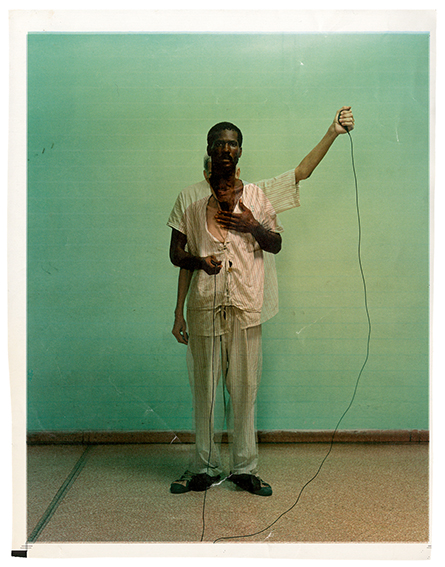
Scarti 2013

Adam Broomberg & Oliver Chanarin. Scarti, 2013.

Ghetto was published by Trolley Books ten years ago. It documented twelve contemporary gated communities, and was photographed by Adam Broomberg & Oliver Chanarin entirely on large format colour negative. The book took three years to produce and is now out of print.

Scarti di avviamento is the technical term at the printers in Italy for the paper that is fed through the printing press to clean the drums of ink between print runs. This by-product is usually destroyed once the book is printed.

But during the printing of Ghetto, the scarti – Italian for scraps – were saved and stored away by publisher Gigi Giannuzzi. Following his untimely death in December 2012 these scarti were discovered.

The twice-printed sheets reveal uncanny and often beautiful combinations.

Yet, in truth, they are nothing but a series of little accidents. …”

More here, here, and here.

Sunday, August 14, 2016

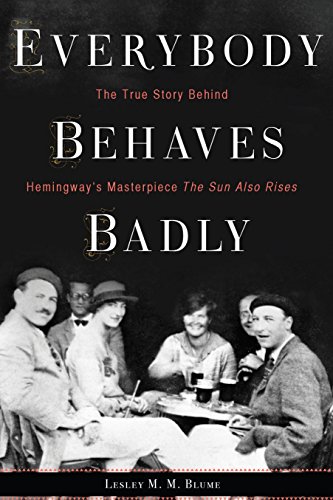
The True Story Behind Hemingway’s Masterpiece “The Sun Also Rises”

Shehryar Fazli in the Los Angeles Review of Books:

EbbTo read or reread Hemingway is always, in part, to inquire into the mystery of his significance. The ideals he symbolized are dated — masculinity and “heroic dissipation,” to quote Edmund Wilson in his collection The Wound and the Bow — while the appeal of his deceptively lean style seems to have eluded several generations of American novelists who valued excess over omission. However, if we can’t explain why, we also can’t evade the proposition that Ernest Hemingway continues to matter.

Lesley M. M. Blume’s Everybody Behaves Badly: The True Story Behind Hemingway’s Masterpiece “The Sun Also Rises” offers an opportunity to visit the question afresh. It isn’t just an account of Hemingway’s writing of his first major work, but also of an animating moment in literary history, when modernism was maturing in the barrel and Hemingway readied to pour the United States its first major dose. Like Hemingway’s posthumously published A Moveable Feast, Blume’s book covers the author’s search for a style, as well as a subject that would be thoroughly modern but would also capture the wider public’s imagination.

More here.

Fractured Lands: How the Arab World Came Apart

14arab-characterportraits-slide-A8YB-superJumbo

Scott Anderson in the NYT Magazine:

Before driving into northern Iraq, Dr. Azar Mirkhan changed from his Western clothes into the traditional dress of a Kurdish pesh merga warrior: a tightfitting short woolen jacket over his shirt, baggy pantaloons and a wide cummerbund. He also thought to bring along certain accessories. These included a combat knife, tucked neatly into the waist of his cummerbund, as well as sniper binoculars and a loaded .45 semiautomatic. Should matters turn particularly ticklish, an M-4 assault rifle lay within easy reach on the back seat, with extra clips in the foot well. The doctor shrugged. “It’s a bad neighborhood.”

Our destination that day in May 2015 was the place of Azar’s greatest sorrow, one that haunted him still. The previous year, ISIS gunmen had cut a murderous swath through northern Iraq, brushing away an Iraqi Army vastly greater in size, and then turning their attention to the Kurds. Azar had divined precisely where the ISIS killers were about to strike, knew that tens of thousands of civilians stood helpless in their path, but had been unable to get anyone to heed his warnings. In desperation, he had loaded up his car with guns and raced to the scene, only to come to a spot in the road where he saw he was just hours too late. “It was obvious,” Azar said, “so obvious. But no one wanted to listen.” On that day, we were returning to the place where the fabled Kurdish warriors of northern Iraq had been outmaneuvered and put to flight, where Dr. Azar Mirkhan had failed to avert a colossal tragedy — and where, for many more months to come, he would continue to battle ISIS.

Azar is a practicing urologist, but even without the firepower and warrior get-up, the 41-year-old would exude the aura of a hunter. He walks with a curious loping gait that produces little sound, and in conversation has a tendency to tuck his chin and stare from beneath heavy-lidded eyes, rather as if he were sighting down a gun. With his prominent nose and jet black pompadour, he bears a passing resemblance to a young Johnny Cash.

The weaponry also complemented the doctor’s personal philosophy, as expressed in a scene from one of his favorite movies, “The Good, the Bad and the Ugly,” when a bathing Eli Wallach is caught off guard by a man seeking to kill him. Rather than immediately shoot Wallach, the would-be assassin goes into a triumphant soliloquy, allowing Wallach to kill him first.

“When you have to shoot, shoot; don’t talk,” Azar quoted from the movie. “That is us Kurds now. This is not the time to talk, but to shoot.”

Azar is one of six people whose lives are chronicled in these pages. The six are from different regions, different cities, different tribes, different families, but they share, along with millions of other people in and from the Middle East, an experience of profound unraveling. Their lives have been forever altered by upheavals that began in 2003 with the American invasion of Iraq, and then accelerated with the series of revolutions and insurrections that have collectively become known in the West as the Arab Spring. They continue today with the depredations of ISIS, with terrorist attacks and with failing states.

More here.

We Are Nowhere Close to the Limits of Athletic Performance

10102_696b0709b9a2d7d9e2c25b71476ec255

Stephen Hsu in Nautilus:

For many years I lived in Eugene, Oregon, also known as “track-town USA” for its long tradition in track and field. Each summer high-profile meets like the United States National Championships or Olympic Trials would bring world-class competitors to the University of Oregon’s Hayward Field. It was exciting to bump into great athletes at the local cafe or ice cream shop, or even find myself lifting weights or running on a track next to them. One morning I was shocked to be passed as if standing still by a woman running 400-meter repeats. Her training pace was as fast as I could run a flat out sprint over a much shorter distance.

The simple fact was that she was an extreme outlier, and I wasn’t. Athletic performance follows a normal distribution, like many other quantities in nature. That means that the number of people capable of exceptional performance falls off exponentially as performance levels increase. While an 11-second 100-meter can win a high school student the league or district championship, a good state champion runs sub-11, and among 100 state champions only a few have any hope of running near 10 seconds.

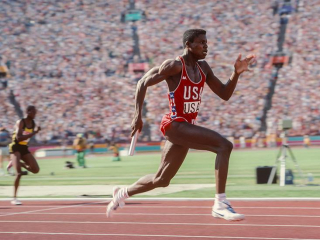
Keep going along this curve, and you get to the freaks among freaks—competitors who shatter records and push limits beyond imagination. When Carl Lewis dominated sprinting in the late 1980s, sub-10 second 100m times were rare, and anything in the 10-second flat range guaranteed a high finish, even at the Olympics. Lewis was a graceful 6 feet 2 inches, considered tall for a sprinter. Heights much greater than his were supposed to be a disadvantage for a sprinter, forcing a slower cadence and reduced speeds—at least that was the conventional wisdom.

So no one anticipated the coming of a Usain Bolt. At a muscular 6 feet 5 inches, and finishing almost half a second faster than the best of the previous generation, he seemed to come from another species entirely. His stride length can reach a remarkable 9.3 feet, and, in the words of a 2013 study in the European Journal of Physics, demonstrated performance that “is of physical interest since he can achieve, until now, accelerations and speeds that no other runner can.”

Bolt’s times weren’t just faster than anyone else in the world. They were considerably faster even than those of a world-class runner from the previous generation that was using performance-enhancing drugs.

More here.

The Most Intolerant Wins: The Dictatorship of the Small Minority

1-kB_cWkC195GVsgK-Kuym_Q

Nassim Nicholas Taleb in Medium:

The best example I know that gives insights into the functioning of a complex system is with the following situation. It suffices for an intransigent minority –a certain type of intransigent minorities –to reach a minutely small level, say three or four percent of the total population, for the entire population to have to submit to their preferences. Further, an optical illusion comes with the dominance of the minority: a naive observer would be under the impression that the choices and preferences are those of the majority. If it seems absurd, it is because our scientific intuitions aren’t calibrated for that (fughedabout scientific and academic intuitions and snap judgments; they don’t work and your standard intellectualization fails with complex systems, though not your grandmothers’ wisdom).

The main idea behind complex systems is that the ensemble behaves in way not predicted by the components. The interactions matter more than the nature of the units. Studying individual ants will never (one can safely say never for most such situations), never give us an idea on how the ant colony operates. For that, one needs to understand an ant colony as an ant colony, no less, no more, not a collection of ants. This is called an “emergent” property of the whole, by which parts and whole differ because what matters is the interactions between such parts. And interactions can obey very simple rules. The rule we discuss in this chapter is the minority rule.

The minority rule will show us how it all it takes is a small number of intolerant virtuous people with skin in the game, in the form of courage, for society to function properly.

More here.

Happy vs. high achieving: What ought to be our parenting objective?

Mihal Greener in Salon Books:

Pensive_girlHappiness was the last thing on my mind when the Netherlands welcomed me with a cocktail of jet lag and neck pain. The jet lag subsided, but my neck still hasn’t forgiven me for seven years of straining to make eye contact with the impossibly tall Dutch. As it turned out, it was hard to avoid reflecting on happiness in the Netherlands, especially when raising a family there. Dutch kids play without parents hovering, enjoy the fresh air while being transported around by bike and every Wednesday afternoon, when schools close early, parks are filled with Dutch dads hanging out with their kids on papadag — an unpaid, weekly “daddy day.” Combined with five weeks of paid annual leave and an expectation that families are home to eat dinner together, this seemed like bliss. Questions about the cost of this lifestyle only started a few years later when an expat father struck up a conversation at the local trampoline center. As we watched our children bounce, he readily shared his reasons for sending his children to an international school. At the top of his list was a belief that Dutch schools fail to instill ambition and don’t push students to achieve. The question of my young children’s ambition levels had, at that point, never crossed my mind. Yet his frustration with the Dutch system made me question if producing happy kids was at the expense of ambition and achievement. What do we actually mean when we say that we just want our children to be happy?

Can it be a coincidence that the countries with the happiest children are those where both social welfare and a desire for conformity are prevalent? If a more egalitarian society is what it takes to produce happy children, is it a trade-off we’re willing to make? Even Partanen admits that, “Many a Nordic citizen gazes at America with envy, wishing his or her uniqueness could be celebrated the way it would be in the United States.” Add to this the question of whether happy children grow up to become happy adults, and perhaps we should start to ask ourselves if the focus on happiness is the right measure for a life well lived.

More here.

The quiet radicalism of Years & Years

Alex Macpherson in New Huumanist:

Years-YearsThe gay icon in pop music is a curious phenomenon. It’s hard to pin down any underlying reasons for the bond between gay audiences and straight female divas without falling back on reductive clichés. And while the stereotype may well be supported by the empirical evidence at any Madonna or Beyoncé concert, it has often been used to dismiss entire genres of music based on the perceived shallowness of their fans (see also those other famed consumers of pop, teenage girls). But it’s nonetheless odd that such intense identification is largely reserved for those divas. The pop genre has rarely provided much in the way of out gay male pop stars – and even fewer whose music specifically reflects what it’s like to be gay and young. In recent years, there has been a place for the mature gay singer-songwriter, from George Michael to Will Young, but for all their talents, the middle-of-the-road respectability of their music isn’t going to capture any newly-out 20-year-old’s emotions. The latest iteration of this type is the bafflingly popular Sam Smith, a child of privilege whose ignorance of gay history seems to be matched by his disapproval of anything “overly” gay, from hook-up apps to using male pronouns in his love songs. There were always the Pet Shop Boys, of course. But as finely as Neil Tennant conveyed guilt, emotional nuance and power dynamics in songs such as “Rent” and “It’s a Sin”, his songwriting and vocal performances were defined by poise and self-possession. This air of detachment was often worn as armour and more brittle than I’d noticed at the time – but listening to them as a teenager always felt aspirational in a way that listening to Tori Amos or Madonna did not.

In my experience, the connection between a gay fan and a beloved artist is as complex and personal as any other, but a common thread is that air of indirectness. It’s no less real but it’s not about hearing our own experiences sung back to us so much as hearing the spirit of what we’re feeling. Often it’s a different experience entirely that is being sung about, although the occasional song, such as Taylor Swift’s “You Belong with Me”, sounds like it would make more sense with a gay protagonist than a female one. More often, the confessions lie not in the precise words but in the margins and subtext, in the intonation of a phrase or words left unspoken. (It is telling that making the connection to their gay audience too explicit is often a misstep for divas. Lady Gaga’s career has yet to recover from the patronising “Born This Way”, for example.) In retrospect, as a 14-year-old for whom secrecy was paramount, I found not having the exact words to hand, on some level, a relief.

More here.

Saturday, August 13, 2016

The Art of the Eulogy: On ‘Dead People’

1785353365.01.LZZZZZZZ

Nick Ripatrazone in The Millions:

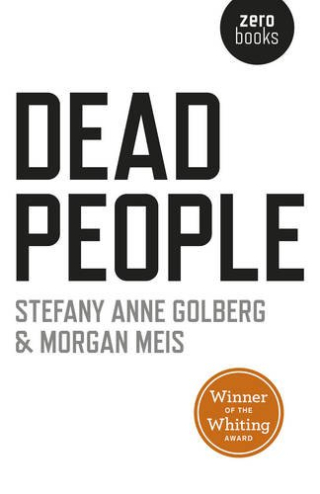
In their new book Dead People, Morgan Meis and Stefany Anne Golberg complicate our understanding of the public action of eulogy. They offer eulogies for a unique cast, includingChinua Achebe, Osama bin Laden, Susan Sontag, and Kurt Cobain. Although the origin of the word “eulogy” is “to speak well,” Golberg and Meis interrogate that idea, and instead see how the “death of a fellow human being can be the opportunity to enter into that person’s life.” The traditional Aristotelian method of eulogy is to step back and consider someone’s life from a distance. Instead, the authors of Dead People dig in: “We’ve chosen to wear our bias on our sleeve. We’ve chosen to take these lives personally.”

Golberg and Meis pen alternating eulogies, some of which were published previously as standalone essays. The result is a book that is very much an anthology. Dead People is not a single narrative, thesis-driven work of non-fiction. In fact, the writers’ introduction to the work is their only action of framing, which results in the book having many different entry points. You don’t need to read Dead People front to back; its value lies within its stylish and substantive reconsideration of an ancient form.

A few entries can example how Meis and Golberg use eulogies as part prose-poems, part historical reconsiderations, and part philosophical treatises. The result is an intellectually entertaining and flexible book. Meis first considers the life of Christopher Hitchens, and consistent with his plan for the book, interrogates the man for his unflinching support of the Iraq war: “Hitch could never say it. There was something greater at stake for him. There was something that he valued more deeply, in this case, than he valued the truth.” It’s a clever way to craft a portraiture of Hitchens, as a man whose morality could exist on some other plane.

More here.

The Philosopher and Her Kisses

Vitaactiva

Stephanie DeGooyer in the LA Review of Books:

A PHONE RINGS in Hannah Arendt’s home study. Her husband, the poet and philosopher Heinrich Blücher, answers. It’s William Shawn, Arendt’s editor at The New Yorker. Arendt signals that she is not home — her report on the Eichmann trial is overdue — and occupies herself at the typewriter. Blücher moves to the hallway where Arendt unexpectedly emerges to playfully chastise him for not kissing her goodbye. Blücher avers: “Never disturb a great philosopher when they are thinking.” Arendt, embracing him, replies, “but they cannot think without kisses.”

This is a scene from Hannah Arendt, the 2012 biopic from director Margarethe von Trotta and distributed by Zeitgeist Films about the political thinker’s personal life after the publication of Eichmann in Jerusalem, her notoriously misunderstood book about the trial of Adolf Eichmann. We watch as Arendt weathers the hostility over her phrase the “banality of evil,” which seemingly made Eichmann’s crimes unexceptional and implicated Jewish council leaders in the extermination of millions of Jews. The American novelist Mary McCarthy features prominently as Arendt’s witty and faithful friend, while Blücher sustains her with kisses and wise counsel. In one odd moment, Arendt appears to draw courage for her own public ostracism by reflecting on a prior conversation with Martin Heidegger about his Nazism. (Heidegger joined the Nazi party in 1933 and stayed a member until it was dismantled in 1945. The nature of his involvement with and the degree of his belief in the Nazi program remains a subject of controversy.)

Hannah Arendt makes academic life alluring, almost sexy. Richard Brody, in his review for The New Yorker, calls the film “soft-core philosophical porn.” Von Trotta, he says, “titillates the craving for the so-called intellectual life while actually offering little intellectual substance.” Indeed, Arendt’s immaculately stylized Riverside Drive apartment is arguably the star of the film, even though no academic today, much less a refugee such as Arendt, could even dream of such an address. But beyond the film’s window-dressed intellectualism is a more important ethical question about how the life of a philosopher, particularly a female philosopher, should be portrayed. In presenting Arendt as a philosopher who cannot think without kisses does von Trotta suggest that Hannah Arendt — the theorist and champion of active, public, political life — can only be viewed meaningfully in her private habitat? Are the thoughts of the female philosopher only as good as the kisses that interrupt and sustain them?

More here.

Cao Fei’s Fantastical Take on China’s Sociopolitical Climate

Copy-of-Cosplayers_A-Ming-at-Home_2004_C-print_75x100cm

Monica Uszerowicz in Hyperallergic:

In Italo Calvino’s novel Invisible Cities, Marco Polo regales Kublai Khan with tales of his travels, musing about the strange poetry of each city and their intersections with memory and selfhood. These cities, in actuality, are not quite real, and whether we are to suspend our disbelief is not clear. As Marco Polo would have it, it’s the space between fantasy and reality from which one gleans the most insight. Regarding the city of Penthesilea, he asks, “Outside of Penthesilea, does an outside exist? Or, no matter how far you go from the city, will you only pass from one limbo to another, never managing to leave it?”

The artist Cao Fei has cited Invisible Cities as a reference point for her short film, “La Town,” which surveys a mysterious city in the throes of post-apocalyptic destitution. La Town is an amalgamation of many places, with its German grocery store, bombed-out McDonalds, and supernatural creatures: a giant octopus appears to have made its way through a window; Santa’s reindeer lay prone on a set of train tracks. The city is built of tiny plastic toys and models, scuffed and bloodied until they lose the inherent charm of being miniature. Two invisible narrators argue back and forth — in French — about the reality of experience, recalling the dialogue between the protagonists of the Alain Resnais 1959 film, Hiroshima Mon Amour, whose memories may or may not be founded in truth. “The illusion, quite simply, is so, so perfect,” says a woman’s voice in Cao’s film. “You saw nothing in La Town,” a man’s voice replies. “Nothing.”

In viewing Cao’s first stateside museum retrospective at MOMA PS1, I found myself continually returning to “La Town.” Its decisive fiction feels allusive of the aftershocks of rapid globalization or, maybe, the singularity. Cao is 37, and the show acts as a chronological timeline of her career, leading visitors from the experimental work of her time at the Guangzhou Art Academy to her recent video, “Rumba II: Nomad,” in which Roomba vacuum cleaners, unleashed at the site of demolished buildings, explore and absorb the urban sprawl like alien creatures.

More here.

‘Hot’ Sex & Young Girls

Heller_2-081816

Zoë Heller reviews Nancy Jo Sales's American Girls: Social Media and the Secret Lives of Teenagers and Peggy Orenstein's Girls and Sex: Navigating the Complicated New Landscape in the NYRB:

History has taught us to be wary of middle-aged people complaining about the mores of the young. The parents of every era tend to be appalled by the sexual manners of their children (regardless of how hectic and disorderly their own sex lives once were, or still are). There were some in the 1950s who were pretty sure that the decadent new practice of “going steady” augured moral disaster. Both Sales and Orenstein have undoubtedly grim and arresting information to impart about the lives of American girls. And neither of them can be dismissed as a sexual puritan. (They are not troubled about teenagers leading active sex lives, they assure us, only about the severely limited forms in which female sexuality is currently allowed to express itself; they are not even against casual sex per se, just eager to ensure that there should be, as Orenstein puts it, “reciprocity, respect, and agency regardless of the context of a sexual encounter.”) Even so, neither of their books entirely avoids the exaggerations, the simplifications, the whiff of manufactured crisis that we have come to associate with this genre.

Both writers make rather invidious comparisons between the frenzied, romance-free social lives of today’s young women and their own halcyon youths. Sales recalls walking back from school with her ninth-grade boyfriend to do homework together at her house. “The point of being together was not to have sex, necessarily. It was to become intimate,” she writes. Orenstein observes that her college experience was not about binge-drinking and hook-ups, but “late-night talks with friends, exposure to alternative music and film, finding my passions, falling in love.”

To use these sun-dappled recollections of life before the iPhone as a way of pointing up the misery of girls’ present conditions is a little misleading. To be sure, certain kinds of sexism have been amplified—or perhaps transmitted more efficiently—in the Internet era, and girls are now under pressure to present themselves as pliable sexual creatures at a much earlier age than they have been in the past. But even in the far-off 1970s and 1980s, young women experienced their share of exploitation, abuse, and unsatisfactory sex.

More here.

‘KNOWN AND STRANGE THINGS’ By Teju Cole

14RANKINE-blog427Claudia Rankine at The New York Times:

Teju Cole’s captivating and lauded novels, “Open City” and “Every Day Is for the Thief,” reflect his identity as a writer with a global perspective — born in the United States and raised in Nigeria. His international access as an author, art historian and photographer — one who also teaches and is a photography critic for The New York Times Magazine — shapes not only his obsessions but, in a chicken-and-egg sense, determines his gaze. He takes in news from African countries and American cities; but also, by necessity and interest, Asian, European and Latin American culture and history. In short, the world belongs to Cole and is thornily and gloriously allied with his curiosity and his personhood. “Known and Strange Things,” his first collection of nonfiction, journeys through all the landscapes he has access to: international, personal, cultural, technological and emotional. When he feels homesick, he informs us in this book, he “visits” his parents in Nigeria through Google maps — a sweet if distant form of connection.

In “The Anxiety of Influence,” the renowned critic Harold Bloom argued that poets, especially those in the Western tradition since the Renaissance, necessarily negotiate the work of their predecessors as they write. “The precursors flood us,” Bloom wrote, “and our imaginations can die by drowning in them, but no imaginative life is possible if such inundation is wholly evaded.” Cole shares Bloom’s interest in the fraught and burdened relationship writers and artists have to our ancestors, and he seeks to answer yet another question: How does the imagination cross and recross racial and filial boundaries, and what does this crossing mean?

more here.