‘Politics Ain’t the Same’ — How the 19th Amendment Changed American Elections

Lynn Sherr in Bill Moyers Blog:
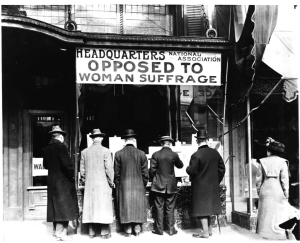
GettyImages-640460473-1024x831My mother was born in the United States of America without the right to vote. I just stopped to re-read that sentence because it seems so, you know, quaint. Okay, preposterous. By the time she neared voting age in 1920, the 19th Amendment to the Constitution was ratified, prohibiting federal and state governments from denying citizens the right to vote “on account of sex.” For the next seven decades, Mother didn’t miss an election. As a child, I remember watching her dress for the occasion: girdle and stockings, dress and heels, hat and gloves, because like many first-generation Americans who’d endured two World Wars, she considered voting a formal affair, a sacred privilege — and duty — defined by her citizenship. That’s my ritual, too (without the body armor), which is why this Friday, Aug. 26 — the 96th anniversary of the day American women got the vote — I’ll offer my annual thanks to the women and men who made it happen. Their exhausting slog over more than half a century was, as noted by the leader of the final surge, Carrie Chapman Catt, agonizing: “480 campaigns to urge legislatures to submit suffrage amendments to voters; 47 campaigns to induce state constitutional conventions to write woman suffrage into state constitutions; 277 campaigns to persuade state party conventions to include woman suffrage planks; 30 campaigns to urge presidential party conventions to adopt woman suffrage planks in party platforms, and 19 campaigns with 19 successive Congresses.” Not to mention countless insults, inanities and hurled rotten eggs. But the result changed the dynamic, opening the electoral process to more individuals than ever before in American history. And with Hillary Clinton now tying her historic candidacy to the legacy of our foremothers, it’s useful to recall its unique place in our often grudgingly shared democracy.

Early suffrage leaders understood their goal as a natural right of citizenship, right up there with life, liberty and the pursuit of happiness. Elizabeth Cady Stanton, who rewrote the Declaration of Independence along feminist lines for the 1848 Seneca Falls women’s rights convention, bemoaned the “degradation of disfranchisement.” But when men didn’t share on the simple grounds of equality, some women resorted to a higher calling — moral superiority — slyly predicting that female reformers would elevate and cleanse the corrupt political world; that everything from the drunken rowdiness on election day to the character of candidates would be purified. According to Susan B. Anthony, woman suffrage would “compel both political parties to nominate candidates of the highest character. A woman would no more vote for a low-down man than a good man for a degraded woman.”

Yeah, well.

More here.

Busting the billion-dollar myth: how to slash the cost of drug development

Amy Maxmen in Nature:

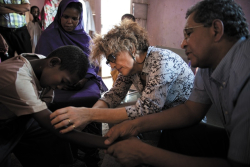
Nathalie-Strub---DSC_1787---copyright-Neil-Brandvold-DNDi_CM2First, there was the pitching and rolling in an old Jeep for eight hours. Next came the river crossing in a slender canoe. When Nathalie Strub Wourgaft finally reached her destination, a clinic in the heart of the Democratic Republic of the Congo, she was exhausted. But the real work, she discovered, had just begun. It was July 2010 and the clinic was soon to launch trials of a treatment for sleeping sickness, a deadly tropical disease. Yet it was woefully unprepared. Refrigerators, computers, generators and fuel would all have to be shipped in. Local health workers would have to be trained to collect data using unfamiliar instruments. And contingency plans would be needed in case armed conflict scattered study participants — a very real possibility in this war-weary region. This was a far cry from Wourgaft's former life as a top executive in the pharmaceutical industry, where the hospitals that she commissioned for trials were pristine, well-resourced and easy to reach. But Wourgaft, now medical director for the innovative Drugs for Neglected Diseases initiative (DNDi), was confident that the clinic could handle the work. She was right. With data from this site and others, the DNDi will next year seek approval for a sleeping-sickness tablet, fexinidazole. It would be a massive improvement on existing treatment options: an arduous regimen of intravenous injections, or a 65-year-old arsenic-based drug that can be deadly.

The DNDi is an unlikely success story in the expensive, challenging field of drug development. In just over a decade, the group has earned approval for six treatments, tackling sleeping sickness, malaria, Chagas' disease and a form of leishmaniasis called kala-azar. And it has put another 26 drugs into development. It has done this with US$290 million — about one-quarter of what a typical pharmaceutical company would spend to develop just one drug. The model for its success is the product development partnership (PDP), a style of non-profit organization that became popular in the early 2000s. PDPs keep costs down through collaboration — with universities, governments and the pharmaceutical industry. And because the diseases they target typically affect the world's poorest people, and so are neglected by for-profit companies, the DNDi and groups like it face little competitive pressure. They also have lower hurdles to prove that their drugs vastly improve lives. Now, policymakers are beginning to wonder whether their methods might work more broadly. “For a long time, people thought about R&D as so complicated that it could only be done by the biggest for-profit firms in the world,” says Suerie Moon, a global-health researcher at the Harvard T.H. Chan School of Public Health in Cambridge, Massachusetts, who studied PDPs and joined the DNDi's board of directors in 2011. “I think we are at a point today where we can begin to take lessons from their experience and begin to apply to them non-neglected disease,” she says.

More here.

Tuesday, August 23, 2016

JOHN FREEMAN IN CONVERSATION WITH NOBEL LAUREATE SVETLANA ALEXIEVICH

John Freeman in Literary Hub:

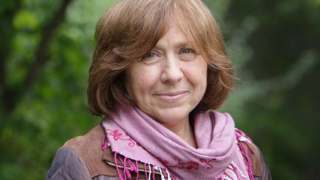
Maxresdefault-1240x698For the past 30 years, Svetlana Alexievich has been writing one long book about the effect of communism and its demise on people in the former Soviet Bloc. Based on interviews, her books conjure a chorus of voices that rise and fall and arrange themselves into symphonic narratives: Here are the voices of Russians scarred by the meltdown of Chernobyl (Voices from Chernobyl), angered by the shame of Afghan War (Zinky Boys), and now, with Secondhand Time, bewildered by the collapse of communism and assumption they should all be capitalists now.

Alexievich was in some ways born into this task. Both of her parents were teachers and her father once studied journalism himself. At university, Alexievich was exposed to the work of Belarusian writer, Ales Adomovich, who believed the 20th century was so horrific it needed no elaboration.

Unlike Studs Terkel, whose oral histories of American life arrange themselves like transcribed radio interviews, Alexievich’s books are strange creations. They never ask the reader to think to imagine their subjects are representative individuals. When she won the Nobel in 2015, Alexievich described them as novels—which is a fair comparison given the meticulous arrangement required to create such clear and evocative pastiche. Whatever they are, her books are as eerie and beautiful as overheard voices on a crowded train car traveling through the night.

More here.

Human Cells Make Up Only Half Our Bodies and a New Book Explains Why

Jonathan Weiner in the New York Times:

21Weiner-master315Reader, as you read these words, trillions of microbes and quadrillions of viruses are multiplying on your face, your hands and down there in the darkness of your gut. With every breath you take, with every move you make, you are sending bacteria into the air at the rate of about 37 million per hour — your invisible aura, your personal microbial cloud. With every gram of food you eat, you swallow about a million microbes more.

According to the latest estimates, about half of your cells are not human — enough to make you wonder what you mean by “you.” Your human cells come from a single fertilized egg with DNA from your mother and father. Microbes began mingling with those human cells even before your first breath, the first kiss from your mother, your first taste of milk. And your human cells could not have built a healthy body without intimate help from all those trillions of immigrant microbes — your other half.

“I am large, I contain multitudes,” Walt Whitman declares in “Leaves of Grass,” in his great poem “Song of Myself.” But what is “self”? According to conventional wisdom, your immune system is supposed to protect you by detecting and rejecting anything in your body that is not “self.” And yet your very immune system is partly built and even partly run by microbes. “Even when we are alone, we are never alone,” Ed Yong writes in his excellent and vivid introduction to our microbiota, or microbiome, the all-enveloping realm of our microbes. “When we eat, so do they. When we travel, they come along. When we die, they consume us.”

More here.

Liberal Islam is not the answer to Islamic State

Zaheer Kazmi in Prospect:

ScreenHunter_2163 Aug. 23 16.24It is commonplace to argue that the problem of Islamist terrorism and extremism would be solved if only Islam reformed itself and became more liberal. But is that right—or even possible?

From religious leaders to former extremists and western governments, a consensus has emerged since 9/11 that stresses the compatibility between Islam and the liberal values of civility, freedom and tolerance, as opposed to terrorist groups such as Islamic State (IS). Yet in many ways Islamist militancy and Islamic liberalism—though seemingly opposed—are two sides of the same reformist coin. They are both engaged in ideological projects for an Islamic revival in a time of western ascendancy. And they are equally plagued with the problems encountered by movements that rest their legitimacy on claims to a unique and timeless authenticity.

Muslim liberals tend to prescribe modern answers to postmodern questions. Their focus on reviving supposedly representative forms of religious authority show them to be ill at ease with the ways in which Islam has become increasingly atomised in a fragmented world. Their intellectual antecedents are the 19th-century modernist movements such as the al-Nahda or cultural “awakening” in the Arab world and the Aligarh movement in British India. They cling to these modes of reform grounded in synthesising Islam with western notions of progress. Post-9/11 calls from western governments and civil society for Muslims to counter the extremism in their midst have reactivated these agendas.

Four problems in particular blight attempts at Islamic liberal reform—none of which have anything to do with duplicity or conspiracy, as Islamophobes allege.

More here.

Anand Giridharadas: A letter to all who have lost in this era

From the TED website:

Summer, 2016: amid populist revolts, clashing resentments and fear, writer Anand Giridharadas doesn't give a talk but reads a letter. It's from those who have won in this era of change, to those who have, or feel, lost. It confesses to ignoring pain until it became anger. It chides an idealistic yet remote elite for its behind-closed-doors world-saving and airy, self-serving futurism — for at times worrying more about sending people to Mars than helping them on Earth. And it rejects the exclusionary dogmas to which we cling, calling us instead to “dare to commit to the dream of each other.”

How photography came to capture the world that we want to see

Kodak_6031470_35mm_Color_Plus_200_123787Claire Lehmann at Triple Canopy:

On a warm spring evening in early May, 1950, Edward Steichen, the director of the Department of Photography at the Museum of Modern Art in New York, opened an exhibition touted as a milestone event: the museum’s first exhibition devoted solely to color photography—titled, authoritatively, “Color Photography.” It featured an extravagant profusion of photographs drawn from science, journalism, and commerce: a microscope picture of an amoeba; an aerial photo taken from a rocket launched over the White Sands missile facility in New Mexico; Life’s images of exploding atomic bombs and the first published color photo of Mars; tear-sheets from the pages of Vogue, Fortune,Ladies’ Home Journal, and other popular magazines. The varied list of photographers included Roman Vishniac, Paul Outerbridge, Eliot Porter, Weegee, Irving Penn, Richard Avedon, Louise Dahl-Wolfe, Horst P. Horst, and Steichen himself.

The abundance of imagery on display served Steichen’s curatorial aim: to probe whether this technology could be a “new” and “creative” medium for the artist, and not just a “means of supplementing or elaborating the recognized attainments of black and white photography.” Chronologically, the show’s earliest works were printed reproductions of Autochromes, the colored-starch glass plates patented by the Lumière Brothers in 1904, marking that invention as the inauguration of modern color photography. But chronology didn’t guide the exhibition: the physical layout was determined by image source (e.g., the military, the magazine) and display needs of various media, particularly the many color transparencies, which had to be lit from behind in darkened rooms.

more here.

In defense of Rudyard Kipling

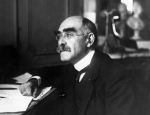
Martyris-RudyardKipling-1200Michael Dirda at The Washington Post:

Earlier this summer I was on a panel at a literary conference where I happened to say that Rudyard Kipling was a wonderful writer. Immediately, a number of people in the audience began to boo and hiss. Two of my fellow panelists nearly shrieked that Kip­ling was utterly beyond the pale, being at once racist, misogynist and imperialist. Not entirely surprised by this reaction, but nonetheless flabbergasted by its vehemence, I made a flustered attempt to champion the author of “Plain Tales From the Hills,” “The Jungle Books” and “Kim.” I declared what many believe, that he is the greatest short-story writer in English. This only made things worse. Finally, with some desperation I blurted out: “How much Kipling have you actually read?”

A short silence followed, and, without any answer to my question, the discussion moved on to other, less heated topics. But I felt significantly downcast. So when I got home I sat down and reread“The Jungle Books,” recently reprinted by Penguin because of a new film about Mowgli, the “Man-cub” reared by wolves. I also dipped into a number of biographies and critical works, visited the website of the Kipling Society and tried to clarify my own thoughts about, arguably, the most controversial author in English literature.

more here.

the music of ‘Tailleferre’

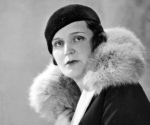
Leportrait-300x250Michael Johnson at Open Letters Monthly:

Tailleferre struggled to be considered asexual in musical terms, asking to be called simply “a composer,” not a “woman composer.” Even today her granddaughter Elvie de Rudder, still teaching music in a Paris lycée, bristles at those who refer to her as “Germaine.” Nobody calls Milhaud “Darius” or Poulenc “Francis,” she says. “So just call her ‘Tailleferre’.” Easy first-name usage can connote condescension, especially in protocol-sensitive France.

With hindsight, we can conclude that Tailleferre was cheated out of her rightful place in the legacy of Les Six. The other more prominent members – Poulenc, Milhaud and Arthur Honegger – are routinely credited as originators of a modern French School of composing. No less an authority on contemporary music as the late Joseph Machlis maintained in his book Introduction to Contemporary Music that Tailleferre and another member of the group, Louis Durey, “dropped from sight” after a brush with fame in the 1920s. Not true. They continued making an impact of their own choosing and at their own pace.

Tailleferre’s natural modesty didn’t help her career. She undervalued herself in part because of the patriarchal culture of early 20th century Europe. Playing her submissive role to the hilt, she told an interviewer she had no grand pretensions about her oeuvre. “It’s not great music, I know, but it’s gay, light hearted music which is sometimes compared with that of the ‘petits maîtres’ of the 18th century. And that makes me very proud.’’ She added, “I write music because it amuses me.” You can almost hear her tiny voice apologizing for what she has done.

more here.

Anglosplaining: why Germans like learning about their past from Anglo‑Saxons

Andreas Kluth in The Economist:

German-history-webMany Germans have been glued to a television series, “Where We Come From”, that explains Germany’s long, complicated and often tragic history. The “we” in the title, however, is deceptive, for the host and narrator is Sir Christopher Clark, an Australian historian knighted for his services to Anglo-German relations. His academic credentials are excellent. His book on Prussia, “Iron Kingdom”, may be the best on the subject. His tome on the first world war, “The Sleepwalkers”, became a bestseller. But Germany has plenty of its own historians. Why Clark?

The answer starts with the dappled bow tie he wears as he drives around Germany in a red cabriolet vw Beetle: the quintessential Brit (Aussies are close enough) in the quintessential German vehicle. Then there’s the language. Clark speaks grammatically flawless German, but with enough of an English cadence to sound cheeky, witty and incisive. Occasionally he uses humour, which can still be shocking on German public television. Sometimes he even says nice things about the country’s past, which to Germans is truly shocking. He does not seem full of himself. To Germans that is refreshing. German Anglophiles consider such attributes “Anglo-Saxon”. The term is stretchable in this context and includes anybody English-speaking, whether Celtic or Saxon, pale or brown, from down under or beyond the pond. Clark is not an isolated case. The late Gordon Craig, a Scottish-American historian, achieved similar success. So has Timothy Garton Ash, a historian at Oxford and Stanford, who wows Germans with pithy insights delivered in sophisticated German.

More here.

The Known: Cancer Is Really, Really Old. The Unknown: How Common It Was

George Johnson in The New York Times:

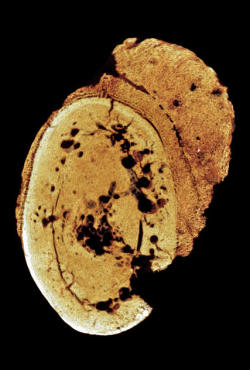
BoneCarcinogens abounded 1.7 million years ago in Early Pleistocene times when a nameless protohuman wandered the South African countryside in what came to be known as the Cradle of Humankind. Then, as now, ultraviolet radiation poured from the sun, and radon seeped from granite in the ground. Viruses like ones circulating today scrambled DNA. And there were the body’s own carcinogens, hormones that switch on at certain times of life, accelerating the multiplication of cells and increasing the likelihood of mutations.

That, rather than some external poison, was probably the cause of a bone tumor diagnosed as an osteosarcoma found fossilized in Swartkrans Cave, a paleoanthropological trove northwest of Johannesburg. A paper in the current South African Journal of Science describes the discovery, concluding that it is the oldest known case of cancer in an early human ancestor. “The expression of malignant osteosarcoma,” the authors wrote, “indicates that whilst the upsurge in malignancy incidence is correlated with modern lifestyles, there is no reason to suspect that primary bone tumours would have been any less frequent in ancient specimens.” Perhaps the main reason there is more cancer today is that people live much longer, leaving more time for dividing cells to accumulate genetic mistakes. Osteosarcoma, however, occurs most frequently in younger people, as their limbs undergo adolescent spurts of growth. That and the fact that bones outlast softer organs make osteosarcoma a natural cancer to look for among early hominins, the zoological tribe that includes humans and their extinct kin.

More here.

Monday, August 22, 2016

Current Genres of Fate: The New Immortal

by Paul North

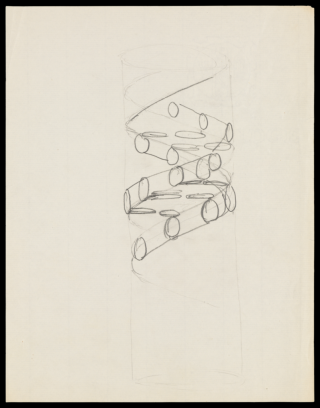
Sketch of the DNA Double Helix by Francis Crick

Sketch of the DNA Double Helix by Francis Crick

Natural science is as valuable as its expression. What does this mean? An analogy with the economy will help. When we work, our working has to produce benefits for us beyond just the work itself. Those benefits can be called the expression of the work. Mostly they take the form of money—but not always. Natural science is similar. To be valuable it has to express itself in other forms, just as work does.

Even where natural science gives us a big new truth, like the theory of relativity in physics or the theory of evolution in biology, this truth—which may be compelling and very simple to grasp, or very complex and difficult and require some convincing before we believe in it—its truth is not its expression. Truth is one thing, expression another. Natural science has all sorts of expressions. We tend to think of it as a closed club with secret goings on in hidden chambers. Nevertheless, it periodically sends out bulletins that concern us all. This is part of what I mean by “expression.” Natural science—physics, biology, chemistry, both the theoretical and the empirical kinds—sends out messages about life and history to a very large audience.

Natural science has many expressions. To be sure, its earliest and most secretive expression is the technical papers shared among scientists, which journalists misquote and the NSF decodes for the purposes of giving grants. But of course these technical documents are only as good, as useful, as praised and as prized—ultimately—as their capacity for wider expression. They should produce conferences and volumes. They should change the practices of other scientists and they should eventually change the goals of science, by a little or a lot. Such expressions remain within the non-public confines of scientific circuits however. Science has its own internal public, but intellectual sectors like natural science always aim at a greater public. This does not mean that science follows fads and fashions. Quite the contrary: it exists to remake the popular sphere in its own image, just as art does, or entertainment, or the military or other kinds of politics. So what are the greater effects of natural science? What are its widest expressions?

Read more »

Sunday, August 21, 2016

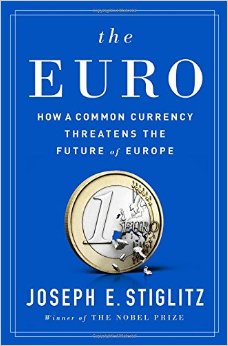
Nobel Laureate Joseph Stiglitz Says the Euro Needs Big Reform

Roger Lowenstein in the New York Times Book Review:

51vO7MbFwrL._SY344_BO1,204,203,200_The nasty headlines from across the Atlantic — Brexit, terrorism, debt crises — almost make us forget that these were supposed to be Europe’s salad days. With a common currency and increasing integration, Europe was, finally, bidding adieu to cross-border conflict and economic crisis. Turmoil and strife were so very 20th century; the future was to be only digital apps and polyglot cafes.

Well, they still have Chartres, and they still have Goethe. They also have millions of migrants, rising nationalism, recurrent recessions and plummeting birthrates. What went wrong?

Joseph E. Stiglitz, the former chief economist of the World Bank and winner of the Nobel in economic science, proposes a simple answer. In “The Euro: How a Common Currency Threatens the Future of Europe,” he argues that the chief source of Europe’s malaise is its 17-year-old currency experiment. “While there are many factors contributing to Europe’s travails,” he writes, “there is one underlying mistake: the creation of the single currency, the euro.”

Stiglitz is not speaking about the obvious fact that 19 independent states use a common currency, but about their failure so far to create the quilt of institutions and shared regulations to make it work. This sounds wonky, and though Stiglitz spews plenty of populist rhetoric, “The Euro” is thick with dense paragraphs (imagine an economics text written by Michael Moore). Still, the underlying idea is ­simple.

More here.

This woman may know a secret to saving the brain’s synapses

Emily Underwood in Science:

ScreenHunter_2160 Aug. 21 23.46In 2010, neurobiologist Beth Stevens had completed a remarkable rise from laboratory technician to star researcher. Then 40, she was in her second year as a principal investigator at Boston Children’s Hospital with a joint faculty position at Harvard Medical School. She had a sleek, newly built lab and a team of eager postdoctoral investigators. Her credentials were impeccable, with high-profile collaborators and her name on an impressive number of papers in well-respected journals.

But like many young researchers, Stevens feared she was on the brink of scientific failure. Rather than choosing a small, manageable project, she had set her sights on tackling an ambitious, unifying hypothesis linking the brain and the immune system to explain both normal brain development and disease. Although the preliminary data she’d gathered as a postdoc at Stanford University in Palo Alto, California, were promising, their implications were still murky. “I thought, ‘What if my model is just a model, and I let all these people down?’” she says.

Stevens, along with her mentor at Stanford, Ben Barres, had proposed that brain cells called microglia prune neuronal connections during embryonic and later development in response to a signal from a branch of the immune system known as the classical complement pathway. If a glitch in the complement system causes microglia to prune too many or too few connections, called synapses, they’d hypothesized, it could lead to both developmental and degenerative disorders.

Since then, finding after finding has shored up and extended this picture.

More here.

‘X’ Marks the Spot Where Inequality Took Root

Stan Sorscher at the website of the Economic Opportunity Institute:

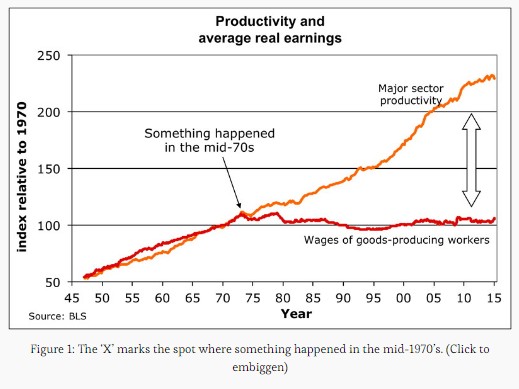
In 2002, I heard an economist characterizing this figure as containing a valuable economic insight. He wasn’t sure what the insight was. I have my own answer.

The economist talked of the figure as a sort of treasure map, which would lead us to the insight. “X” marks the spot. Dig here.

The graphic below tells three stories.

First, we see two distinct historic periods since World War II. In the first period, workers shared the gains from productivity. In the later period, a generation of workers gained little, even as productivity continued to rise.

ScreenHunter_2159 Aug. 21 23.29

The second message is the very abrupt transition from the post-war historic period to the current one. Something happened in the mid-70’s to de-couple wages from productivity gains.

The third message is that workers’ wages – accounting for inflation and all the lower prices from cheap imported goods – would be double what they are now, if workers still took their share of gains in productivity.

More here. [Thanks to Jim Culleny.]

The Week Democracy Died

Yascha Mounk in Slate:

ScreenHunter_2158 Aug. 21 23.22There are years, decades even, in which history slows to a crawl. Then there are weeks that are so eventful that they seem to mark the dissolution of a world order that had once seemed solid and to foretell the rise of one as yet unknowable.

The week of July 11, 2016, has every chance of being remembered as one of those rare flurries of jumbled, inchoate, concentrated significance. The centrifugal forces that are threatening to break political systems across the world may have started to register a decade ago; they may have picked up speed over the last 12 months; but never since the fall of the Berlin Wall have they wreaked havoc in so many places in so short a span of time—showcasing the failures of technocratic rule, the terrifying rise of populist strongmen, and the existential threat posed by Islamist terrorism, all in the span of seven short days.

At first glance, a political crisis in London; a terrorist attack in Nice, France; a failed putsch in Ankara, Turkey; and a bloviating orator on his way to becoming the Republican nominee for the presidency of the United States look like the dramatic apex of very different, barely connected screenplays. To my eye, they are garish panes of glass that add up to one unified, striking mosaic. Looked at from the right distance, they tell the story of a political system, liberal democracy, that has long dominated the world—and is now in the midst of an epic struggle for its own survival.

More here.