Ostend: Stefan Zweig, Joseph Roth, and the Summer Before the Dark

Prochnick-1George Prochnik at Jewish Review of Books:

The Belgian resort town of Ostend began serving up a beguiling mix of social pageantry and dreamy ocean reveries to cosmopolitan vacationers early in the 19thcentury. Elegant hotels and cafés sprang up to accommodate the many thousands of visitors who traveled there each year, primarily from Germany and other landlocked nations of Europe’s interior. Horse racing, casino gambling, splendid displays of fashion on the promenade, and a busy schedule of colorful festivals heightened the resort’s appeal. The sea itself gained renown for its mesmerizing luminosity, which some attributed to the presence of innumerable mollusks.

In 1902, when the Viennese author Stefan Zweig was only 21 years old, he wrote one of his first travel pieces about “the season” at Ostend. This affectionate caricature observes that while people typically visit watering places for “harmonious relaxation in the calm contemplation of nature,” Ostend’s clientele was different. Rather than an opportunity to switch off, its visitors sought “another shining link in the endless chain of society’s distractions.” The city had become

the unofficial rendezvous-location for the real and bogus aristocracy that one sees floating like a spume above the waves of capitals, everywhere encountering and recognizing itself, and for whom a home-town is merely a station in transit.

At season’s end, the town was returned to the fishermen and fell into a deep slumber until the “unique, unforgettable game of human fallibility, passions and distractions” began again.

more here.

Friday Poem

The Seventh

If you set out in this world,
better be born seven times.
Once, in a house on fire,
once, in a freezing flood,
once, in a wild madhouse,
once, in a field of ripe wheat,
once, in an empty cloister,
and once among pigs in sty.
Six babes crying, not enough:
you yourself must be the seventh.

When you must fight to survive,
let your enemy see seven.
One, away from work on Sunday,
one, starting his work on Monday,
one, who teaches without payment,
one, who learned to swim by drowning,
one, who is the seed of a forest,
and one, whom wild forefathers protect,
but all their tricks are not enough:
you yourself must be the seventh.

If you want to find a woman,
let seven men go for her.
One, who gives heart for words,
one, who takes care of himself,
one, who claims to be a dreamer,
one, who through her skirt can feel her,
one, who knows the hooks and snaps,
one, who steps upon her scarf:
let them buzz like flies around her.
You yourself must be the seventh.

If you write and can afford it,
let seven men write your poem.
One, who builds a marble village,
one, who was born in his sleep,
one, who charts the sky and knows it,
one, whom words call by his name,
one, who perfected his soul,
one, who dissects living rats.
Two are brave and four are wise;
You yourself must be the seventh.

And if all went as was written,
you will die for seven men.
One, who is rocked and suckled,
one, who grabs a hard young breast,
one, who throws down empty dishes,
one, who helps the poor win;
one, who worked till he goes to pieces,
one, who just stares at the moon.
The world will be your tombstone:
you yourself must be the seventh.
.

by Attila József
from Winter Night: Selected Poems of Attila József
translated from the Hungarian by John Bátki

Oberlin College Press, 1997
.

Physics Confronts Its Heart of Darkness

Lee Billings in Scientific American:

DarkPhysics has missed a long-scheduled appointment with its future—again. The latest, most sensitive searches for the particles thought to make up dark matter—the invisible stuff that may comprise 85 percent of the mass in the cosmos—have found nothing. Called WIMPs (weakly interacting massive particles), these subatomic shrinking violets may simply be better at hiding than physicists thought when they first predicted them more than 30 years ago. Alternatively, they may not exist, which would mean that something is woefully amiss in the underpinnings of how we try to make sense of the universe. Many scientists still hold out hope that upgraded versions of the experiments looking for WIMPs will find them but others are taking a second look at conceptions of dark matter long deemed unlikely.

Whatever dark matter is, it is not accounted for in the Standard Model of particle physics, a thoroughly-tested “theory of almost everything” forged in the 1970s that explains all known particles and all known forces other than gravity. Find the identity of dark matter and you illuminate a new path forward to a deeper understanding of the universe—at least, that is what physicists hope. WIMPs would get their gravitational heft from being somewhere between one and a thousand times the mass of a proton. Their sole remaining connection to our familiar world would be through the weak nuclear force, which is stronger than gravity but only active across tiny distances on the scale of atomic nuclei. If they exist, WIMPs should surround us like an invisible fog, their chances of interacting with ordinary matter so remote that one could pass through light-years of elemental lead unscathed.

More here.

Former BBC head Mark Thompson on Trump, Orwell and what’s gone wrong with political language

Jonathan Green in The Telegraph:

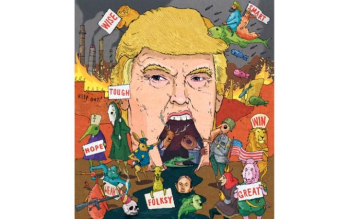
TrumpAuthenticism is not a synonym for authentic. Quite the opposite. It is first cousin to another weaselly coinage: truthiness, which is not “truth” as most people conceive it but belief that stems from gut instinct, from “common sense”; ideas that irrespective of evidence, logic or analysis, “just feel right”. It is the equivalent of popular etymology, the staunchly held belief that the f-word, for instance, comes from “Fornicate Under Command of the King”. It is fuelled by rumour and populist fantasy, usually with a partisan subtext: President Obama is a Muslim, Europe takes £350 million of our NHS cash per week. It is the lingua franca of a “post-factual” society, and the go-to position, claims Thompson, for our unappetising political conversation. Thompson, a fully qualified member of the liberal wing of the Great and Good, was ranked the world’s 65th most powerful person by Forbes magazine. He enjoyed a starry career at the BBC, topped out with eight sometimes contentious years as director-general; he has run Channel 4, and is now chief executive of The New York Times. The experience gleaned from his media career informs this, his first book, but the inspiration for its writing came from a more arcane post: as Oxford’s first Humanitas Visiting Professor in Rhetoric and the Art of Public Persuasion.

In Enough Said, Thompson considers the current state of political language and its effect, far from positive, on our world. He is not optimistic. Like a hellfire preacher, he thunders his jeremiad: “Intolerance and illiberalism are on the rise almost everywhere. Lies go unchecked. Free speech is denied and state repression is returning… In the Middle East and Africa, and in the streets and suburbs of European cities, the murderous idiocy of religiously inspired nihilism can prove more persuasive than the milk-toast promises of secular democracy. We hear politicians talk. Children drown, starve, are blown to smithereens. The politicians go on talking. At home, boundaries – of political responsibility, mutual respect, basic civility… are broken by the week. Often it feels as if there’s a nihilistic spirit at work here, too, a politics with no positive agenda of its own which seeks only to divide.” At the heart lies a degenerate public language that serves to “boost the immediate impact of political language at the price of depth and comprehensibility”.

More here.

Thursday, September 1, 2016

How does Mohammed Hanif make sense of the turbulence and chaos in Pakistan?

Mushtaq Bilal in News Laundry:

Mushtaq Bilal (MB): You work as a journalist, a job that involves a lot of writing, and you have written plays for both the stage and the screen. Why did you feel the need to shift to fiction?

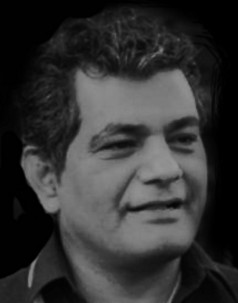
ScreenHunter_2186 Sep. 01 23.33Mohammed Hanif (MH): I was always interested in telling stories and so I tried various formats. All these things, including journalism, the stage, and the film, are collaborative in nature. You have to work with other people. And that is great if it works well. There is no better feeling than having your own little theatre play being performed. And that is great if it works well. There is no better feeling than having your own little theatre play being performed. But when it doesn’t work, it is quite heartbreaking and everybody starts to accuse each other. The director says the actors did not perform well; the actors say their lines were not well written. What drew me into fiction writing was that you were on your own completely and you would do it all by yourself. Whether it is good or bad, it is solely yours and it doesn’t require any budget or investment either. All you need is some paper and a ball pen and you are good anywhere. I think this was the reason.

More here.

US physicists just revealed plans to build the most viable nuclear fusion devices ever

From Science Alert:

ScreenHunter_2185 Sep. 01 23.22While nuclear fission requires things to be heated to just a few hundred degrees Celsius, nuclear fusion machines have to recreate conditions on the Sun, so we’re talking several million degrees here.

And because nuclear fusion machines are basically starting their reactions from scratch, we first need to achieve temperatures far hotter than those estimated to exist in the centre of the Sun – at least 100 million degrees Celsius.

So far, the closest anyone’s gotten to the dream of limitless energy is a team of physicists at the Wendelstein 7-X stellarator in Greifswald, Germany, and researchers at China's Experimental Advanced Superconducting Tokamak (EAST) – both of which have been trying to hold onto the super-heated plasma that results from the fusion reaction.

“During the process of nuclear fusion, atoms' electrons are separated from their nuclei, thereby creating a super-hot cloud of electrons and ions (the nuclei minus their electrons) known as plasma,” Daniel Oberhaus explains for Motherboard.

“The problem with this energy-rich plasma is figuring out how to contain it, since it exists at extremely high temperatures (up to 150 million degrees Celsius, or 10 times the temperature at the Sun’s core). Any material you can find on Earth isn’t going to make a very good jar.”

More here.

Capitalism and democracy: the strain is showing

Martin Wolf in the Financial Times:

ScreenHunter_2184 Sep. 01 18.47High quality global journalism requires investment. Please share this article with others using the link below, do not cut & paste the article. See our Ts&Cs and Copyright Policy for more detail. Email [email protected] to buy additional rights. http://www.ft.com/cms/s/0/e46e8c00-6b72-11e6-ae5b-a7cc5dd5a28c.html#ixzz4J1Vtc0rp

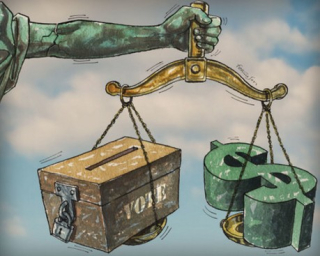
Democracy is egalitarian. Capitalism is inegalitarian, at least in terms of outcomes. If the economy flounders, the majority might choose authoritarianism, as in the 1930s. If economic outcomes become too unequal, the rich might turn democracy into plutocracy.

Historically, the rise of capitalism and the pressure for an ever- broader suffrage went together. This is why the richest countries are liberal democracies with, more or less, capitalist economies. Widely shared increases in real incomes played a vital part in legitimising capitalism and stabilising democracy. Today, however, capitalism is finding it far more difficult to generate such improvements in prosperity. On the contrary, the evidence is of growing inequality and slowing productivity growth. This poisonous brew makes democracy intolerant and capitalism illegitimate.

Today’s capitalism is global. This, too, can be regarded as natural. Left to themselves, capitalists will not limit their activities to any given jurisdiction. If opportunities are global so, too, will be their activities. So, as a result, are economic organisations, particularly big companies.

Yet, as Professor Dani Rodrik of Harvard University has noted, globalisation constrains national autonomy. He writes that “democracy, national sovereignty and global economic integration are mutually incompatible: we can combine any two of the three but never have all three simultaneously and in full”.

More here.

Rhino-escape tips to omelette Viagra – 14th-century Arab encyclopaedia published in English

Alison Flood in The Guardian:

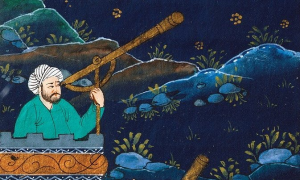
UntitledDealing with everything from “the Classification of Names of Dust and its Qualities” to “Poetic Descriptions of the Down on the Young Male Cheek”, via the ingredients of an omelette which increases sexual potency, a 14th-century Egyptian scholar’s attempt to catalogue all knowledge has been translated into English for the first time. Shihab al-Din al-Nuwayri lived from 1279 and 1333. He was a civil servant in the Mamluk empire until he retired from government service in the 1310s and decided to catalogue everything known to exist, in an encyclopaedia which eventually spanned more than 9,000 pages and 33 volumes. Penguin Classics, which publishes the first ever English translation of The Ultimate Ambition in the Arts of Erudition in October, said that the compendium of knowledge from the classical Islamic world was “as important a work to civilization as Pliny’s natural history”, and “an astonishing record of the knowledge of a civilization”.

…His goal, al-Nuwayri writes in a preface, was “securing the essential and banishing the incidental, adorning it with the necklace of my own sayings, and the pearls of my predecessors”. “My own words in it are like the night clouds leading the rain clouds, or the patrol followed by the squadron. They merely interpret the book’s contents and frame them like eyebrows over the eyes,” he writes, adding, warningly, “I have followed the traces of those excellent ones before me, pursuing their path and connecting my rope to theirs. So if there should be any complaint, the dishonour is upon them and not me.”

More here.

Lo And Behold, Reveries Of The Connected World

Amara D. Angelica in KurzweilAI:

In the movie “Lo and Behold, Reveries Of The Connected World,”, legendary documentarian Werner Herzog discovers and explores the internet in a series of ten impressionistic vignettes. These range from internet pioneers (Leonard Kleinrock, Robert Kahn, Danny Hillis), AI/roboticists (Sebastian Thrun, Tom Mitchell, “Raj” Rajkumar, Joydeep Biswas), and Mars explorers (with Elon Musk — Herzog volunteered to go) to dystopians — how a solar flare could crash our internet-based civilization in a few days, electrosensitive hermits living off the grid, online-game addicts, black-hat hackers (Kevin Mitnick), government intrusion (Jonathan L. Zittrain), a family cruelly harrassed by trolls, and smartphone-obsessed Tibetan monks. KurzweilAI readers may not find much new in the film, but I found it compelling anyway, thanks to explorer-poet-philosopher Herzog’s soft-spoken, quirky humor (“Does the Internet dream of itself?” was one question he asked) and unrushed, contemplative — almost meditative — style, plus awesome, unobtrusive music.

More here.

Camera-phone Lucida

UnnamedJacob Mikanowski at The Point:

Forty years ago, the great art historian Michael Baxandall introduced the idea of the period eye. Renaissance viewers, for instance, brought a world of experience to bear on paintings. They were used to estimating, assessing and appraising. They shared a visual language, in which meaning was expressed through color harmonies, costly fabrics and metaphorical meanings. When they looked at a painting of the Annunciation, they priced out the cloth on the Virgin’s table, guessed the number of hogsheads of grain that would fit in a baptismal font and recognized the allusion to the Neoplatonic doctrine of forms concealed in the stained glass of the apse. Few among us now measure the world in casks of wine or yards of taffeta. But the broader point stands: vision is not neutral but shaped by our historical moment.

Today, we look at Instagram feeds with the same level of scrutiny as the Renaissance merchants who converted their Madonnas into ducats. Only the criteria of judgment have changed. Does the user obey the unwritten laws of adult Instagram, posting less than once a day, avoiding too many shots of their face, going easy on the hashtags? (Teen Instagram rules are different, if even more stringent). How are their vacations? Do they inspire envy in a way that’s beguiling, or merely crass? Are they eating in the right places? Instagram can seem like an index of mores in the age of self-branding and self-surveillance. But even as we look and like, we often fail to see to what extent our present image-world is rooted in the past. Instagram hasn’t yet introduced much that’s new to art, or even to vision.

more here.

the great dying

ImagesJohn Bannigan at the Dublin Review of Books:

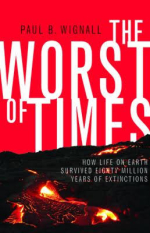
Catastrophic extinctions like storms or earthquakes vary in scale but of the twenty that have occurred since the beginning of the Palaeozoic five are singled out as massive because the extinction rate exceeded seventy-five per cent. The Worst of Times describes the eighty-million-year time span from the mid-Permian to the mid-Jurassic, during which two massive extinctions occurred as well as four of lesser magnitude. Wignall gives a detailed account of the most massive one of all, in which ninety-five per cent of all life perished 250 million years ago. This was the second in the series and occurred at the Permian-Triassic (P-Tr) boundary. The account is based largely on field studies in which he has had major involvement over twenty-five years.

The main argument is that the extinctions were due to enormous episodes of volcanism and that their severity was intensified by the peculiar geography of the planet at the time. Wignall begins with the geography. In the Palaeozoic nearly all the land of the earth was concentrated in a single super-continent called Pangea. Shaped a bit like an irregular fat letter C, Pangea stretched from pole to pole. The shallow concavity of the C was open to the east and enclosed the Thetys Ocean with the equator on its southern shore. The Panthalassa Ocean occupied the rest of the planet. Pangea was the last of a series of super-continents formed by cycles of coalescence and fragmentation resulting from movements of the earth’s tectonic plates. The volcanism was caused by columns of magma ascending from the core-mantle boundary of the planet.

more here.

Rereading Patricia Highsmith’s eerie romance-as-thriller

51xOraJSN9LTerry Castle at Bookforum:

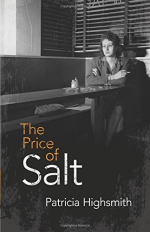
Much as I love this dizzyingly erotic book, there’s something magnificently bogus about this ending: an inauthenticity that becomes even more glaring when one sees the events recast in précis. The Price of Salt was partly inspired by a chance meeting Highsmith had while working at Bloomingdale’s in December 1948, an episode that in real life went nowhere. A glamorous blonde in furs asked Highsmith for assistance, and Highsmith at once became almost insanely infatuated, making two unsuccessful stalker-like trips to New Jersey to find (and presumably spy on) the object of her coup de foudre. The novel is exactly what didn’thappen between Highsmith and her own “Mrs. Aird.” And the fantasy goes still further: It emerges that not only is newly divorced Carol gorgeous, rich, and the proud possessor of a chic new apartment in uptown Manhattan (so long, New Jersey suburbs), she’s also a scholarly expert on antique furniture and plans to set up her own upscale shop. Simultaneously, a series of lucrative set-design gigs with renowned avant-garde Russian directors in exile fall into Therese’s lap. You can easily conjure up the future iterations of such mutual good fortune: Therese and Carol—artsy (if still discreet) power couple of lesbian Manhattan! Yum.

In an intriguing aside in The Talented Miss Highsmith (2009), the second and far more freewheeling of the two Highsmith biographies to date, Joan Schenkar notes that lesbian producer-director and Actors Studio member Terese Hayden wished, somewhat perversely, to adapt The Price of Salt for the stage as a heterosexual love story, in which the Carol figure would be changed into a man named Carl. That the idea fizzled is a good thing: Making the story over into banal heterosexualia strikes one as bathos exemplified.

more here.

Wednesday, August 31, 2016

SEAMUS HEANEY ON WILLIAM WORDSWORTH’S ONE BIG TRUTH

Seamus Heaney died three years ago. But not before he penned this.

From Literary Hub:

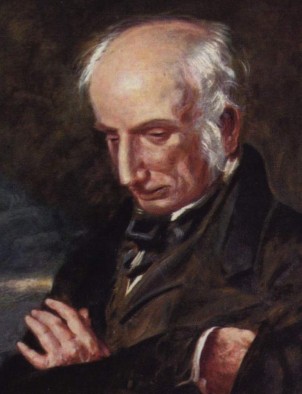
ScreenHunter_2183 Aug. 31 21.41As a child, William Wordsworth imagined he heard the moorlands breathing down his neck; he rowed in panic when he thought a cliff was pursuing him across moonlit water; and once, when he found himself on the hills east of Penrith Beacon, beside a gibbet where a murderer had been executed, the place and its associations were enough to send him fleeing in terror to the beacon summit.

Every childhood has its share of such uncanny moments. Nowadays, however, it is easy to underestimate the originality and confidence of a writer who came to consciousness in the far from child-centred eighteenth century and then managed to force a way through its literary conventions and its established modes of understanding: by intuition and introspection he recognized that such moments were not only the foundation of his sensibility, but the clue to his fulfilled identity.

By his late twenties, Wordsworth knew this one big truth, and during the next ten years he kept developing its implications with intense excitement, industry and purpose. During this period, he also elaborated a personal idiom: “nature” and “imagination” are not words that belong exclusively to Wordsworth, yet they keep coming up when we consider his achievement, which is the largest and most securely founded in the canon of native English poetry since Milton. He is an indispensable figure in the evolution of modern writing, a finder and keeper of the self-as-subject, a theorist and apologist whose Preface to Lyrical Ballads (1802) remains definitive.

More here.

How the simple definition of a hydrogen bond gives us a glimpse into the heart of chemistry

Ashutosh Jogalekar in The Curious Wavefunction:

ScreenHunter_2182 Aug. 31 21.32A few years ago, a committee organized by the International Union of Pure and Applied Chemistry (IUPAC) – the international body of chemists that defines chemical terms and guides the lexicon of the field – met to debate and finalize the precise definition of a hydrogen bond.

Defining a hydrogen bond in the year 2011? Hydrogen bonds have been known for at least seventy years now. It was in the 1940s that Linus Pauling defined them as foundational elements of protein structure; the glue that holds molecules including life-giving biological molecules like proteins and DNA together. Water molecules form hydrogen bonds with each other, and this feature accounts for water's unique properties. Whether it's sculpting the shape and form of DNA, governing the properties of materials or orchestrating the delicate dance of biochemistry performed by enzymes, these interactions are essential. Simply put, without hydrogen bonds, not just modern civilization but life itself would cease to exist. No wonder that they have been extensively studied in hundreds of thousands of molecular structures since Pauling highlighted them in the 1940s. Today no chemistry textbook would be legitimate without a section on hydrogen bonding. The concept of a hydrogen bond has become as familiar and important to a chemist as the concept of an electromagnetic wave or pressure is to a physicist.

What the devil, then, were chemists doing defining them in 2011?

More here.

The Co-Founder of n+1 Is ‘Against Everything’

Daphne Merkin in the New York Times:

ScreenHunter_2181 Aug. 31 21.24We live in singularly unsubtle times, when presidential candidates shout invective instead of delivering talking points and Twitter posts privilege catchiness over nuance. Then again, ours has never been a culture to value the reflective life — unlike in France, say, where public intellectuals hold political positions, or England, where Oxbridge dons form an aristocracy of the mind. Except for a brief period during the last century, from the 1930s through the 1960s or so, when an active intelligentsia (even the word sounds dated) loosely known as the New York Intellectuals formed around a clutch of publications including Partisan Review, The Nation and Commentary, and critics like Lionel Trilling, Dwight Macdonald and Mary McCarthy had a say on matters literary and political, we tend to give short shrift to intellection for its own sake, regarding it as something best corralled off in the academy.

And indeed, for the last 20 years, instead of thinkers, we have seen the rise of pundits, those ubiquitous opiners on the news of the day who take the short view of necessity. This trend has been bucked by a handful of serious-minded magazines with a spectacularly small readership and by the occasional erudite voice in newspapers like this one. Sensing a gap in the discourse, a group of young, mostly ­Harvard-educated writers started a publication called n+1 in 2004, which attempted to fill the void where Partisan Review and the like had once engaged in “the life of significant contention,” as Diana Trilling put it. Which brings us, happily, to the occasion of “Against Everything,” a new collection of essays by Mark Greif, an editor at n+1 (where most of these pieces first appeared) and a frequent contributor since its inception on widely disparate themes.

More here.

happy death poem

Donald-revellCraig Morgan Teicher at Poetry Magazine:

Donald Revell has mastered a poetic genre few poets even attempt: the happy poem. That’s not to say that his poetry doesn’t grapple with darkness—it does, and deeply. This poem is called “Death,” after all, and Revell tries as hard as he can in this small space to meet mortality head-on. One of Revell’s possible goals is to engender a sense of awe: in his poems, life is fundamentally amazing, even though—even because—it has an ending. Poets write poems for many reasons, chief among them to express feelings, to articulate the vagaries and fine points of an emotional state. Poets also write to create emotional states in readers, and this Revell poem invites readers to accept death. Without ever forgetting the mortal stakes of every moment, Revell manages to sing joyfully, no matter his subject. He knows deeply what the words have always been telling him: that all our terrors, such as “space and time,” are “inventions / Of sorrowing men”; in this poem, he chooses not to be one.

As a celebratory poet, Revell is in good company: Shakespeare, Donne, Blake, Herbert,Dickinson, and Whitman come to mind as voices playing in the background of “Death.” All these poets revel—a pun on Revell’s name that he seems to have taken seriously—in details and in the capacity of the imagination to elevate them toward a kind of holiness. Of course, many of these poets also had a particular kind of holiness in mind, as does Revell; when he (or the others) uses the word soul, he means it in the Christian sense: the immortal soul that will live eternally in heaven.

more here.

MUSIC AS A VOLATILE ART FORM

Yarbrough-web1Marshall Yarbrough at The Brooklyn Rail:

For a while now I’ve had a theory about a select group of artists who were making music in the 1960s and ’70s. These are musicians who seem related to their time only obliquely: they may have been marked by it, but they were not of it. Other artists’ greatness might lie in their perfectly embodying certain musical directions of the day—the Beatles, for example. These musicians, on the other hand, have inherent greatness; that it might have been expressed in the language of their day is instructive, but ultimately incidental—they were tapping a deeper vein.

These musicians evoke a term used for a few writers in German literature—Jean Paul, Hölderlin, Kleist—who pop up between the eras of Classicism and Romanticism but don’t fit neatly in either category: die großen Einzelnen, or “the great individuals.” These writers fall between both epochs and draw from each, but to understand them you ultimately have to take them on their own terms. Likewise, each of these few musicians is a category unto himself—if they are to be viewed collectively, it is by virtue of their shared idiosyncrasy. To the extent that it’s helpful, I’d like to label this group. For want of a better term, I’ll call them the Great White Weirdos.

Each Weirdo works, if not within the confines of, then at least alongside a given genre. Thus you’ve got blues and jazz Weirdos (Captain Beefheart, Frank Zappa); country Weirdos (Leon Russell, Lee Hazlewood); and pop Weirdos (Randy Newman, Harry Nilsson). There’s no getting around the fact that these are all white men. In emphasizing their whiteness alongside their weirdness, I want to point out a certain self-awareness on their part, particularly when it comes to the use of rock, jazz, and blues—musical forms developed by black musicians.

more here.

Nicholson Baker, Substitute Teacher

Baker_photo460Malcolm Harris at The New Republic:

Baker is often frustrated with the material he’s asked to push on students, and this reaches its peak with a graphic Holocaust documentary called Auschwitz: Death Camp starring Oprah and Elie Wiesel that he shows to successive 10th-grade English classes. Watching piles of bodies, Baker thinks,

I knew that this was the wrong documentary to be showing to a group of choiceless, voiceless high school kids at eight-thirty on a Monday morning, in connection with a compare-and-contrast media-studies assignment … These high schoolers were being tortured to the point of numbness and indifference by gruesome imagery—and the Holocaust was being trivialized through inattention, both at the same time. Why was this happening? Why was I a part of this?

By the end of the video two girls are doing a cheerleader-style H-O-L-O-C-A-U-S-T! chant, and Baker doesn’t know whom to blame.

Classroom technology has changed a lot since Baker last visited—even since I did—and having a substitute isn’t the break for students it used to be if their daily progress is watched by a school iPad. Some teachers take a curatorial approach, delegating a large portion of their pedagogy to instructional apps, Youtube videos, and downloaded worksheets. On day nine Baker hears two teachers discussing iPad assignments when they have subs, “You delete them without reading them?” one asks. “Yes,” the other says, “They don’t do anything anyway.”

more here.