
Category: Recommended Reading
Miloš Forman (1932 – 2018)
Sunday Poem
Then
Out in the yard, my sister and I
tore thread from century plants
to braid into bracelets, ate
chalky green bananas,
threw coconuts onto the sidewalk
to crack their hard, hairy skulls.
The world had begun to happen,
but not time. We would live
forever, sunburnt and pricker-stuck
our promises written in blood. Not yet
would men or illness distinguish us,
our thoughts cleave us in two.
If she squeezed sour calamondines
into a potion, I drank it. When I jumped
from a fig tree, she jumped.
.
by Trish Crapo
from Walk Through Paradise Backward
Slate Roof, 2004
.
‘Main Nijaam Se Naina’ by Farid Ayaz & Abu Mohammed
Saturday, April 14, 2018
Here’s to Unsuicide: Everett Hamner interviews Richard Powers
From the Los Angeles Review of Books:
EVERETT HAMNER: One of my favorite aspects of your National Book Award–winning The Echo Maker, published a dozen years ago now, is the way its birds are not anthropomorphized so much as its human characters are zoomorphized: we find the public “banking and wheeling in such perfect synchrony,” a man who has “grown as placid as a bottom feeder,” and another dancing like a “clumsy, autumn-honking fledgling.” In short, there is no humanism here without an even larger biocentrism. How was this relationship evolving as you began to imagine The Overstory, and how did it matter — or not — that the interspecies tie is not just to other animals, but to trees?
The Overstory may present an even greater challenge to the sense of exceptionalism we humans carry around inside us. It’s the story of immense, long-lived creatures whom many people think of as little more than simple automatons, but who, in fact, communicate and synchronize with each other both over the air and through complex underground networks, who trade with and protect and sustain their own and other species. It’s about immensely social beings with memory and agency who migrate and transform the soil and regulate the weather and create a breathable atmosphere. As the great Le Guin put it, the word for world is forest.
Our kinship with trees seems, at face value, much more distant and abstract, but we share a considerable amount of our genes with them, and they (trees come from many different families in their own right) represent several large branches of the single, ramifying experiment called life on earth, a big-boled thing on which we humans occupy just one small and remote branch.
More here.
The Heroes of This Novel Are Centuries Old and 300 Feet Tall
Barbara Kingsolver in the New York Times:
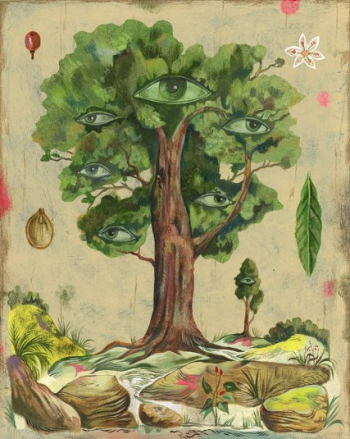
And for all that, trees are things to us, good for tables, floors and ceiling beams: As much as we might admire them, we’re still happy to walk on their hearts. It may register as a shock, then, that trees have lives so much like our own. All the behaviors described above have been studied and documented by scientists who carefully avoid the word “behavior” and other anthropomorphic language, lest they be accused of having emotional attachments to their subjects.
More here.
A fate worse than death
Cathy Rentzenbrink in Prospect:
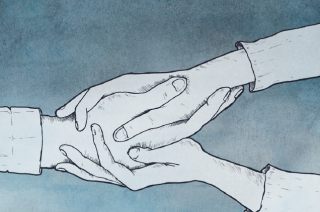
I laid my hand on Matty’s bare, bloodstained chest and I talked and talked until we arrived at hospital. Then Matty was rushed away from me. I filled out forms with a nurse and rang my parents. I can still hear my mother’s voice as I delivered the information that would throw a grenade into our lives.
After my parents arrived a surgeon came to see us. “I’ve saved your son’s life,” he said. “We don’t know yet whether that was the right thing to do.” He told us that the next 48 hours were crucial. We commenced what the newspapers called our bedside vigil. More talking. I held Matty’s hand and watched his chest rise and fall as a ventilator pumped air into his lungs. All we wanted was for Matty not to die. Moving around the hospital in the night I stumbled into the chapel. I was an atheist but had been to a Catholic school and I knew the prayers. I prayed that my brother would not die. I believed we were in a binary situation. I only knew about life and death, I knew nothing of the in-between.
Now—older, wiser, sadder—I know that I was praying for the wrong thing. It would have been better for my poor, lost brother and for everyone who loved him if he’d died when he was knocked over by the car.
More here.
Gillian Ayres My Fiercely independent Friend
Sue Hubbard in Artlyst:
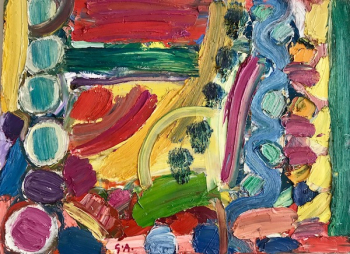
I first met her in 1984 when, as a young arts journalist, I was sent to interview her in her Three Bears cottage in a remote glade of a Cornish valley. It was a long way to go, and I was invited to stay. Warm and chaotic, the place was full of animals, cigarette smoke and, I believe, followed the Quentin Crisp approach to housekeeping, which was that after four years the dust never got any worse. I found it amazing that Gillian was able to produce such an array of stunning, jewel-like canvases from her small studio. We hit it off right away. Feisty, opinionated, fiercely intelligent and well read, we discussed everything from art, to Shakespeare and religion, which she hated. And she cooked delicious meals.
Born in 1930, she grew up in Barnes, then still semi-rural with its wooded common and market gardens where, many years later I, myself, was to live. It was a comfortable middle-class existence. She attended St. Paul’s Girls school where her best friend was the future politician Shirley Williams. She once sent me a photograph of them sitting on a haystack. With her long golden locks, she was a stunning teenage. But it was on a day in 1943, she told me, as she was going up to the school art room, that she discovered some illustrated monographs on van Gogh, Gauguin and Monet. Already well versed in poetry and music, she had excelled at drawing and painting since she’d been a small child, but this was the moment she knew she wanted to be an artist.
More here.
Joseph’s Machines: How to go straight from dinner to cake
the novels of Mathias Énard
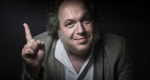
We are lucky to have translations of the French novelist Mathias Énard, whose career suggests the exploratory, variegated template of Faulkner. A translator from Persian, Arabic, and Spanish, Énard has written nine novels in an assortment of styles and on an assortment of subjects. As Faulkner nearly always located his fiction in Mississippi, Énard has focused on the lands surrounding the Mediterranean, what he calls in his eponymous novel, the “Zone.” And as the themes of slavery, black-white relations, history, Reconstruction, and the South run through Faulkner’s novels, Énard has his touchstones of music, violence, East-West relations, and literature, all of which appear in his most recent book to be translated by Charlotte Mandell into English, the 2015 Prix Goncourt winner, Compass.
The novel takes place over a single sleepless night in 2012. The narrator, Franz Ritter, is a musicologist specializing in the “Oriental” influence on European classical music. He has just received a note along with an article written by a fellow Orientalist and long unrequited love, Sarah, and is also contending with an unspecified, possibly terminal, medical diagnosis. He reflects on their meetings over the years across Europe and the Middle East, thinks about articles he should write, and contemplates the influence of the East (which, to him, extends only as far as Iran) on the West (which he sees stretching no further than Portugal).
more here.
‘There is no such thing as past or future’
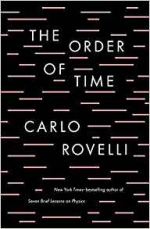
Rovelli’s work as a physicist, in crude terms, occupies the large space left by Einstein on the one hand, and the development of quantum theory on the other. If the theory of general relativity describes a world of curved spacetime where everything is continuous, quantum theory describes a world in which discrete quantities of energy interact. In Rovelli’s words, “quantum mechanics cannot deal with the curvature of spacetime, and general relativity cannot account for quanta”.
Both theories are successful; but their apparent incompatibility is an open problem, and one of the current tasks of theoretical physics is to attempt to construct a conceptual framework in which they both work. Rovelli’s field of loop theory, or loop quantum gravity, offers a possible answer to the problem, in which spacetime itself is understood to be granular, a fine structure woven from loops.
String theory offers another, different route towards solving the problem. When I ask him what he thinks about the possibility that his loop quantum gravity work may be wrong, he gently explains that being wrong isn’t the point; being part of the conversation is the point. And anyway, “If you ask who had the longest and most striking list of results it’s Einstein without any doubt. But if you ask who is the scientist who made most mistakes, it’s still Einstein.”
more here.
Will Pope Francis Cause a Schism in the Catholic Church?
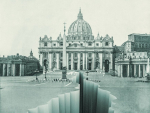
Francis seems less intent on altering the Church’s most controversial doctrines than on exhibiting boredom with the whole angst-ridden discourse that surrounds them. When he was asked about footnote 351, shortly after “Amoris Laetitia” was published, he said that he couldn’t remember it. Earlier in his papacy, while fielding questions from the Vatican press corps on a plane, he was asked about the Church’s stance on homosexuality. He replied, “Who am I to judge?” It sounded more like a plea to move past the issue than like an actual invocation of humility. (After all, when it comes to society’s market-driven indifference to the poor, or even to Francis’s pet theological causes, such as devotion to the Virgin Mary, he is not shy about offering judgments.) Francis quickly became popular in the press, and among liberal non-Catholics. After the worst years of the clerical-abuse crisis in the Church, here was a leader who embodied Catholicism’s lastingly positive, if comparatively abstract, associations. (Few of us imagine ourselves as opposed to love, mercy, and human dignity.) He sounded willing, even eager, to leave the less comfortable conversations—about divorce, contraception, homosexuality—behind.
But the appeal of the institution of the Papacy, for many, lies in its promise of constancy. According to Catholic teaching, the office was created when Christ named the apostle Peter the first leader of the Church, saying, in a pun on the Greek meaning of Peter’s name, “Upon this rock will I build my church.” The more impressive the edifice you’d like to build, the more important a stable base becomes. Today, under Francis, and in the wake of Benedict’s resignation—he is now Pope Emeritus, a title that has never existed before—the Papacy has become the site for unexpected shifts and discontinuities.
more here.
The Post-Campaign Campaign of Donald Trump
Charles Homans in The New York Times:
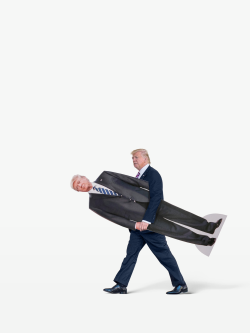
Saccone took the stage briefly before Trump did, and his people were circulating in the hangar: normal-looking suburban Republican operatives and volunteers of the sort who are still jarring to see attached to the Trump roadshow, like insurance-claims adjusters piled into the bed of a monster truck. But this was a Trump event in spirit: the email advisory from Donald J. Trump for President Inc., his official presidential campaign committee, described it as a “campaign rally” but did not mention Saccone, explaining instead that Trump would “highlight the benefits that his historic tax cuts are providing hard-working families across Pennsylvania and to celebrate our booming economy now that America is once again open for business.” Onstage, Trump seemed to intermittently remember the tax cuts and the booming economy, and even more intermittently that he was supposed to be promoting the candidate, whom he had reportedly derided in private as “weak.” But he mostly did what he usually does at his rallies: recite the latest verse of the ballad of Donald Trump, the president who would be doing great things for the people in this room were it not for his many antagonists.
More here.
Saturday Poem
Bishop Tutu's Visit to the White House: 1984
I'm afraid for you a little, for your sense of shame, I feel you are
accustomed to ordinary evil.
Your assumption will be that disagreeing with your methods, he will
nevertheless grasp the problems.
You will assume that he will be involved, as all humans must be, for
what else is it is be human,
in a notion of personal identity as a progress toward a more conscious,
inclusive spiritual condition,
so that redemption, in whatever terms it might occur, categorically will
have been earned.
How will you bear that for him and those around him, righteousness
and self are a priori equal,
that to have stated one's good intentions excuses in advance from any
painful sense of sin?
I fear you will be wounded by his obtuseness, humiliated by his pride,
mortified by his absurd power.
by C.K. Williams
from Selected Poems
Noonday Press, 1994
Friday, April 13, 2018
Tom Lehrer at 90: a life of scientific satire
Andrew Robinson in Nature:
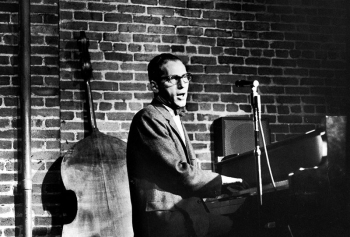
In the 1960s, Lehrer followed up with more than a dozen astringent, cynical and often pointedly political songs, such as ‘So Long, Mom, I’m Off to Drop the Bomb (A Song for World War III)’. As The New York Timeshad it, “Mr. Lehrer’s muse [is] not fettered by such inhibiting factors as taste.” (Lehrer reprinted the quote in his album liner notes.) In the fraught geopolitics and paranoia of the cold war, however, Lehrer’s social criticism touched a chord with many in the United States. Fans might, however, have been surprised to learn that he had crunched numbers for the National Security Agency as an army draftee in the mid-1950s.
More here.
Mathematicians Explore Mirror Link Between Two Geometric Worlds
Kevin Hartnett in Quanta:

To physicists, the correspondence was interesting. To mathematicians, it was preposterous. They’d been studying these two geometric settings in isolation from each other for decades. To claim that they were intimately related seemed as unlikely as asserting that at the moment an astronaut jumps on the moon, some hidden connection causes his sister to jump back on earth.
“It looked totally outrageous,” said David Morrison, a mathematician at the University of California, Santa Barbara, and one of the first mathematicians to investigate the matching numbers.
Nearly three decades later, incredulity has long since given way to revelation. The geometric relationship that the physicists first observed is the subject of one of the most flourishing fields in contemporary mathematics. The field is called mirror symmetry, in reference to the fact that these two seemingly distant mathematical universes appear somehow to reflect each other exactly.
More here.
A vast collection of war crimes masquerading as a civil war
Roy Gutman in The Daily Beast:
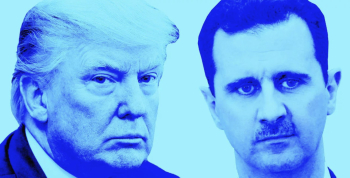
The war began seven years and one month ago, and despite the efforts of two international groupings dealing with Syria, the U.S.-Russian-led Geneva Process and the Astana group of regional rivals, Turkey, Iran and Russia, there’s been no end in sight. The impasse is usually blamed on the obduracy of Syrian President Bashar al Assad.
But at its heart Syria is a vast collection of war crimes masquerading as a civil war. Shortly after Syrians took to the streets in a national uprising to demand political reform in 2011, Assad went to war against his own people, targeting cities and towns, hospitals and rescue services, mosques, schools and public markets. He directed his security forces to put hundreds of thousands under starvation siege in the Damascus suburbs, blocked the population from medical supplies and repeatedly used chemical weapons, the latest case being in Douma on Saturday.
More here. [Thanks to Idrees Ahmad.]
Duke professor’s beautiful law of human progress
J. Peder Zane in The News & Observer:
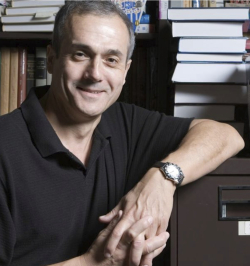
Life has indeed improved dramatically since the 17th century, but Pinker’s thesis fails to account for the steady improvement that occurred before then — a point he noted in his previous book, “The Better Angels of Our Nature,” which demonstrated the inexorable decline in violence since the Stone Age.
A far more comprehensive explanation is offered by Adrian Bejan, a professor of mechanical engineering at Duke University who grounds these happy achievements not in the arbitrary whims of humanity but the eternal laws of physics.
Bejan’s work — which was the subject of a book we wrote together, “Design in Nature,” and which will be honored in Philadelphia this week when he receives the prestigious Benjamin Franklin Medal — is so compelling, and beautiful, because of its holistic approach. His monumental discovery, the constructal law, does not see humanity as distinct from nature but as a part of it; it holds that human progress is governed and predicted by the same phenomenon that has inexorably improved the natural world.
More here.
Tom Petty’s “I Won’t Back Down”: Producer Rick Beato Explains What Makes This Song Great
‘The Art of the Wasted Day’ by Patricia Hampl
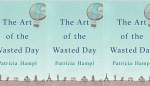
In her new book, The Art of the Wasted Day, Patricia Hampl meanders through disparate terrain: A garden in Llangollen, Wales. A smoky café in Prague. A library in Brno housing notebooks that detail the genetic lives of peapods. A monastery in California. Small towns near the headwaters of the Mississippi River. Disparate yet similar, all places that allow the mind to wander and encourage the leisurely waste of a day. But a day of leisure is not a waste; it is, instead, necessary for reflection and introspection, even the flowering of character.
As she muses, Hampl frequently touches on her husband and on Montaigne. We first meet her husband as Hampl is having a panic attack on an airplane. One seatmate, a nurse, coaches her to breathe deeply while her husband takes her hand into his, a “beautiful hand I’ve always loved.” Several pages later she recounts their first meeting, years earlier, when she is moving into an apartment and he, resident in the building, offers to show her where the garbage bins are located. From this they build a life together, with a shared love of poetry and conversation at the kitchen table, coffee cups between them. We never learn his name though she often returns to him, just as she circles back to Montaigne, the garden in Wales, the peapods in Brno. We learn that his beautiful hand is now dust, in her words, and she slowly pays out the facts surrounding his death, only hinting at some. The details, like his name, are not the point. What is important is her memory of his voice, prodding and encouraging her, as she continues her side of their conversations.
more here.