Notes on the Art of Rhetoric

0520015460.01.MZZZZZZZKyle Winkler at The Millions:

For most of us, rhetoric boils down to what you learned in high school when the teacher drew a triangle on the chalkboard and wrote logos, ethos, pathos. “These are the three appeals to the audience,” the teacher said. Reason, character, emotion. “A composition will try to include all three of these for best effect,” you may’ve heard. But these three alone aren’t rhetoric. Instead, consider adding Kenneth Burke’s idea of “identification” from A Rhetoric of Motives, that states “[y]ou persuade a man only insofar as you can talk his language by speech, gesture, tonality, order, image, attitude, idea, identifying your ways with his.”

Prince Hamlet is a prime rhetorician in the Burkean sense. (Actually, William Shakespeare was the rhetorician, but I’m being generous.) After speaking to his father’s ghost, Hamlet confides to Horatio: “I perchance hereafter shall think meet / To put an antic disposition on;” antic, as in, grotesque; meaning, Hamlet’s fixing his words and actions to fit the ass-backwards scene in his home. Because “time is out of joint” in Elsinore. And Hamlet, too, will be out of joint if he doesn’t persuade those around him he’s mad. Oddly, Hamlet will persuade everyone he’s nuts, but it will be against their common sense, against his prior character, and against what passes for royal emotion among his kin. That is a type of persuasion.

more here.

old school criticism

P.549Michael Dirda at the Washington Post:

Both these excellent books — Christopher de Hamel’s “Meetings With Remarkable Manuscripts” and Jorge Carrión’s “Bookshops” — reinvigorate an old-fashioned form of criticism, sometimes summed up by the phrase “the adventures of a soul among masterpieces.”

During the middle part of the 20th century, humanist scholarship in many disciplines modeled itself on the sciences, rejecting anything that smacked of the personal, subjective and essayistic. To art scholars, traditional connoisseurship was deemed overly impressionistic; in literary study, New Critics — under the banner of “the poem itself” — banished the biographical in favor of intensive verbal analysis; among historians, the Annales school shied away from narrative and fine writing, as practiced by a Gibbon or Michelet, to emphasize data, data, data.

No one would deny the crucial value of technical, “just the facts, ma’am” approaches, but they can seem more than a little arid to anyone not already passionate about a subject. Certainly, casual readers gravitate to scholarly books that combine knowledge and authority with a winning style and a vivid sense of the author’s personality. De Hamel and Carrión each show how this can be done supremely well.

more here.

The Rules of the Doctor’s Heart

Siddhartha Mukherjee in The New York Times:

SidEvery medical case, to paraphrase the writer Viet Thanh Nguyen, is lived twice: once in the wards and once in memory. Some of what follows is still intensely vivid, as if it were shot in high-def video. Other parts are blurry — in part because I must have subconsciously deleted or altered the memories. I was 33 then and a senior resident at a hospital in Boston. I had been assigned to the Cardiac Care Unit, a quasi I.C.U. where some of the most acutely ill patients were hospitalized. In mid-September — it had been a moody, rain-drenched month, as I recall — I admitted a 52-year-old man to the unit. I’ll call him by the first letter of his given name, M. As medical interns, we were forewarned by the senior residents not to identify too closely with patients. “A weeping doctor is a useless doctor,” a senior once told me. Or: “You cannot do an eye exam if your own eyes are clouded.” But M.’s case made it particularly hard. He was a doctor and a scientist — an M.D., a Ph.D., like me. He must have been about 15 years ahead of me in his schooling; I could imagine him returning to my class in med school to teach us “Patient-Doctor,” in which students are taught how to deal with real-life patients. He’d trained as a medical resident and then as a fellow in cardiology at another hospital across town. He was now an assistant professor — it seemed like such a victory to have that title — and ran a small laboratory. I knew a student who once worked with him. Six degrees of separation? There was barely one.

Earlier that year, in March or April, M. became short of breath in the middle of his run. (Was his running route the same as mine? Across the Longfellow Bridge at Mass General, looping around the river and then back again by Storrow Drive?) His legs turned cold and blue. He had dizzy spells and lost words in midsentence. He saw a cardiologist — presumably one of his own colleagues — who diagnosed heart failure. A series of scans must have revealed a sluggish heart. In place of the regular, intentional motion — jellyfish pulsing in a tank — there was an eerie wobbliness, just jelly. A biopsy was performed, and the diagnosis was amyloidosis, a mysterious condition in which misfolded proteins begin to be deposited in the organs of the body. Sometimes the proteins come from cancer cells; sometimes from poorly understood sources. The deposits choke the organs: heart, liver, blood vessels, kidneys. “And then, bit by bit by bit, I was all pro-te-in,” he said dryly, paraphrasing the Tin Man in Oz. We laughed. M. needed a new heart. I’m writing this casually, as if you go to the used-heart salesman on Long Island and pick one up on a three-year lease. Hearts are notoriously hard to find; someone has to die for you to get one. About 3,000 hearts are available in the United States every year. Many come from youngish men and women who’ve had accidents or drowned, leaving them in a peculiar limbo — brain-dead but heart-alive. But there are never enough: At any given moment, about 4,000 patients are waiting for a heart. Many of them will never find one.

More here.

Friday, October 27, 2017

My Quantified Monster and Me

171018_QUANTS_dungeonsDragonsDice.jpg.CROP.promo-xlarge2

Jacob Brogab in Slate:

When I think back to the demons of my childhood, I almost always linger longest on the rust monster. Though it resembled a crudely drawn armadillo, it was the size of a mountain lion. Other, more dangerous, beasts lived in the caves where I found it; there were neither claws on its three-toed feet nor fangs in its mouth. Still, it was a frightening creature: Tentacular whiskers, each longer than a human arm, emerged from its smirking maw. Those unearthly appendages probed the empty space between us, tasting the air. Whenever they touched a metal object—my shield, my armor, my sword, my dagger—it would immediately oxidize, crumbling into a useless pile of reddish flakes. And then the rust monster would feed.

I met this creature in a solo adventure that accompanied the 1983 Dungeons & Dragons basic rule set my mother brought home from the library. Before our fateful encounter, I would ably fight off less-challenging antagonists like giant rats and angry goblins, but the rust monster, which presided over a cache of precious gems, undid me. It wasn’t the beast’s own stats—its formidable hit points or the difficulty of piercing its armored hide—that frightened me, but its ability to literally eat away at my own protective gear. Our struggle would leave me defenseless. I’d flee the cavern with only my fists to fight back against the other horrors that lurked in the dark and only my thin skin to protect me against their jagged blades.

More here.

German Question(s)(3): Applying the Debt Brake

Adam Tooze over at his website:

The “reform narrative” that is crucial to understanding the self-conception of Germany’s political class today has several strands. It addressed the labour market by way of welfare rights (Hartz IV, coming to a blog near you soon). It addressed the labour market by way of a new politics of childcare (see the blogpost last week). It also addressed the key issue of public finance. A wide ranging debate within Germany going back to the late 1990s swirled around the issue of public debt. Reunification had led to heavy borrowing. But as Germans acknowledged, the tendency to run deficits clearly went far beyond that.

The short version of the story is that in response to a growing sense of alarm, German politicians rallied. Faced with the miserable track record of the last decades and the shock of the 2008 crisis, in 2009 they “did the right thing”. They applied the debt brake – a constitutional amendment requiring them to balance the books both at the national and local level. As a result Germany’s fiscal fortunes have since diverged radically from those of the rest of the industrialized world and the rest of the EU. The essential starting point of the Federal Republic’s agenda in the Eurozone crisis was to extend this new model of fiscal policy to the rest of Europe.

More here.

The Shape of Randomness

Kendra Redmond over at The Physics Buzz blog:

We often rely on shapes and patterns when navigating the world. Poison ivy or an innocent plant? A nasty rash or the imprint of the textured wall you were leaning against? Similarly, scientists often use shapes and patterns to interpret datasets. Do the points follow a straight line? Appear in clusters? On the street and in the lab, shapes help us organize information, interpret data, and even make predictions.

While some sets of data are relatively straightforward to interpret, others get messy quickly. It can be difficult to extract useful information from maps of complicated situations like the relationship between diseases and their associated genes. This is because the structures that emerge often depend on parameters chosen by researchers through a somewhat arbitrary process, making it difficult to tell when a structure is really significant. In new research recently published in the American Physical Society’s journal Physical Review E, a team of scientists from Université Laval in Canada, the Politecnico di Torino and the ISI Foundation in Italy introduce a valuable tool for determining whether the shape of a complex dataset is actually significant.

This map represents the complex relationship between crimes and individuals in St. Louis. The blue shapes correspond to criminal cases; the orange dots represent involved individuals (criminals, victims, and witnesses). The system is highly organized, according to the simplicial configuration model.
Image Credit: Alice Patania, Giovanni Petri, Francesco Vaccarino, and Jean-Gabriel Young.

Diseases and their associated genes are just one example of what scientists classify as a complex system. Many other systems fall into this category too—the Earth’s climate, living cells, the human brain, social structures—really any system that is difficult to describe because it contains so many moving, interacting pieces. Of course, understanding these same systems can have a profound effect on our quality of life, enabling early warning systems, targeted treatments, and effective interventions.

A common way of studying these systems is with complex networks, a way of visually representing components and their interactions and looking at the structures that emerge. For example, the traditional network approach considers each component to be a node and each interaction between two components as a line linking them together. Research shows that the network approach is effective in helping us understand many systems. However, you can lose important information by applying it to a complex system that can’t be broken down into a set of clean interactions between two components.

More here.

The End of Empire

For-Money-Fish-1stOct2017-850x720

Chris Hedges in truthdig:

The global vacuum we leave behind will be filled by China, already establishing itself as an economic and military juggernaut, or perhaps there will be a multipolar world carved up among Russia, China, India, Brazil, Turkey, South Africa and a few other states. Or maybe the void will be filled, as the historian Alfred W. McCoywrites in his book “In the Shadows of the American Century: The Rise and Decline of US Global Power,” by “a coalition of transnational corporations, multilateral military forces like NATO, and an international financial leadership self-selected at Davos and Bilderberg” that will “forge a supranational nexus to supersede any nation or empire.”

Under every measurement, from financial growth and infrastructure investment to advanced technology, including supercomputers, space weaponry and cyberwarfare, we are being rapidly overtaken by the Chinese. “In April 2015 the U.S. Department of Agriculture suggested that the American economy would grow by nearly 50 percent over the next 15 years, while China’s would triple and come close to surpassing America’s in 2030,” McCoy noted. China became the world’s second largest economy in 2010, the same year it became the world’s leading manufacturing nation, pushing aside a United States that had dominated the world’s manufacturing for a century. The Department of Defense issued a sober report titled “At Our Own Peril: DoD Risk Assessment in a Post-Primacy World.” It found that the U.S. military “no longer enjoys an unassailable position versus state competitors,” and “it no longer can … automatically generate consistent and sustained local military superiority at range.” McCoy predicts the collapse will come by 2030.

More here.

worldwide DFW

1444946a-b8ca-11e7-b7b5-90f864fcf1124Elsa Court at the TLS:

Interpreting Wallace’s work is not an easy task. His novels and short stories use many voices; they insert dense analytical jargon into passages of lyrical prose; and they invite readers to go back and forth between the small print of the main text and the smaller print of footnotes: yet Wallace also warned young writers that “The reader cannot read your mind”. What are we to make of the formal obstacles his own writing poses, bearing in mind his claim that good writing always actively attempts communication – and his broader injunction to open up and communicate sincerely?

In The Unspeakable Failures of David Foster Wallace, Clare Hayes-Brady suggests that Wallace dramatizes the inward entrapment of consciousness, and invites the reader to struggle against it. Hayes-Brady’s title is playfully deceptive: she suggests that Wallace’s “failures” are also at the crux of his greatest achievement – namely, his re-enactment of our failure to communicate.

For Hayes-Brady, “commitment to the process of communication (rather than its outcome) is the driving force of [Wallace’s] writing”. The difficulties he seems to pose derive from his deeper sense of communication as a continuing dialogical process. The “failure” of communication, in this context, is to be understood as “generative”: not so much a defeat as an invitation, after Beckett, to use the certainty of failure as a reason to keep trying.

more here.

How ISIS is hastening the end of the Yezidis’ ancient oral tradition

83245Alex Cuadros at Lapham's Quarterly:

There is a Yezidi hymn about a man whose tongue was cut off by the sultan of Mosul. For three days and three nights, he could not even lament. So he went to the valley of Lalish, to the holy community led by Sheikh Adi—the only perfect being other than God. “Sheikh Adi blew on his mouth / four times,” and the man’s tongue grew back better than before.

Some nine hundred years ago, before Sheikh Adi settled in Lalish, he is said to have stopped at a spring in the Sinjar Mountains, eighty miles west, near what is now the border with Syria. I could hear the spring’s trickle when my pickup’s engine shut off. It was at the end of a rutted track off a narrow asphalt road, past hundreds of white poly-cotton tents branded UNHCR and UNICEF. A shrine was built there, a conical spire rising from a slash of green in the dry scree. My interpreter called out for the caretaker, and from an adjoining compound a man emerged whose beard reached almost to his eyes. He was a feqir, literally “poor man”—a Yezidi ascetic. Introducing himself as Khalid Barakat, he led us to a patio and pulled out mats for us to sit on. One of his sons served fresh goat yogurt and sugar-rich tea.

Khalid agreed to talk about August 2014, when the black flags came. Suddenly the valley filled with Yezidis fleeing their villages in the surrounding plains. ISIS had rounded up and murdered a thousand Yezidis in the space of a few days. Thousands of women and children had been abducted. Khalid sheltered as many people as he could, American planes dropped water and food, but it was not enough.

more here.

Theodore Dreiser’s New York

Mike Wallace in The Paris Review:

Theodore_dreiser_1-1-copyIn late November 1894, in the depths of the 1890s depression, Theodore Dreiser arrived in New York. He soon headed for City Hall Park, where he bulled his way into the World building, successfully evading the hired muscle who barred the doors of most Park Row newspapers, keeping desperate job seekers at bay. Once inside, he managed to land an unsalaried position as a space-rate reporter, paid by the column inch, on the strength of having served a lengthy journalistic apprenticeship in various midwestern cities. Dreiser liked newsmen. He appreciated their cynical dissent from prevailing pieties. “One can always talk to a newspaper man,” Dreiser would write, “with the full confidence that one is talking to a man who is at least free of moralistic mush.” His own life had rubbed him free of Victorian illusions. His family was grit-poor, his father a beaten man. The Dreisers were always on the move—being evicted or chasing cheaper rents—and ostracized as trash by “respectable” people. The slums of Terre Haute and Chicago taught him that life was hard, amoral, and indifferent to the individual—ideas reinforced by his readings of Spencer, Huxley, and Darwin.

Nevertheless, New York shocked him. “Nowhere before had I seen such a lavish show of wealth, or, such bitter poverty.” On his “reporting rounds,” Dreiser recalled, he was stunned by the numbers of “down-and-out men—in the parks, along the Bowery and in the lodginghouses that lined that pathetic street. They slept over gratings anywhere from which came a little warm air, or in doorways or cellar-ways,” exhibiting a “dogged resignation to deprivation and misery.” He was astonished and “over-awed” by the “hugeness and force and heartlessness of the great city, its startling contrasts of wealth and poverty, the air of ruthlessness and indifference and disillusion that everywhere prevailed.” Dreiser grew convinced that New York epitomized the Darwinian struggle for existence. In the “gross and cruel city” impersonal forces lifted up the arrogant rich; fire, disease, and winter storms carried off the shivering poor. He wondered why more New Yorkers didn’t protest what Howells had called “the perpetual encounter of famine and of surfeit.” World work did not go well. He was given bottom-drawer assignments—covering suicides, Bellevue, the morgue—and not many of those, not enough to live on.

More here.

How a Psychologist’s Work on Race Identity Helped Overturn School Segregation in 1950s America

Leila McNeill in Smithsonian:

Download-wrFrom a young age, Mamie Phipps Clark knew she was black. “I became acutely aware of that in childhood, because you had to have a certain kind of protective armor about you, all the time … You learned the things not to do…so as to protect yourself,” she would say later, when asked in an interview how she first became aware of racial segregation. Growing up attending an all-black school in Hot Spring, Arkansas left an indelible impression on Clark; even as a young child, she knew that when she grew up she wanted to help other children. And help children she did. Clark would go on to study psychology and develop valuable research methodology that combined the study of child development and racial prejudice— helping her field incorporate the felt experience of childhood racism. Ultimately, her work in social psychology crossed over into the Civil Rights Movement: Her research and expert testimony became instrumental to ending school segregation across the country in the landmark Brown v. Board of Education case of 1954.

…Her master’s thesis, “The Development of Consciousness in Negro Pre-School Children,” surveyed 150 black pre-school aged boys and girls from a DC nursery school to explore issues of race and child development—specifically the age at which black children become aware that they were black. For the study that formed the basis of her thesis, she and Kenneth recruited the children and presented them with a set of pictures: white boys, black boys, and benign images of animals and other objects. They asked the boys to pick which picture looked like them, and then asked the girls to pick which picture looked like their brother or other male relative. The conclusion of the study showed a distinct racial awareness of self in boys aged three to four years. The results were, in Kenneth’s words, “disturbing.”

More here.

Thursday, October 26, 2017

On Instafame & Reading Rupi Kaur

Kazim Ali at the Poetry Foundation:

Rupi Kaur  sun-and-flowers  coverRupi Kaur isn’t just Instagram-famous, she’s famous-famous. Apparently outselling Homer, this young woman of color from the suburbs of Toronto has become a global phenomenon in two short years. Like anyone who is popular, she has her share of detractors. Some critics decry the quality of the verse, others question the means by which “fame” arrives, still others critique the politics of Kaur’s narrative, including the extent to which an exoticizing orientalism may be at more sinister work in commodifying narratives of marginalization and suffering. Regardless of those criticisms, no one can deny the immensity of her audience, both virtual and at the live readings she gives.

So one question I get from my friends and relatives who aren’t poets and who aren’t interested in poetry or in my unlikely life as a poet is, “what do you think of Rupi Kaur?” And how to answer the question? What do I think of Rupi Kaur? Well on the surface of it I’m mildly annoyed that I gave so many years to learning craft, reading deeply, doing everything I could to become a better poet, because it seems that all it takes is some superficial musings, some pretty okay (honestly) drawings, and one (admitted awesome) photo to go viral and make you the most famous poet in the world, and maybe of all time.

But you know what, on the surface of it I’m all right with a young woman of color putting the canon of Western civilization off its pedestal for once. Is it interesting as poetry? Not to me. But neither are Hallmark cards and I still buy and send those.

More here.

Physicists theorize that a new “traversable” kind of wormhole could resolve a baffling paradox and rescue information that falls into black holes

Natalie Wolchover in Quanta:

ScreenHunter_2869 Oct. 26 17.38In 1985, when Carl Sagan was writing the novel Contact, he needed to quickly transport his protagonist Dr. Ellie Arroway from Earth to the star Vega. He had her enter a black hole and exit light-years away, but he didn’t know if this made any sense. The Cornell University astrophysicist and television star consulted his friend Kip Thorne, a black hole expert at the California Institute of Technology (who won a Nobel Prize earlier this month). Thorne knew that Arroway couldn’t get to Vega via a black hole, which is thought to trap and destroy anything that falls in. But it occurred to him that she might make use of another kind of hole consistent with Albert Einstein’s general theory of relativity: a tunnel or “wormhole” connecting distant locations in space-time.

While the simplest theoretical wormholes immediately collapse and disappear before anything can get through, Thorne wondered whether it might be possible for an “infinitely advanced” sci-fi civilization to stabilize a wormhole long enough for something or someone to traverse it. He figured out that such a civilization could in fact line the throat of a wormhole with “exotic material” that counteracts its tendency to collapse. The material would possess negative energy, which would deflect radiation and repulse space-time apart from itself. Sagan used the trick in Contact, attributing the invention of the exotic material to an earlier, lost civilization to avoid getting into particulars. Meanwhile, those particulars enthralled Thorne, his students and many other physicists, who spent years exploring traversable wormholes and their theoretical implications. They discovered that these wormholes can serve as time machines, invoking time-travel paradoxes — evidence that exotic material is forbidden in nature.

Now, decades later, a new species of traversable wormhole has emerged, free of exotic material and full of potential for helping physicists resolve a baffling paradox about black holes.

More here.

ISIS After the Caliphate

Scott Atran, Hoshang Waziri, and Richard Davis in the New York Review of Books:

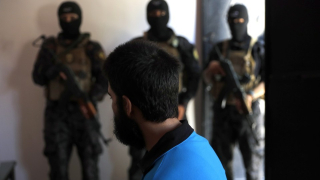
Isis-capturedFollowing the expulsion of the Islamic State, or ISIS, from Mosul in Iraq, and with the imminent fall of the group’s de facto capital of Raqqa in Syria, reports have suggested that ISIS fighters are defecting or surrendering en masse. But such bullish appraisals of the collapse of ISIS’s fighting spirit may be over-optimistic.

Most people who have fled from ISIS-controlled areas have done so because they were terrified of the invading Shia militias and Shia-dominated Iraqi government forces. Last month, when Iraqi forces liberated the area around the city of Hawija, north of Tikrit, it wasn’t only ISIS fighters who ran. Those from families who had a member in ISIS, even if dead, did also. Many internally displaced Sunni Arabs we interviewed told us that they left their homes and risked passing through Iraqi army and Shia militia lines to reach the Kurdish Peshmerga because “they are also Sunni” and “don’t want to kill us.”

Although there is some evidence of local ISIS forces in Iraq abandoning the fight, ISIS’s foreign volunteers are much more likely to fight to the death or melt away in the hope of fighting another day. A center run by the Kurdish intelligence service in Dibis, north of Hawija, to screen those fleeing ISIS territory had detected only one foreign fighter, an Egyptian, in recent weeks. The head of the center, Captain Ali Muhammad Syan, said that as many as eight thousand people were screened since the start of operations to retake Hawija in September. Nearly all of them, he said, had links to ISIS, mostly through family connections, but many were not actual combatants.

More here.

Jean-Paul Sartre and the demands of freedom

SartreGary Cox at the TLS:

In Existentialism and Humanism, Sartre wrote, “There is no genius other than that which is expressed in works of art”. True to a central maxim of his existentialist philosophy – “to be is to do” – Sartre built his colossal reputation as a philosopher, novelist, playwright, screenwriter, biographer, diarist, literary theorist, essayist and journalist out of sustained hard work. He was gifted but preferred to attribute his achievements to perspiration rather than inspiration. As he wrote in his autobiography, Words: “Where would be the anguish, the ordeal, the temptation resisted, even the merit, if I had gifts?” From childhood his ambition was to be the great, dead French writer he became. He wrote for at least six hours a day for most of his life. “If I go a day without writing, the scar burns me.”

Sartre’s prolific and often drug-fuelled output is now a part of the legend, along with his numerous love affairs (despite his self-proclaimed ugliness), his wartime adventures and the post-war, hard-left political activism that led him and his lifelong companion, Simone de Beauvoir, to fraternize with many dictators.

By the standards of most philosophers, Sartre led an exciting life. His adventures, his singular appearance, his relentless radicalism, his eccentricity, make him an easy figure to caricature, and he was canny when it came to crafting his image, but for all that there is a serious, systematic and inspiring philosophy behind the melodrama, a grand theory rooted in the best traditions of Western thought.

more here.

Public Theology in Retreat

AsplendidwickednessandotheressaysBrad East at the Los Angeles Review of Books:

Hart is an Eastern Orthodox theologian, philosopher, and cultural commentator. Born and raised in Maryland, he studied at Cambridge and the University of Virginia. He has taught at Virginia, Duke, Providence, St. Louis, and Notre Dame. Since 2003, he has published 10 books, the most notable of which include Atheist Delusions, a sort of intellectual history of early Christianity in response to the so-called “New Atheists”; The Experience of God, a philosophical and interreligious elaboration of classical theism; and The Beauty of the Infinite, a full-bore metaphysics of beauty, his first published book and still magnum opus. Two of these books were published with Yale University Press, with a third coming out this November: a translation of the New Testament. And for the last decade or so, Hart has written the back-page column for the magazine First Things.

Hart’s accolades have come readily from within his guild and its various subdisciplines, including being rewarded the Michael Ramsey Prize in 2011 by Rowan Williams, then-Archbishop of Canterbury. But his books have also received notices from diverse, non-religious venues such as The New Yorker, the Guardian, the New Republic, The New York Times, The New Criterion, and National Review. The praise heaped upon Hart is extravagant: “a national treasure,” “an indispensable voice,” “the best living American systematic theologian,” “without doubt today’s most brilliant essayist, polemicist, and fabulist.”

more here.

How Joni Mitchell created her own tradition

Cover00 (2)Carl Wilson at Bookforum:

It’s 1984 or 1985, Prince and the Revolution are in California, and they decide to drive out to Joni Mitchell’s house in Malibu for dinner. All devotees—Prince says his favorite album ever is 1975’s The Hissing of Summer Lawns—they chat and admire her paintings, and then Prince wanders to the piano and starts teasing out some chords. “Joni says, ‘Oh wow! That’s really pretty. What song are you playing?’” as band member Wendy Melvoin later recalls. “We all yelled, ‘It’s your song!’” Prince will perform his gorgeous arrangement of Mitchell’s “A Case of You” in concerts up to the final month of his life.

This anecdote from David Yaffe’s Reckless Daughter: A Portrait of Joni Mitchell is rare for being sweet and funny, not sad or rancorous. It’s endearingly humbling, while still hinting at her ample ego: She really does love her own stuff, even when she doesn’t know it’s hers. And why shouldn’t she? For more than a decade, the singer from Saskatchewan bounded from masterpiece to masterpiece, her second-string songs superior to almost anyone else’s best. Yet, among her generation’s legends, she is the most persistently sidelined.

Mitchell is easy to pigeonhole as that “poetic, confessional female singer-songwriter,” provided you overlook half her work and the fact that, before her, there really was no such thing.

more here.

The Failure of Italian Feminism

Guia Soncini in The New York Times:

ImageAmericans and Italians are such similar creatures: We both care about news only if it concerns us. That’s why in Italy there’s no such thing as the Harvey Weinstein scandal; here, it’s the Asia Argento scandal. Either way, it hasn’t made us look good. “Victim-Blaming,” Vanity Fair proclaimed last week, after Ms. Argento, who says Mr. Weinstein raped her, declared that she was considering leaving Italy because of attacks on her by her compatriots. “Weinstein Accuser Feels ‘Doubly Crucified’ ” read the Associated Press headline. Suddenly we were patriarchal, sexist Italy again. It’s true, I thought while reading, but it’s not the whole truth.

…It hasn’t, for instance, been in the male-dominated world of newspapers where Ms. Argento has been on the receiving end of the worst attacks. While there have been some widely cited examples of egregious behavior — the editor in chief of a right-wing tabloid said Ms. Argento “must have liked it” — these are exceptions. The bulk of the Italian press has been on Ms. Argento’s side. It has, rightly, treated her gently: The newspaper La Stampa published a 2,000- word interview with her, in which she denied that she’d maintained a five-year relationship with Mr. Weinstein; the interviewer never challenged her on this revision. Prominent male columnists have come to Ms. Argento’s defense — this, in a country that has a total of zero national newspapers edited by women and zero female columnists in its main national papers.

Where the reaction to Ms. Argento’s story has been truly vicious has been on social media. And there, it has primarily come from women. There was the woman who wouldn’t believe Ms. Argento because she did not find her likable when she was competing on “Dancing With the Stars”; the one that claims “Asia asked for it” because she once filmed a scene in which she French-kissed a dog; the one who says — as if it matters — “I’ve simply never liked her.” (I won’t link to the likes of them here.) What this tells us about Italian feminism isn’t clear, but it’s certainly ugly. There’s something under-ripened about the state of feminism in my country. In other countries, to proclaim oneself a feminist is taken to mean that you are a person who defends the rights of women to live as they like, to have equal rights and opportunities, and to be in charge of their sexuality. In Italy, those who call themselves feminists treat what is supposed to be a fundamental component of one’s worldview as a sort of battle between high-school cliques: I will fight for your rights — as long as we’re friends. If a sexual assault victim has been unfriendly, we will side with the next one, the one who answers our phone calls. Our sympathies are determined not by who has suffered but by who has invited us to her dinner parties.

More here.