
Category: Recommended Reading
cecil taylor (1929 – 2018)
Sunday Poem
Always
—for Charles Simic
Always so late in the day
In their rumpled clothes, sitting,
Around a table lit by a single bulb,
The great forgetters were hard at work.
They tilted their heads to one side, closing their eyes.
Then a house disappeared, and a man in his yard
With all his flowers in a row.
The great forgetters wrinkled their brows.
Then Florida went and San Francisco
Where tugs and barges leave
Small gleaming scars across the Bay.
One of the great forgetters struck a match.
Gone were the harps of beaded lights
That vault the rivers of New York.
Another filled his glass
And that was it for crowds at evening
Under sulphur yellow street lamps coming on.
And afterwards Bulgaria was gone, and then Japan.
"Where will it stop?" one of them said.
"Such difficult work, pursuing the fate
of everything known," said another.
"Down to the last stone," said a third,
"And only the cold zero of perfection
Left for the imagination." And gone
Were North and South America,
And gone as well the moon.
Another yawned, another gazed at the window:
No grass, no trees . . .
The blaze of promise everywhere.
by Mark Strand
from To Read a Poem
Harcourt Brace, 1992
.
Even in old age, philosopher Bryan Magee remains wonder-struck by the ultimate questions
Jason Cowley in New Statesman:
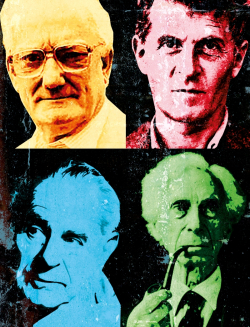
Magee and I chatted for a couple of hours that afternoon as bright sunshine streamed through the high windows of his sitting room. What I liked about his approach was his willingness to demystify philosophical problems by demonstrating that they were not theoretical but existential – about the nature of reality, encountered in the course of living. Yet as I prepared to leave that afternoon, Magee, who through choice lived alone having once been briefly married, said something that I’ve never forgotten. “I get the impression,” he said, “that you feel I am lonely and unfulfilled.” There was some truth in this: he did seem unfulfilled, and not because he lived alone. There was something restless in his manner: an irritable reaching after fact and reason, as Keats wrote in a different context. And he’d never committed himself fully to one discipline, preferring instead to occupy many different public roles as a broadcaster, politician, teacher, author and poet. And he told me – he was 67 at the time – that he believed himself still to be capable of “doing great things”. He used a German word to describe how he felt about his own potential, Machtgefühl. Macht = power, Gefühl = feeling or sense. So, in broad translation, Machtgefühl: a feeling of or having a sense of power. I have also seen the word translated as “feeling of superiority” (even though I haven’t seen macht translated as “superiority”).
As an impressionable younger man, I was pretty impressed by what Magee had achieved already. What more could he do or have done? Why even now such restlessness and vaulting ambition? In his book, Confessions of a Philosopher (1997), which is a history of Western philosophy told through his own intellectual journey, Magee offers what could be a partial answer to these questions when he describes how in his late thirties, despite having a passionate attachment to life, he was driven to the edge of mental illness, even suicide, by metaphysical terror. He learned to control his terror, which, though he did not say so, recalled Blaise Pascal’s fear of “immensity of spaces which I know not and which know not me”, through reading the writings of others, notably Arthur Schopenhauer. “I think the feeling of meaninglessness is worst of all, worse than the fear of death itself,” Magee said. “The feeling that nothing matters, that there’s no point to anything. Certainly, I have experiences, in the forms of extreme existential terror, states of mind that bordered on the intolerable.”
More here.
Saturday, April 7, 2018
Tina Turner interview: the singer on Ike, Buddhism and leaving America for Switzerland
Bryan Appleyard in The Times:
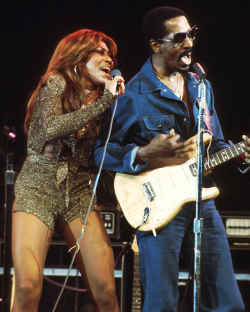
By the age of 16, she was living in St Louis with her sister, Aillene. In a club, they saw a band, Ike Turner and the Kings of Rhythm. One day he grabbed a mic and sang, and he took her into the band and, after a while, seduced her, in spite of the fact that she didn’t fancy him at all.
“I felt awful. I didn’t know how to say no, because I needed the work. I think I wasn’t educated to handle that.”
They married in 1962, and she suffered years of violent abuse. But Ike made her a star. When he released Tina singing A Fool in Love in 1960, he unleashed one of rock’n’roll’s greatest stars on the world.
She sang and yelled through Ike’s arrangements, often with a black eye or a busted lip, or even worse. On stage, she was the most powerful creature anybody had ever seen; off stage, she was enslaved.
More here.
Demanding that a theory is falsifiable or observable, without any subtlety, will hold science back
Adam Becker in Aeon:

Despite his pantomime of despair, Pauli’s letters reveal that he didn’t really think his new sub-atomic particle would stay unseen. He trusted that experimental equipment would eventually be up to the task of proving him right or wrong, one way or another. Still, he worried he’d strayed too close to transgression. Things that were genuinely unobservable, Pauli believed, were anathema to physics and to science as a whole.
Pauli’s views persist among many scientists today. It’s a basic principle of scientific practice that a new theory shouldn’t invoke the undetectable. Rather, a good explanation should be falsifiable – which means it ought to rely on some hypothetical data that could, in principle, prove the theory wrong. These interlocking standards of falsifiability and observability have proud pedigrees: falsifiability goes back to the mid-20th-century philosopher of science Karl Popper, and observability goes further back than that. Today they’re patrolled by self-appointed guardians, who relish dismissing some of the more fanciful notions in physics, cosmology and quantum mechanics as just so many castles in the sky. The cost of allowing such ideas into science, say the gatekeepers, would be to clear the path for all manner of manifestly unscientific nonsense.
But for a theoretical physicist, designing sky-castles is just part of the job.
More here.
The Coffee-Flavored American Dream
Ghaith Abdul-Ahad in the New York Times:
Ahead of us lay the port of Mokha, or Al-Mukha in Arabic, where from the 15th century onward ships set sail with precious Yemeni coffee bound for Istanbul, London, Amsterdam and eventually New York — so much coffee that the word “mocha” became synonymous with it.
Those days are gone. In Yemen today, sweet chai masala is far more prevalent than coffee, and as my friends and I drove through the dusty lanes of Mokha that afternoon, the town appeared to be little more than a cluster of mud-colored hovels and shacks built from cinder blocks and metal sheets. Mokha’s only association with coffee was the half-ruined, ancient mosque of Ali Ibn Omar al-Shadhili, the Sufi credited with bringing the coffee plant from Ethiopia to Yemen. Coffee seemed to have been relegated to history.
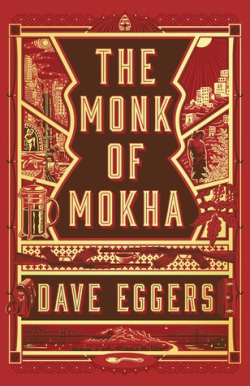
Enter Mokhtar Alkhanshali, the soft-spoken young Yemeni-American protagonist of Dave Eggers’s latest nonfiction book, “The Monk of Mokha,” who got into his head the mad idea of reviving that long-dead trade and exporting high-quality coffee arabica beans out of Yemen.
More here.
Why I want to stop talking about the “developing” world
Bill Gates in his blog:
I talk about the developed and developing world all the time, but I shouldn’t.
My late friend Hans Rosling called the labels “outdated” and “meaningless.” Any categorization that lumps together China and the Democratic Republic of Congo is too broad to be useful. But I’ve continued to use “developed” and “developing” in public (and on this blog) because there wasn’t a more accurate, easily understandable alternative—until now.
I recently read Hans’ new book Factfulness: Ten Reasons We're Wrong About the World—and Why Things Are Better Than You Think. In it, he offers a new framework for how to think about the world. Hans proposes four income groups (with the largest number of people living on level 2):
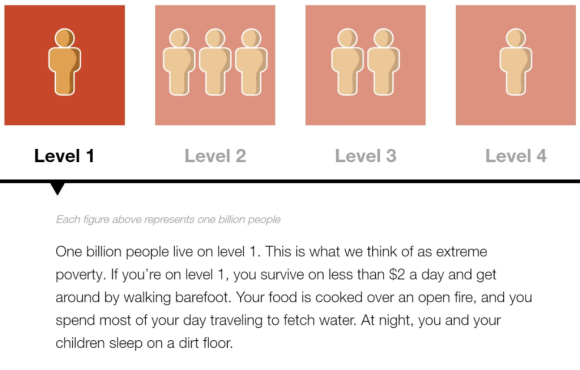
This was a breakthrough to me. The framework Hans enunciates is one that took me decades of working in global development to create for myself, and I could have never expressed it in such a clear way. I’m going to try to use this model moving forward.
Why does it matter? It’s hard to pick up on progress if you divide the world into rich countries and poor countries. When those are the only two options, you’re more likely to think anyone who doesn’t have a certain quality of life is “poor.”
More here.
Anthony Bourdain on Yelp
Recipe for a Just Society
Michael J Sandel in The New York Times:
Robert B. Reich’s new book, “The Common Good,” is a welcome response to this challenge. One of the most prominent voices among progressives, Reich has written insightfully about the changing nature of work brought about by globalization and the growing inequality it has generated. He served as secretary of labor in the Clinton administration, but in 2016 endorsed Bernie Sanders over Hillary Clinton. Reich’s book diagnoses the decline of the common good in American life and suggests ways of restoring it. He begins by observing that even the term has fallen into disuse: “The common good is no longer a fashionable idea. The phrase is rarely uttered today, not even by commencement speakers and politicians.” Reich defines the common good as consisting in “our shared values about what we owe one another as citizens who are bound together in the same society.” What binds us as Americans, he argues, is not birth or ethnicity but a commitment to fundamental ideals and principles: respect for the rule of law and democratic institutions, toleration of our differences and belief in equal political rights and equal opportunity.
More here.
WHO IS JUNICHIRO TANIZAKI?
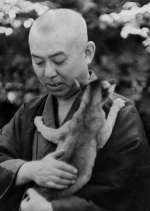
Asking who Jun’ichirō Tanizaki is may seem a little bizarre, especially to those with any kind of interest in Japanese literature. Nominated several times for the Nobel Prize in Literature, and even shortlisted the year before his death, Tanizaki is one of the more prominent figures in modern Japanese literature, and he is also well-known for his other endeavors, such as his translation of The Tale of Genji from old Japanese into the modern language.
But on a more personal level, the question is not quite as strange as it might initially appear. Readers often develop an image of a writer while working through their books, and many of the top Japanese authors seem easily classifiable, from the eccentric Kōbō Abe to the calm, traditionalist aesthete Yasunari Kawabata, the political protests of Kenzaburō Ōe, and, more vivid than most, Yukio Mishima’s unique blend of homoerotic and right-wing tendencies. But who exactly is Tanizaki?
To get a clearer picture of a writer, we can, of course look to his body of work, or at least those books that are available in translation. Major works like The Makioka Sisters, Some Prefer Nettles, Naomi, and Quicksand show a writer with a fascination for certain themes, including cultural differences between the Japanese regions and the sometimes-fraught relationships between the sexes.
more here.
Patient X by David Peace – portrait of a tortured artist
Patient X is told in Peace’s trademark fragmented, incantatory style, as distinctive in its way as, say, full-blown Henry James, using repetition, hyperbole and italicised interior monologue to create swirling hallucinatory effects. “In his study, sweating and bitten, Ryūnosuke felt like a flying fish, lucklessly fallen onto the dusty deck of a dry-docked ship, to die tormented by the screams of cicadas, tortured by the probosces of mosquitoes.” “You stare at your face, your skin and your skull. […] You are the magician, you are the sorcerer. In your tuxedo, in your top hat.”
Unlikely as it seems, Peace’s extraordinary, highly performative style is as well suited to depicting Akutagawa’s various struggles as a writer as it was to portraying the drama of being Brian Clough. “Down there was a man named Ryūnosuke, who was writing in Hell with all the other sinners. This man had once been an acclaimed author but he had led a most selfish life, hurting even the people who loved him.” This is essentially a novel about a man being confronted with “his selves, his legion of selves – son and father, husband and friend, lover and writer, Man of the East and Man of the West […] his selves and his characters too […] his many creations and, of course, his sins, his countless, countless sins: his pride, his greed, his lust, his anger, his gluttony, his envy and his sloth.”
more here.
A Tokyo Romance: A Memoir
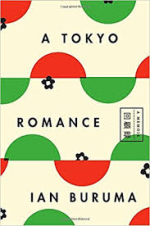
Anyone seriously interested in contemporary Japan, in particular its theatre, cinema and struggles with national identity since the American occupation, will most likely have at some time read Ian Buruma. There are only a few scholars, journalists, critics and commentators writing about Japan in English worth reading, and Buruma is one. So I wondered what I might find in this short book, subtitled ‘A Memoir’ presumably to distinguish it from strict autobiography. Buruma can be very funny: his novel about cricket, Playing the Game, contains an unforgettable character employed by an exceedingly fat maharaja whose sole and unlikely job is, when signalled, to raise a buttock of the prone prince so he might fart more comfortably. There are many comparably improbable images, usually sexual, often harrowing, in this account of Buruma’s six years in Japan, from 1975 until 1981. It might be an unwise choice of gift for your maiden aunt.
Buruma was twenty-four when he arrived in Tokyo in 1975, having by this time rejected a legal career. After acquiring a Japanese girlfriend in Amsterdam, he became interested in avant-garde theatre and cinema (his uncle was the director John Schlesinger) and decided to try his luck in Japan, obtaining a grant to study film at Nichidai in Ekoda.
more here.
Saturday Poem
Question
Body my house
my horse my hound
what will I do
when you are fallen
Where will I sleep
How will I ride
What will I hunt
Where can I go
without my mount
all eager and quick
How will I know
in thicket ahead
is danger or treasure
when Body my good
bright dog is dead
How will it be
to lie in the sky
without roof or door
and wind for an eye
With cloud for shift
how will I hide?
May Swenson
from A Book of Luminous Things
Harcourt, 1996
.
Friday, April 6, 2018
What’s Wrong with the Critique of Capitalism Now
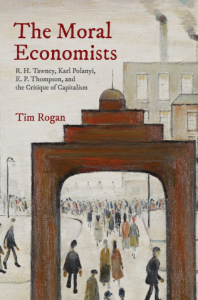
An interview with Tim Rogan, author of The Moral Economists, over at the Princeton University Press blog:
What’s wrong with capitalism? Answers to that question today focus on material inequality. Led by economists and conducted in utilitarian terms, the critique of capitalism in the twenty-first century is primarily concerned with disparities in income and wealth. It was not always so. In The Moral Economists, Tim Rogan reconstructs another critical tradition, developed across the twentieth century in Britain, in which material deprivation was less important than moral or spiritual desolation. Examining the moral cornerstones of a twentieth-century critique of capitalism, The Moral Economists explains why this critique fell into disuse, and how it might be reformulated for the twenty-first century. Read on to learn more about these moral economists and their critiques of capitalism.
You begin by asking, ‘What’s wrong with capitalism?’ Shouldn’t we start by acknowledging capitalism’s great benefits?
Yes, absolutely. This was a plan for the reform of capitalism, not a prayer for its collapse or a pitch for its overthrow. These moral economists sought in some sense to save capitalism from certain of its enthusiasts—that has always been the project of the socialist tradition out of which these writers emerged. But our question about capitalism—as about every aspect of our social system, every means by which we reconcile individual preferences to arrive at collective decisions—should always be ‘What’s wrong with this?;’ ‘How can we improve this?;’ ‘What could we do better?’ And precisely how we ask those questions, the terms in which we conduct those debates, matters. My argument in this book is that our way of asking the question ‘What’s wrong with capitalism?’ has become too narrow, too focused on material inequality, insufficiently interested in some of the deeper problems of liberty and solidarity which the statistics recording disparities of wealth and income conceal.
More here.
Caltech Scientists Breed Bacteria That Make Tiny High-Energy Carbon Rings
Caltech scientists have created a strain of bacteria that can make small but energy-packed carbon rings that are useful starting materials for creating other chemicals and materials. These rings, which are otherwise particularly difficult to prepare, now can be "brewed" in much the same way as beer.
Emily Velasco at the Caltech website:

"Bacteria can now churn out these versatile, energy-rich organic structures," Arnold says. "With new lab-evolved enzymes, the microbes make precisely configured strained rings that chemists struggle to make."
In a paper published this month in the journal Science, the researchers describe how they have now coaxed Escherichia colibacteria into creating bicyclobutanes, a group of chemicals that contain four carbon atoms arranged so they form two triangles that share a side. To visualize its shape, imagine a square piece of paper that's lightly creased along a diagonal.
More here.
50 Years Later, ‘2001: A Space Odyssey’ Is Still A Cinematic Landmark
John Powers at NPR:

Nobody was quite sure what to make of it. The critics were harsh, with Varietydismissively saying flatly, "2001 is not a cinematic landmark." It's hard to imagine being more wrong.
You see, even if you don't like the movie — and I don't, particularly — the one thing that's undeniable is that it's a cinematic landmark. Not only was it the No. 1 box office movie of 1968 — young people flocked to it to have their minds blown — but in international polls, 2001 routinely ranks as one of the top 10 films of all time. An avant-garde art film dressed in Hollywood money, it unknowingly foreshadowed the future of movies as effects-driven blockbusters.
I saw it again a few days ago, inspired by Michael Benson's terrific new book, Space Odyssey: Stanley Kubrick, Arthur C. Clarke and the Making of a Masterpiece. Though Benson is afflicted with what a friend calls the "Stanley syndrome" — he never stops telling you that Kubrick is a "genius" and "a perfectionist" — his book is filled with nifty stories. My favorite is when the control-freak director asks Lloyd's of London if they could insure him in case NASA spoiled 2001's plot by discovering extraterrestrial life before the movie came out.
More here.
How to Win an Argument About Guns
Nicholas Kristof in the New York Times:
Tragically, predictably, infuriatingly, we’re again mourning a shooting —this time at YouTube’s headquarters — even as the drive for gun safety legislation has stalled in Washington. Polls show that nine out of 10 Americans favor basic steps like universal background checks before gun purchases, but the exceptions are the president and a majority in Congress.
Usually pundits toss out their own best arguments while ignoring the other side’s, but today I’m going to try something new and engage directly with the arguments made by gun advocates:
You liberals are in a panic over guns, but look at the numbers. Any one gun is less likely to kill a person than any one vehicle. But we’re not traumatized by cars, and we don’t try to ban them.
It’s true that any particular car is more likely to be involved in a fatality than any particular gun. But cars are actually a perfect example of the public health approach that we should apply to guns. We don’t ban cars, but we do work hard to take a dangerous product and regulate it to limit the damage.
We do that through seatbelts and airbags, through speed limits and highway barriers, through driver’s licenses and insurance requirements, through crackdowns on drunken driving and texting while driving. I once calculated that since 1921, we had reduced the auto fatality rate per 100 million miles driven by 95 percent.
Sure, we could have just said “cars don’t kill people, people kill people.” Or we could have said that it’s pointless to regulate cars because then bicyclists will just run each other down. Instead, we relied on evidence and data to reduce the carnage from cars. Why isn’t that a model for guns?
More here.
Automating Inequality: How High Tech Tools Profile, Police, and Punish the Poor
WHEN MARGUERITE DURAS GOT KICKED OUT OF THE COMMUNIST PARTY

Fun fact about Marguerite Duras: in addition to being a brilliant novelist, Academy Award-nominated filmmaker, and playwright, she was, for many years, a committed communist. And she was very good at it. She joined the French Communist Party in 1944. She was a communist, writes Laure Adler in Marguerite Duras: A Life, “because it was the party of the working classes, because it defended the poor and the pure. But she was a particular kind of communist, a euphoric, utopian, idealistic communist.” She became fairly militant about it—knocking on doors, selling copies of L’Humanité, recruiting whomever she could find, and eventually became the secretary of her local cell. Sometimes she wrote short stories on the backs of communist pamphlets.
Her companions, Robert Antelme (her husband) and Dionys Mascolo (her lover)—by the way, did everyone know that Duras lived with both her husband and her lover and everyone was fine with it? I could not love her any more—joined too. But soon Duras began to have doubts; the Moscow trials and Stalinism, in particular, distressed her, and a new friendship with an alluring Italian named Elio Vittorini showed them a new model: “the free communist though not necessarily Marxist intellectual, the affective, protesting communist.”
more here.