
Aida Edemariam in The Guardian:
 Between 2001 and 2015, sales of translated fiction grew by 96%. One reason, argues Daniel Hahn, who last year established a prize for first translations, is that publishers seem to be taking more account of what people actually want to read. For a long time, he says, the emphasis was on “quite challenging, highbrow literary fiction,” which led to an unhelpful conflation of “difficult” with “translated”. Then Christoper MacLehose published Stieg Larsson’s The Girl With the Dragon Tattoo, which promptly sold 12,000 copies, in hardback. “It seems to me,” says Lisa Appignanesi, chair of this year’s Man Booker international prize, which is announced on 22 May, “we have become much more interested in literature which is not conventional; there are different traditions on the continent, which are not quite so emphatically led by character and the movement of plot.”
The important thing, then, is to be led by readers. Colm Tóibín, when not writing his own fiction, commissions books for a tiny imprint called Tuskar Rock. Two of their translated books are shortlisted for this year’s Booker international prize – Like a Fading Shadow by Spanish author Antonio Muñoz Molina and The World Goes On, by Hungarian novelist Laszlo Krasznahorkai. Some years ago, Tóibín was asked to introduce Krasznahorkai at a reading in Edinburgh, and “noticed that the venue was full”. At which point he realised that readers in English were no longer getting their information about books from traditional sources, and that it was important to work out how they were doing it and “try to tap into it”. So, in that spirit, we have looked around Europe – in this year when we are preparing to leave it for ever – to find out what Europeans are reading, and what we’ll be reading next.
More here.
 Three years ago
 Chimpanzees are among human beings’
  The day after a
  Skye Cleary and Massimo Pigliucci in Aeon:
 Terence Renaud reviews Gareth Stedman-Jones’s new book in H-Net:
 Nils Gilman in the LA Review of Books:
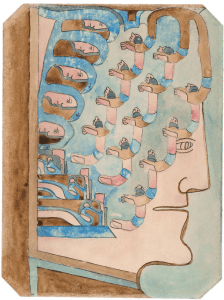 Hearing voices is, it turns out, surprisingly common. In 1894, a team led by Henry Sidgwick, a philosopher at the University of Cambridge, published the Census of Hallucinations, which surveyed 17,000 people in the United Kingdom and found that around 10 percent of them reported having seen, heard, or felt something “which impression, so far as you can discover, was not due to any external physical cause.” Many more recent studies have supported that observation. In 1983, two psychologists, Thomas Posey and Mary Losch, modified Sidgwick’s basic question and found that the rate skyrocketed to 70 percent when participants were given the opportunity to say that they had heard a voice but decided that it wasn’t real. And as many as 80 percent of people who have lost a loved one report hearing, seeing, or feeling them in the months after their death.
 Privately, many climate and energy experts admit that the fastest, easiest, and cheapest way to decarbonize energy supplies is with nuclear power.
 Imagine a year where what we’ve long taken for granted, that technology destroys jobs but also creates new and better jobs, is discovered to no longer be true. Instead, machines permanently displace human labor, and what new jobs are created, are mostly worse jobs.
 William Trevor was the literary heir of Chekhov, Maupassant and the James Joyce of the short-story collection Dubliners. He was one of the great contemporary chroniclers of the human condition, in all its pathos, comedy and strangeness. As a writer he looked at the world with an always surprised but never scandalised eye, and his writer’s heart was with those awkward and obscurely damaged souls who cannot quite manage the business of everyday life – all of us, that is.
 Fifty years ago today, the first installment of Charles Portis’s True Grit was published in the Saturday Evening Post. It was reprinted in book form by Simon & Schuster later that year, adapted into a movie (with John Wayne!) the year after, and became a bestseller. It had entered into the murky realm of cult literary classic when it was adapted to film for a second time (with Jeff Bridges!) in 2010, and now I’d rate it as Pretty Famous. If you haven’t read the novel, I will tell you that—even for someone who doesn’t typically go in for Westerns—it is wonderful, due in large part to its narrator, Mattie Ross. There may be action and adventure between these pages, but Mattie Ross’s voice is what makes this novel unforgettable. As Ed Park
  With the death of Stephen Hawking and the discussion it produced on black holes it was a little surprising that there was little or no mention of the man who created the subject, J. Robert Oppenheimer, who died in 1967 at the age of 62. He often said that the J stood for nothing but I have a copy of his birth certificate on which his first name is given as ‘Julius’. In his day Oppenheimer was the most celebrated physicist in the United States. His portrait had been on the cover of Time magazine and he was on first-name terms with much of the Washington establishment, until he lost his security clearance in 1954.
 Upper-middle-class professionals love data. We tend to think that the smug, smart people who run companies like Google and Uber have some secret knowledge; we even give them our personal information, uneasily, but ultimately with a bit of a shrug. We’re seduced by similar smug, smart, supposed innovators hawking data’s potential to revolutionize health care and education. We assume technology and the information it yields is making everyone’s life easier, freer and more comfortable.
 I remember the moment when code began to interest me. It was the tail end of 2013 and a cult was forming around a mysterious “crypto-currency” called bitcoin in the excitable tech quarters of London, New York and San Francisco. None of the editors I spoke to had heard of it – very few people had back then – but eventually one of them commissioned me to write the first British magazine piece on the subject. The story is now well known. The system’s pseudonymous creator, Satoshi Nakamoto, had appeared out of nowhere, dropped his ingenious system of near-anonymous, decentralised money into the world, then vanished, leaving only a handful of writings and 100,000 lines of code as clues to his identity. Not much to go on. Yet while reporting the piece, I was astonished to find other programmers approaching Satoshi’s code like literary critics, drawing conclusions about his likely age, background, personality and motivation from his style and approach. Even his choice of programming language – C++ – generated intrigue. Though difficult to use, it is lean, fast and predictable. Programmers choose languages the way civilians choose where to live and some experts suspected Satoshi of not being “native” to C++. By the end of my investigation I felt that I knew this shadowy character and tingled with curiosity about the coder’s art. For the very first time I began to suspect that coding really was an art, and would reward examination.
 It was noon in early 1942 as Johann Grüner approached the ‘German House’ in the Polish town of Nowy Targ for lunch. As a mid-level Nazi bureaucrat in occupied Poland, he enjoyed the privileges of power and the opportunity for career advancement that came with duty in the East. The German House, a mix of cultural centre, restaurant and pub, was one of the privileges enjoyed by the occupiers. As he entered the building, he could hear a boisterous celebration within. At the front door, a clearly inebriated Gestapo official passed by, a beer coaster with the number 1,000 written in red pinned to his blouse. Addressing Grüner, the policeman drunkenly bragged: ‘Man, today I am celebrating my 1,000th execution!’