
by Jonathan Kujawa

“Meaningless! Meaningless!”
says the Teacher.
“Utterly meaningless!
Everything is meaningless.”
— Ecclesiastes 1:2
This spring I taught one of my favorite classes. Officially, it goes by the name of Discrete Math and covers various standard topics: sets, functions, basic logic, modular arithmetic, counting problems, graph theory, etc. Unofficially, it is our department’s boot camp for people who want to take advanced math classes.
Up through high school math, and even in most freshman and sophomore math classes, the goal of a math class is for students to be able to use standard tools to solve standard questions. We are teaching students to distinguish between a screw and a nail, and to know to twist one with a screwdriver and hit the other with a hammer. Most problems and techniques are chosen more for teachability and testability, than for being interesting or useful. What matters is The Answer. It is right or wrong, and it’s right because someone said so. We shouldn’t blame the teachers for this state of affairs. They suffer as much as anyone under our educational system.
But math is meant to be a creative, human activity. In Discrete Math our students are deprogrammed of their twelve years of bad math education. I teach it using a slow version of the Socratic method, sometimes called Inquiry-Based Learning. Students are given a well-chosen series of problems to solve, but many are ambiguous or open-ended. They collaborate, share ideas, present written and oral solutions, and they critique each other’s work. For students used to being force-fed, Clockwork Orange style, it’s liberating, exciting, exhilarating, and terrifying all at once.
The first challenge is to get the students to deeply internalize the fact that words have meaning. If we’re going to talk about even numbers, then we’d better all agree on which numbers are even. Is 104 even? How about -2, or 0, or π?
Worse, they discover there are no God-given definitions in mathematics. Students are always a bit shocked to realize it was people just like them who came up with the math they take for granted. Even the equals sign was invented by someone, after all. Definitions can be contentious. Read more »

 It’s with a certain pleasure that I can recall the exact moment I was seduced by the musical avant-garde. It was in the fourth grade, in a public elementary school somewhere in New Jersey. Our music teacher, Mrs. Jones, would visit the classroom several times a week, accompanied by an ancient record player and a stack of LPs. You could always tell when she was coming down the hall because the wheels of the cart had a particularly squeak-squeak-wheeze pattern. However, such a Cageian sensibility was not the occasion of my epiphany. I’m also not sure if fourth-graders are allowed to have epiphanies, or, which is likelier, if they are not having them on a daily basis.
 If by “objectivity” we mean “wholly lacking personal biases”, in wine tasting, this idea can be ruled out. There are too many individual differences among wine tasters, regardless of how much expertise they have acquired, to aspire to this kind of objectivity. But traditional aesthetics has employed a related concept which does seem attainable—an attitude of disinterestedness, which provides much of what we want from objectivity. We can’t eliminate differences among tasters that arise from biology or life history, but we can minimize the influence of personal motives and desires that might distort the tasting experience.

 This last month or so I’ve been desperately trying to get the 2000s chapter fit for human consumption. I’ve
 The fact that anything happens securely on the web should be mind-boggling. In some ways, the internet is like a group of people shouting at each other across an open field. How can you hold a secret conversation when anyone might be listening? How do you prevent imposters, when you can’t always see the face behind the shout?
 On Monday, April 23rd, a 25-year old man named Alek Minassian drove a rented van down a sidewalk in Toronto, killing eight women and two men. The attack was reminiscent of recent Islamist terror attacks in New York, London, Stockholm, Nice, and Berlin. Just before his massacre, he posted a note on Facebook announcing: “Private (Recruit) Minassian Infantry 00010, wishing to speak to Sgt 4chan please. C23249161, the Incel Rebellion has already begun! We will overthrow all the Chads and Stacys! All hail the Supreme Gentleman Elliot Rodger!” The phrase paid homage to a young man named Elliot Rodger. In 2014, Rodger shot and killed six people in Isla Vista, California, before taking his own life.
 Between 2001 and 2015, sales of translated fiction grew by 96%. One reason, argues Daniel Hahn, who last year
  Three years ago
 Chimpanzees are among human beings’
  The day after a
  Skye Cleary and Massimo Pigliucci in Aeon:
 Terence Renaud reviews Gareth Stedman-Jones’s new book in H-Net:
 Nils Gilman in the LA Review of Books:
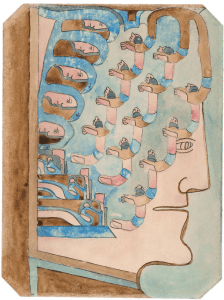 Hearing voices is, it turns out, surprisingly common. In 1894, a team led by Henry Sidgwick, a philosopher at the University of Cambridge, published the Census of Hallucinations, which surveyed 17,000 people in the United Kingdom and found that around 10 percent of them reported having seen, heard, or felt something “which impression, so far as you can discover, was not due to any external physical cause.” Many more recent studies have supported that observation. In 1983, two psychologists, Thomas Posey and Mary Losch, modified Sidgwick’s basic question and found that the rate skyrocketed to 70 percent when participants were given the opportunity to say that they had heard a voice but decided that it wasn’t real. And as many as 80 percent of people who have lost a loved one report hearing, seeing, or feeling them in the months after their death.