
Jane Brody in The New York Times:
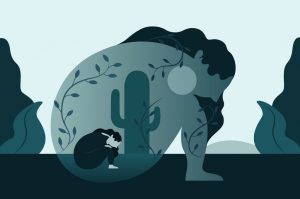 A four-minute film produced for the UnLonely Film Festival and Conference last month featured a young woman who, as a college freshman, felt painfully alone. She desperately missed her familiar haunts and high school buddies who seemed, on Facebook at least, to be having the time of their lives. It reminded me of a distressing time I had as an 18-year-old college sophomore — feeling friendless, unhappy and desperate to get out of there. I didn’t know it then, but I was in the age bracket — 18 to 24 — that now has the highest incidence of loneliness, as much as 50 percent higher than occurs among the elderly. For young adults, loneliness and social isolation are major precipitants of suicide, experts say. Fortunately, I visited the university health clinic where an astute psychologist examined my high school records, including a long list of extracurricular activities, and noted that I had done only schoolwork during my first year in college.
“There’s nothing the matter with you that wouldn’t be fixed by your becoming more integrated into the college community,” she said. She urged me to get involved with something that would connect me to students with similar interests. I protested that as a biochemistry major with classes six mornings a week and four afternoon labs, I had no time for extracurricular activities. And she countered: “You have to find time. It’s essential to your health and a successful college experience.” Having no better option, I joined a monthly student-run magazine that fit into my demanding academic schedule. I soon fell in love with interviewing researchers and writing up their work. I also befriended a faculty adviser to the magazine, a grandfatherly professor who encouraged me to expand my horizons and follow my heart. Two years later as a college senior and the magazine’s editor, I traded courses in physical chemistry and advanced biochemistry for news reporting and magazine writing. The rest is history. Armed with a master’s degree in science writing and two years as a general assignment reporter, at 24 I was hired by The New York Times as a science writer, a job I have loved for 53 years. In making rewarding social connections in college, I not only conquered loneliness, I found a path to a marvelous career.
More here.
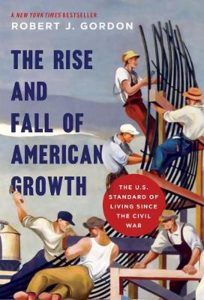 The ability to control electricity so that it arrives in measured doses where and when needed combined with simple steps to improve public sanitation, such as running water, indoor toilets and the removal of the uncountable tons of horse manure that marked major cities before the advent of the internal combustion engine that spurred roads and transportation networks that enabled frozen food to be enjoyed from coast to coast, wrought a step change in living standards unlikely to be repeated.

 Give me a break I mutter. I text—and I text. Incessantly I text. Send money. Now. Send money. More money. You don’t reply. You will. It is Spring and I am young. Everyone around me on the beach is around my age or younger. We are young.
 We, as emotional beings, place a high value on happiness and joy. Happiness is more than a feeling to us – it’s something we require and strive for. We’re so fixated on happiness that we define the pursuit of it as a right. We seek happiness not only for ourselves and our loved ones, but also for our planet and its creatures.
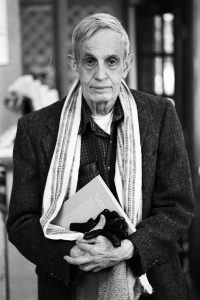 In 1950, John Nash — the mathematician later featured in the book and film “A Beautiful Mind” — wrote a
  “
“ Philosophers love to hate Ayn Rand. It’s trendy to scoff at any mention of her. One philosopher told me that: ‘No one needs to be exposed to that monster.’ Many propose that she’s not a philosopher at all and should not be taken seriously. The problem is that people are taking her seriously. In some cases, very seriously.
 A HUNDRED-DOLLAR BILL is lying on the ground. An economist walks past it. A friend asks the economist: “Didn’t you see the money there?” The economist replies: “I thought I saw something, but I must have imagined it. If there had been $100 on the ground, someone would have picked it up.”
 In 1989, a trainee physician called Edward Bullmore treated a woman in her late fifties. Mrs P had swollen joints in her hands and knees. She had an autoimmune disease. Her own immune system had attacked her, flooding her joints with inflammation. This, in turn, had eaten away at Mrs P’s collagen and bone, noted Bullmore, who was 29, and whose real ambition was to become a psychiatrist.
 After the fall of the Berlin Wall, East German citizens were offered the chance to read the files kept on them by the Stasi, the much-feared Communist-era secret police service. To date, it is estimated that only 10 percent have taken the opportunity. In 2007, James Watson, the co-discoverer of the structure of DNA, asked that he not be given any information about his APOE gene, one allele of which is a known risk factor for Alzheimer’s disease. Most people tell pollsters that, given the choice, they would prefer not to know the date of their own death—or even the future dates of happy events. Each of these is an example of willful ignorance. Socrates may have made the case that the unexamined life is not worth living, and Hobbes may have argued that curiosity is mankind’s primary passion, but many of our oldest stories actually describe the dangers of knowing too much. From Adam and Eve and the tree of knowledge to Prometheus stealing the secret of fire, they teach us that real-life decisions need to strike a delicate balance between choosing to know, and choosing not to.
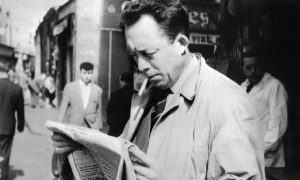 Surprisingly, few of the world’s great philosophers have directly addressed this question. Instead, they have focused on a subtly different question: what does it mean to live well? In his