
Reality Demands
Reality demands
we also state the following:
life goes on.
It does so near Cannae and Borodino,
at Kosovo Polje and Guernica.
There is a gas station
in a small plaza in Jericho,
and freshly painted
benches near Bila Hora.
Letters travel
between Pearl Harbor and Hastings,
a furniture truck passes
before the eyes of the lion of Cheronea,
and only an atmospheric front advances
towards the blossoming orchards near Verdun.
There is so much of Everything
that Nothing is quite well concealed.
Music flows
from yachts near Actium
and couples on board dance in the sunlight.
So much keeps happening,
that it must be happening everywhere.
Where stone is heaped on stone,
there is an ice cream truck
besieged by children.
Where Hiroshima had been,
Hiroshima is again
manufacturing products
for everyday use.
Not without its charms is this terrible world,
not without its mornings
worth our waking.
In the fields of Maciejowice
the grass is green
and on the grass is — you know how grass is —
transparent dew.
Maybe there are no fields other than battlefields,
those still remembered,
and those long forgotten,
birch woods and cedar woods,
snows and sands, iridescent swamps,
and ravines of dark defeat
where today, in sudden need,
you squat behind a bush.
What moral flows from this? Maybe none.
But what really flows is quickly-drying blood,
and as always, some rivers and clouds.
On the tragic mountain passes
the wind blows hats off heads
and we cannot help–
but laugh.
by Wislawa Szymborska
from Poems New and Collected
Harcourt, 1998
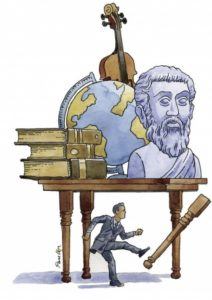 The humanities are taking it on the chin. If there were any doubts about this proposition, they have been dispelled by the University of Wisconsin at Stevens Point’s
 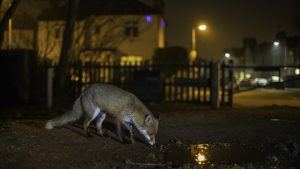 In 2011, the wildlife biologist Justin Brashares and his students set up a series of camera traps in and around Ruaha National Park in southern Tanzania. They were studying the effects of human activities on antelope reproduction, but their cameras soon revealed an odd and far more obvious pattern. While the antelope inside the park were active during the day, those outside the park, closer to human settlements, were active primarily at night—even though lions, which prey on antelope both inside and outside the park, typically hunt at night. The contrast in behavior was so stark that when Brashares and one of his students looked at a plot of the data, they laughed in disbelief. When faced with a choice between humans and lions, it appeared, antelope preferred to tangle with lions, and they were going nocturnal to do so.
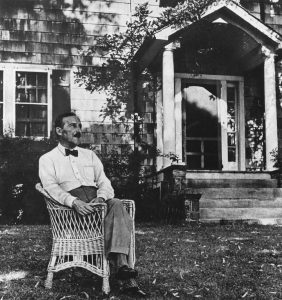 The Austrian émigré writer Stefan Zweig composed the first draft of his memoir, “
 The US Environmental Protection Agency has, of late, been operating on the principle that you can prevent environmental disasters by simply getting rid of the environment. As part of this mission, the EPA has considered a plan to put climate science up for public debate. This “Red Team, Blue Team” exercise would have pitted scientists against people who do not like them in order to cast doubt on the consensus that human activities are warming the planet. I am completely on board with this, as long as the Blue Team also gets private jets and enormous security details. We will, however, take a pass on the used Trump Hotel mattresses.
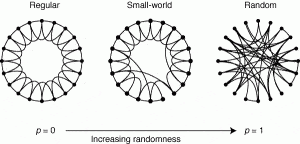 In 1998, Watts and Strogatz
 Political debates in Europe these days seem to have only one subject. At one point or another they all turn to the issue of migration, Islam, and a danger to “the West”, which are presented as essentially synonymous. Germany’s political future seems currently to
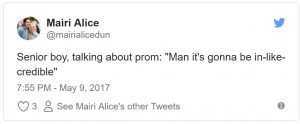 Like has undergone radical developments in modern English. It can function as a hedge (‘I’ll be there in like an hour’), a discourse particle (‘This like serves a pragmatic function’), and a sentence adverb (‘It’s common in Ireland, like’). These and other non-standard usages are frequently criticised, but they’re probably
 IQ scores have been steadily falling for the past few decades, and environmental factors are to blame, a new study says.
 If you wade through the
  What do we mean by diversity? And why is it good – or not?
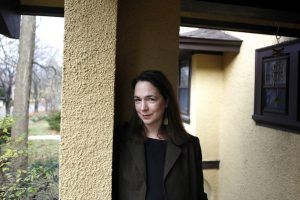 I first encountered Lorrie Moore when I read “How to Become a Writer,” a mesmerizingly bleak story from her 1985 debut collection, Self-Help, which I imagine to be so frequently anthologized because editors want something of hers and because the title is so appealing. Besides, it’s a promising one, suggesting a clear set of instructions. Like much of Self-Help, the story is voiced in second-person imperative, but it can only offer directions down a road to nowhere: “First,” its opening lines instruct, “try to be something, anything, else.”